
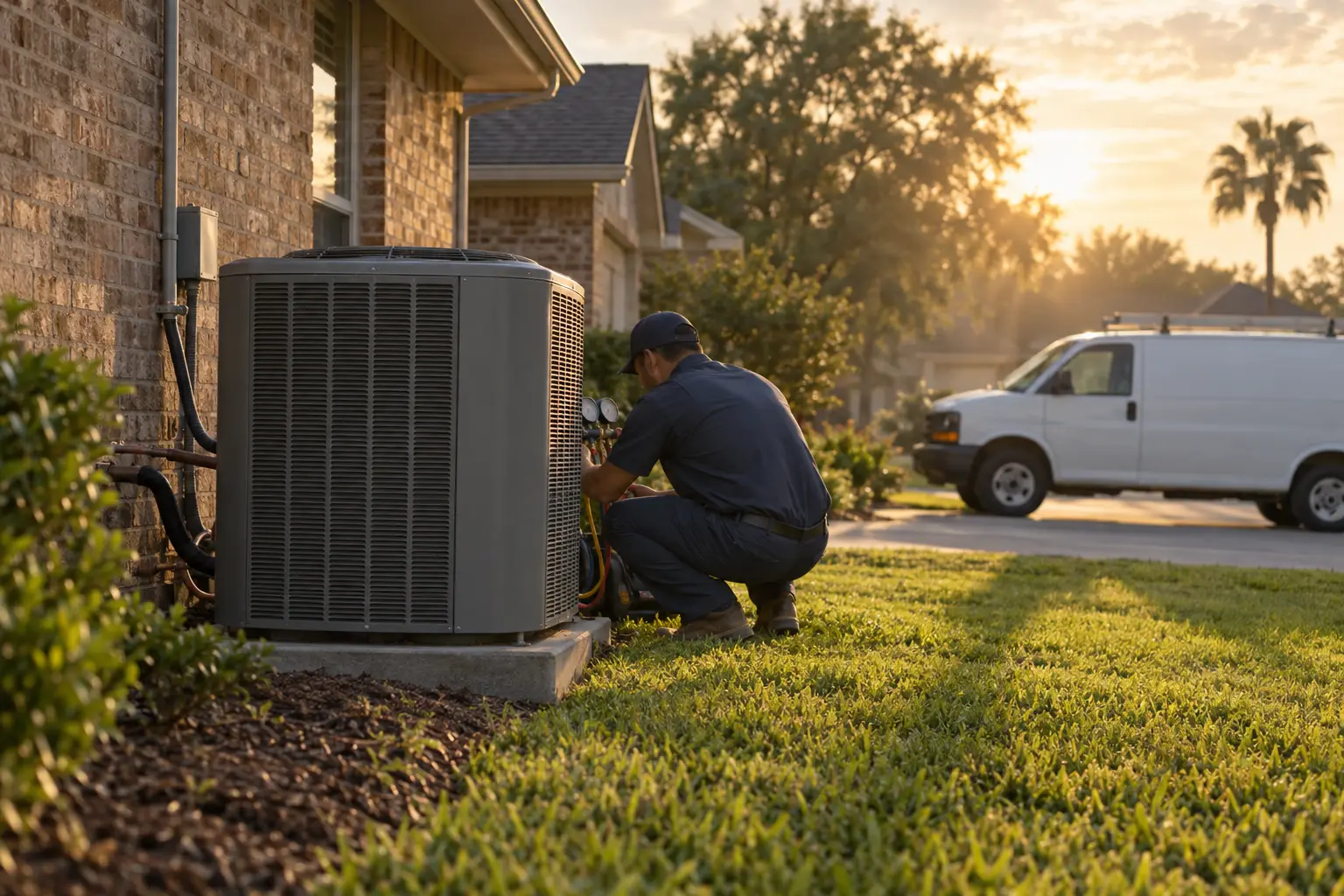
Google Ads for HVAC Companies: Is It Worth It in Houston?
TL;DR: Google Ads is usually worth it for Houston HVAC companies that answer calls fast, track booked jobs instead of clicks, and send ad clicks to pages that match the search. Texas is a cooling-heavy market with a lot of licensed AC contractors, so it pays to plan ahead. Search Ads, Local Services Ads and Maps SEO each have a different job.
Google Ads for HVAC companies is usually worth it in Houston when three things are true. You answer calls fast. You track booked jobs, not clicks. Your ads send people to pages that match what they searched. Miss one of those and ad spend leaks. Get all three right and Search Ads put you in front of people who need AC work today.
This guide is for HVAC owners deciding where the next marketing dollar should go. It covers how the ads work, how they compare to other channels, what drives cost and how to tell if they are paying off.
What do Google Ads actually do for an HVAC company?
Google Search Ads show your ad when someone searches for a service you sell, like AC repair Katy or furnace replacement. You pay when someone clicks. You choose the keywords, the zip codes, the hours and the page the click lands on.
Local Services Ads (LSAs) are a separate Google product. They show near the top of the page with a Google Verified badge. You pay per lead instead of per click. Many HVAC companies that run paid search use both.
The big difference from SEO is speed. A Search campaign can start showing as soon as Google approves it. Map pack and organic rankings take months to build.
Why does the Houston market change the math?
Houston is a cooling market first. In the EIA’s 2020 household energy survey, about 95% of Texas households used air conditioning and 83% used central AC. Almost every house in Sugar Land is a possible service call. A dead system in August is an urgent search, not a casual one.
It is also a crowded market. The Texas Department of Licensing and Regulation reports 19,163 licensed air conditioning contractors statewide for fiscal 2025. Many of them bid on the same repair and replacement keywords you do. That pushes click costs up during heat waves.
There is a Texas rule to plan for too. Under 16 TAC §75.71(h), advertising that asks for air conditioning or refrigeration business must include the affiliated licensee’s license number. Build your TACL number into your landing pages and ad assets from day one. Confirm the details with TDLR or your attorney.
Search Ads vs. Local Services Ads vs. Maps SEO: which does what?
Each channel catches a different kind of customer at a different cost. Here is how they compare for an HVAC company.
| Channel | How you pay | How fast it starts | Control you get | Best HVAC use |
|---|---|---|---|---|
| Google Search Ads | Per click | Fast, once approved | Keywords, zip codes, hours, landing page | Emergency repair, system replacement, high-ticket installs |
| Local Services Ads | Per lead | After Google screening | Budget, job types, service area | Steady repair and service calls |
| SEO: Maps + AI search | Monthly service, no cost per click | Months to build | Profile, pages, reviews | Lower long-term cost per lead |
| Facebook and Instagram ads | Per view or click | Fast | Audience and creative | Maintenance plan offers; people are not searching yet |
Search Ads and LSAs catch people who need help now. Maps SEO and AI search build a base that does not stop when the budget does. Social ads can create interest, but the person scrolling is not searching for AC repair at that moment.
The same logic applies across the trades. Our breakdown of how Google Ads works for fire protection companies shows the setup in a commercial trade. Our page on Google Ads PPC for general contractors covers high-budget project leads.
What are the pros and cons of Google Ads for HVAC companies?
Google Ads gives you speed and control, but it charges for every click whether the job books or not. Weigh both sides before you set a budget.
Pros
- Shows up the day a campaign is approved, not months later.
- Targets by zip code, so you can focus on the parts of Houston where your crews already work.
- Lets you push replacement and install keywords, where one job can cover a lot of clicks.
- Scales up in a heat wave and down in a mild week.
- Gives you search-term data that shows what customers actually type.
Cons
- Clicks cost money even when the caller is shopping for the lowest price.
- Leads stop the day you pause the budget.
- Bad keyword control burns spend on DIY searches and job seekers.
- Missed calls waste paid clicks, and in summer, missed calls go up.
- Without booked-job tracking, you cannot tell good campaigns from bad ones.
If your phones go to voicemail at 6 p.m. in July, fix that first. Ads multiply whatever happens after the click.
What does it cost, and how do you know it’s working?
Your total cost has two parts: the ad spend you pay Google and the fee you pay whoever manages the account. The ad spend depends on your market, not a set price.
What drives your ad spend
- Service mix. Replacement and install keywords usually cost more per click than tune-ups.
- Service area. More zip codes means more searches and more spend.
- Season. Competition rises when the heat index does.
- Landing pages. A page that matches the search turns more clicks into calls.
- Answer rate. Every missed call raises your real cost per booked job.
Measure booked jobs, not clicks
Clicks and form fills are not revenue. Google lets advertisers import offline conversions so the ad account can see which ads led to sales made by phone or by a sales rep. When Google’s bidding learns from sold jobs, it stops chasing cheap clicks that never book.
Ask for three numbers each month: cost per qualified lead, cost per booked job and revenue from sold jobs. Then listen to a sample of call recordings. They show whether the problem is the ad or the phone handling.
Why Results Digital is a fit for HVAC owners
- Results Digital has marketed contractors and trades since 2015.
- We are a Google Partner, based in Houston and veteran-owned (US Marines).
- We build Dynamic Search Ads on your own local service pages.
- LSA management is included.
- We optimize to booked appointments and sold jobs, not clicks or form fills.
- We run daily AI search-term audits and add negative keywords.
- Every lead is tracked, and you can listen to your own call recordings.
- New leads get an AI + SMS follow-up text right away to help book the job.
- Management is a $750/mo flat fee no matter the ad spend, plus a $497 one-time setup; ad spend is paid directly to Google.
- Plans are month-to-month, with a 30-day money-back guarantee on the first month.
Most clients pair Ads with SEO: AI + Maps, so every new local service page also becomes an ad landing page. See how that works in our roofing SEO and Google Ads case study from Lake County, Florida.
Want to know if Google Ads makes sense for your HVAC company? Call (832) 850-2641 or book a consultation with Results Digital.
Frequently Asked Questions
Should a Houston HVAC company keep running Google Ads in winter?
Usually yes, with a smaller budget and a different keyword mix. Demand moves toward heating repair, maintenance plans and planned replacements, so the campaigns should follow it instead of going dark.
How much ad spend does an HVAC company need for Google Ads?
There is no single number. It depends on your service area, the services you push and how many competitors bid in your zip codes. Ad spend is paid directly to Google and is separate from the management fee.
Do Google Ads help my HVAC company show up in ChatGPT or AI Overviews?
Not directly. Paid ads do not earn mentions in AI answers. That comes from SEO work like schema, citations, directory listings and reviews, which is what SEO: AI + Maps covers.
What is the difference between Google Ads management alone and the SEO bundle?
Ads management alone is $750/mo plus a $497 setup. The SEO + Google Ads bundle is $1,397/mo with a $997 setup and the Ads setup fee waived. With the bundle, the 10 new local service pages built each month can also serve as ad landing pages.
Is there a long-term contract for Google Ads management?
No. Plans are month-to-month, and the first month comes with a 30-day money-back guarantee.
Recommended Reads
- Google Ads Management for Gutter Companies | Results Digital
- Google Ads for Fire Protection Companies: How It Works
- SEO Services for Siding Companies: Drive More Leads | Results Digital