
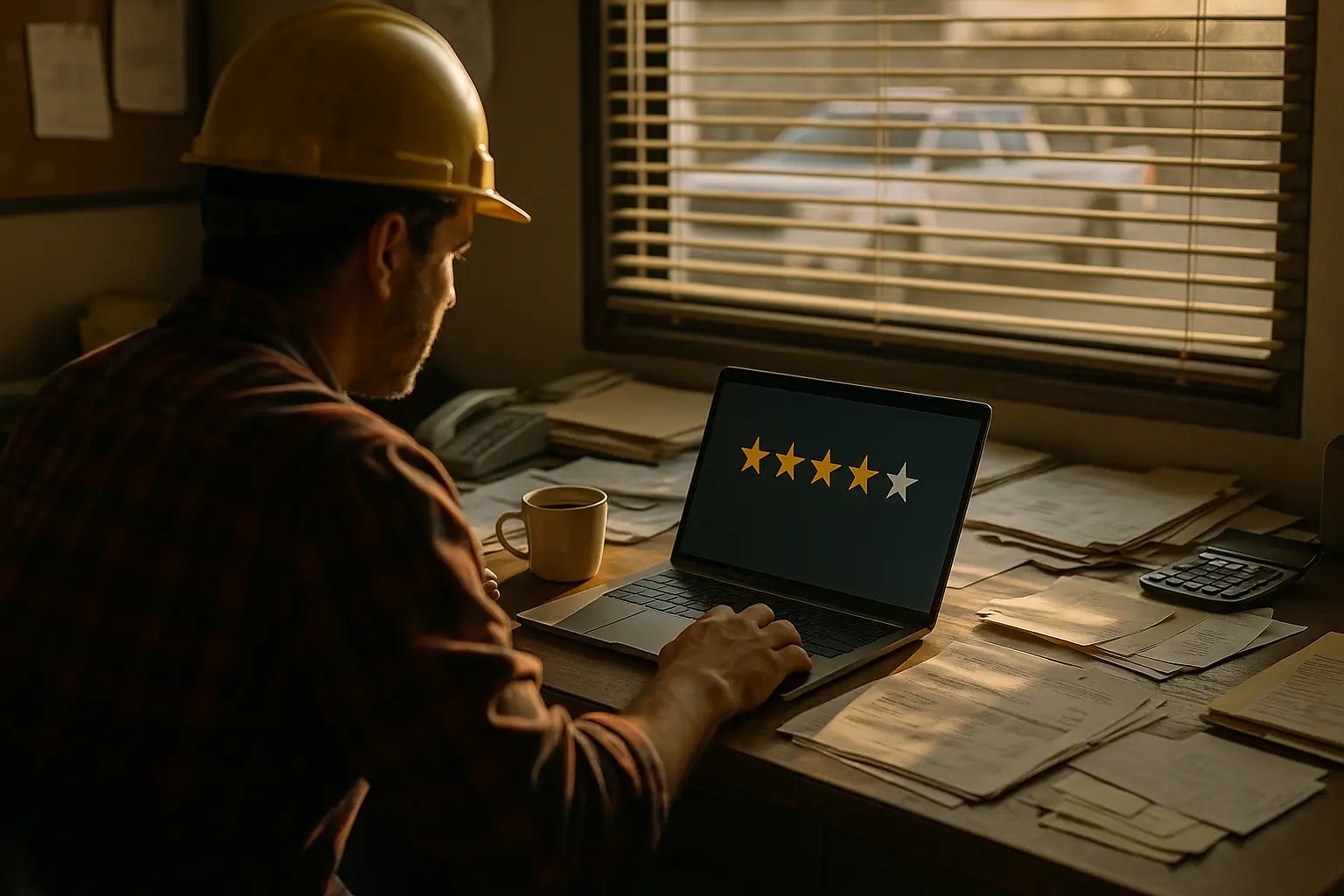
Responding to Bad Reviews as a Contractor: A 7-Step Guide
TL;DR: Reply to a bad Google review within one to two business days. Keep the reply short and factual, then take the real conversation offline. Flag the review only if it breaks Google’s policies, and never use threats or pressure to get a review removed. In Texas, suing a reviewer can leave your company paying their legal fees.
Responding to bad reviews as a contractor comes down to three moves. Reply within a day or two. Keep it short and factual. Move the real conversation offline. Never argue in public, and flag the review only if it breaks Google’s rules. You are writing the reply for future prospects, not for the angry customer.
In Greater Houston, a lot of people will read that reply. A roofer in Katy can book weeks of work after one hailstorm. An HVAC company in Tomball can get flooded with no-cool calls during an August heat wave. Busy seasons bring a burst of reviews, and some of them will be bad. A defensive reply can sit near the top of your profile for the rest of the season.
Why does a bad reply hurt more than a bad review?
Prospects expect a few complaints, but they don’t expect a contractor to fight with a customer in public. Google’s own review reply guidance says a mix of good and bad reviews often looks more believable than a perfect score. It also tells businesses to stay professional and polite, and to keep replies short.
Think about who reads your reply. It’s a property manager in Sugar Land comparing three bids, or a builder checking whether to sub work to you. They want to see how you act when a job goes wrong. A calm, specific reply answers that question better than any ad.
What do you need before you reply?
Gather the facts and decide who replies before you type anything. Have these ready:
- Owner or manager access to your Google Business Profile.
- The job record: date, address, invoice and assigned crew.
- Photos, texts, emails and call recordings tied to the job.
- One person who owns review replies, plus a backup for busy weeks.
- A short written rule for what your company will and won’t say in public.
Responding to bad reviews as a contractor: the 7 steps
- Wait a few hours, not a few weeks. Read the review, step away, then reply within one to two business days. A fast reply shows you pay attention. An angry reply shows the opposite.
- Confirm it’s a real customer. Search your CRM by name, phone number and address, and check that the dates line up. If you find no record, note it for step 6.
- Call the customer before you post. If the job is real, pick up the phone first. Often the issue is something a call can fix, like a missed callback or a cleanup question.
- Write a short public reply. Thank them, name the specific issue and give a direct way to reach a named manager. Add one neutral fact only if you need to correct the record. Keep it to about five sentences.
- Leave out private details. Never post the customer’s address, the job price, insurance claim details or anything personal. Google says replies must follow the same content policies as reviews.
- Flag the review if it breaks Google policy. Fake reviews, reviews meant for another business and reviews with harassment can qualify. You can use Google’s process for reporting inappropriate reviews, and if the flag is denied, you get one appeal.
- Fix the cause and keep fresh reviews coming. Three reviews about the same no-show problem point to an operations issue, not a marketing one. After you fix it, a steady flow of honest reviews from recent jobs pushes one bad review down the page. Our guide on getting more Google reviews without begging or bribing covers how to build that system.
What a good reply looks like
Here is a sample for a roofing company after a slow callback during storm season:
Thanks for telling us, Mark. A two-day wait for a callback on an active leak is not our standard. I’ve pulled the job notes and want to make this right. Please call me directly at our office and ask for Dana. — Dana, Operations Manager
It’s short, it names the problem and it gives a real next step. It doesn’t make excuses or blame the storm.
Should you reply, report or do both?
Most bad reviews just need a reply. Only reviews that break Google’s policies should be reported. Use this table to decide.
| Review type | Example | Reply publicly? | Report to Google? |
|---|---|---|---|
| Honest complaint from a real customer | Crew showed up late, missed callback | Yes, short and calm | No |
| Real customer, wrong facts | Claims you never followed up when your call log shows you did | Yes, with one neutral fact | No, disagreement alone does not qualify |
| No record of the reviewer | Describes a pool cage or fence job you never did | Yes, briefly say you can’t find the job | Yes, flag it as fake or off-topic |
| Harassment or personal info | Posts a technician’s home address | Optional, keep it to one line | Yes |
| One star, no text | A rating with no comment | Yes, invite them to call | No |
Google states that it does not remove reviews just because a business disagrees with them. Save your flags for clear policy violations.
What mistakes make a bad review worse?
The worst mistakes turn a private complaint into a public fight or a legal problem. Avoid these:
- Arguing line by line. Even if you are right, a long rebuttal reads as defensive.
- Posting job details. Prices, claim numbers and addresses do not belong in a public reply.
- Copy-and-paste replies. The same canned apology on every review tells prospects nobody read them.
- Threatening to sue. The FTC’s rule on consumer reviews and testimonials bars unfounded legal threats, intimidation and knowingly false accusations used to get a review removed.
- Gag clauses in your contracts. Under the federal Consumer Review Fairness Act, a form contract cannot restrict a customer’s honest reviews. Check your proposal templates.
- Ignoring the review. Silence lets the customer’s version stand alone.
Texas adds another risk. Under the Texas Citizens Participation Act, a reviewer you sue can ask the court to dismiss the case. If the reviewer wins that motion, your company may have to pay their attorney’s fees. Talk to a lawyer before taking any legal step.
When should you hand review management to someone else?
Bring in help when replies fall behind the volume of work you finish. Watch for these signs:
- Reviews sit unanswered for more than a week.
- Whoever happens to see a review writes the reply.
- The same complaint keeps showing up, and nobody tracks it.
- Your new reviews come in slower than your competitors’ do in the Map Pack.
- You run Google Local Services Ads, where your star rating sits right next to your ad.
Why Results Digital is a fit
Results Digital has marketed contractors and trades since 2015.
For our clients, review requests and responses are automated, and live Google reviews display on their websites.
Monthly reports show map-grid rankings, AI search mentions, qualified leads and cost per qualified lead.
We are a Google Partner and a veteran-owned company, founded by a US Marine.
Service is month-to-month, with no long-term contract and a 30-day money-back guarantee on the first month.
We take one contractor per trade per market, and once a market is filled, we won’t take on a competitor. HVAC companies can see how this works on our page for HVAC contractor marketing in Houston.
Want to know if your trade is still open in your market? Call (832) 850-2641 or book a consultation with Results Digital.
Frequently Asked Questions
Can a contractor delete a bad Google review?
No. Only Google can remove a review, and it only removes reviews that break its policies. You can flag a review and file one appeal if the flag is denied.
Should I reply to a one-star review that has no text?
Yes. A short reply that invites the person to call shows prospects that you follow up. It may also uncover a real customer you can help.
Is it smart to sue a customer in Texas over a negative review?
Talk to a lawyer first. Under the Texas Citizens Participation Act, a reviewer can move to dismiss a speech-based lawsuit, and if they win, the business that sued may have to pay their attorney’s fees.
Can I use templates or AI to draft review replies?
A draft is fine as a starting point. Every reply you post should still mention the specific issue, because Google advises against sending the same generic reply to everyone.
Does replying to reviews help my Google Maps ranking?
Google lists replying to reviews as a best practice, but it hasn’t published how much replies weigh in rankings. Treat replies mainly as a trust signal for prospects.
Recommended Reads
- Google Local Services Ads for Contractors: Is the Google Verified Badge Worth It?
- How Contractors Can Get More Google Reviews Without Begging or Bribing
- Houston's Digital Marketing Agency for Contractors & Trades