

Residential Remodel Leads Facebook Ads: 2026 Guide
Facebook advertising for residential remodeling is defined as paid Meta campaigns designed to capture contact information from homeowners actively planning kitchen, bathroom, basement, or whole-home renovation projects. Residential remodel leads Facebook ads work because Meta’s targeting puts your offer in front of the right homeowner at the right moment, before they call a competitor. Lead costs typically fall between $25 and $75 per lead for kitchen, bathroom, and basement remodels. That range means a well-run campaign can deliver qualified prospects at a fraction of what you’d pay through referral networks or lead aggregators. This guide covers setup, campaign creation, optimization, and the mistakes that drain budgets without producing booked jobs.
What do you need to run residential remodel leads Facebook ads?
Every effective campaign starts with the right infrastructure. Skipping this step is like sending a sales rep out without a business card or a pitch.
Facebook Business Manager is the control center for all paid campaigns. You need a verified Business Manager account, a connected ad account, and a Facebook Pixel installed on your website before you spend a single dollar. The Pixel tracks which visitors take action after seeing your ad, which feeds the algorithm the data it needs to find more buyers like them.
Creative assets are the second requirement. Remodeling is a visual trade. You need before-and-after photos, short project walkthrough videos, and at minimum one strong static image per ad set. Blurry phone photos will not convert. Invest in a few hours of professional photography on a completed project and you’ll use those assets for months.

Audience targeting options for remodelers
Properly structured campaigns balance multiple audience layers. Here is how each one works:
| Audience type | How it works | Best use case |
|---|---|---|
| Interest-based | Targets users by home improvement, renovation, or DIY interests | Cold prospecting, new markets |
| Lookalike audiences | Mirrors your existing lead list or customer database | Scaling proven campaigns |
| Retargeting | Re-engages website visitors or video viewers | Recapturing warm, high-intent prospects |
| Broad targeting | Lets Meta’s algorithm self-optimize with minimal restrictions | High-budget campaigns with strong creative |
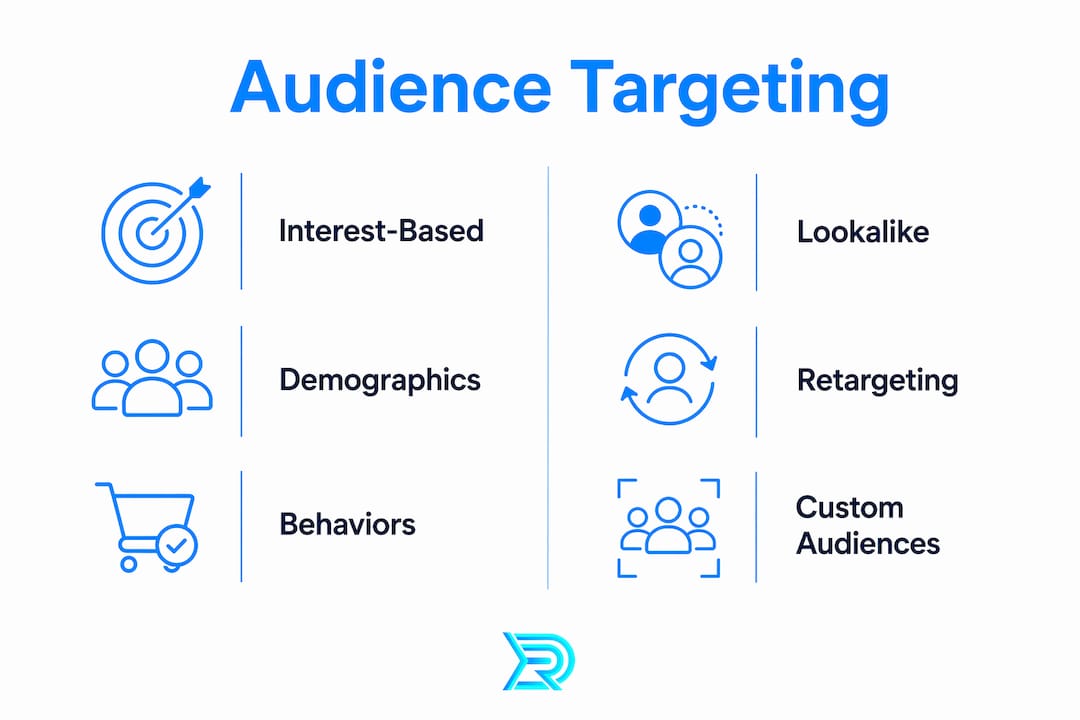
Lookalike audiences built from prior remodel leads boost targeting efficiency by reaching homeowners with similar behavior patterns to your best customers. Upload your existing customer list to Meta and build a 1%–3% lookalike to start. For a deeper breakdown of how audience segmentation works across digital channels, audience targeting strategies are well worth reviewing before you build your first ad set.
Budget minimums matter more than most contractors realize. A daily budget under $20 gives Meta’s algorithm too little data to exit the learning phase. Start at $30–$50 per day per ad set and plan for a 7–14 day learning window before drawing conclusions.
How do you create high-converting Facebook ads for remodel jobs?
Campaign creation follows a clear sequence. Skipping steps mid-funnel produces inconsistent results and wasted spend.
-
Choose your campaign objective. Select “Lead Generation” when you want prospects to submit their contact info directly inside Facebook. Select “Traffic” when you want to drive visitors to a dedicated landing page. Lead Generation reduces friction. Traffic campaigns give you more control over the qualification process.
-
Build your ad creative. Your headline should name the specific service and the outcome. “Kitchen Remodel in 6 Weeks” outperforms “We Do Remodeling.” Your primary image or video should show a finished project, not a logo. Creative is the primary lever for optimization in remodeling Facebook ads. Meta’s algorithm needs variety to find the strongest asset, so upload GIFs, short videos, and static images within the same ad set.
-
Write copy that speaks to the homeowner’s situation. Address the problem first. “Tired of your outdated kitchen?” lands harder than a list of services. Follow with a clear benefit, then a direct call to action: “Get a free estimate this week.”
-
Select and layer your audiences. Start with interest-based targeting in your service area. Layer in homeownership data from Meta’s detailed targeting options. Once you have 100 or more leads in your CRM, build a lookalike audience from that list.
-
Choose between Lead Forms and landing pages. Lead forms simplify conversion by keeping the prospect inside Facebook, but landing pages allow more detailed qualification questions and stronger brand presentation. Test both. Run the same ad to a Lead Form for two weeks, then swap to a landing page for two weeks, and compare cost per qualified lead.
-
Set your schedule and budget. Run ads Tuesday through Saturday. Most homeowners research remodeling projects mid-week and on weekends. Avoid Sunday evenings and Monday mornings for remodeling audiences. Allocate your daily budget evenly across ad sets during the first 14 days, then shift spend toward the top performer.
Pro Tip: Add a qualifying question to your Lead Form, such as “What is your estimated project budget?” This one field filters out tire-kickers and cuts your follow-up time in half.
How do you optimize and scale Facebook campaigns for remodel leads?
Optimization is not a one-time task. It is a weekly discipline.
The three metrics that matter most are cost per lead, click-through rate (CTR), and conversion rate from lead to booked estimate. Regular A/B testing of creatives, audiences, and lead form fields consistently improves lead quality in remodeling campaigns. If your CTR drops below 1%, your creative is fatiguing. Swap in a new image or video before cutting the budget.
Retargeting is the highest-return lever most remodelers ignore. Retargeting campaigns achieve 6.7x higher click-through rates compared to industry benchmarks in remodeling. Allocate roughly 20% of your total monthly ad budget to retargeting audiences, specifically website visitors, video viewers, and anyone who opened but did not submit your Lead Form. For a practical walkthrough of retargeting setup, retargeting ad setup covers the mechanics in detail and translates directly to remodeling campaigns.
Creative rotation and algorithm learning
Using multiple creative formats gives Meta’s algorithm the options it needs to find the highest-converting asset. Run at least three creative variations per ad set: one static before-and-after image, one short video (15–30 seconds), and one GIF or carousel. Rotate new creative every 3–4 weeks to prevent audience fatigue.
| Optimization action | Frequency | What to look for |
|---|---|---|
| Creative refresh | Every 3–4 weeks | CTR drop below 1% |
| Audience expansion | Every 30 days | Cost per lead rising 20%+ |
| Budget reallocation | Weekly | Top-performing ad set by cost per lead |
| Retargeting audience update | Every 14 days | New website visitors and video viewers |
Scaling works best when you increase budget gradually. A 20% budget increase every 5–7 days gives the algorithm time to adjust without resetting the learning phase. Doubling a budget overnight forces a full reset and often spikes cost per lead for 7–10 days.
Pro Tip: Before scaling spend, confirm your follow-up process can handle the volume. Leads that go unanswered for more than 5 minutes convert at a fraction of the rate of leads contacted immediately.
What mistakes kill Facebook ad results for remodelers?
Most underperforming campaigns share the same five problems.
-
Targeting too broadly. Selecting the entire state instead of your actual service radius floods your pipeline with leads you cannot serve. Geo-target by zip code or a radius around your office. Tighter geography produces higher-quality leads at lower cost.
-
Ignoring retargeting. Sending 100% of your budget to cold audiences wastes the warmest prospects. Homeowners who visited your website already know your brand. Retargeting them costs less and converts faster. The value of retargeting for contractor businesses is well documented.
-
Weak ad creative. Stock photos of generic kitchens do not build trust. Your own project photos, even taken on a modern smartphone, outperform stock imagery because they prove you do the work locally.
-
No testing cadence. Running the same ad for 60 days without changes is flying blind. Set a weekly calendar reminder to review CTR, cost per lead, and conversion rate. Make one change at a time so you know what moved the needle.
-
Vague calls to action. “Learn more” is not a call to action for a remodeling lead. “Get your free kitchen estimate” tells the homeowner exactly what happens next. Specific CTAs consistently outperform generic ones.
After capturing leads, the follow-up process determines whether they become booked jobs. Effective lead nurturing after initial contact is what separates contractors who close at 30% from those closing at 10%.
What I’ve learned running Facebook ads for contractors
After years of running paid social campaigns for contractors across the United States, one pattern stands out clearly. Remodelers who treat Facebook ads as a “set it and forget it” channel consistently burn through budget and blame the platform. The ones who win treat it like a sales process: test, measure, adjust, repeat.
The biggest shift I’ve seen in 2026 is how much Meta’s algorithm rewards creative quality over audience precision. Three years ago, you could win with tight targeting and mediocre creative. That window has closed. Today, your ad image or video does more targeting work than your audience settings do. A compelling before-and-after video of a bathroom remodel will find the right homeowners even in a broad audience, because Meta’s system learns from engagement signals.
I also push back on the idea that more leads always means better results. A contractor running $3,000 per month in ads who books 8 out of 20 leads is outperforming one spending $5,000 who books 6 out of 40. Lead quality, not volume, determines revenue. That means qualifying questions in your Lead Form, fast follow-up, and honest budget conversations with prospects matter as much as the ad itself.
Local market preferences also shape what works. A contractor in the Southeast gets different engagement on deck and outdoor living ads than one in the Midwest, where basement finishing and insulation upgrades drive more clicks. Test your creative against your local market before assuming national benchmarks apply to your area.
— Results
Homeowners who search for a remodeler are already planning a project, and Google Ads optimized for booked jobs put you in front of them at that exact moment.
Want more booked jobs from search? Results Digital runs SEO: AI + Maps and Google Ads for contractors and trades, with one client per trade per market and month-to-month terms. Schedule a consultation to see if your market is open.
FAQ
What is the average cost per lead for remodeling Facebook ads?
Lead costs for kitchen, bathroom, and basement remodels typically fall between $25 and $75 per lead on Facebook. Your actual cost depends on your service area, creative quality, and audience targeting.
Should I use Facebook Lead Forms or a landing page?
Both formats work, and testing both is the only way to know which converts better for your audience. Lead Forms reduce friction; landing pages allow stronger qualification and brand presentation.
How much should I spend on Facebook ads to generate remodel leads?
Start at $30–$50 per day per ad set to give Meta’s algorithm enough data to exit the learning phase. Scale budget by 20% every 5–7 days once a campaign is performing.
What audience targeting works best for home renovation leads?
Combining interest-based audiences, lookalike audiences, and retargeting produces the strongest results. Lookalikes built from your existing customer list are especially effective for reaching high-intent homeowners.
How often should I update my Facebook ad creative?
Refresh creative every 3–4 weeks or sooner if your CTR drops below 1%. Creative variety across GIFs, videos, and static images gives Meta’s algorithm the options it needs to find the best-performing asset.