

General Contractor Niche Market Targeting: 2026 Guide
General contractor niche market targeting is the strategic process of focusing your marketing, messaging, and services on specific, well-defined client segments to increase lead quality, profitability, and business growth. The U.S. construction market is a $2.2 trillion industry, and contractors who try to serve everyone in it end up competing on price alone. Content marketing generates 54% more leads than traditional advertising for contractors. That number reflects a simple truth: buyers respond to contractors who speak directly to their situation, not to generic “quality work” claims. Niche specialization is how you build that connection at scale.
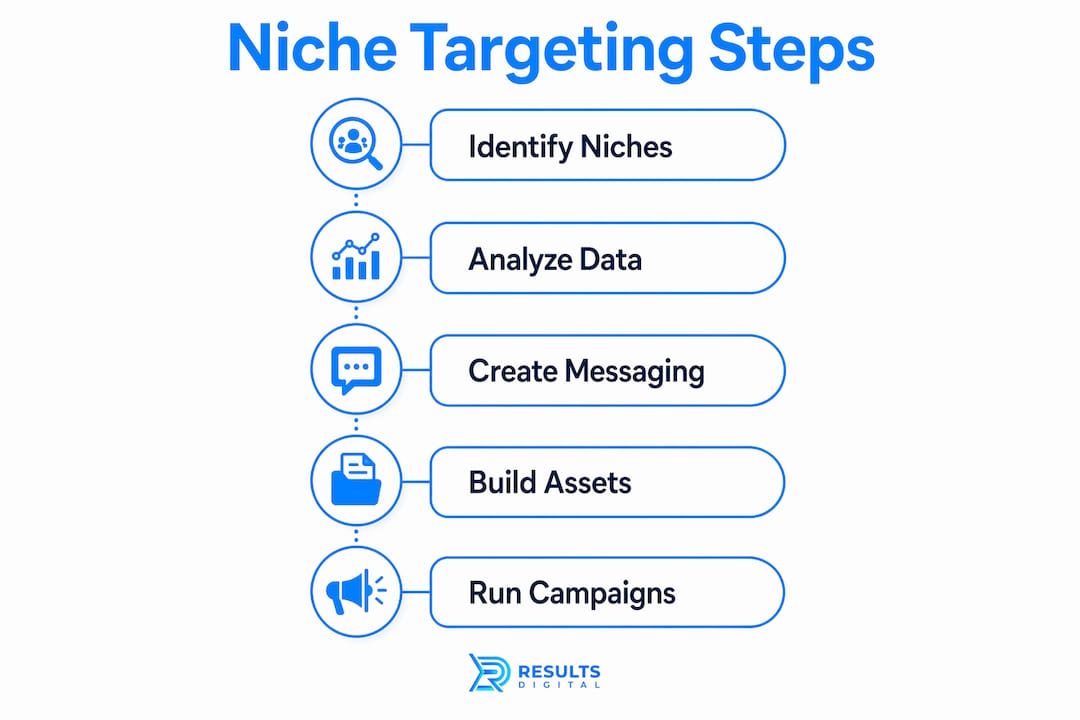
How to identify the best niche markets for your general contracting business
Niche selection starts with your operational strengths, not with what sounds profitable. Map what your crew does best: fast turnaround on occupied commercial spaces, high-end residential finishes, or tenant improvement buildouts. Then match those strengths to buyer segments where those capabilities create real value.
Four criteria drive good niche selection:
- Buyer profile: Who is making the decision? A property manager, a homeowner, or a real estate investor? Each has different triggers, timelines, and communication expectations.
- Project type: Kitchen remodels, commercial office builds, and multifamily renovations require different crews, tools, and subcontractor relationships.
- Geographic concentration: Local micro-market domination produces higher lead quality than broad metro targeting. Dense geographic focus builds name recognition faster.
- Operational fit: If your crew runs best on projects between $50,000 and $200,000, targeting $10,000 bathroom flips or $5 million commercial builds will strain your margins and your team.
Use Google Trends, local permit data from your county building department, and neighborhood-level demographic data to validate demand before committing. Permit data tells you where construction activity is actually happening, not just where you think it is.
Pro Tip: Pull the last 12 months of residential and commercial permit data for your top three zip codes. The permit volume by project type tells you exactly which niches are active in your market right now.

Why does your messaging fail to convert niche buyers?
Generic messaging that tries to appeal to all buyers leads to poor lead quality. Buyers in different niches have completely different concerns, and a message that addresses none of them specifically converts nobody well.
A homeowner planning a kitchen renovation worries about living in a construction zone, staying on budget, and whether the contractor will show up consistently. A commercial property manager worries about code compliance, minimal business disruption, and documentation for the building owner. An investor doing a fix-and-flip worries about speed, cost control, and resale value. One message cannot address all three.
Effective niche messaging targets one buyer type and speaks to their specific triggers:
- Process clarity: “We complete occupied office renovations in phases so your team never loses a full workday.”
- Speed: “We deliver investor-ready finishes in 30 days or less on projects under $80,000.”
- Documentation: “Every project includes a full photo log, permit record, and warranty package for your property files.”
Leads convert best when your messaging directly addresses distinct buyer concerns instead of using generic “quality work” claims. Quality is the baseline expectation, not a differentiator.
Pro Tip: Write one paragraph of messaging for each buyer type you serve. If you cannot write it in plain language without using the phrase “quality work,” you do not yet know your buyer well enough.
Building digital assets that attract and convert niche leads
Your website homepage is not a niche marketing tool. It is a brand overview. The real conversion work happens on service-specific landing pages that address local intent and include real project proof.
Niche-specific landing pages outperform generic homepages in both SEO rankings and conversion rates. A page titled “Commercial Tenant Improvement Contractor in Houston” will rank for that search and convert that visitor far better than a homepage that lists 12 services. Each page should include a clear headline, a short description of your process, three to five real project photos with captions, and a visible call to action above the fold.
| Digital asset | Generic homepage | Niche landing page |
|---|---|---|
| Search ranking | Broad, competitive | Specific, lower competition |
| Visitor intent match | Low | High |
| Lead quality | Mixed | Qualified |
| Conversion rate | Lower | Up to 3x higher |
Local SEO for niche targeting means building your Google Business Profile around the specific service and geography you want to own. Choose a primary category that matches your niche, add niche-specific photos, and collect reviews that mention the type of work you want more of. A review that says “They finished our office renovation on time and on budget” is worth more than ten reviews that say “Great contractor.”
Building trust online through real project documentation, before-and-after photos, and client testimonials is the fastest way to close the credibility gap with new niche buyers. Buyers who find you through search are already interested. Your job is to remove doubt, not create excitement.
Pro Tip: Create one dedicated landing page per niche and per primary service area. If you serve three niches across two cities, that is six pages. Each one should read as if it was written only for that buyer in that location.
How to run targeted marketing campaigns for your niche
Paid search combined with strong landing pages and fast follow-up is the most effective way to capture immediate demand in niche markets. Here is how to build the campaign correctly.
- Choose niche-specific keywords. Target phrases like “commercial office renovation contractor Dallas” or “historic home remodel contractor Austin.” Avoid broad match terms like “general contractor near me” that attract every buyer type at once.
- Send every ad click to a matching landing page. An ad for tenant improvement work must go to your tenant improvement page, not your homepage. Mismatched landing pages kill conversion rates.
- Set up call tracking. Use a unique phone number on each landing page so you know exactly which campaign generated each call. Flying blind on attribution wastes budget fast.
- Score leads by fit and urgency. Not every lead deserves the same follow-up speed. A commercial developer with a signed lease and a 90-day build deadline needs a callback within the hour. A homeowner “thinking about” a remodel next year can go into a nurture sequence.
- Follow up within five minutes. Speed to lead is the single biggest variable in conversion rate for contractor leads. A five-minute callback converts at a dramatically higher rate than a two-hour callback.
For Google Ads PPC campaigns, use negative keywords aggressively to block irrelevant searches. If you specialize in commercial work, add “residential,” “home,” and “house” as negatives from day one.
Referral partnerships and community presence are critical for trust and repeat business in contractor niche markets. Build relationships with commercial real estate brokers, property managers, and interior designers who serve your target buyer. One strong referral partner can deliver more qualified leads than a $3,000 monthly ad budget.
Pro Tip: Track your cost per lead and cost per signed contract separately for each niche. If one niche costs twice as much to acquire but closes at three times the rate, the math still favors it.
What mistakes kill niche targeting campaigns?
Most niche targeting campaigns fail before they start because contractors skip the alignment step between their operations and their chosen niche. Failing to align operational standards with niche buyer expectations causes high lead volume but low conversion rates. You can generate 50 leads a month and still lose money if your crew cannot deliver what your messaging promises.
Watch for these specific failure patterns:
- Broad keyword targeting: Bidding on “contractor” or “remodeling” attracts every buyer type and drives up cost per lead without improving quality.
- Generic messaging on niche pages: A landing page that says “We do quality work at fair prices” is not a niche page. It is a homepage with a different URL.
- Slow follow-up: A lead that waits four hours for a callback has already called two other contractors. Speed is not optional in niche markets.
- Spreading across too many niches at once: Owning one niche completely beats being mediocre in five. Pick one, dominate it, then expand.
- Ignoring lead quality data: Track which campaigns produce leads that actually sign contracts, not just leads that fill out forms. A common contractor digital marketing mistake is optimizing for lead volume instead of lead quality.
The fix for most of these problems is the same: get specific. Specific niche, specific buyer, specific message, specific page, specific follow-up sequence.
Key Takeaways
Niche market targeting works for general contractors because specific messaging, matched to a specific buyer and backed by specific digital assets, produces higher-quality leads at a lower cost per signed contract than broad marketing ever will.
| Point | Details |
|---|---|
| Niche selection starts with operations | Match your crew’s strengths to buyer segments before choosing a niche. |
| Specific messaging converts | Address one buyer type’s exact concerns; generic claims produce low-quality leads. |
| Landing pages outperform homepages | Niche-specific pages generate up to 3x more qualified leads from the same ad spend. |
| Speed to lead determines conversion | Calling back within five minutes dramatically increases your close rate on niche leads. |
| One niche at a time | Dominating one niche fully beats spreading thin across several simultaneously. |
What I have learned after years of contractor niche marketing
Most contractors resist niche targeting because it feels like leaving money on the table. I get it. Saying no to a project type is uncomfortable when your phone is not ringing. But here is what I have seen repeatedly: the contractors who try to serve everyone end up known for nothing. The ones who plant a flag in one niche and defend it consistently are the ones who build real businesses.
The contractors I have worked with who grew fastest were not the ones with the biggest ad budgets. They were the ones who got brutally specific about their buyer, built messaging that made that buyer feel understood, and then showed up consistently in the places that buyer looks. That combination of specificity and consistency is what creates the “I keep seeing this company everywhere” effect in a local market.
One thing most articles will not tell you: your referral network matters more than your ad spend in the long run. Referral partnerships and community presence create a defensible position that paid ads alone cannot replicate. A competitor can outbid you on Google. They cannot replicate the trust you have built with a commercial real estate broker who has sent you 12 projects over three years.
The contractor content marketing strategy that works is not complicated. It is consistent, specific, and buyer-focused. Most contractors quit before consistency pays off. The ones who stay the course own their niche.
— Results
Want more booked jobs from search? Results Digital runs SEO: AI + Maps and Google Ads for contractors and trades, with one client per trade per market and month-to-month terms. Schedule a consultation to see if your market is open.
FAQ
What is general contractor niche market targeting?
General contractor niche market targeting is the practice of focusing your marketing, services, and messaging on a specific client segment, such as commercial tenant improvement or high-end residential remodeling, to attract higher-quality leads and close more contracts.
Why do general contractors need niche marketing?
Niche marketing produces better leads because specific messaging addresses the exact concerns of a defined buyer type. Generic messaging attracts unqualified inquiries and drives up cost per acquisition.
What are the best niches for general contractors?
Strong niches include commercial tenant improvement, occupied office renovation, historic home restoration, multifamily unit turns, and high-end residential remodeling. The best niche aligns with your crew’s existing strengths and local permit activity.
How do niche-specific landing pages improve lead quality?
Niche-specific landing pages match the visitor’s exact search intent and address their specific concerns, which produces up to 3x more qualified leads from the same ad spend compared to sending traffic to a generic homepage.
How do I find the right niche for my contracting business?
Pull local permit data by project type, map your crew’s operational strengths, and identify which buyer segment values those strengths most. Validate demand with Google Trends and local market research before committing your marketing budget.