
You spend real money generating roofing leads. A homeowner fills out your form or calls your office, and then nothing happens. No job, no revenue, just a dead opportunity. Understanding why roofing leads go cold is one of the highest-leverage problems you can solve in your business. The gap between a lead coming in and a signed contract is where most roofing contractors lose 40% or more of their potential revenue. This guide breaks down the exact reasons leads lose interest and gives you a concrete playbook to fix it.
Table of Contents
- Key takeaways
- Why slow response time kills roofing leads
- Poor qualification and weak follow-up habits
- Pre-heating leads before the hard pitch
- Technology that prevents leads from going cold
- Practical steps to keep your leads warm today
- My take on what actually separates winners from the rest
- Ready to stop losing roofing leads?
- FAQ
Key takeaways
| Point | Details |
|---|---|
| Speed is everything | Responding within 5 minutes makes you 21x more likely to qualify a lead and win the job. |
| Follow-up frequency matters | Most roofers stop at 2 attempts, but 80% of deals need 5 or more touchpoints to close. |
| Not all leads are equal | Treating aggregator leads and organic leads the same wastes your sales time and budget. |
| Pre-heating converts better | Warming leads across 3 to 5 channels over 14 to 28 days pushes cold leads toward decisions. |
| Technology closes the gap | CRM systems and automated alerts prevent missed calls and keep your pipeline moving. |
Why slow response time kills roofing leads
This is the single biggest reason roofing leads go cold, and most contractors underestimate just how fast the clock starts ticking. A homeowner with a damaged roof is not loyal. They are anxious, shopping around, and ready to talk to whoever calls first.
Responding within 5 minutes makes you 21 times more likely to qualify the lead. Wait 30 minutes and you are 100 times less likely to even connect. That is not a slight disadvantage. That is a wipeout.
The contractor who reaches a homeowner first wins 35 to 50% of jobs outright, before competitors even get a chance to pitch. Think about that: nearly half your market share is determined not by your price, your quality, or your reviews. It is determined by whether you picked up the phone first.
Here is the problem. Roofers are on job sites 80% of the time during busy seasons. You are on a roof or in a truck when leads come in. By the time you check your messages, that homeowner has already talked to two other contractors.
Common patterns that cause delayed lead response include:
- Leads going to a general inbox that nobody monitors during work hours
- No dedicated person assigned to respond to new inquiries
- Relying on the owner or project manager to handle leads while they are in the field
- Using a contact form with no SMS or email alert set up for instant notification
- No after-hours process for leads that arrive outside business hours
Pro Tip: Put a visible response-time promise on your website. A simple “We call back within 60 seconds” builds trust immediately and sets you apart from competitors who never make that commitment. Then build the process behind it to actually deliver.
The lead response time impact on your close rate is not marginal. It is structural. Fix your response process and you fix one of the most common lead generation pitfalls in the roofing industry.
Poor qualification and weak follow-up habits
Slow response starts the problem. Poor follow-up finishes it. Most roofing contractors treat every lead the same and give up too quickly. Both are expensive habits.
Not every lead has the same intent. A homeowner who just got hit by a hailstorm and has insurance funds ready is a completely different opportunity than someone casually browsing roof replacement costs for a project a year from now. Treating aggregator leads and organic leads identically wastes your sales time and dilutes your focus on the leads most likely to convert.

High-intent leads need speed and a personal touch. Low-intent leads need a nurture sequence, not a hard close on the first call. When you route both through the same process, you either annoy the browsers or under-serve the ready buyers.
Now add the follow-up problem on top. 80% of deals require 5 or more follow-ups, but most roofers stop after two attempts. Two calls with no answer and they move on. That lead goes into a dead pile when it was actually winnable with two more touchpoints.
The specific habits that cause leads to go cold at this stage include:
- No written notes or CRM record after the first contact attempt
- Follow-up messages that are generic (“Just checking in”) with no added value
- Inconsistent timing, calling every day for two days then never again
- No differentiation in messaging based on where the lead came from or what they asked about
- Zero email or text follow-up, relying entirely on phone calls
Pro Tip: Build separate messaging sequences for different lead types. A storm-damage lead gets an urgent, insurance-focused follow-up. A replacement inquiry gets educational content about materials and ROI. Tailored messaging shows you understand their situation, and that alone separates you from every contractor sending the same generic script.
Structured, automated follow-up sequences improve reply rates, reduce lead leakage, and make your pipeline predictable. Without a system, you are flying blind.
Pre-heating leads before the hard pitch
Cold leads do not buy. That sounds obvious, but most contractors skip this step entirely and go straight to quoting. Understanding how to warm up cold leads is the difference between a 1% conversion rate and something closer to 20%.
Cold leads convert at roughly 1%, while warm leads convert between 15% and 80%. Pre-heating is the process of engaging a prospect across multiple channels with useful content before you ever ask for the sale. The goal is to increase buyer readiness by building familiarity and trust over time.
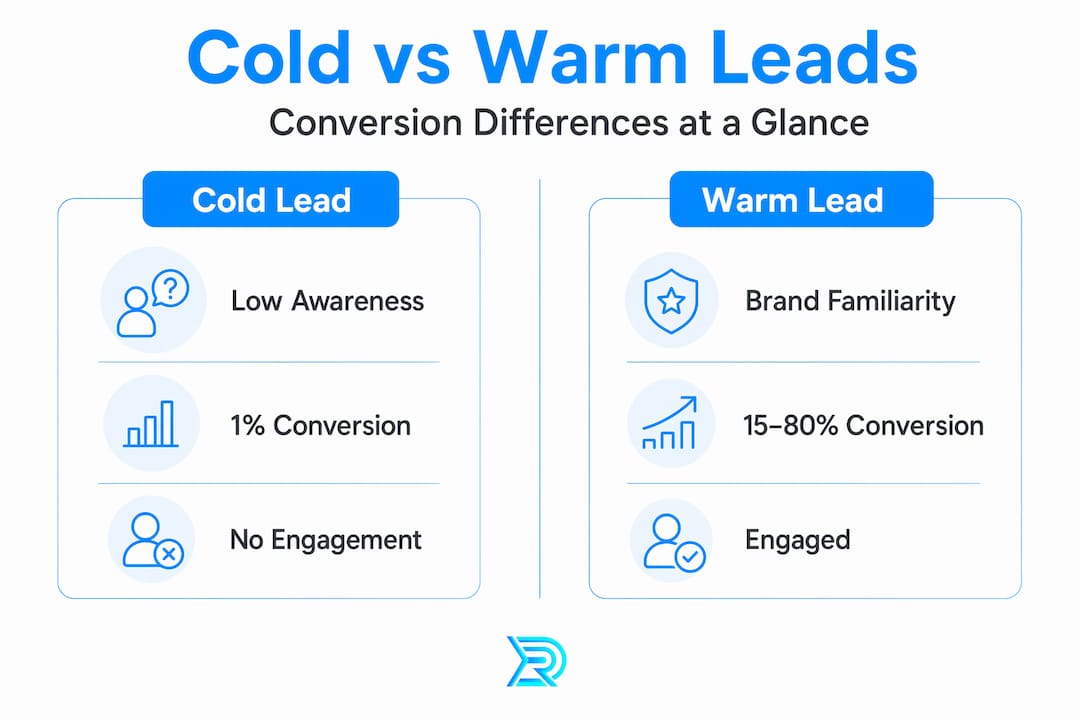
Here is what the difference looks like in practice:
| Characteristic | Cold lead | Warm lead |
|---|---|---|
| Awareness of your brand | None or minimal | Has seen your content or ads multiple times |
| Trust level | Low | Moderate to high |
| Response to outreach | Skeptical or unresponsive | Open and engaged |
| Conversion rate | Around 1% | 15% to 80% |
| Ideal approach | Educate first, sell later | Personalized follow-up with offer |
| Channels needed | 3 to 5 touchpoints | 1 to 2 direct outreach attempts |
Engaging leads on 3 to 5 channels over 14 to 28 days before a direct sales conversation significantly increases their readiness. That means a combination of email, retargeting ads, social media, SMS, and direct mail working together, not just one channel firing once.
Effective pre-heating content for roofing leads includes:
- Seasonal maintenance checklists (“5 things to check on your roof before winter”)
- Before and after project showcases with clear scope and outcome
- Short videos explaining how insurance claims work for storm damage
- Google reviews and testimonials from homeowners in the same zip code
- Educational blog posts answering the questions homeowners actually search
The “small yes” tactic works well here. Instead of asking for a full estimate call, ask if they want a free maintenance checklist or a quick roof health video. Content marketing generates 3x more leads and costs 62% less than traditional methods. That means your content investment compounds over time rather than burning budget with no residual value.
For strategies on exactly what content works for converting roofing leads, Resultsdigitalus has a full resource on roofing lead content ideas worth bookmarking.
Technology that prevents leads from going cold
You cannot manage what you cannot track. Most contractors lose leads not because of bad intentions but because they have no system. A lead arrives, gets a missed call, falls off the radar, and nobody knows it happened until it is too late.
CRM adoption is the foundational fix. When every lead gets logged automatically, assigned to a team member, and tagged by source and intent, nothing falls through the cracks. Lead qualification and routing improve efficiency significantly when you track lead source and match it to the right response process. A Google Ads lead gets routed to your fastest responder. A newsletter subscriber gets added to a nurture sequence.
Automation handles what humans forget. Here is what a solid technology-powered lead response workflow looks like:
- New lead fills out your website form
- Automated SMS and email alert fires to your lead responder within 30 seconds
- CRM auto-creates a contact record and assigns a follow-up task
- Automated text goes to the homeowner confirming receipt and expected callback time
- If no contact after attempt one, automated reminder fires to the sales rep at the next scheduled interval
- After 3 attempts with no response, lead enters a long-term nurture email sequence
Fast proposal follow-ups within 24 hours prevent deal cooling after an estimate is sent. Build that automatic reminder into your CRM so no proposal sits ignored for three days while your competitor calls to check in.
Pro Tip: Display your response time promise prominently on your website homepage and landing pages. “We respond within 60 seconds during business hours” is a differentiator that costs nothing to publish but builds immediate trust with every visitor.
Resultsdigitalus builds websites designed specifically for roofing lead capture. A roofing lead generation website that integrates with your CRM and fires instant alerts is not a luxury. It is the foundation your entire lead process depends on.
Practical steps to keep your leads warm today
You do not need a six-month overhaul to start improving your lead conversion rate. These are changes you can implement this week.
-
Set a 60-second callback rule. Assign one person, whether that is a dedicated CSR or a virtual receptionist service, to respond to every new lead within 60 seconds during business hours. This single change alone can recover a significant share of leads you are currently losing.
-
Build a 5-touchpoint follow-up sequence. Map out five contact attempts spaced 2 to 5 days apart. Mix phone calls, texts, and emails. Follow-up sequences with 3 to 5 contacts spaced at optimal intervals maximize reply rates without crossing into pestering territory.
-
Qualify leads at first contact. Ask three questions: What type of roofing issue are you dealing with? Do you have insurance coverage or is this out of pocket? How soon are you looking to move forward? These answers tell you exactly how to prioritize and message that lead going forward.
-
Create one piece of educational content per month. A blog post, a short video, or a downloadable checklist. Companies with active blogs see 67% more monthly leads than those without. Start small and build the habit. For local roofing marketing ideas that compound over time, consistent content is a proven driver.
-
Review your conversion metrics weekly. Look at how many leads came in, how many were contacted within 5 minutes, how many reached a second touchpoint, and how many converted. If you do not measure the funnel, you cannot find where leads are going cold.
My take on what actually separates winners from the rest
I have worked with roofing contractors across the country, from two-crew operations to companies running 18 crews at peak season, and I have seen the same pattern repeat itself. The contractors who struggle with lead conversion almost always underestimate how perishable a lead is.
A roofing lead is not like a retainer client. It does not wait. The homeowner who filled out your form at 2 PM on Tuesday has already called four other contractors by Wednesday morning if you have not reached them. I have seen storm season surge traffic generate hundreds of leads for a contractor who had no process to handle them. Half evaporated within 48 hours, not because of price or competition, but because of silence.
The mindset shift that changes everything is treating every lead like a job you have already won that you can still lose. That urgency changes how you staff your phones, how you build your CRM, and how seriously you take follow-up.
Technology adoption is where I see the biggest gap between roofing companies that scale and those that plateau. The ones that grow treat their CRM and their response workflow as seriously as their crew scheduling. The ones that struggle still run leads from memory and a spreadsheet.
My recommendation is always the same: fix speed first, fix qualification second, then build your nurture system. In that order. Speed without qualification burns you out. Qualification without speed means you never get the chance to qualify anyone.
— Results
Ready to stop losing roofing leads?
If this article gave you clarity on where your leads are going cold, the next step is building the infrastructure to fix it. Resultsdigitalus works exclusively with roofing contractors, which means every campaign, every landing page, and every lead workflow we build is designed specifically for your trade, your market, and your close rate.
We build roofing PPC campaigns that generate high-intent leads and pair them with response systems built to convert. From Google Ads to SEO to CRM integration, everything is engineered to get leads into your pipeline and keep them warm until they sign. No generic marketing. No shared strategies with your competitors. If you are ready to fix your lead conversion process, Resultsdigitalus is the partner built for exactly that.
FAQ
Why do roofing leads go cold so fast?
Roofing leads go cold because homeowners are shopping multiple contractors at once and commit to whoever responds first. Waiting even 30 minutes to call back makes you 100x less likely to connect than a contractor who responds in 5 minutes.
How many follow-ups should I do before moving on?
Do not stop at two. 80% of deals close after 5 or more follow-ups, so build a sequence of at least five touchpoints spaced 2 to 5 days apart using calls, texts, and emails.
What is the difference between a cold and warm roofing lead?
A cold lead has minimal brand awareness and converts at roughly 1%. A warm lead has been engaged across multiple channels and converts between 15% and 80%. Pre-heating through content and retargeting is how you move leads from cold to warm before your sales call.
How can a CRM help my roofing lead conversion?
A CRM logs every lead automatically, assigns follow-up tasks, and triggers automated alerts so no inquiry gets missed. This is especially critical during busy seasons when roofers miss up to half their calls while working in the field.
What content helps warm up cold roofing leads?
Educational content works best: seasonal maintenance checklists, before and after project photos, insurance claim guides, and local testimonials. Companies with active blogs generate 67% more leads monthly than those without, making consistent content one of the most cost-effective lead warming tools available.
