
Most roofing business owners have made at least one bad sales hire. You brought someone on, spent weeks getting them up to speed, and watched them either quit after 30 days or drag through the year without closing enough to justify their cost. To hire roofing sales reps effectively, you need a system, not just a job posting. The difference between companies that scale and companies that stall is almost always their hiring and onboarding process. This guide gives you the exact framework to recruit, evaluate, and retain the closers who will actually move your numbers.
Table of Contents
- Key Takeaways
- How to hire roofing sales reps effectively: preparation first
- The step-by-step hiring process for top reps
- Onboarding new hires for fast ramp-up
- Common hiring mistakes that hurt roofing companies
- Measuring success and improving your process
- What I have learned about hiring roofing sales reps
- Ready to fill your pipeline before your reps even knock a door?
- FAQ
Key Takeaways
| Point | Details |
|---|---|
| Prepare before you post | Define role competencies, compensation, and filters before writing your first job ad. |
| Use structured evaluation | Score candidates on defined competencies independently to avoid gut-feel hiring mistakes. |
| Engineer the first sale fast | Pair new hires with experienced closers and assign prime territories to close a deal within 60 days. |
| Track 90-day ramp-up | Reps who reach full productivity before 60 days retain at 72% versus 51% for slower ramps. |
| Measure and adjust continuously | Track deal size, retention rates, and manager feedback to refine your recruitment process over time. |
How to hire roofing sales reps effectively: preparation first
Before you post a single job listing, you need to do the strategic groundwork that most roofing owners skip. Skipping this step is why so many hires fail in the first 90 days.
Define what “good” actually looks like. Top companies define 4 to 5 competencies that predict success before they ever interview a candidate. For roofing sales, those competencies typically include rejection resilience, urgency creation, structured follow-up habits, the ability to disqualify bad leads fast, and comfort with physical canvassing. Write those down and build your entire hiring process around them.
Build a job ad that filters, not just attracts. Effective roofing sales job ads need to set clear expectations upfront. Include specific income data like average rep earnings, top-rep earnings, and daily activity requirements. You want candidates who are excited by real numbers, not people chasing vague “unlimited earning potential.” One proven filter phrase: “If you’ve never knocked a door, that’s fine. If you’re looking for a lottery ticket, this isn’t it.”
Pro Tip: Post your job ad on industry-specific Facebook groups and roofing contractor forums in addition to general job boards. You will reach candidates who already understand the trade and have a higher likelihood of sticking.
Set your compensation structure before interviews start. Do not wing it in the offer conversation. Decide upfront whether you are running draw against commission, base plus commission, or pure commission. Know your industry benchmarks. Candidates who are serious about a roofing sales career will ask sharp questions, and vague answers will cost you the best ones.
Here is a quick breakdown of compensation models commonly used in roofing sales:
| Compensation Model | Best For | Key Tradeoff |
|---|---|---|
| Pure commission | Experienced closers | High upside, high early dropout risk |
| Draw against commission | New hires during ramp-up | Lower dropout, tighter cash management needed |
| Base plus commission | Balanced teams and retention | Predictable cost, less urgency in weak performers |
| Tiered commission | High-performance cultures | Strong motivator, complex to administer |
The step-by-step hiring process for top reps
With preparation done, you can run a hiring process that actually surfaces talent instead of just filling a seat. Here is how to do it correctly.
-
Source from multiple channels. Generic job boards like Indeed will send you a high volume of unqualified applicants. To find roofing sales professionals worth your time, tap into structured referral programs that incentivize your current reps. A $500 referral bonus for a hire that stays 90 days pays for itself within the first week that rep closes a job.
-
Run a phone screen built around competencies. Before spending an hour on a face-to-face interview, do a 15-minute call focused only on your defined competencies. Ask about their last rejection and how they handled it. Ask what their personal close rate was in their previous role. You will disqualify 60% of candidates in this step alone.
-
Use independent interviewer scoring. Avoid group interviews where one person’s opinion anchors the entire evaluation. Have at least two people interview candidates separately and score them on the same competency rubric before comparing notes. This removes the bias that causes most roofing companies to hire based on charisma over capability.
-
Do a ride-along or field audition. Put your top candidates in the field with a current rep for a half-day. You will learn more in three hours of watching them interact with homeowners than in five rounds of interviews. Watch for listening skills, how they handle objections, and whether they self-correct when something does not land.
-
Make the offer with clarity. Present average and top-rep income clearly alongside activity expectations. A candidate who understands exactly what is required and says yes is far more committed than one who accepted a vague promise.
Pro Tip: When negotiating offers with strong candidates, lead with the 90-day trajectory, not just the starting structure. Show them what reps who ramp fast actually earn. Concrete numbers close the conversation faster than flexible language.
Onboarding new hires for fast ramp-up
Getting someone through the door is not the finish line. How you bring them into the operation determines whether they become a top performer or a statistic.
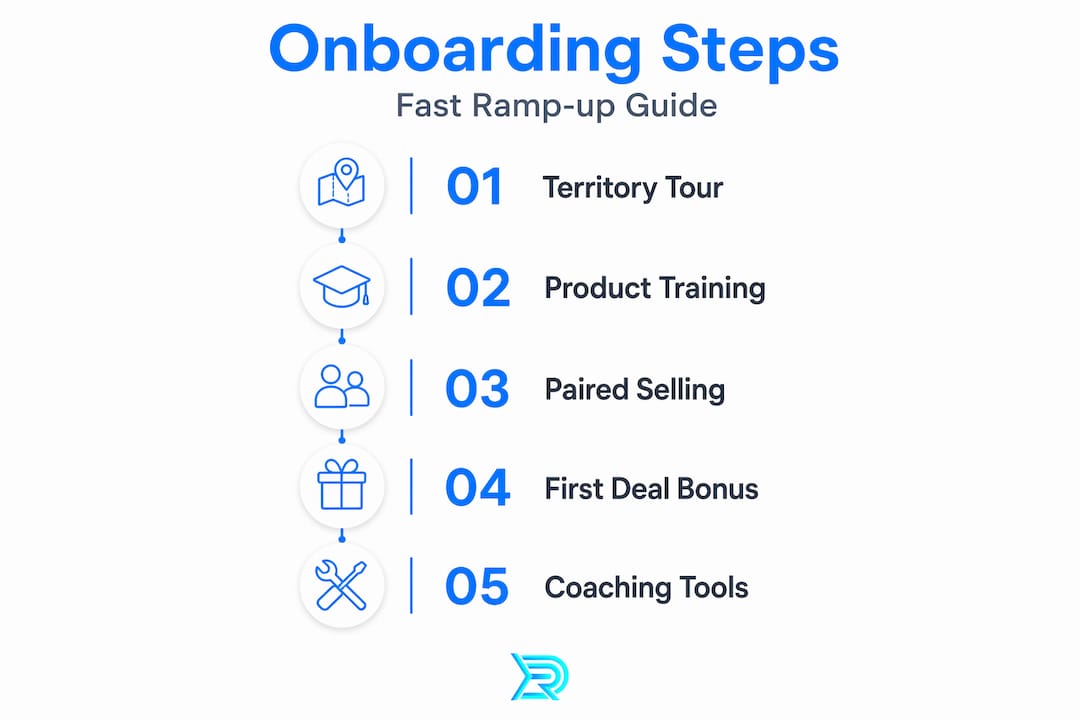
Start with territory familiarity and the sales logic behind your products. New reps need to understand not just what you sell, but why homeowners buy. Teach them how to identify storm-affected neighborhoods, how to read an adjuster report at a basic level, and how your quoting process works. Reps who understand the business close at higher rates than those who only know the script.
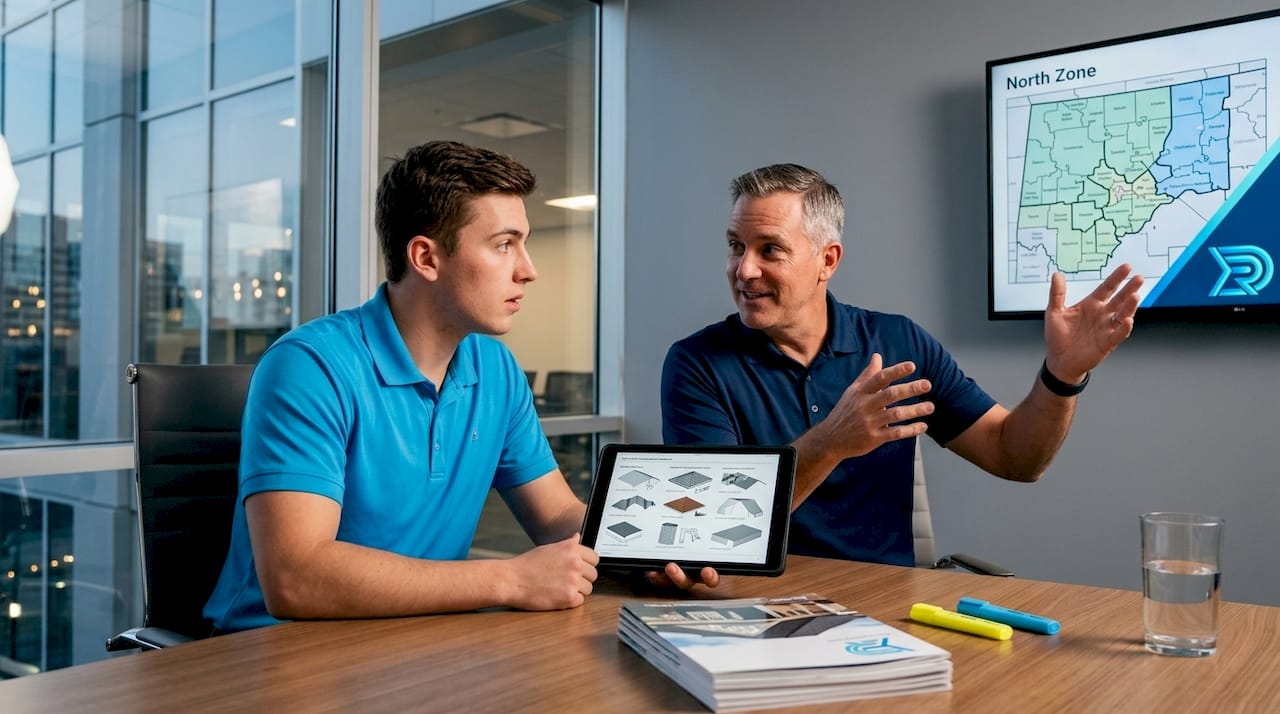
Pair every new hire with one of your experienced closers during the first two weeks. This is not shadowing. The new hire should be running conversations while the closer is available to step in on live calls. First-weekend wins are engineered by pre-assigning prime territories and having your best closer take live inbound calls alongside the new rep. Getting that first deal done fast matters more than most managers realize.
Reps who close a deal within their first two weekends retain at significantly higher rates. That first sale is not just about revenue. It is proof to the rep that the system works and that they can succeed in it. Build your onboarding calendar around engineering that moment.
Here is a structured 30-day onboarding benchmark to track new reps:
| Week | Focus Area | Key Milestone |
|---|---|---|
| Week 1 | Product knowledge, territory overview | Complete product quiz, first field ride-along |
| Week 2 | Canvassing with closer support | First homeowner conversations logged |
| Week 3 | Solo canvassing with check-ins | First estimate submitted |
| Week 4 | Close tracking and follow-up habits | First closed deal or strong pipeline created |
Pro Tip: Set a first-sale bonus of $250 to $500 specifically for closing within the first 30 days. It creates urgency without being punitive and gives new reps a concrete goal tied to real money.
Beyond the first deal, invest in call recording and logic-driven quoting tools that double as coaching aids. These tools let you review real conversations, identify where reps stall, and coach with specifics instead of generalities.
Common hiring mistakes that hurt roofing companies
The roofing industry repeats the same hiring errors at scale. Here is where most companies go wrong, and what to do instead.
- Relying on commission-only structures for brand-new reps. This sounds like low risk, but it drives your best candidates toward employers who offer a ramp draw. You end up with a revolving door of desperate or disengaged people.
- Hiring on gut feel rather than competency scores. Charisma is not a proxy for closing ability. If you cannot describe why you hired someone beyond “they seemed hungry,” your process is broken.
- Writing generic job ads with no filters. A job ad that could apply to any sales role attracts applicants who could apply to any sales role. Specificity in your ad saves hours of wasted interviewing.
- Skipping infrastructure investment. Scaling headcount without scaling infrastructure means your new reps are flying blind without proper tools, coaching, or territory management. Good reps will leave for companies that have their act together operationally.
- Ignoring the discovery framework in training. Top closers disqualify bad leads fast using a structured discovery process. If your training does not teach reps when to walk away from a bad prospect, you are wasting their time and yours.
“Sales hiring deserves the same strategic discipline as buying capital equipment. You would never purchase a $50,000 piece of equipment based on a 20-minute conversation and a good feeling.” — Industry Today
Measuring success and improving your process
The best roofing companies treat hiring as an ongoing system, not a one-time event. Once your reps are in the field, you need data to know if your process is working.
Track these metrics for every new hire through the first 90 days:
- Time to first close: How many days from start date to first deal closed.
- 90-day revenue contribution: Total sales volume attributed to the rep in their first quarter.
- Activity ratios: Doors knocked, appointments set, estimates submitted, and deals closed. These reveal where in the funnel each rep struggles.
- Deal size trends: Reps who sell comprehensive weather protection systems rather than just roofs can increase average deal size by 20%. Track whether your training is driving that behavior.
After the 90-day mark, collect feedback from both the manager and the rep. Ask the manager what gaps appeared in the hire’s competencies. Ask the rep what in the onboarding process felt unclear or under-supported. That two-sided feedback loop tells you where your recruitment process needs adjustment.
Use that data to update your competency rubric, refine your job ad copy, and adjust your onboarding schedule. Hiring is not a set-it-and-forget-it function. The companies that win at roofing sales treat it like a product they are always iterating.
What I have learned about hiring roofing sales reps
I have worked with enough roofing contractors to know that the hiring problem is almost never a talent shortage. It is an infrastructure shortage. Owners hire bodies and then wonder why performance is mediocre, but they have not built a system that gives a rep a real chance to succeed.
The contractors I have seen scale fastest did not just hire more people. They built something worth joining. Clear territories. Coaching support. Tools that reduce cognitive load. Reps who understand the sales funnel from first knock to signed contract close more and stay longer.
My honest take: if you want better reps, become a better operation first. The best closers have options. They will not stay in a chaotic environment where they are handed a clipboard and told to figure it out.
The referral piece also matters more than most owners admit. High-performing reps come from referral programs built into the culture, not from a job board refresh every six months. Pay your current reps to recruit, and give them a reason to brag about working for you.
— Results
Ready to fill your pipeline before your reps even knock a door?
Your sales reps can only close what they get in front of. If your lead flow depends entirely on door knocking and hope, you are leaving serious revenue on the table. At Resultsdigitalus, we build digital marketing systems specifically for roofing contractors that generate pre-qualified leads through SEO, Google Ads, and Meta Ads. Every campaign we run works exclusively for one roofing company per market.
We helped a Florida roofing company grow from 3 crews to 18 before they sold for $60 million. That kind of growth does not happen without consistent lead flow backing up a strong sales team. Whether you need roofing SEO that ranks or a website that converts visitors into booked appointments, Resultsdigitalus has the infrastructure to support your reps from the first click to the signed contract. No long-term contracts. Just results.
FAQ
How long does it take to hire a quality roofing sales rep?
Expect four to six weeks from posting to field-ready if you use a structured process with a phone screen, competency interview, and field audition. Rushing this timeline typically produces hires that quit within 60 days.
What qualities should I look for in a roofing sales rep?
Prioritize rejection resilience, urgency creation, structured follow-up habits, and comfort with physical canvassing. Charisma alone does not predict close rates in a field sales environment.
Should I offer a base salary or pure commission for new reps?
A draw against commission works best for new hires during ramp-up. Pure commission structures increase early dropout rates and push strong candidates toward competitors who offer more stability.
How do I reduce roofing sales rep turnover?
Engineer an early win by pairing new reps with experienced closers and assigning prime territories. Reps who close within 60 days retain at a 72% rate compared to 51% for those who take longer to ramp.
Where is the best place to find roofing sales professionals?
Industry-specific referral programs, roofing contractor Facebook groups, and trade-specific job boards outperform general platforms. Your current top reps are often your best recruiters if you incentivize them properly.
