
TL;DR:
- Effective roof repair marketing requires understanding your current metrics, setting specific goals, and tailoring assets to local clients. Managing campaigns step-by-step, measuring downstream results, and optimizing follow-up processes significantly improve lead conversion and revenue. Industry-specific tracking, rapid response times, and authentic visual proof are critical for sustained success in competitive local markets.
You’re spending money on ads, your phone isn’t ringing nearly enough, and when it does, half the callers aren’t even in your service area. Sound familiar? Roof repair marketing is one of the most competitive spaces in local advertising, and throwing budget at generic campaigns without a clear process is how contractors burn through cash with nothing to show for it. This guide walks you through a proven, step-by-step framework built specifically for local roof repair businesses, so you can generate more qualified calls, book more jobs, and stop guessing at what works.
Table of Contents
- Assess your current marketing and set targets
- Prepare effective roof repair marketing assets
- Launch and manage your roof repair campaign step by step
- Measure, optimize, and troubleshoot for better results
- The hard truth about roof repair marketing most guides miss
- Take the next step: Expert help for your roof repair marketing
- Frequently asked questions
Key Takeaways
| Point | Details |
|---|---|
| Start with clear goals | Set measurable targets for leads, appointments, and closed jobs before launching roof repair ads. |
| Use proven assets | Effective campaigns rely on strong landing pages, real project photos, clear offers, and call tracking. |
| Track real value | Go beyond cost per lead by measuring booked jobs and downstream revenue. |
| Optimize regularly | Evaluate and adjust your campaigns weekly to eliminate wasted spend and boost high-value results. |
| Segment by job type | Separate repair from replacement leads for better ad relevance and profitability. |
Assess your current marketing and set targets
Before launching new marketing efforts, you need clarity on where you stand. Too many contractors jump into Google Ads or Facebook without ever benchmarking their starting point, which means they have no way of knowing if anything actually improved.
Start by pulling data on your current cost per lead (CPL, the dollar amount you spend for each new inquiry), total leads per month, conversion rate from lead to booked job, and overall return on investment. If you don’t have this data yet, that’s your first problem to solve. Without it, you’re flying blind.
Here’s a quick comparison of the most common marketing channels roof repair contractors use and where each one tends to shine:
| Channel | Best for | Typical lead speed | Lead quality |
|---|---|---|---|
| Google Search Ads | Urgent repair calls | Fast (same day) | High |
| Local SEO | Long-term visibility | Slow (weeks/months) | High |
| Facebook Ads | Brand awareness and retargeting | Medium | Medium |
| Google Local Services Ads | Trust-based calls | Fast | High |
| Door-to-door canvassing | Storm damage areas | Immediate | Variable |
Notice that not every channel delivers the same type of lead. Digital marketing for roofing contractors involves knowing which channel matches your immediate goal versus your long-term growth strategy.
One critical mistake is optimizing only for the cheapest leads. As the data shows, benchmark-driven bidding can mislead you when you’re running mixed job types, because a low CPL on small patch jobs drags down your overall revenue per lead compared to full replacement inquiries.
Set monthly targets that go beyond just “more leads.” Aim for specific numbers: calls per week, booked appointments, and closed jobs by job type. Granular goals give you something real to optimize toward.
Key metrics to track from day one:
- Cost per lead by campaign and job type
- Lead-to-appointment conversion rate
- Appointment-to-closed-job rate
- Average job revenue per lead source
- Total marketing ROI by channel
Pro Tip: Segment your leads by job type from the very beginning. A call about a minor shingle repair and a call about storm damage restoration are completely different in value, and lumping them together in your tracking will give you misleading numbers that make your best campaigns look mediocre.
Prepare effective roof repair marketing assets
With clear goals set, you’ll want to gather the right tools and materials before you start building your campaign. Launching ads without solid assets in place is like sending a sales rep out without a business card or a pitch. The campaign might run, but it won’t perform.
Your marketing assets are everything a potential customer sees and interacts with before they decide to call you. The quality of those assets directly determines your conversion rate. Here’s a breakdown of what you need and what each asset does for your campaign:
| Asset | Purpose | Priority |
|---|---|---|
| Dedicated landing page | Converts ad clicks into calls and form fills | Critical |
| Before/after photos | Builds credibility and shows proof of work | High |
| Customer reviews/testimonials | Provides social proof and local trust | High |
| Clear service offer (e.g., “Free Inspection”) | Gives visitors a reason to act now | High |
| Call tracking number | Attributes calls to specific campaigns | Critical |
| Click-to-call button (mobile) | Reduces friction for mobile users | High |
| Certifications and licensing info | Establishes credibility | Medium |
Your landing page deserves special attention. This is not your homepage. It’s a focused, distraction-free page with one goal: get the visitor to call or submit a form. Look at real roof repair campaign examples to see how dedicated pages are structured differently from general service pages.
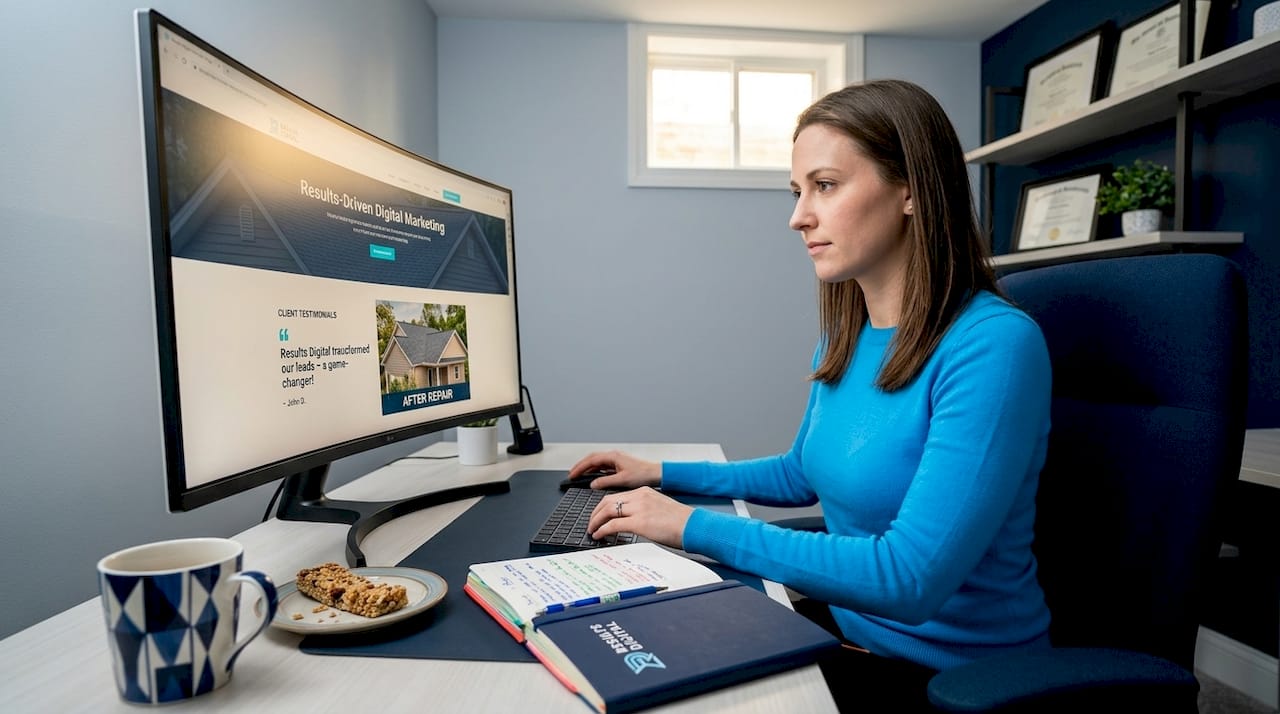
Before/after photos are one of your most powerful selling tools, and most contractors underuse them. Every completed roof repair job is a content opportunity. Take photos in good lighting, get the homeowner’s permission, and include a brief caption noting the location (city or neighborhood) and the type of repair. Local specificity matters enormously to someone who lives two streets away and is looking for a contractor they can trust.
The types of digital marketing for roofers that consistently drive results are built around tailoring your assets to attract local clients, which means your reviews, photos, certifications, and messaging all need to speak to the specific community you serve. A generic “we’re the best” claim does nothing. A five-star review from a neighbor down the street does everything.
For tracking, set up a unique call tracking number for each campaign source so you know exactly where every call came from. Pair that with form submission tracking in Google Analytics or your CRM. If you implement these roofing marketing tips from the start, you’ll have clean data to make confident decisions instead of educated guesses.
Minimum assets checklist before launching any paid campaign:
- Dedicated landing page with a single, clear call to action
- At least five before/after photo sets
- Ten or more recent Google reviews (ideally 4.5 stars or higher)
- Call tracking software connected to your ad platform
- Mobile-optimized design tested on iOS and Android
Launch and manage your roof repair campaign step by step
Once your assets are in place, you’re ready to go live and manage the campaign for results. This is where a lot of contractors get excited and rush, then wonder why the first two weeks produce garbage leads. Slow down and follow the process.
Here’s a clear numbered process for launching and managing your campaign:
- Define your targeting parameters. Set your geographic radius (typically 15 to 30 miles for roof repair), target homeowners ages 30 to 65, and limit your schedule to hours when you can actually answer the phone.
- Build your keyword list and add negative keywords immediately. Negative keywords are search terms you don’t want to trigger your ads, like “DIY,” “free,” “how to,” and competitor brand names. Skipping this step is one of the fastest ways to burn through budget on useless clicks.
- Write your ad copy around your strongest offer. Lead with urgency and specificity: “Emergency Roof Repairs in [City], Fast Response, Free Inspection” beats “Roof Repair Services Available.”
- Set your initial bids conservatively. Start at the lower end of the recommended bid range and collect data before scaling up. Aggressive bidding on day one without data often produces expensive, low-quality leads.
- Launch with at least two ad variations per ad group so you can start testing which message resonates better with your audience.
- Monitor search term reports daily for the first two weeks. This is where you’ll catch irrelevant queries draining your budget and find new negative keywords to add.
- Track lead quality, not just volume. Log every call: was it in your service area? Was it the right job type? Did it book?
- Adjust bids and budgets based on real lead quality data after two full weeks, not after two days.
“Optimizing for downstream close rate, not just cost per lead, is what separates profitable roof repair campaigns from expensive ones.” This is a principle backed by real campaign data showing that the cheapest leads often close at the lowest rates.
For more detail on structuring the full marketing process for roofing contractors, including how to integrate paid ads with organic strategies, it helps to see the whole picture before you launch.
Understanding what the customer journey looks like from a roof repair services perspective can also help you write more resonant ad copy and landing page content.
Pro Tip: Review your search term report every single day for the first 14 days of a new campaign. This is when you’ll catch the most wasted spend. Budget-burning irrelevant clicks cluster heavily in a campaign’s early days before the algorithm has enough data to self-correct.
Measure, optimize, and troubleshoot for better results
Launching is only the start. Ongoing measurement and problem-solving drive real gains. Most of the performance improvement in any campaign comes in the weeks and months after launch, not the first day.
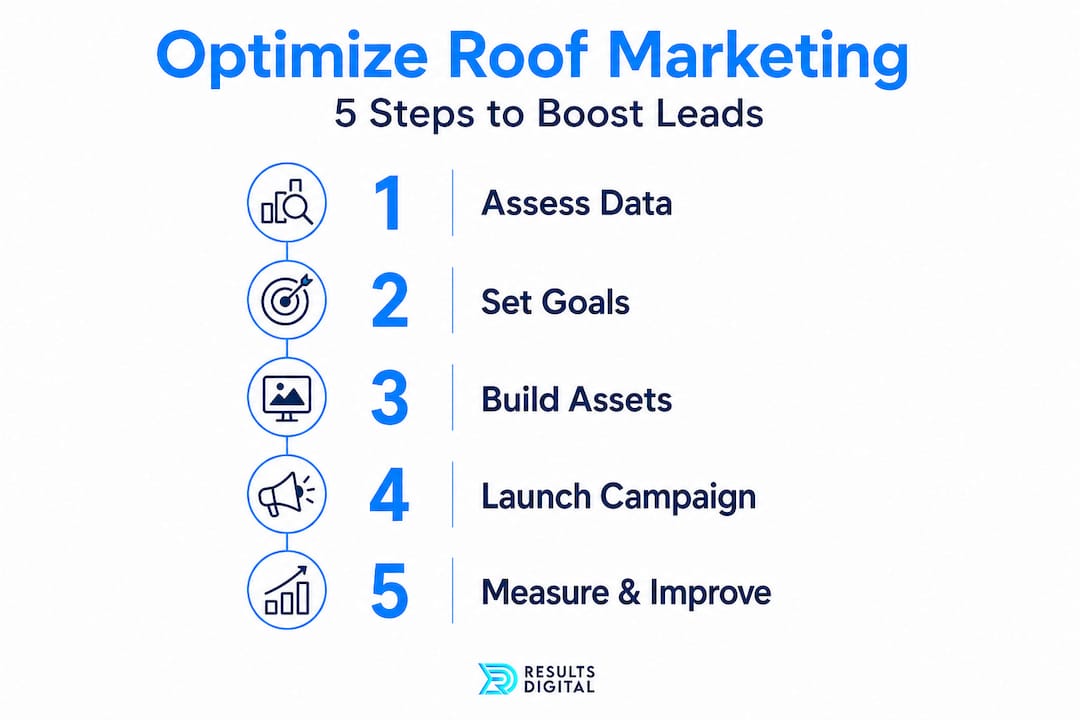
Here’s a before-and-after look at what campaign metrics typically look like when proper optimization is applied consistently:
| Metric | Before optimization | After optimization |
|---|---|---|
| Cost per lead | $120 | $72 |
| Lead-to-appointment rate | 28% | 51% |
| Appointment-to-close rate | 40% | 63% |
| Average revenue per lead | $680 | $1,450 |
| Wasted spend (irrelevant clicks) | 35% | 8% |
These improvements don’t happen by accident. They come from systematically reviewing data and fixing specific problems. The most important shift in mindset is understanding that downstream close rate matters far more than CPL when evaluating campaign health.
Common problems and fixes to look for:
- High impressions, low clicks: Your ad copy isn’t compelling enough. Rewrite the headline with a stronger offer or benefit.
- High clicks, low form fills or calls: Your landing page isn’t converting. Check load speed, clarity of the call to action, and mobile usability.
- Lots of calls, few booked jobs: Your follow-up process or sales pitch needs work, or you’re attracting the wrong job type.
- Rising CPL over time: Your Quality Score may be dropping. Review ad relevance and landing page alignment with your keywords.
Check your tracking setup regularly. It’s common for call tracking to break after website updates, and if you’re not getting attribution data, you can’t make smart decisions. Review your top roofing marketing strategies periodically to benchmark your own approach against what’s working in the broader market.
Respond to leads within five minutes whenever possible. Research consistently shows that response speed is one of the top predictors of whether a lead converts to a booked job. A lead that waits 24 hours is often a lead that already called your competitor.
The hard truth about roof repair marketing most guides miss
Here’s what most marketing guides won’t tell you: optimizing your ads is the easy part. The real performance gap between contractors who win and those who struggle comes after the click.
We’ve worked with roofing contractors who had solid campaigns with reasonable CPLs, but their close rate on those leads was half of what it should have been. The ads weren’t the problem. The follow-up was. Calls were going to voicemail. Estimates were being delayed by two or three days. No one was sending a recap email or follow-up text. The marketing was working. The sales process was leaking revenue.
This is why we always push contractors to bring their closed-job data into every marketing review. Not just how many calls you got, but which of those calls turned into jobs, and what those jobs were worth. Lead value, not just cost, has to drive every campaign decision.
Industry averages for CPL or conversion rate are useful as reference points, but they’re dangerous as targets. A contractor targeting high-value commercial repairs in an affluent suburb will have a completely different cost structure than one chasing storm damage in a rural county. Benchmarks built from blended national data often have almost nothing to do with your specific market, your service mix, or your team’s capacity.
The contractors who consistently dominate their local market treat marketing as a closed-loop system. Leads in, jobs tracked, revenue attributed, data reviewed. If your SEO for roofing contractors is generating calls but your team isn’t logging outcomes, you’re making decisions in the dark. Fix the tracking before you fix the ads.
Take the next step: Expert help for your roof repair marketing
For contractors who want faster traction or help implementing these systems, expert support is available. Trial and error in paid advertising is expensive, and every month of suboptimal campaigns is revenue you’re not capturing.
Results Digital works exclusively with roofing and exterior contractors, which means every strategy we build is designed for your industry, your job types, and your market. We partner with only one contractor per market, so you’re never competing against one of our own clients. Whether you’re looking for a full-service campaign or want to understand how digital marketing for service-based companies can be structured for your business, we’re ready to help. Explore our lead generation tips for trades or reach out directly to talk strategy with a team that knows roofing inside and out.
Frequently asked questions
What is the most effective digital channel for roof repair leads?
Targeted Google Search Ads are the most effective for generating qualified roof repair leads because they reach homeowners at the exact moment they need urgent service, which is why roofing PPC data consistently shows higher close rates from search intent traffic than from social media campaigns.
How should I measure marketing success beyond cost per lead?
Track downstream metrics like booked jobs, closed deals, and actual revenue from each channel, because true campaign ROI only becomes visible when you connect ad spend directly to revenue generated, not just leads counted.
How quickly should I follow up with roof repair leads?
Contact new roof repair leads within five minutes of their inquiry. Response speed is one of the single biggest predictors of whether a potential customer books with you or calls the next contractor on the list.
What’s an easy win to boost roof repair campaign results?
Use genuine before-and-after roof repair photos combined with local customer testimonials on your landing page and ads. Authentic visual proof from recognizable neighborhoods builds trust faster than any headline you could write.
Should I target all types of roofing jobs the same way?
No. Segment your campaigns for repairs versus replacements so your messaging, bidding, and budget allocation reflect the actual value of each job type. Blending job types together in a single campaign masks your true performance and makes it nearly impossible to optimize for your highest-revenue work.
