
Add an account-level negative keyword list of 50 or more roofing-specific terms before you spend another dollar. Block DIY searches, job hunters, suppliers, and “cheap” or “free” queries right out of the gate. This single move, applied through your Shared Library → Negative Keyword Lists in Google Ads, catches the traffic that drains budget across every campaign type at once, rather than patching each campaign one at a time.
Start with exact and phrase match negatives for the biggest offenders. Here’s the shortlist to add in the next 30 minutes:
- how to install a roof
- roofing jobs
- roofing careers
- free roof inspection
- cheap roofers near me
- roofing supplies
- gutter cleaning
- solar panel installation
- roofing tools for rent
- diy roof repair
- roof shingles wholesale
- roofing apprenticeship
Next 30 minutes, in order:
- Paste the list above into a shared negative list and apply it to every active campaign.
- Exclude zip codes outside your service radius and set location targeting to “Presence,” not “Presence or Interest.”
- Pull your Search Terms report from the last 30 days and scan for anything you missed.
Key Takeaways
Roofing accounts that pair an account-level foundational negative list with weekly search term reviews consistently spend less on junk clicks and generate higher-quality leads.
| Point | Details |
|---|---|
| Start with a foundational list | Load 50 to 100 account-level negatives covering DIY, jobs, supplies, and rentals before launch. |
| Match match type to risk | Use phrase match for most terms; reserve exact match for narrow, high-risk phrases like job titles. |
| Fix location targeting first | Set location options to “Presence” and exclude zip codes outside your drive-time radius. |
| Pair negatives with landing pages | Prequalify remaining traffic with clear service scope, pricing cues, and a short lead form. |
| Review search terms weekly | Add new negatives every Monday and audit the full list monthly to catch drift. |
Table of Contents
- Why Roofing Negative Keywords Change the Economics of Your Google Ads
- Which Negative Keywords Should Every Roofing Campaign Block?
- How Do Negative Match Types Work in Roofing Campaigns?
- How Do You Stop Paying for Out-of-Area Roofing Clicks?
- How Do Landing Pages Work With Negative Keywords to Prequalify Leads?
- How Do You Build and Maintain a Living Negative Keyword List?
- Ready-to-Import Negative Keyword Lists for Roofing Campaigns
- An Agency Perspective on Roofing Negative Keywords
- Stop Wasting Ad Spend on the Wrong Roofing Traffic
- Frequently Asked Questions About Roofing Negative Keywords
- Sources
Why Roofing Negative Keywords Change the Economics of Your Google Ads
Negative keywords are the difference between paying for clicks and paying for leads. Every roofing search query falls somewhere on an intent ladder: pure research at the bottom, job seekers and suppliers in the middle, and ready-to-hire homeowners at the top. Roofing negative keywords exist to keep your budget at the top of that ladder.
Most roofing accounts leak money in the same four spots. Broad match keywords pull in tangential queries your ad group never intended to target. Performance Max campaigns, which rely on automated signals instead of explicit keyword lists, often serve ads against DIY or job-search intent because the algorithm optimizes for volume, not fit. Landing pages get mismatched traffic when a generic “roof repair” ad sends a commercial property manager to a residential shingle page. And out-of-area clicks pile up when location settings default to interest-based targeting instead of physical presence.
One industry audit found that roofing accounts applying a disciplined negative keyword strategy can save several hundred to over a thousand dollars a month on mid-sized budgets, according to PipelineOn’s roofing Google Ads guide. That’s not a one-time cleanup. It’s the ongoing return on treating your Search Terms report like a weekly audit, not a quarterly afterthought.
The fix starts with understanding where negatives fit in your account structure, which categories matter most for roofing specifically, and how match types determine whether a negative blocks too much or too little.
Which Negative Keywords Should Every Roofing Campaign Block?
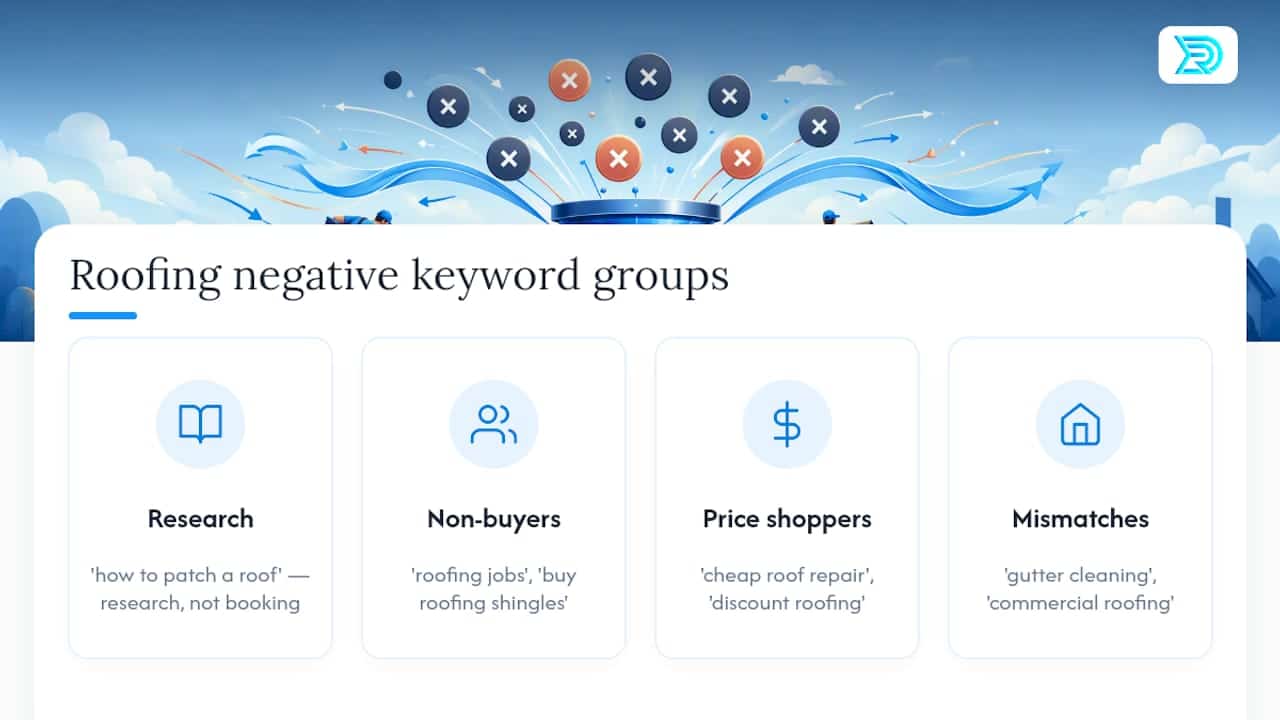
Every roofing account should block eight recurring categories of low-intent traffic: DIY and education searches, job seekers, suppliers, price shoppers, adjacent trades, rental and tool queries, commercial-only or residential-only mismatches, and reputation research. Each group carries its own edge cases worth understanding before you block on autopilot.
DIY and education queries. Homeowners searching “how to patch a roof” or “roof repair tutorial” are almost never ready to hire. Research on DIY roof repair confirms this segment skews heavily toward research, not booking. Add as phrase match: “how to repair a roof,” “diy roofing,” “roof repair steps,” “roofing tutorial,” “roof maintenance tips,” “how to install shingles.”
Jobs and hiring. “Roofing jobs near me,” “roofer salary,” “roofing apprenticeship,” “hiring roofers” — these terms come from job seekers, not customers. Block as exact match: [roofing jobs], [roofer salary], [roofing company hiring], [apprentice roofer], [roofing crew jobs].
Materials and supplies. Contractors and DIYers searching for wholesale shingles, underlayment, or roofing nails aren’t looking for installation. Add: “roofing supplies wholesale,” “buy roofing shingles,” “roofing nails bulk,” “roofing membrane suppliers,” “shingle manufacturer.”
Price shoppers. “Cheap roofers,” “discount roofing,” and “lowest price roof replacement” flag budget-first searchers who rarely convert for contractors who don’t compete on price alone. Industry reporting on cheap roofing risks notes this segment often gets burned by underqualified providers, which is exactly the reputation risk you don’t want your ads near. Add: “cheap roof repair,” “discount roofing contractor,” “lowest price roofing,” “budget roofers.”
Adjacent trades. “Gutter cleaning,” “solar panel installation,” and “siding repair” pull traffic if you don’t offer those services. If you’re a roofing-only shop, block them. If you also do siding or gutters, move these to campaign-level negatives instead of account-level, so you can run separate campaigns for each service line.
Rentals and tools. “Roofing tool rental,” “shingle removal tool for rent,” “roof rake rental” indicate someone doing the work themselves, not hiring it out.
Commercial versus residential mismatches. If you only serve homeowners, block “commercial roofing contractor,” “flat roof commercial,” and “industrial roofing.” If you only serve commercial clients, reverse the logic and block residential terms instead.
Reputation and research searches. Queries like “roof repair vs replacement” indicate someone comparing options, not ready to book. RoofSimple’s comparison guide is a good example of the exact content this searcher wants, which tells you they’re not yet at the quote stage.
Account-level placement works best for universal exclusions: DIY, jobs, supplies, rentals. Campaign or ad group level makes more sense for anything conditional, like adjacent trades you sometimes offer or commercial/residential splits that vary by campaign.
Pro Tip: Don’t blanket-block “free” without checking your own offer first. If you run a “free inspection” promotion, negating “free” account-wide will silence the exact ad you’re trying to serve. Handle it at the campaign level instead.
How Do Negative Match Types Work in Roofing Campaigns?
Start with account-level phrase and exact negatives for foundational terms everyone should block, then layer campaign or ad group negatives for anything local or service-specific. Google’s own partner documentation confirms negatives can be applied at both account and campaign level, which is exactly why the split matters. Foundational blocks go wide. Situational blocks stay narrow.
Three match types govern how negatives behave:
- Broad match negatives block any query containing all the words in your negative, regardless of order. Least precise, easiest to misfire.
- Phrase match negatives block queries containing your exact phrase in that word order, with extra words allowed before or after. This is the workhorse for most roofing negatives.
- Exact match negatives block only the precise query you list, word for word. Use this for narrow terms where you need surgical precision, like job-title searches.
Implementation checklist:
- Build your foundational list in Shared Library → Negative Keyword Lists and apply it to every campaign at launch.
- If you run seasonal storm-response campaigns, pause them between events rather than deleting them, and re-check negatives before reactivating.
- Performance Max campaigns accept account-level negatives but have historically limited keyword-level control, so lean harder on audience signals and asset group structure to compensate.
- Import via Google Ads Editor for bulk changes across multiple campaigns at once.
The most common pitfall is over-blocking with broad match negatives. Negating the broad term “roof” would block legitimate queries like “roof replacement quote,” since broad match negatives catch any query containing that root word alongside others. Stick to phrase and exact match for anything that touches a word your real customers might also use.
How Do You Stop Paying for Out-of-Area Roofing Clicks?
Exclude zip codes outside your service radius and switch location targeting from “Presence or Interest” to “Presence” alone. This single setting change stops Google from serving your ads to people who searched for your city but live somewhere you’d never send a crew.
The setup takes three steps:
- Compile a list of zip codes within your actual drive-time radius, not just a circle on a map. Traffic and crew logistics matter more than straight-line distance.
- Add every zip code outside that radius as a location exclusion at the campaign level.
- Set location options to target people whose location matches your service area, excluding those who show interest without being physically present.
For multi-city operators, city-level modifiers in ad copy (“Serving Dallas and Fort Worth”) work alongside geo exclusions to reinforce the message. Practitioner guidance consistently points to zip-level exclusion as the single fastest fix for local budget leaks, since it addresses the problem at the targeting layer instead of chasing it keyword by keyword.
Watch call duration, conversion location, and click-to-book distance in your reporting. A pattern of short calls or bookings from addresses near the edge of your exclusion zone usually means your radius needs tightening, not your keyword list.

How Do Landing Pages Work With Negative Keywords to Prequalify Leads?
Negative keywords stop irrelevant searchers from clicking. Landing pages and ad copy handle everyone who gets through, filtering out the remaining low-intent traffic before it becomes a wasted phone call.
A landing page built to prequalify includes:
- A clear statement of service scope (residential only, specific roofing systems, no repairs under a certain size)
- Pricing cues, even ranges, so budget mismatches self-select out before they call
- An explicit service-area statement matching your geo-targeted campaigns
- A short form, four fields maximum, plus a visible click-to-call number
- Licensing, insurance, and review-count trust signals above the fold
Ad copy should carry the same filters. Callouts like “Residential shingle replacement only,” “Licensed & insured,” and “Serving [service area]” repel the wrong click before it happens. Track phone clicks, form starts, and scroll depth as micro-conversions. A page that gets clicks but no form starts usually has a mismatch between what the ad promised and what the page delivers. Our guide on PPC for roofers covers this pairing in more depth.
How Do You Build and Maintain a Living Negative Keyword List?
Negative keyword management is proactive account defense, not a one-time setup task. Treat it like a firewall: it needs regular updates as new junk traffic patterns emerge, or the account drifts back toward waste within weeks.
Here’s the cadence that keeps a roofing account clean over time:
- Launch week: build the account-level master negative list with 50 to 100 foundational terms and apply it before your first campaign goes live.
- Daily, weeks one through four: review the Search Terms report daily during the learning phase. Riverstone Marketing Solutions’ roofing strategy guide recommends adding 15 to 30 negatives in this window alone, since early data reveals patterns you can’t predict from a template list.
- Weekly, ongoing: scan search terms every Monday, add anything new, and note the reason for each addition.
- Monthly: audit which negatives have actually blocked impressions versus which have gone quiet, and check for overlap or conflicts between lists.
- Quarterly: prune negatives that no longer apply, especially after service-area or offering changes.
Track it in a spreadsheet with these fields: term, first-seen date, match type, level applied (account, campaign, or ad group), reason for adding, and last-reviewed date. This turns your negative list into an audit trail instead of a black box, which matters when you’re explaining budget decisions to a business owner or a client.
Pro Tip: Launch every new roofing account with a shared negative list of 50 to 100 foundational terms already loaded, before the first click hits. Karooya’s account-level negative keyword guide backs this exact approach as standard practice for preventing leakage during the learning phase, when Google’s algorithm is still figuring out who to show your ads to.
Ready-to-Import Negative Keyword Lists for Roofing Campaigns
Import these groups through Tools → Shared Library → Negative Keyword Lists, or paste them directly into Google Ads Editor for bulk upload across campaigns. Use phrase match for most entries below; switch to exact match only for short, high-risk terms like job titles.
Account-level foundational list (apply everywhere):
- diy roof repair
- roofing jobs
- free roof inspection
- roofing supplies
- roofer salary
- roofing apprenticeship
- roofing tool rental
- cheap roofing
Jobs and hiring:
- roofing careers
- roofing crew hiring
- apprentice roofer
- roofing company jobs near me
DIY and education:
- how to install a roof
- roof repair tutorial
- roofing for beginners
- diy roof maintenance
Materials and supplies:
- roofing shingles wholesale
- buy roofing materials
- roofing nails bulk
- shingle manufacturer
Adjacent trades (skip if you offer these services):
- gutter cleaning
- solar panel installation
- siding repair near me
Price shoppers:
- cheap roofers near me
- lowest price roof replacement
- discount roofing contractor
Reputation and research:
- roof repair vs replacement
- roofing contractor reviews reddit
- is roofing a scam
For geo exclusions, build a separate campaign-level list of the specific zip codes or cities outside your service radius. This isn’t a keyword list. It lives in campaign settings under location exclusions.
After importing, check the Negative Keyword Conflicts report inside Google Ads to catch any negative accidentally blocking a keyword you’re actively bidding on. Over-blocking is just as costly as under-blocking. Give it 48 hours post-import, then compare impression volume against the prior week to confirm the list is doing its job without silencing legitimate traffic.
An Agency Perspective on Roofing Negative Keywords
What consistently works for roofing clients isn’t a static list. It’s the discipline of reviewing search terms weekly and treating every new negative as data, not busywork. Because we work exclusively with one roofing company per market, every negative list we build reflects that specific contractor’s service area and offer, not a generic template. Check our digital marketing services for roofers for how this plays out across active campaigns.
Stop Wasting Ad Spend on the Wrong Roofing Traffic
Negative keywords work because they filter out research, job-search, and price-shopping intent before it costs you a dollar, and disciplined weekly review keeps that filter sharp as new junk traffic emerges. A one-time list catches today’s waste. Only an ongoing cadence catches next month’s.
If your account has been running for a while without a documented negative keyword review, that’s the fastest place to find hidden budget leaks. Resultsdigitalus builds and manages Google Ads campaigns exclusively for one roofing contractor per market, which means your negative list gets built around your actual service area and offer, not a copy-paste template shared across competitors. No long-term contracts. We earn the relationship every month by keeping your cost per lead honest.
Frequently Asked Questions About Roofing Negative Keywords
What are the most important negative keywords for roofing PPC campaigns?
The highest-impact terms block DIY searches, job seekers, suppliers, and “free” or “cheap” modifiers. These four categories account for the bulk of wasted clicks in most roofing accounts.
Should negative keywords be applied at the account or campaign level?
Foundational, universal exclusions like DIY and job-search terms belong at the account level. Situational exclusions, like adjacent trades you sometimes offer, work better at the campaign or ad group level.
How often should I update my roofing negative keyword list?
Review the Search Terms report weekly, add new negatives every Monday, and run a full audit monthly. During the first month of a new campaign, daily reviews catch patterns a static list misses.
Can negative keywords block legitimate customers by mistake?
Yes, especially with broad match negatives or overly aggressive blanket terms like “free” when you actually offer free inspections. Test after every import and check the Negative Keyword Conflicts report.
Do Performance Max campaigns support negative keywords for roofing?
Account-level negative lists apply to Performance Max, but keyword-level control has historically been more limited than in standard search campaigns. Lean on audience signals and asset groups to reinforce targeting.
Sources
- Google Partners — agency resources and documentation
- Account-level negative keyword list for Google Ads
- Roof repair vs replacement
