
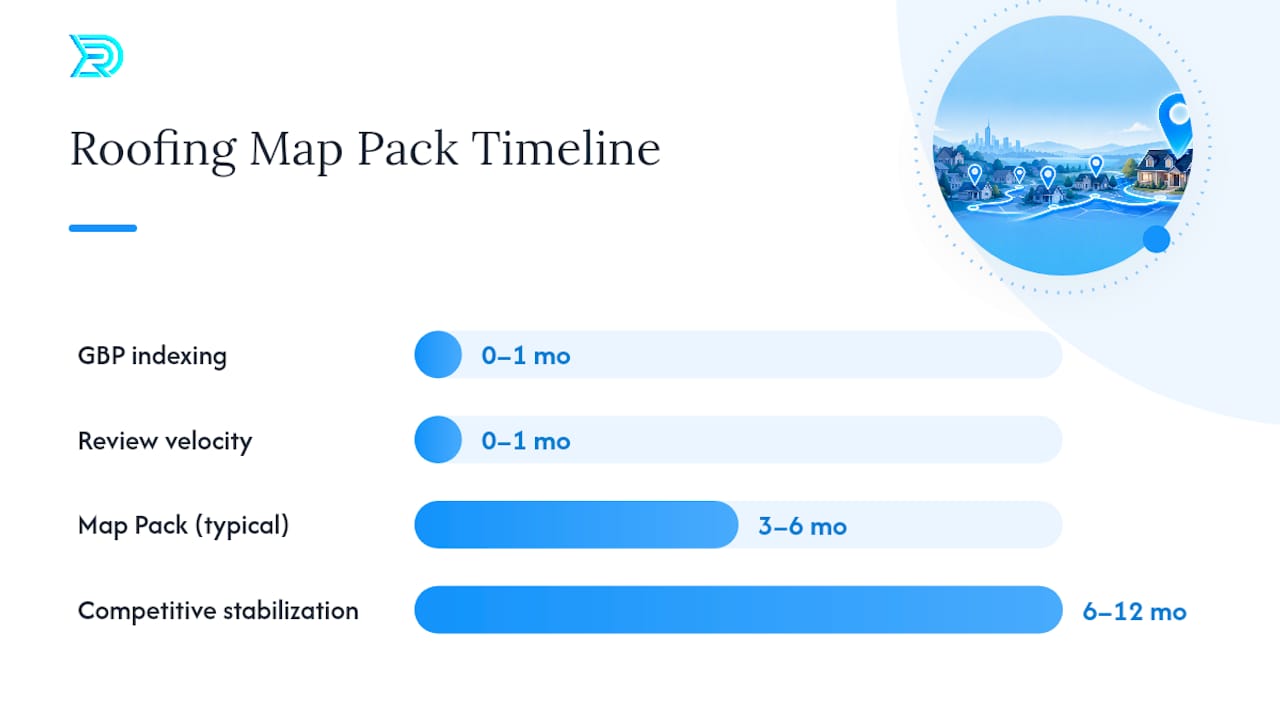
If you want to move up in the Map Pack, do these five things in order: complete every field in your Google Business Profile, fix every mismatched name-address-phone listing across the web, build a review system that generates fresh feedback every week, publish city-specific service pages on your website, and get your phones answered fast enough to win Local Service Ads placement. Do all five consistently and you’ll typically see measurable Map Pack movement in 3 to 6 months, with more competitive metros taking closer to 6 to 12 months.
Here’s your week-one checklist:
- Audit and complete your Google Business Profile. Fill every field: categories, services, hours, attributes, service area, and business description.
- Run a NAP consistency check. Search your business name across Google, Yelp, Angi, and the Better Business Bureau to catch mismatched phone numbers or old addresses.
- Launch a review request workflow. Text every completed job a review link within two hours of the crew leaving the site.
- Publish two city or service pages. Start with your two highest-volume storm markets or neighborhoods.
- Set your service-area radius. Cap it at a realistic 45 to 60 minute drive time instead of claiming an entire region.
Pro Tip: Don’t try to do all five at once if you’re a one-person marketing department. GBP completion and NAP cleanup come first because they take days, not months, and they’re the foundation everything else builds on.
Here’s the honest timeline. In the first 0 to 30 days, expect your GBP to become fully indexed and your review velocity to pick up, but don’t expect rank movement yet. By 3 to 6 months, if you’ve kept up citations, reviews, and content, you should see Map Pack appearances for your core service-city combinations, a pattern consistent with how combined GBP, citation, and review efforts typically play out. By 6 to 12 months, competitive metro rankings for high-value terms like “roof replacement” plus your city name should stabilize if you’ve kept the work consistent. If you’d rather hand this whole process to a team that does it daily for roofing companies specifically, that option exists further down this guide.
Key Takeaways
Winning roofing google maps ranking comes down to consistent execution across GBP completeness, review velocity, citation accuracy, and local content, sustained over 3 to 6 months rather than fixed once and forgotten.
| Point | Details |
|---|---|
| Complete your GBP first | Fill every category, service, and attribute field before touching any other tactic. |
| Build a review system | Ask in person immediately after the job and follow up by text within 2 hours. |
| Match your website to your GBP | Publish a dedicated page for every city listed in your service area. |
| Fix responsiveness for LSAs | Answer calls within 3 rings and track missed-call rate weekly. |
| Hand off execution if needed | Resultsdigitalus manages GBP, reviews, city pages, and ads exclusively for one roofer per market. |
Table of Contents
- Why Roofing Google Maps Ranking Drives Better Leads Than Ads Alone
- Which Google Business Profile Fields Actually Move Your Ranking?
- How Many Reviews Do You Need to Win the Map Pack?
- What Photos and Google Posts Actually Boost Map Pack Relevance?
- Do City and Service Pages on Your Website Actually Help Your Map Pack Ranking?
- How Do You Fix Inconsistent Business Listings Across the Web?
- Local Service Ads or Organic Map Pack: Which Should You Invest In First?
- What KPIs Prove Your Google Maps Ranking Is Actually Improving?
- What Roofing-Specific Mistakes Get Your Google Maps Listing Suppressed?
- Does Answering Homeowner Questions on Your Profile Improve Rankings?
- How Results Digital Helps Roofers Win the Map Pack
- Why Steady GBP Work Beats Ad-Only Growth Every Time
- Essential Tools for Tracking Your Local Roofing Rankings
- Frequently Asked Questions
- Sources
Why Roofing Google Maps Ranking Drives Better Leads Than Ads Alone
The Map Pack is the three-listing block that shows up above organic results when someone searches “roofer near me” or “roof repair [city].” It’s the first thing a homeowner sees on their phone after a storm, and it’s built almost entirely on data you control: your profile, your reviews, and your local footprint.
Google itself confirms that local rankings come down to three factors: relevance, distance, and prominence. Distance is out of your hands, but relevance and prominence are exactly what a complete, active, well-reviewed profile builds. That’s the entire game for roofing google maps ranking: control what you can control, and do it better than the three competitors sitting in that Map Pack box.
The numbers back up why this matters more for roofers than almost any other local trade:
- Between 91% and 95% of consumers read online reviews before choosing a local contractor, and a roof is a five-figure decision most homeowners make once a decade.
- A majority of mobile local searches lead to an in-person visit or call within a single day, which means Map Pack visibility converts almost immediately into calls.
- Search volume for storm-related terms spikes 3 to 5 times normal levels after hail or wind events, and homeowners searching in that window aren’t comparison shopping. They’re calling whoever shows up first.
- Storm-damage and insurance-claim keywords convert at 2 to 3 times the rate of generic “roofing” searches, which makes those specific terms worth targeting on purpose rather than hoping they show up.
Think of it as three layers stacking on top of each other. Your GBP is the storefront Google shows first. Your website is the proof homeowners check before they call. Your citations and reviews are the trust signal Google uses to decide whether your storefront deserves the top spot. Weak any one layer and the other two can’t fully compensate.
Which Google Business Profile Fields Actually Move Your Ranking?
Your GBP isn’t a set-it-and-forget-it directory listing. It’s the single highest-leverage asset in your entire local SEO effort, and most roofing companies leave half of it blank.
Categories. Your primary category should be “Roofing Contractor,” full stop. Don’t get clever and choose “General Contractor” or “Home Improvement” hoping for broader reach. It dilutes relevance for the exact searches you want to win. Add secondary categories only if they’re genuinely accurate: “Gutter Cleaning Service” if you offer it, “Siding Contractor” if you do both trades.
Services. List every service as its own line item, not a paragraph. Structure them the way homeowners search:
- Roof replacement
- Storm damage repair
- Insurance claim assistance
- Roof inspection
- Emergency tarping
- Gutter installation (if applicable)
Business description, hours, and attributes. Write the 750-character description around what you actually do and where, mentioning your primary service cities naturally rather than stuffing keywords. Set your hours accurately, and turn on the “24-hour” or “emergency service” attribute if you actually offer it. Set your service area to a realistic radius, not a full state.
Here’s the sequence for building this out properly:
- Claim and verify your profile if you haven’t already.
- Set primary category, then add up to 3 relevant secondary categories.
- Add every service you offer as an individual line item.
- Write your business description mentioning 2 to 3 core service cities.
- Set hours and enable accurate attributes (emergency service, free estimates, women-owned, veteran-owned).
- Set your service area radius.
- Upload your first batch of project photos.
Pro Tip: Google’s local algorithm treats roofing as a high-risk category prone to spam, largely because of storm chasers who blanket entire regions with fake service areas after a hail event. Keep your service radius to a credible 45 to 60 minute drive from your physical location. A profile that suddenly claims coverage across three states after a hailstorm is one of the fastest ways to trigger a suppression review.
Media matters here too. Upload real project photos weekly, not stock images. A profile with 40 real photos of actual jobs outperforms one with 5 generic stock shots almost every time, because Google and homeowners can both tell the difference.

How Many Reviews Do You Need to Win the Map Pack?
Review volume and recency are two of the most direct prominence signals Google has, and for roofing specifically, they matter more than almost any other trade because the purchase decision is so high-stakes.
Set concrete targets instead of vague goals. Aim for your first 80 reviews as a baseline credibility threshold, then push toward 200 in competitive metro markets where three or four established roofers are already sitting in the Map Pack. That range aligns with what practitioners have found actually moves the needle for local roofing visibility.
The timing of the ask matters as much as the volume. In-person requests made immediately after a job produce far higher response rates than an automated email sent three days later when the homeowner has moved on mentally. Build this into your crew’s closeout routine:
- Have the crew lead ask verbally before leaving: “If you’re happy with the work, a Google review helps us a ton.”
- Send a text within two hours with a direct review link, not a generic homepage.
- Follow up once, three days later, if there’s no response. Don’t follow up twice.
- Mention the service city and type of work in your ask so customers naturally include it (“Thanks for choosing us for your roof replacement in [city]!”).
Responding matters just as much as collecting. Reply to every review within 24 hours. For positive reviews, thank the customer by name and reinforce the service type. For negative reviews, respond calmly, acknowledge the specific issue, and offer to resolve it offline. A fast, professional response to a bad review often does more for your credibility than the five-star reviews around it, because prospective customers read how you handle conflict.
Track review velocity (how many you’re getting per month) and review freshness (how recent your most recent five reviews are) as separate metrics. A profile with 150 reviews but nothing in the last four months looks stale to both Google and homeowners scrolling through it.
What Photos and Google Posts Actually Boost Map Pack Relevance?
A GBP that hasn’t been touched in three months signals inactivity, and inactivity is the opposite of prominence. The fix is a repeatable content cadence, not a one-time upload sprint.
For photos and video, prioritize real job documentation over polished marketing shots:
- Before-and-after shots of the same roof section, shot from the same angle.
- Close-ups of actual storm damage (hail bruising, missing shingles, flashing failures) that double as educational content for insurance-claim searchers.
- Crew-at-work shots that show scale and professionalism.
- Short vertical video clips (15 to 30 seconds) of tear-off or installation, since Google increasingly surfaces video in local results.
Name your image files descriptively before uploading (roof-replacement-[city]-2026.jpg beats IMG_4821.jpg) and keep location data intact when your camera app supports it, since it reinforces the geographic relevance Google is already weighing.
Post at least once a week, and treat Google Posts like a mini announcement board rather than a second Facebook feed. High-converting post types for roofers include:
- Storm alerts offering free inspections (“Hail came through [city] last night? We’re booking free inspections through Friday.”)
- Insurance claim assistance reminders during active storm season.
- Recently completed project spotlights with a direct link to request a quote.
- Seasonal maintenance reminders (gutter cleaning before fall, inspection before winter).
Mention your service city by name in post copy and photo descriptions wherever it fits naturally. It won’t feel like keyword stuffing if it’s true: “Finished this full tear-off and replacement in Round Rock this week.” Organize your photo uploads into named albums by project or month so restocking new work takes minutes, not an afternoon of scrolling through your camera roll.
Do City and Service Pages on Your Website Actually Help Your Map Pack Ranking?
Yes, and this is where most roofing companies’ local SEO efforts fall apart. Your GBP can be flawless, but if your website doesn’t back it up with matching, keyword-relevant content, you’re leaving relevance signals on the table.
Build a dedicated page for every city or service area you claim on your GBP, not one generic “service area” page listing twelve towns in a bullet list. A strong city page includes a clear H1 naming the city and service (“Roof Replacement in [City]”), a short section on local evidence (storm history, common roof types in the area, recent project examples), photos from jobs in that specific city, and a clear call-to-action for a free inspection or quote. If you cover both cities and distinct services, build separate pages for each combination where search volume justifies it, rather than trying to cram everything onto one page.
Add structured data to reinforce what your pages already say. Implement LocalBusiness schema on your homepage, RoofingContractor or service-specific schema on your service pages, FAQPage schema anywhere you answer common questions, and AggregateRating schema if you’re pulling in review data legitimately. This helps Google confirm what your business actually does and where, closing the loop between your GBP claims and your site’s content.
Technical basics still matter here. Pages need to load fast on mobile, since most local searches happen on a phone in the moments right after a storm or a leak. Embed a map showing your service area on your contact page, and link every city page back to your homepage and to each other so Google can crawl your entire service footprint easily.
Pro Tip: Your GBP service area and your website’s city pages need to match exactly. If your profile claims 12 cities but your site only has content for 3, that gap tells Google your prominence claim is thinner than it looks, which can quietly cap how far your listing rises. Building a matched set of city pages is one of the fastest ways to close that gap, and it’s a core piece of structured local SEO work built specifically around roofing search patterns.
How Do You Fix Inconsistent Business Listings Across the Web?
Inconsistent NAP data (your business name, address, and phone number) across directories is one of the most common, and most fixable, ranking problems in roofing local SEO. Search Engine Journal identifies this as one of the fastest and highest-impact cleanups a local business can run.
Here’s the audit process:
- Search your exact business name in Google, then check the top 10 directory results that surface.
- List every instance of your name, address, and phone number you find, including old addresses from before a move.
- Flag every mismatch: abbreviated street names, old suite numbers, tracking phone numbers instead of your main line.
- Claim and correct each listing directly, starting with the highest-authority directories.
- Set a recurring 90-day calendar reminder to recheck, since directories sometimes revert data during their own updates.
Prioritize these directories first, since they carry the most weight for contractor businesses: Google Business Profile, the Better Business Bureau, Angi, HomeAdvisor, Yelp, and your local chamber of commerce. Every listing needs to show the exact same formatting, down to whether you write “St.” or “Street.”
Local backlinks build on top of a clean citation base. Look for opportunities with material suppliers who list their contractor network, local news outlets covering storm damage (a quick quote from you as a local roofer is often easy to land after a major weather event), trade associations relevant to your business structure, and community sponsorships like a youth sports team or local charity event. Homeowners researching who to hire also read general vetting advice, and resources like this guide on evaluating local roof repair companies show what criteria they’re weighing before they ever search your name on Maps.
Pro Tip: If you only have time for one fix this month, make it NAP consistency. It’s often the single fastest ranking win available because it requires no new content, no new reviews, and no waiting period. It just requires someone sitting down for an afternoon and correcting what’s already broken.
Local Service Ads or Organic Map Pack: Which Should You Invest In First?
They’re not competing for the same problem, and treating them as interchangeable is where a lot of roofing marketing budgets get wasted. LSAs get you a verified badge and near-instant visibility above the organic Map Pack, but Google ranks LSA participants primarily on responsiveness metrics, not the same relevance and prominence signals that drive organic Maps rankings.
| Factor | Local Service Ads | Organic Map Pack |
|---|---|---|
| Ranking basis | Call responsiveness, booking rate, verification status | GBP completeness, reviews, citations, backlinks |
| Time to visibility | Days, after background check and verification | 3 to 6 months typical, longer in competitive metros |
| Cost structure | Pay per qualified lead, roughly $45 to $130 depending on market | No per-lead cost, ongoing time or agency investment |
| Best use case | Immediate volume during storm surges | Long-term, compounding lead flow |
| Control over placement | Limited, algorithm-driven by responsiveness | Direct control through profile and content work |
Responsiveness is the whole game for LSAs. Missed calls, slow answer times, and low booking-to-lead conversion rates all suppress your placement, regardless of how good your reviews look. If you’re running LSAs, treat your call answer service level agreement seriously:
- Answer within 3 rings during business hours, and route after-hours calls to a live answering service rather than voicemail.
- Track your missed-call rate weekly and treat anything over 10% as a problem to fix immediately.
- Measure booking conversion (calls that turn into scheduled estimates), not just call volume.
The practical sequence for most roofing companies: build your organic GBP foundation first because it compounds and gets cheaper over time, then layer in LSAs specifically during storm surges when you need immediate volume and organic rank alone can’t move fast enough. A temporary paid push during peak storm windows fills the gap while your organic signals mature in the background.
What KPIs Prove Your Google Maps Ranking Is Actually Improving?
Track five numbers monthly, and you’ll know within weeks whether your work is paying off instead of guessing for six months and hoping.
Calls and direction requests. Both live inside GBP Insights and represent the clearest sign that people are finding and acting on your listing. Website clicks from your profile. Shows whether your GBP is successfully sending qualified traffic to your city pages. Booking rate. The percentage of calls or clicks that turn into a scheduled inspection or estimate. New review count and average rating. Tracks whether your review system is actually running or has gone quiet. Discovery versus direct searches. GBP Insights breaks down whether people found you by searching your business name (direct) or by searching a service category (discovery). A healthy profile shows growing discovery search volume over time, since that’s evidence you’re winning new customers rather than just retaining brand awareness.
Use Google Business Profile Insights as your free, built-in dashboard for most of this. Layer in a rank tracker built for local map queries to see your actual Map Pack position for target terms, call tracking software to tie phone leads back to specific channels, and a review monitoring tool like BrightLocal to track velocity and sentiment across platforms in one place.
Here’s what realistic movement looks like across timeframes:
| Timeframe | Small metro (low competition) | Competitive metro (high competition) |
|---|---|---|
| 30 days | GBP fully optimized, review flow started, no rank movement yet | Same setup work, no visible rank movement |
| 3 months | Map Pack appearances for 1 to 2 core terms | Early movement possible, often still page 2 for top terms |
| 6 months | Consistent Map Pack presence for most core service terms | Map Pack appearances for lower-competition city-service combos |
| 12 months | Strong, stable ranking across service area | Competitive for top terms if citations, reviews, and content stayed consistent |
If you’ve hit the 6-month mark with zero movement, run this troubleshooting checklist before assuming the strategy failed: confirm your GBP is fully verified and not under any restriction, recheck for NAP mismatches you may have missed, verify your review velocity hasn’t stalled, and confirm your city pages are actually indexed by searching site:yourdomain.com [city name] in Google.
What Roofing-Specific Mistakes Get Your Google Maps Listing Suppressed?
Most local ranking problems in roofing come down to a handful of repeat mistakes, and nearly all of them are self-inflicted.
Service-area overreach after a storm. A roofer in one city suddenly claims coverage across an entire state the week after a hailstorm. Google’s algorithm treats this pattern, common among storm chasers, as a spam signal and can suppress the listing’s visibility in response. Fix: keep your service radius at a credible 45 to 60 minute drive and expand gradually if you genuinely open a second location.
Inconsistent directory listings. An old address or a tracking phone number that doesn’t match your GBP sits quietly on five directories, diluting your prominence signal without you noticing. Fix: run the citation audit outlined earlier and correct every mismatch you find.
Ignoring GBP after initial setup. A profile that hasn’t had a new photo or post in three months looks abandoned. Fix: put a recurring weekly calendar block on your schedule for GBP updates, even if it’s just five minutes uploading a job photo.
Using paid ads to mask local SEO failures. Running LSAs or Google Ads to compensate for a weak organic profile works short term but never builds the compounding asset that keeps costs down over years. Fix: treat paid as a supplement to organic work, not a replacement for it.
Run this 30-minute audit monthly:
- Check your GBP for any unread Q&A or unanswered reviews.
- Confirm your service area hasn’t drifted or expanded without your knowledge.
- Spot-check three directories for NAP accuracy.
- Review your last 30 days of review velocity against your target.
- Confirm your most recent photo upload is less than two weeks old.
A correct approach looks like steady, incremental growth: one or two new cities added per year as you genuinely expand, reviews arriving at a consistent pace of 5 to 15 per month, and a service radius that matches where your crews actually work. An incorrect approach looks like a service area that doubles overnight, a review count that jumps from 20 to 90 in a single week, and a profile with three different phone numbers floating around the internet. If you want a deeper breakdown of these patterns, this rundown of common roofing marketing mistakes covers several more that quietly cost contractors leads every month.
Does Answering Homeowner Questions on Your Profile Improve Rankings?
Yes, and it’s one of the most underused levers on the entire platform. Pre-seeding your GBP’s Q&A section with 10 to 15 questions you answer yourself, covering insurance claims, material options, and warranty terms, improves relevance for exactly the high-intent searches homeowners run after storm damage.
Here’s a field workflow that turns this research into a repeatable system rather than a one-time experiment. Your crew lead or office manager keeps a running list of the questions homeowners ask most during estimates: “Will my insurance cover this?” “What’s the difference between architectural and 3-tab shingles?” “How long does a warranty last?” Post those exact questions to your GBP Q&A, then answer them yourself in plain, specific language rather than marketing copy.
Pair that with the review-timing research already covered: in-person asks made immediately after job completion consistently outperform delayed automated requests. A simple field script covers both:

Crew lead, at the truck before leaving: “We’re really proud of how this turned out. If you’ve got 30 seconds, a Google review helps other homeowners in [city] find us.”
Follow-up SMS, sent within 2 hours: “Thanks again for trusting us with your roof! Here’s a quick link to leave a review if you have a minute: [link]. We appreciate it more than you know.”
Measure this like any other test. Track your review response rate for two weeks after introducing the script (what percentage of asked customers actually leave a review), and compare it against your previous email-only baseline. Early indicators of success show up fast: a jump in review submissions within the first 30 days and, often, a couple of reviews that specifically mention your city or service type without you prompting for it. That kind of organic keyword mention in customer language is exactly the relevance signal Google is looking for.
How Results Digital Helps Roofers Win the Map Pack
Everything in this guide works, but it takes consistent hours every week: writing posts, chasing reviews, correcting citations, building city pages, and watching call responsiveness. Resultsdigitalus was built specifically to take that off a roofing contractor’s plate, with an exclusivity model that means we only work with one roofing company per market, so there’s no split attention between you and a competitor down the street.
Our roofing clients get GBP management and optimization, a structured review acquisition system, city and service landing pages with proper schema, Local Service Ads setup and monitoring, and paid ad management for storm surges when organic alone can’t move fast enough. We’ve taken roofing companies from a handful of crews to citywide dominance, including one Florida roofer we grew from 3 crews to 18 before it sold for $60 million. That kind of growth doesn’t come from one tactic. It comes from every piece in this guide running at once, correctly, every month.
If you want a straight answer on where your profile currently stands, start with our roofing SEO services page and request a free audit of your Google Business Profile. There’s no long-term contract. We earn the work every month, the same way you earn a homeowner’s trust on every roof.
Why Steady GBP Work Beats Ad-Only Growth Every Time
The biggest misconception roofing owners have about local SEO is that it’s a project with an end date. It isn’t. Every roofer we’ve watched succeed treats their Google Business Profile the way they’d treat a crew’s daily equipment check: unglamorous, recurring, and non-negotiable. The ones who treat it as a one-time setup task, then pour their remaining budget into ads to compensate for a stale profile, end up paying $45 to $130 per lead indefinitely instead of building an asset that gets cheaper to maintain every year. Reviews compound. Citations compound. City pages compound. Ads don’t, they just turn off the moment you stop paying. If you take one thing from this guide, make it this: fix your foundation first, and treat paid spend as a seasonal accelerant, not a permanent crutch.
Essential Tools for Tracking Your Local Roofing Rankings
You don’t need a dozen subscriptions to run this playbook well. Start with what’s free, then add paid tools only where they solve a specific measurement gap.
- Google Business Profile Insights (free): your primary source for calls, direction requests, and discovery-versus-direct search data.
- BrightLocal: a paid platform for review monitoring, citation tracking, and rank tracking built specifically for local businesses; their consumer review research is also worth reading directly for the underlying behavioral data.
- Call tracking software: assigns unique numbers per channel so you can prove which leads came from your GBP versus paid ads.
- A dedicated rank tracker: monitors your actual Map Pack position for target city-service terms, since GBP Insights alone won’t show you competitor position.
For deeper reading beyond this guide, Search Engine Journal’s local pack rankings breakdown is the clearest explanation of how Google’s relevance, distance, and prominence factors actually work together. If you’re deciding what to buy versus what to run free, start free for the first 90 days, since GBP Insights and manual citation checks will tell you almost everything you need while your foundation is still being built. Add a paid rank tracker or BrightLocal subscription once you’re managing reviews and citations across more than one or two service cities, when manual tracking starts eating more time than it saves.
Frequently Asked Questions
How long does it take to rank on Google Maps for roofing?
Most roofing companies see initial Map Pack movement within 3 to 6 months when GBP optimization, citations, and reviews are handled together, with competitive metro markets often taking 6 to 12 months for top terms.
Do I need a website to rank in the Google Maps Map Pack?
Yes. Your website’s city and service pages provide the relevance signals and proof points that back up your GBP claims, and a thin or missing site limits how far your listing can climb.
How many reviews does a roofing company need to compete in the Map Pack?
Aim for at least 80 reviews as a baseline, pushing toward 200 in competitive metros where established roofers already dominate the top three listings.
Should I run Local Service Ads or focus on organic Google Maps ranking?
Build your organic GBP foundation first since it compounds over time, then layer in Local Service Ads during storm surges when you need immediate lead volume that organic rank alone can’t deliver fast enough.
What’s the fastest fix for a roofing company with poor Google Maps visibility?
A NAP consistency audit across major directories is often the quickest win, since correcting mismatched business names, addresses, and phone numbers requires no new content or waiting period.
Sources
- BrightLocal — Local Consumer Review Survey
- PipelineOn — Roofing digital marketing
- Neil Patel — Roofing marketing guide
- Astucia — Local SEO for roofing companies (2026)
