
The typical roofing cost per lead varies widely for residential jobs, depending on channel, market, and how you define “lead.” That range is almost useless on its own, which is exactly the problem: sticker CPL tells you what you paid, not what you made. The number that actually matters is cost-per-booked-job (CPJ), and you get there by dividing CPL by your close rate.
- Storm-driven marketplace leads: in the range typical of shared leads with multiple contractors
- Organic/SEO leads: effectively $0–$40 once ranked, but slow to build
- Exclusive vendor leads: $150–$400, sold to you alone
- Google Ads (paid search): averages $228.15 per lead across roofing accounts
That $228.15 figure comes from a LocaliQ analysis of 3,211 home-services campaigns, and it hides enormous variance between accounts that convert well and accounts that bleed money on bad targeting.
Pro Tip: *Stop reporting CPL to your ownership team. Report CPJ.
Key Takeaways
Converting sticker CPL into cost-per-booked-job using your actual close rate is the only reliable way to judge whether a lead source is profitable.
| Point | Details |
|---|---|
| CPL varies widely by channel | Residential roofing leads range from $35 to $400, with commercial jobs running $250 to $800. |
| CPJ beats CPL as a metric | Divide CPL by close rate to see true cost per booked job before judging any channel. |
| Exclusive leads often win on CPJ | Higher sticker price frequently produces a lower or comparable CPJ than cheaper shared leads. |
| Speed-to-lead changes everything | Contacting leads within 5 minutes can double contact rates and cut effective CPJ. |
| Resultsdigitalus builds the full pipeline | The agency pairs paid channels, SEO, and follow-up systems under an exclusive, no-contract model for roofing contractors. |
Table of Contents
- Average Roofing Cost Per Lead by Channel
- How Do You Turn CPL Into Cost Per Booked Job?
- What Makes a Roofing Lead “Qualified”?
- What Should You Ask Before Buying Roofing Leads?
- Tactics That Lower Your Real Cost Per Booked Job
- How Long Does It Take Different Channels to Ramp Up?
- A Real Roofing Client Case Study
- What Red Flags Should You Watch for When Buying Leads?
- Is a Cheaper Lead Actually a Better Lead?
- How Resultsdigitalus Helps You Fix Your CPL-to-CPJ Gap
- Frequently Asked Questions
- Sources
Average Roofing Cost Per Lead by Channel
Every channel prices leads differently because every channel delivers a different level of intent, exclusivity, and buyer readiness. A homeowner who fills out a form on your own website after reading five blog posts is a different animal than someone who clicked “get 4 quotes” on a marketplace at 11 p.m.
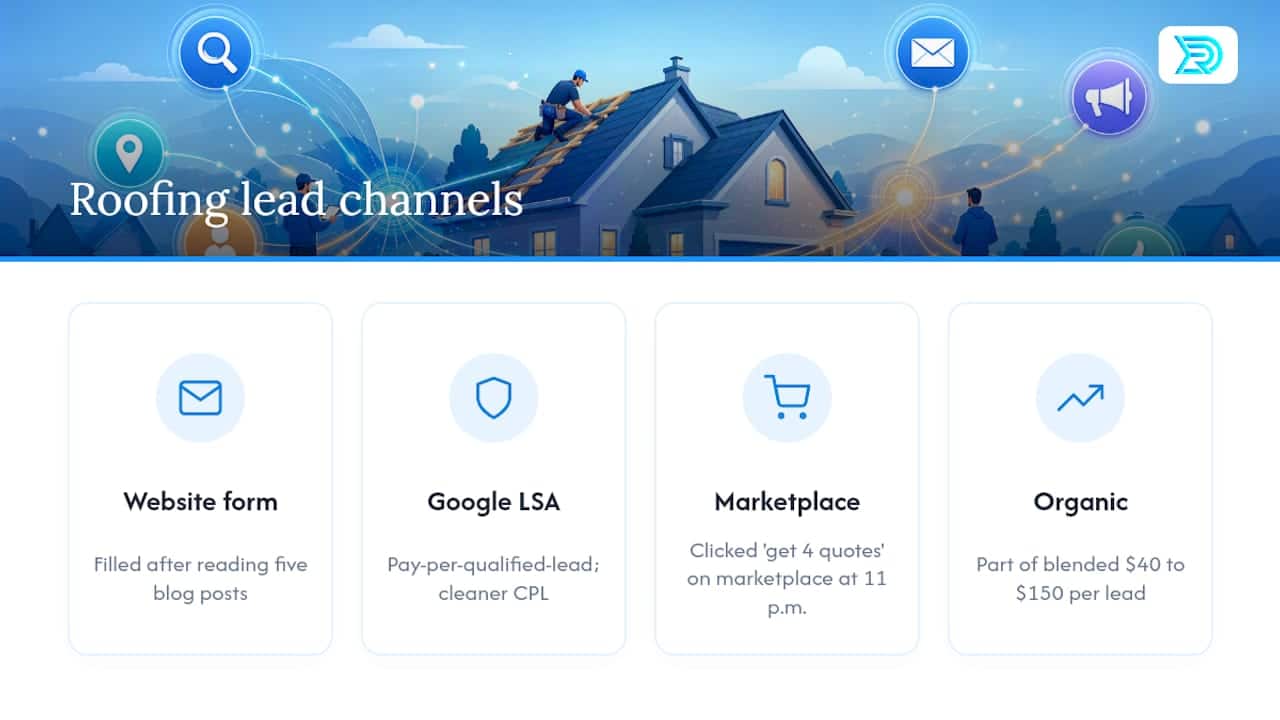
Google’s Local Services Ads run on a pay-per-qualified-lead model, meaning you’re only billed when a lead meets Google’s qualification criteria, not just for clicks or impressions. That structure tends to produce cleaner CPL numbers than standard PPC, though volume can be inconsistent in smaller metros.
Blended across channels, many roofers land on an effective cost of $40 to $150 per lead once you average paid search, LSAs, marketplace buys, and organic together. Isolate Google search alone and the number jumps back toward $228.
Commercial roofing leads run in an entirely different bracket, typically $250 to $800, reflecting bigger tickets and a much smaller buyer pool. And storm markets distort everything: expect CPL to spike 50% to 100% above baseline in the weeks after a major hail event, as every roofer within 100 miles bids on the same keywords.
The gap between top-quartile and bottom-quartile Google Ads accounts is enormous. Two roofers in the same metro, running the same offer, can see double-digit percentage swings in CPL purely because of account structure, ad copy, and landing page quality. Sticker price is a starting point, not a verdict on the channel.
How Do You Turn CPL Into Cost Per Booked Job?
That’s the number to compare against your average ticket and margin, not the $200 sticker price.
Here’s how that plays out across three realistic scenarios:
- Low close rate (10%): $150 CPL ÷ 0.10 = $1,500 CPJ. Even a cheap lead source becomes expensive fast when follow-up is weak.
- Typical close rate (20-25%): $150 CPL ÷ 0.22 ≈ $682 CPJ. This is where most disciplined roofing operations land.
- High close rate (35%+, exclusive leads with fast follow-up): $300 CPL ÷ 0.35 ≈ $857 CPJ. Notice the higher sticker price doesn’t necessarily produce a higher CPJ.
That third scenario is the one contractors constantly underestimate. A budgeting approach that works backward from job goals, rather than forward from ad spend, usually surfaces this pattern: exclusive leads cost more per unit but often produce a lower or comparable CPJ once you factor in the close-rate lift.
To build this in a spreadsheet, set up four columns: leads purchased, total spend, jobs closed, and average ticket. Divide spend by jobs closed for CPJ, then divide CPJ by average ticket to see what percentage of each job’s revenue goes to acquisition. Run this monthly, by channel, not blended, so you can see which sources are actually earning their keep. Most roofing companies discover at least one channel quietly losing money once they separate the numbers this way.
What Makes a Roofing Lead “Qualified”?
A raw inquiry isn’t a lead. A lead isn’t a booked inspection. A booked inspection isn’t a signed job. Treating all four as interchangeable is how contractors overestimate their pipeline and underestimate their true acquisition cost.
- Raw inquiry: form fill or call, no verification (lowest value, cheapest sticker price)
- Qualified conversation: contact confirmed, project scope discussed, timeline established
- Booked inspection: appointment set and confirmed on the calendar
- Signed job: contract executed, deposit collected
Exclusive leads, shared marketplace leads, LSA leads, and self-generated organic leads sit at different points on the price-versus-control spectrum. Exclusive vendor leads cost more but you’re the only contractor calling that homeowner. Shared leads from a marketplace, as HomeAdvisor’s own model describes, typically go out to multiple contractors simultaneously, which is exactly why their sticker price runs lower.
Pro Tip: Ask every vendor how fresh their leads are before they reach you. A lead that’s four hours old converts at a fraction of the rate of one delivered in real time, and that gap alone can swing your CPJ by hundreds of dollars.
What Should You Ask Before Buying Roofing Leads?
Comparing lead vendors on price alone is how contractors get burned. You need the same operational data from every provider before you can compare apples to apples.
Request this from every vendor before signing anything:
- Exact definition of a “lead” (raw inquiry vs. verified contact)
- Exclusivity terms: how many contractors receive the same lead
- Delivery method and average lead age at time of delivery
- Refund or credit policy for bad or duplicate leads
- Average close rate reported by contractors in your specific market
Then push further with contract-specific questions:
- Who owns the homeowner’s contact data after purchase, you or the vendor?
- What’s the exclusivity window, and does it reset for future work?
- Is there a validation process before you’re billed, or are you charged on delivery regardless of quality?
- What’s the refund SLA in writing, not just verbally promised?
Weigh every vendor claim against your own CPJ model. A vendor bragging about “premium leads” means nothing if their close rate for your market doesn’t beat what you already get from cheaper sources.
Tactics That Lower Your Real Cost Per Booked Job
Most of the leverage in reducing CPJ isn’t in the ad platform. It’s in what happens in the first five minutes after a lead comes in.
- Speed-to-lead: Contacting a lead within 5 minutes versus 30 minutes can double your contact rate.
- Automated SMS follow-up: Catches homeowners who won’t answer a call from an unknown number.
- Dedicated appointment setters: Free your estimators to sell instead of chase.
- Simple CRM routing rules: Ensure no lead sits unassigned overnight. A contractor CRM built for this workflow automates the handoff so nothing slips.
On the asset side, prequalification questions on your landing page filter out tire-kickers before they ever hit your phone, and a steady stream of fresh reviews improves both LSA ranking and PPC quality score.
Pro Tip: Track lead-to-inspection and inspection-to-close as two separate numbers. If inspections are booking fine but jobs aren’t closing, your problem is sales, not marketing, and no amount of CPL optimization will fix that.
How Long Does It Take Different Channels to Ramp Up?
Set your budget expectations by channel speed, not just channel cost. Paid channels buy you immediacy. Owned channels buy you a lower long-run cost, but only after months of investment.
- Work backward from your goal: if you need 12 jobs a month at a 20% close rate, you need 60 qualified leads.
- Divide your monthly ad budget by your target CPL to see if that lead volume is realistic.
- Layer channels so you’re never dependent on just one source ramping on schedule.
| Channel | Time to Predictable Volume |
|---|---|
| Exclusive lead vendors | Immediate, if inventory is available |
| Paid search / Meta ads | 2–6 weeks to stabilize |
| Local Services Ads | 2–4 weeks |
| SEO / organic | 6–12+ months |
A Real Roofing Client Case Study
Resultsdigitalus has taken roofing clients through exactly this model, pairing paid channels for immediate volume with SEO investment for long-run CPL reduction. One Florida roofing client grew from 3 crews to 18 before selling the company for $60 million, built on a channel mix and speed-to-lead process refined over years, not a single campaign tweak.
The pattern we see across every roofing client that scales isn’t a magic ad platform. It’s disciplined follow-up on every lead, paired with a growing owned-channel base that keeps lowering blended CPL over time.
Full case specifics are proprietary to each client engagement, but the underlying model is consistent:
- Veteran-owned, founded 2015 in Montgomery, Texas
- One contractor per trade, per market (exclusivity by design)
- No long-term contracts; results are earned monthly
What Red Flags Should You Watch for When Buying Leads?
Not every lead vendor is operating in good faith, and the roofing industry has no shortage of cautionary tales. The FTC’s final order against HomeAdvisor for deceptive lead marketing is a matter of public record, and contractor lawsuits alleging bogus or recycled leads have followed similar marketplaces.
Watch for these warning signs before you sign anything:
- Vague lead definitions with no verification standard
- The same lead sold to five or more contractors simultaneously
- No refund or credit policy for disconnected numbers or duplicate submissions
- Close-rate claims the vendor won’t back up with references in your market
Before paying, call the number yourself to confirm it’s live, and ask the vendor for two contractor references in a comparable market who’ll speak to actual close rates.
Is a Cheaper Lead Actually a Better Lead?
Chasing the lowest sticker CPL is the most expensive habit in roofing marketing. A profitable, exclusive lead with relentless same-hour follow-up will outperform a cheap shared lead every time margin is the measure, not just volume. The channels worth building patience for are the ones you own: search rankings and a well-worked customer database compound into the lowest long-run cost per lead you’ll ever get.
How Resultsdigitalus Helps You Fix Your CPL-to-CPJ Gap
Most agencies sell you traffic and call it a day. Resultsdigitalus builds the entire pipeline, from the ad account to the landing page to the follow-up process, because a cheap lead with no speed-to-lead system behind it is money wasted.
As a veteran-owned agency working exclusively with one roofing company per market, Resultsdigitalus manages Google Ads, SEO, and Local Services optimization side by side, so you’re never competing with another client of ours for the same keywords. In the first 30 to 90 days, that typically means faster lead response systems, cleaner tracking so you know your real CPJ by channel, and a landing page built to convert instead of just look good. There are no long-term contracts. You keep the agency because the numbers hold up month over month.
If your current cost per lead looks fine on paper but your booked jobs don’t reflect it, start with a digital marketing audit to see exactly where the gap is happening.
Frequently Asked Questions
What is a good roofing cost per lead?
A “good” CPL depends entirely on your close rate and average ticket.
Why are roofing leads so expensive on Google Ads?
High-ticket jobs and intense local competition push bids up. The average roofing Google Ads CPL sits at $228.15, but well-optimized accounts routinely beat that average by a wide margin.
Should I buy exclusive leads or shared marketplace leads?
Exclusive leads cost more upfront but typically close at a higher rate since you’re not racing four other contractors to the phone. Shared leads work better as supplemental volume, not your primary pipeline.
How do I calculate cost per booked job?
Divide your total lead spend by the number of jobs actually signed from that spend. If you spent $3,000 and closed 4 jobs, your CPJ is $750, regardless of what any individual lead cost.
Does SEO really lower cost per lead over time?
Yes, once rankings mature. Organic leads carry no marginal cost per click, though building that visibility typically takes 6 to 12 months or more of consistent investment.
Sources
- Roofing Lead Cost Benchmarks (PipelineOn)
- How Much Does a Roofing Lead Cost? (Roofing Snapshot)
- Compare Roofing Lead Costs & Sources | PeakIntent
- Local Services documentation (Google Support)
- FTC press release on HomeAdvisor order
