
Roofing click fraud is the deliberate, repeated clicking of your pay-per-click ads by competitors, automated bots, or organized click farms with no intent to hire you. The industry term is “invalid click activity,” and it costs roofing contractors real money every single day. Between 11% and 14% of Google Ads clicks in home services and roofing are fraudulent or invalid. That means for every ten clicks you pay for, at least one is worthless. If you run Google Ads for your roofing business, understanding what is roofing click fraud is the first step to stopping the bleed.
What is roofing click fraud and who is behind it?
Roofing click fraud is invalid click activity targeting your paid search ads, generated by three main sources: competing roofing companies, automated bots, and manual click farms. Each operates differently, but the goal is the same. They want your daily budget gone before real customers can see your ads.
Competitor-driven fraud is the most direct form. A rival roofing company clicks your Google Ads repeatedly to exhaust your daily budget. This tactic is called click-thrashing. Once your budget runs out, your ads disappear and theirs move up. It is a calculated attack, not an accident.

Automated bots are software programs that mimic human browsing behavior. They visit your landing page, move a mouse cursor, scroll the page, and exit without converting. Google’s filters catch many bots, but sophisticated scripts rotate IP addresses and vary click timing to avoid detection. You pay for every one of those clicks.
Click farms are the hardest to stop. Click farms use real humans on real devices to click ads, which bypasses most automated bot filters. A real person in a low-wage country clicks your “emergency roof repair” ad, spends ten seconds on your page, and leaves. Google sees a legitimate visit. You see a wasted click.
- Competitors target your highest-performing keywords to maximize budget drain
- Bots rotate IP addresses and simulate mouse movements to avoid filters
- Click farms use real devices and real browsers to evade detection
- All three methods can run simultaneously against a single campaign
Pro Tip: Check your Google Ads IP report weekly. A cluster of clicks from the same IP range with zero conversions is a strong signal of competitor or bot activity.
Why is the roofing industry especially vulnerable to click fraud?
Roofing is one of the highest-value trades in home services. A single signed contract can be worth $10,000 to $50,000 or more. That value makes every lead worth fighting over, and it makes your ad budget worth attacking.
-
High cost per click. Roofing keywords command premium prices due to high project value and seasonal demand. Insurance-related roofing terms rank among the most expensive in all of home services. When each click costs $15 to $50, fraudsters can drain a daily budget in minutes.
-
Storm season surges. After a hailstorm or hurricane, search volume spikes overnight. Storm season triggers high-intent clicks from insurance adjusters, public adjusters, and competitors, not just homeowners. Broad keywords attract this mixed traffic fast, burning your budget before genuine leads ever see your ad.
-
Hyper-competitive local markets. In markets like Dallas, Houston, or Atlanta, dozens of roofing companies compete for the same zip codes. The financial incentive to knock a competitor off the first page is real. One company draining another’s budget for $50 in fraudulent clicks could cost that competitor a $20,000 job.
-
Urgency-driven search behavior. Homeowners searching after storm damage need a roofer now. Competitors know this. Draining your budget during peak demand hours means those urgent callers never find you.
-
Single-lead value justifies the attack. Each valid roofing lead can be worth thousands of dollars. That math makes even a modest investment in click fraud worthwhile for a bad actor.
The roofing industry is a prime target because each valid lead can be worth thousands of dollars, attracting intense competitor sabotage. Fraud is not random. It is calculated.
What is the impact of click fraud on roofing ad campaigns?
Click fraud does not just waste money. It corrupts every metric you use to make decisions. When your data is dirty, your campaign optimization is flying blind.
| Impact Area | Without Click Fraud | With Click Fraud |
|---|---|---|
| Budget efficiency | Spend reaches real prospects | Budget depletes on bots and competitors |
| Ad visibility | Ads run through peak hours | Ads go dark when budget exhausts early |
| Conversion rate | Reflects real customer behavior | Artificially suppressed by non-converting clicks |
| Cost per lead | Accurate and improvable | Inflated, making campaigns look unprofitable |
| Campaign data | Clean signals for optimization | Corrupted data leads to wrong bidding decisions |
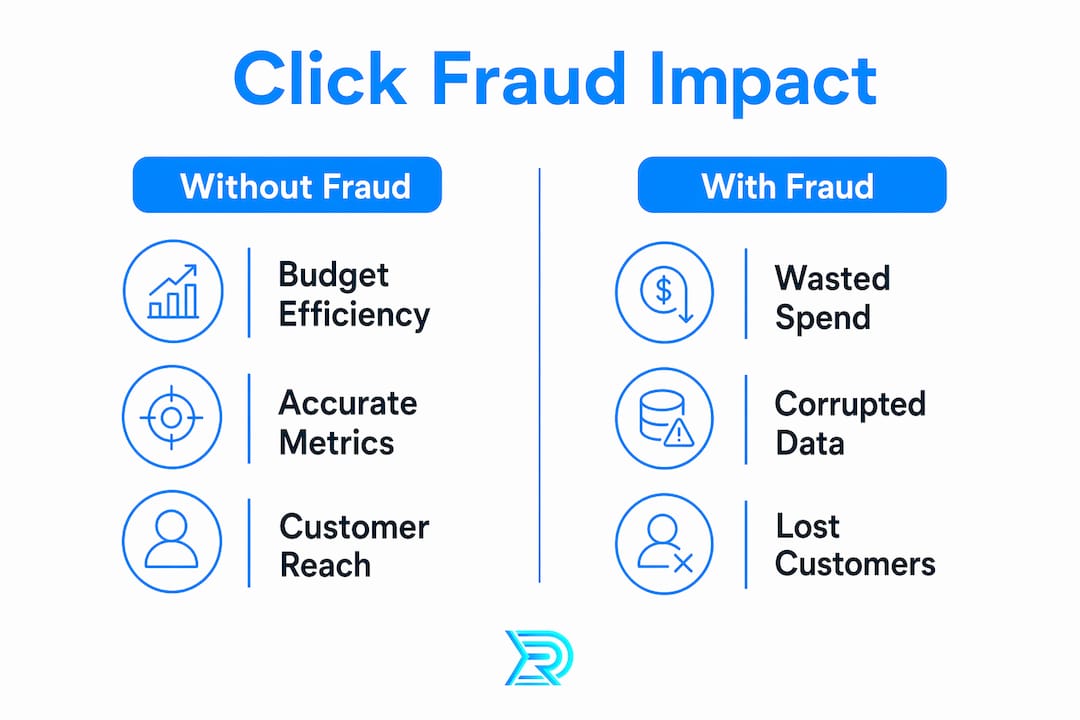
When fraudulent clicks exhaust your budget early, legitimate customers searching during peak hours simply do not see your ads. That is not just a wasted click. That is a lost job. The homeowner calls your competitor instead.
The damage to your metrics compounds over time. Google’s Smart Bidding algorithm learns from your conversion data. When fraud inflates your click volume without adding conversions, the algorithm reads your campaign as underperforming. It may reduce your bids or shift budget to lower-quality placements. You end up paying more for worse results, and the algorithm is not to blame.
Pro Tip: If your cost per lead suddenly spikes with no change in your bids or landing page, run an IP exclusion audit before adjusting your campaign settings. The problem may be fraud, not your strategy.
How can roofing contractors detect and prevent click fraud?
Detection starts with knowing what to look for. Signs of click fraud include budget exhaustion faster than expected, high bounce rates, and suspicious IP activity. These are not always obvious, but they show up in your data if you know where to check.
Warning signs to monitor
- Budget depletes significantly faster than your historical average
- Bounce rate spikes above 80% with no change to your landing page
- Clicks cluster from the same geographic area with zero calls or form fills
- Unusual click volume during off-hours like 2 a.m. to 5 a.m.
- Multiple clicks from the same IP address within a short time window
Prevention methods that work
Conversion-based rules and IP exclusions help reduce fraud impact in Google Ads campaigns. They are a solid starting point, but they are not enough on their own.
Google detects and refunds many invalid clicks but misses up to 40–45% of sophisticated click fraud. That gap is where your money disappears. Relying on Google alone is not a complete defense.
Relying solely on Google’s fraud filters leaves roofing contractors vulnerable. A second layer of protection from third-party tools catches invalid traffic that Google’s system misses and improves your actual return on ad spend.
Practical steps to protect your campaigns:
- Set IP exclusions in Google Ads for any IP address that generates multiple clicks with no conversions
- Tighten geo-targeting to your actual service area, not broad regional or national settings
- Use third-party fraud protection tools like ClickGuardian, FraudBlocker, or ClickPatrol to catch what Google misses
- Switch to phrase and exact match keywords to reduce exposure from broad-match traffic during storm season
- Review your roofing ad performance weekly, not monthly, so you catch anomalies before they drain your budget
“The contractors who catch fraud early are the ones checking their data weekly, not waiting for the monthly report.”
Understanding competitor tactics in roofing ads also helps you anticipate when and how attacks are likely to happen, especially during storm season or when a new competitor enters your market.
Key takeaways
Roofing click fraud is a deliberate, multi-source attack on your ad budget that corrupts campaign data, drains visibility, and hands your leads to competitors.
| Point | Details |
|---|---|
| Fraud rate is significant | Between 11% and 14% of roofing Google Ads clicks are fraudulent or invalid. |
| Three main sources | Competitors, automated bots, and click farms each use different methods to drain your budget. |
| Google’s filters have gaps | Google misses up to 40–45% of sophisticated fraud, making a second protection layer necessary. |
| Data corruption is the hidden cost | Fraud inflates click volume without conversions, corrupting Smart Bidding signals and raising cost per lead. |
| Weekly monitoring is non-negotiable | Catching IP clusters, bounce spikes, and early budget exhaustion early limits damage before it compounds. |
What I’ve learned running roofing ad campaigns under fraud pressure
At Resultsdigitalus, we manage Google Ads exclusively for contractors, and the fraud patterns we see in roofing are more aggressive than in almost any other trade. The contractors who get hit hardest are usually the ones running broad match keywords with no IP exclusion rules and no third-party monitoring. They assume Google handles it. Google does not handle all of it.
The most underestimated threat is click farms. Most roofing contractors focus on blocking bots, but click farms remain a growing threat in 2026 because they use real humans. No bot filter catches a real person clicking from a real phone. The only way to catch it is behavioral analysis: time on page, scroll depth, and conversion patterns over time.
The contractors who protect their budgets best do three things consistently. They monitor their campaigns weekly, not monthly. They run third-party fraud detection alongside Google’s native filters. And they tighten their keyword match types during storm season when broad traffic spikes and fraud risk peaks. That combination does not eliminate fraud, but it limits the damage to a manageable level.
One more thing: do not let fraud prevention paralyze your campaign scale. Tightening geo-targeting too aggressively or excluding too many IPs can cut real traffic. The goal is layered protection, not a locked-down campaign that stops generating leads.
— Results
Roofing ad fraud protection starts with the right partner
Roofing contractors running Google Ads without fraud protection are paying for clicks that will never become customers. Resultsdigitalus builds and manages Google Ads campaigns for roofers with fraud detection built into every campaign from day one.
Our campaigns include IP exclusion protocols, geo-targeting built to your actual service area, and ongoing performance audits to catch suspicious activity before it drains your budget. We work with one roofing company per market, so your campaign is never competing with our other clients. If you want your ad spend working for real leads, explore our digital marketing services built specifically for roofing contractors.
FAQ
What is roofing click fraud in simple terms?
Roofing click fraud is when competitors, bots, or click farms repeatedly click your Google Ads with no intent to hire you, draining your budget without generating real leads.
How does click fraud work in roofing PPC campaigns?
Fraudulent clicks deplete your daily budget early, causing your ads to stop showing during peak hours when real customers are searching for a roofer.
Can Google stop roofing click fraud on its own?
Google detects and refunds many invalid clicks, but misses up to 40–45% of sophisticated fraud. A third-party tool like ClickGuardian or FraudBlocker is necessary to close that gap.
What are the clearest signs of click fraud in roofing ads?
Budget exhausting faster than normal, high bounce rates with no landing page changes, and click clusters from the same IP with zero conversions are the clearest warning signs.
Is click fraud in roofing illegal?
Click fraud is considered fraudulent activity and violates Google’s advertising policies. Civil legal action is possible, but detection and prevention at the campaign level is the most practical defense for most roofing contractors.
