
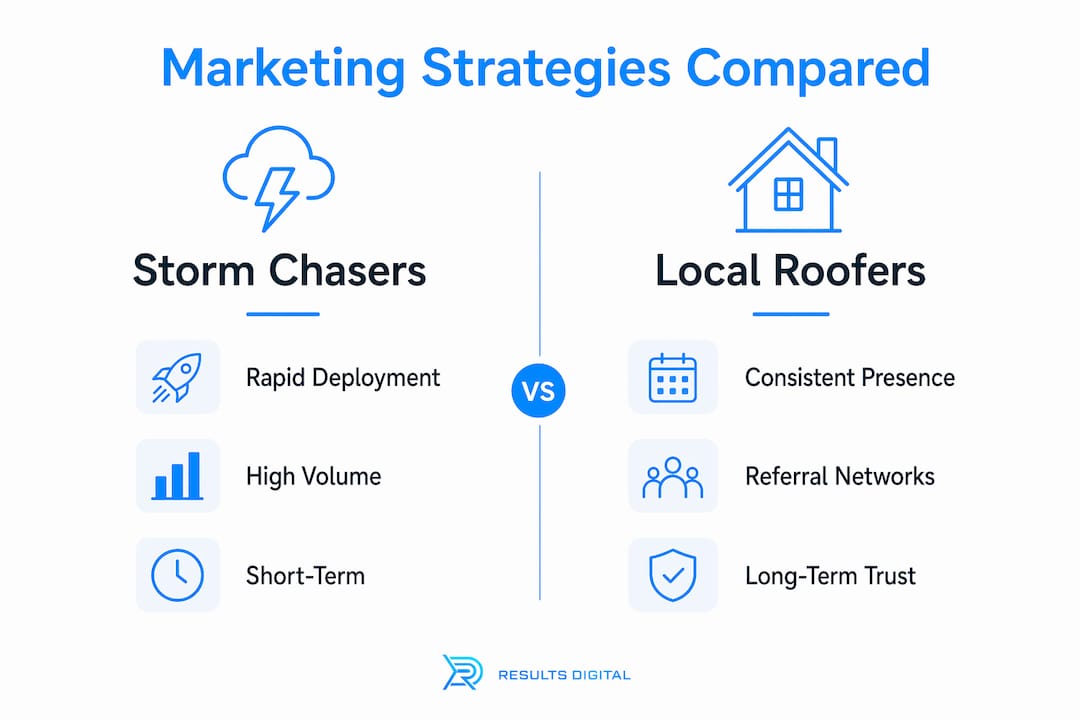
Storm chaser roofers are contractors who relocate to disaster-affected markets immediately after severe weather events, deploying volume-based insurance claim tactics instead of building long-term community presence. Understanding how storm chaser roofers market differently is critical for any roofing professional or marketing strategist who wants to compete, adapt, or protect their local market share. The industry term for these operators is “itinerant contractors,” though “storm chasers” is the phrase homeowners and roofers alike use every day. Their marketing playbook is built on speed, urgency, and aggressive lead capture. Local roofers who ignore these tactics get outmaneuvered in the weeks that matter most.
How storm chaser roofers market differently from day one
Storm chasers treat marketing as a rapid-deployment operation. Within 48 hours of a major weather event, crews arrive in the affected zip codes, set up temporary offices, and begin saturating the area with door-to-door canvassing. That speed gives them first-notice-of-loss dominance, meaning they reach homeowners before any local competitor even updates their Google Ads campaign.
Their digital tactics match that urgency. Storm chasers launch pay-per-click campaigns targeting keywords like “storm damage roof repair” and “hail damage roofer near me” within hours of an event. Google Ads cost per lead for storm damage keywords ranges from $45 to $130, and storm chasers accept those costs because their volume model absorbs them. They are not building a brand. They are buying leads at scale.
Temporary LLCs are a standard part of the storm chaser model. A new entity gets registered in the target state, a local phone number gets set up, and a basic landing page goes live. This creates the appearance of a local business without any of the roots. The cycle typically runs 12–18 months before the operation moves to the next high-risk zone.
- Deploy within 48 hours. Canvassing teams arrive before local contractors mobilize.
- Launch storm-specific Google Ads. High-bid campaigns target damage keywords immediately.
- Register a temporary LLC. Creates a local business facade for quick market entry.
- Focus on insurance claims. Adjusters and claim paperwork become the primary sales tool.
- Maximize volume. Margins come from quantity, not quality or repeat business.
Pro Tip: If you are a local roofer, set up a pre-built storm landing page now, before any storm hits. When search volume spikes, your page is already indexed and ready to capture traffic that storm chasers are paying $100 per click to reach.
How do local roofers’ marketing strategies compare to storm chasers?
Local roofers compete on a completely different timeline. Their marketing is built for consistency, not crisis. Always-on SEO and Google Business Profile optimization generate steady organic leads month after month, at a cost per lead that drops over time as authority builds. Organic leads take 6–12 months to mature, but they carry higher trust and lower acquisition costs than paid storm traffic.

The comparison between the two models is stark:
| Marketing Factor | Storm chaser roofers | Local roofers |
|---|---|---|
| Speed to market | 48 hours post-storm | Always present |
| Lead source | Paid ads, door knocking | SEO, referrals, reviews |
| Warranty offered | 5–10 year limited | 20–25 year manufacturer-backed |
| Community ties | None | Chamber of Commerce, referral networks |
| Business lifespan in market | 12–18 months | Years to decades |
| Cost per lead | $45–$130 (paid) | Lower over time (organic) |
Local roofers who build their Google Business Profile authority before storm season gain a structural advantage. When search volume spikes after a hail event, their listing already ranks. Storm chasers have to buy that visibility.
- Consistent review velocity builds trust that no ad budget can replicate overnight.
- BBB accreditation, manufacturer certifications like GAF Master Elite, and extended warranties signal permanence to homeowners.
- Chamber of Commerce relationships and neighborhood referral networks generate leads that cost nothing per acquisition.
- Pre-built storm landing pages activate automatically when local search demand spikes.
Local referral networks are the single biggest structural advantage a local roofer holds. Storm chasers cannot replicate years of community trust in 48 hours, no matter how much they spend on Google Ads.
What risks do storm chaser marketing tactics create?
Storm chaser marketing creates real financial and reputational damage, for homeowners and for the local contractors left to fix the aftermath. Rushed inspections and incomplete damage assessments are the direct result of a volume-first model. For every 1,000 square feet repaired by storm chasers, local contractors lose an estimated $1,850 in potential revenue from quality-related callbacks and warranty disputes.
The risks extend beyond lost revenue:
- Insurance claim manipulation. Storm chasers sometimes file inflated or inaccurate claims, exposing homeowners to fraud liability and future coverage issues.
- No warranty enforcement. A 5–10 year limited warranty means nothing when the company dissolves its LLC and moves to the next market.
- Reputational spillover. Homeowners burned by storm chasers often distrust all roofers, making it harder for legitimate local contractors to close deals.
- Bidding wars on keywords. When storm chasers flood Google Ads with high bids, local roofers face inflated costs per lead even on their own branded terms.
- Rushed labor quality. Volume pressure leads to shortcuts that generate callbacks, code violations, and insurance disputes months later.
Homeowner distrust is the most underrated risk. When a storm chaser leaves town with a bad reputation, that distrust sticks to every roofer in the area. Local contractors inherit the skepticism without having earned it.
How can roofing professionals compete against storm chaser tactics?
Competing against storm chasers requires a two-track marketing program: one track that runs year-round, and one that activates the moment a storm hits your market. Retail and replacement leads made up 79.2% of 2025 U.S. roofing installations. That means the majority of your revenue opportunity exists outside storm events entirely. Storm chasers ignore that market. You should own it.
- Build your storm infrastructure before storm season. Create dedicated landing pages for storm damage, hail repair, and insurance claim assistance. Have them indexed and live before you need them.
- Maintain Google Business Profile authority year-round. Post weekly updates, respond to every review, and add photos of completed jobs. Authority built in calm weather pays off when search volume spikes.
- Set a storm-response ad budget in advance. Decide now what you will spend per day during a storm event. Flying blind on ad spend during a bidding war destroys margins.
- Earn certifications that storm chasers cannot fake. GAF Master Elite, Owens Corning Platinum Preferred, and OSHA 30 certification signal permanence and professionalism. Digital workflows and certified labor increase gross margins by 25% versus average contractors.
- Activate your referral network immediately after a storm. Text past customers, alert your insurance agent contacts, and post on neighborhood platforms like Nextdoor within 24 hours of an event.
Pro Tip: Review your roofing Google Ads strategy before hail season. Set bid caps for storm keywords so you do not get dragged into a cost-per-lead war you did not budget for.
The best roofing marketing programs combine always-on organic channels with scalable paid ad capacity that can surge during storm events. That combination is what storm chasers structurally cannot replicate. They have the surge. They do not have the foundation.
The uncomfortable truth about storm chaser marketing
Working with roofing contractors across the country at Resultsdigitalus, I have watched storm chasers roll into markets and generate more leads in two weeks than a local roofer generates in a quarter. That is real. Denying it does not help you compete.
What I have also watched is what happens 18 months later. The storm chaser is gone. The homeowner has a leaking roof and a dissolved LLC warranty. The local roofer who stayed, built reviews, and kept their Google Business Profile current is now the only trusted option in the market. The storm chaser’s marketing was loud. The local roofer’s marketing was durable.
The contractors who win long-term are the ones who treat storm events as a marketing sprint within a marathon. They have the infrastructure ready, they surge their ad spend for 30–60 days, and then they return to the always-on strategy that builds compounding value. Chasing storms as a business model is a race to zero margins. Building a local brand is a race to pricing power.
My honest recommendation: stop trying to out-spend storm chasers during a storm event and start out-positioning them before one ever hits.
— Results
How Resultsdigitalus helps roofers build marketing that outlasts any storm
Storm chasers will always show up after a disaster. The question is whether your marketing infrastructure is strong enough to compete on day one and still be standing when they leave.
Resultsdigitalus builds year-round digital marketing programs for roofing contractors that include SEO, Google Ads, Google Business Profile management, and custom website design. Every program is built exclusively for one roofing contractor per market. That means your budget, your keywords, and your campaigns work only for you. Whether you need a storm-ready landing page, a Google Ads campaign built to surge during hail season, or an SEO foundation that generates leads every month of the year, Resultsdigitalus delivers it without long-term contracts. Contact the team today to build a marketing program that storm chasers cannot touch.
Key takeaways
Storm chaser roofers win on speed and volume, but local roofers who build year-round digital infrastructure consistently outperform them over any 12-month period.
| Point | Details |
|---|---|
| Speed is the storm chaser’s weapon | Deployment within 48 hours and instant Google Ads give storm chasers first-mover advantage. |
| Local SEO is the local roofer’s defense | Pre-built storm pages and Google Business Profile authority capture leads without paying storm-level CPCs. |
| Warranties reveal the real difference | Storm chasers offer 5–10 year limited warranties; local roofers provide 20–25 year manufacturer-backed coverage. |
| Certifications command higher margins | OSHA 30 certification and manufacturer credentials increase gross margins by 25% versus uncertified competitors. |
| Two-track marketing wins | Combining always-on SEO with a surge-ready paid ad budget beats both pure storm chasers and passive local roofers. |
FAQ
What makes storm chaser roofers different from local roofers?
Storm chaser roofers are itinerant contractors who relocate to disaster zones within 48 hours, focus on volume insurance claims, and operate through temporary LLCs before moving to the next market. Local roofers build permanent community presence through SEO, referrals, and long-term warranties.
How much do storm damage leads cost on Google Ads?
Google Ads cost per lead for storm damage keywords ranges from $45 to $130. Storm chasers accept those costs because their volume model absorbs them, while local roofers reduce long-term costs through organic SEO.
Can a local roofer compete with storm chasers after a disaster?
Yes. Local roofers with pre-built storm landing pages, active Google Business Profiles, and a pre-set storm ad budget can capture leads immediately without entering a bidding war at full storm-level CPCs.
Why do storm chaser warranties matter to homeowners?
Storm chasers typically offer only 5–10 year limited warranties, and those warranties become unenforceable when the LLC dissolves. Local roofers provide 20–25 year manufacturer-backed warranties that remain valid regardless of business changes.
What is the best long-term roofing marketing strategy?
The most effective approach combines always-on SEO and Google Business Profile management with a scalable paid ad program that surges during storm events. That combination generates consistent leads year-round and captures storm traffic without depending on it.
