
TL;DR:
- Most roofing market data offers broad insights but fails to identify specific local customer segments. Successful contractors use detailed local knowledge to target homeowners needing replacement work, focusing on age, damage, and storm patterns. Applying real-world segmentation through localized campaigns leads to higher conversions and more profitable jobs.
Most roofing contractors open a market research report expecting to walk away with a clear targeting plan, only to close it more confused than when they started. National segmentation data tells you that residential roofing owns a majority of the market, that asphalt shingles dominate by volume, and that replacement activity outpaces new construction. But none of that tells you which homeowners in your zip code are ready to call, what keywords will bring them to your landing page, or why your ad spend keeps bleeding budget without enough booked jobs to show for it. This article breaks down roofing market segmentation in plain language and shows you how to turn broad market data into a local campaign strategy that actually generates leads.
Table of Contents
- What is market segmentation in roofing?
- Key data: Where the roofing market’s real volume is
- How the pros segment: Real-world approaches vs. textbook categories
- Translating segmentation to actionable local marketing
- Perspective: Why true local segmentation beats market reports
- Grow leads and win more jobs with targeted segmentation
- Frequently asked questions
Key Takeaways
| Point | Details |
|---|---|
| Segmentation dimensions | Roofing markets are divided by material, application, installation type, roofing style, end user, and geography. |
| Residential and replacement focus | Most U.S. roofing business comes from residential re-roofing and replacement, not new construction. |
| Go beyond reports | Effective local marketing requires customizing segmentation with actual local insights beyond broad industry buckets. |
| Apply to local campaigns | Contractors should segment leads by local roof age, problems, storm impact, and real buying intent for higher ad ROI. |
| Continuous validation matters | Always validate segmentation and targeting with real job data, not just market-share figures. |
What is market segmentation in roofing?
Market segmentation, at its core, is the practice of sorting customers, jobs, and revenue into logical groups so you can study them separately. In the roofing industry, that sorting happens across several different lenses at the same time. According to the US roofing market structure, segmentation is typically structured along product/material category, application (residential vs. commercial), installation type (new vs. replacement/renovation), roofing type (slope vs. flat/low-slope), end user/sector, and geography.
A solid roofing market analysis pulls all these lenses together to give contractors a 360-degree view of where business is and where it is headed. The trouble is, most contractors either skip the analysis entirely or lean on a single dimension, such as material type, and ignore the rest.
Main US roofing market segmentation buckets
| Segment type | Description | Example values |
|---|---|---|
| Product/material | The roofing material installed | Asphalt shingles, metal, TPO, EPDM, tile |
| Application | The building use type | Residential, commercial, industrial |
| Installation type | Whether the job is new or existing | New construction, replacement, renovation |
| Roofing type | The roof geometry or drainage design | Slope, flat/low-slope |
| End user/sector | Who owns or occupies the building | Homeowners, property managers, REITs |
| Geography | Where the job takes place | Region, state, metro area, zip code |
These six buckets are the standard framework you will see in any professional market report. Each one creates a different cut of the same market, and the most powerful local strategies layer several cuts together at the same time.
Common misconceptions about segmentation
Contractors often carry assumptions about segmentation that hold back their marketing before it even launches. Here are four of the most damaging:
- “Materials are all that matter.” Specifying asphalt shingles as your focus tells you nothing about the customer’s urgency, their insurance situation, or whether they are replacing a 15-year-old roof or shopping for a new build.
- “Segmentation is just for big brands.” Every targeted Google Ad or Facebook campaign you run is an act of segmentation. If you are running ads at all, you are already segmenting, just not always intentionally.
- “National data maps directly to my market.” A national report shows asphalt shingles at 60 percent market share nationally, but your metro area might skew heavily toward metal or tile based on climate and code.
- “One campaign can speak to all segments.” A homeowner whose roof is leaking after a hailstorm has a completely different motivation than a property developer planning a commercial build. Treating them identically wastes your budget.
Understanding roofing marketing strategies requires you to respect each of these distinctions before you write a single line of ad copy.
Key data: Where the roofing market’s real volume is
Now that we know the main segmentation buckets, let’s see where the biggest business actually comes from and how contractors should act on this data.
The numbers are not subtle. US roofing market data shows that residential applications account for approximately 58.1% of total market share by sector, and replacement/renovation work represents roughly 79.2% of total installation activity. Put those two figures together and the story is clear: the typical roofing contractor’s highest-volume opportunity is a homeowner replacing a worn or damaged roof, not a developer building from the ground up.
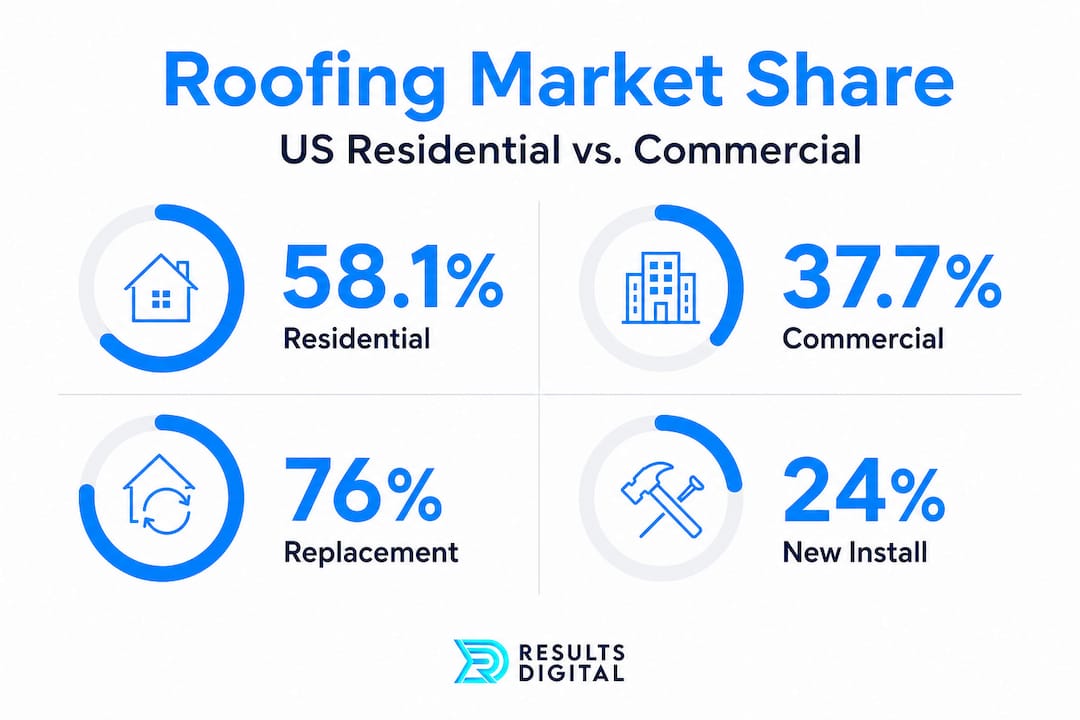
Residential vs. commercial and installation type breakdown
| Dimension | Category | Approximate share |
|---|---|---|
| Application | Residential | ~58.1% |
| Application | Commercial/non-residential | ~41.9% |
| Installation type | Replacement/renovation | ~79.2% |
| Installation type | New construction | ~20.8% |
What does this mean for your roofing marketing budget? It means a large portion of your highest-probability prospects are homeowners who already have a roof that needs work, not people shopping for a brand-new structure. Their search behavior reflects that reality. They type queries like “roof damage repair,” “replace old roof,” or “storm damage roofing contractor” rather than “new roof installation.”

Pro Tip: Build your targeted roofing ads around keywords that signal roof age or damage, such as “worn shingles,” “leaking roof,” or “hail damage estimate.” These phrases mirror the replacement/renovation mindset that drives nearly 80% of roofing market activity.
What contractors miss when they ignore replacement volume is significant. They build landing pages that talk about materials and craftsmanship without ever addressing the homeowner’s real concern: “My roof is failing and I need someone to fix it fast.” When your messaging matches the segment’s actual emotional driver, conversion rates go up and cost per lead goes down. That alignment does not happen by accident. It comes from taking segmentation data seriously and translating it into campaign language.
How the pros segment: Real-world approaches vs. textbook categories
Having seen the major market buckets and what moves the numbers, let’s compare what segmentation looks like on paper versus what actually moves the needle for top performers.
A textbook market report groups contractors under “asphalt shingles” or “single-ply membranes.” A high-performing contractor, on the other hand, thinks about the actual system they installed, the specific building it sits on, and the type of maintenance or replacement cycle that follows. That distinction is the gap between data and dollars.
What shapes real-world segmentation success
Beyond the standard buckets, the following factors have a major impact on whether a segmentation strategy actually converts:
- Roof pitch and geometry affect both material suitability and installation cost, which shapes the customer’s budget expectations.
- Insurance and storm zone designations determine whether a job is likely to be an insurance claim or an out-of-pocket replacement. Storm zone markets behave completely differently from non-storm markets.
- Local building codes and permit requirements vary by jurisdiction and can eliminate certain materials or require specific installation methods, effectively narrowing the addressable segment.
- Installer expertise and crew capacity define what you can realistically promise and deliver, which should directly limit which segments you target.
- The installed system context matters more in commercial work, where maintenance contracts, warranty programs, and manufacturer relationships all tie back to specific system categories.
Textbook vs. contractor-driven segmentation
| Approach | Textbook category | Contractor-driven bucket |
|---|---|---|
| Material focus | “TPO roofing” | “TPO re-roof on flat commercial buildings under 50k sq ft” |
| Application focus | “Residential roofing” | “Storm-damage replacement for 15+ year-old homes in insured zip codes” |
| Installation focus | “New construction” | “Builder-track new installs with pre-negotiated material specs” |
| System focus | “Metal roofing” | “Standing seam metal on residential high-end re-roofs with HOA approval required” |
Pro Tip: If you focus on commercial work, group your targeting and messaging by the specific systems you install, such as TPO, EPDM, or modified bitumen, not just the generic “commercial roofing” label that every competitor uses. It signals expertise and filters out jobs you cannot or should not take.
According to the 2025 Commercial Roofing Trends Report, commercial roofing contractors frequently rely on specific roof system categories, with single-ply systems showing the highest average product involvement and revenue share in 2025, reinforcing the need to align marketing messaging with the actual system your crew installs and certifies.
It is also worth noting that roofing market segmentation methodology commonly uses a mix of primary input, secondary documentation review, and triangulation to define segments and reduce forecast bias. That validation process matters because it means the buckets you read in a report have been refined, but they were built to describe a national or global market, not your specific service area.
A good roofing marketing agency guide will push you to move beyond these broad categories and build your own localized system buckets. Platforms that offer GEO strategies for home services go even further by layering geographic behavioral data onto these categories to sharpen targeting. Your roofing marketing services partner should help you do the same.
Translating segmentation to actionable local marketing
With the importance of real-world segmentation clear, here is how you can actually put these ideas to work in your local market.
The core challenge is moving from a national market report to a campaign that converts in your specific service area. These are not the same task. National data gives you context. Local execution gives you leads. Here is a practical step-by-step process to bridge that gap.
- Audit your actual job mix first. Pull your last 12 to 24 months of completed jobs. Categorize each one by application type, installation type, roof type, and material. This is your real local segment distribution, and it is more accurate than any report.
- Overlay local storm and insurance data. Check NOAA storm event databases for your service area and map which zip codes have the highest claim activity. These zones deserve dedicated campaign segments with insurance-specific messaging.
- Identify permit and code constraints. Some jurisdictions restrict certain materials or require specific fire ratings. Knowing this ahead of time keeps your ads from attracting leads you cannot actually serve.
- Build separate landing pages per segment. A homeowner with hail damage needs a different page than a property manager pricing a flat roof replacement. Segment-specific pages increase conversion rates significantly because the message matches the visitor’s actual situation.
- Match keywords to replacement and repair intent. Since replacement/renovation is dominant, prioritize search terms that reflect existing roof problems over new construction queries.
- Validate spend with your actual conversion data. Never allocate ad budget purely based on market share percentages. If flat roofs represent only 10 percent of your jobs but 40 percent of your revenue, that segment deserves more attention than the national data suggests.
Pro Tip: Resist the temptation to run one broad campaign and call it segmentation. Even splitting residential and commercial into separate ad groups with different landing pages can cut your cost per lead meaningfully.
A critical caution here: local segmentation requires additional layers that market reports simply do not provide. Jurisdictional permitting rules, HOA overlays, local storm insurance patterns, and your crew’s true install capacity all shape which segments you can actually win. Ignoring those local factors is one of the fastest ways to burn through ad budget chasing leads you cannot close or jobs you cannot staff. Review best roofing marketing tips regularly to stay current on how top contractors handle these overlays in practice.
Perspective: Why true local segmentation beats market reports
Here is an experienced take on putting market segmentation to work for your actual business, not just your monthly reports.
Market reports are built by analysts who are measuring a global or national industry. They care about total addressable market, compound annual growth rates, and material volume by tonnage. You care about the phone ringing. Those are not the same goal.
The contractors who consistently outperform their local competitors are not necessarily the ones who read the best reports. They are the ones who know their market at the zip code level. They know which neighborhoods have roofs that are aging into replacement territory. They know which streets got hit by hail last spring. They know which property management companies are out-of-contract and shopping for a new commercial roofing partner. That granular local knowledge is a competitive moat that no national report can provide.
The segment that matters most is not the largest one on a market share chart. It is the one you can win efficiently right now, in your geography, with your crew, at your current capacity.
We have seen this play out repeatedly. A contractor in a mid-size Midwestern market shifted from running generic “roofing contractor” campaigns to building three distinct segments: storm-damage residential claims, flat roof commercial replacements under 30,000 square feet, and aging residential re-roofs in neighborhoods built before 2000. Each segment got its own landing page, its own ad creative, and its own keyword group. The result was not just more leads. It was better leads, shorter sales cycles, and higher average job values, because the messaging spoke directly to each prospect’s situation.
Following a cookie-cutter approach based purely on national data is a shortcut that leads to average results. The contractors who blend market context with practical roofing strategy and genuine local knowledge are the ones who build sustainable pipelines and real competitive advantages in their markets.
Grow leads and win more jobs with targeted segmentation
Segmentation is only valuable when it connects directly to your marketing execution. Understanding the data is one thing. Having a team that can build the campaigns, landing pages, and ad strategies to act on it is another entirely.

Results Digital works exclusively with roofing and exterior contractors, which means every strategy we build starts with the same segmentation frameworks covered in this article and gets layered with local market intelligence specific to your service area. From optimizing your lead generation workflow to identifying the top lead generation platforms best suited for your segment mix, we bring both the market knowledge and the digital execution to turn segmentation clarity into booked jobs. Our SEO for roofing contractors programs are built around the exact replacement/renovation and local intent signals that drive the highest-converting traffic. Ready to stop guessing and start targeting the segments that actually build your business?
Frequently asked questions
What are the main buckets used in roofing market segmentation?
They include material type, application (residential or commercial), installation type, roofing type, end user sector, and geography, as outlined in the US roofing market structure.
Which segment generates the most roofing business in the US?
Replacement and renovation in the residential sector generate the majority of market activity, with replacement/renovation at roughly 79% of total installation volume.
How should local contractors use segmentation for better lead generation?
Contractors should localize segments by tailoring campaigns to roof age, storm events, local regulations, and their actual service mix, following the replacement and re-roof intent signals that drive the highest conversion rates.
Why don’t market report segmentations always work for local lead gen?
National segmentation is often too broad for local campaigns. Local lead generation requires additional layers including jurisdictional permitting rules, local storm and insurance patterns, HOA overlays, and your crew’s actual install capacity.
What is an example of a high-performing commercial roofing segment?
Single-ply systems consistently capture the highest share of contractor involvement and revenue in the commercial sector, according to the 2025 commercial roofing trends data, making them the strongest anchor point for commercial campaign targeting.
