
TL;DR:
- Successful contractors use structured market analysis to identify true demand and revenue opportunities.
- Key components include market segmentation, competitive landscape, demand drivers, and benchmarking.
- Applying accurate local data to marketing strategies enhances lead generation and business growth.
Most roofing contractors build their growth strategy on gut feel. They watch what a nearby competitor is doing, hear buzz at a trade show, and make major decisions based on incomplete pictures. The problem is that the most successful exterior contractors in every market consistently do something different: they use structured market analysis to find where real demand lives and where revenue opportunities are hiding. This article breaks down what roofing market analysis actually means, how to use its core components, and how to connect that data directly to lead generation results that move the needle in 2026.
Table of Contents
- What does roofing market analysis really mean?
- The core components of a roofing market analysis
- Benchmarking and contractor sentiment: Unlocking actionable insights
- Connecting analysis to growth: Turning insights into lead generation
- A smarter market analysis mindset: What most roofers miss
- Take your market analysis further and fuel better leads
- Frequently asked questions
Key Takeaways
| Point | Details |
|---|---|
| Market analysis defined | Structured market analysis uncovers profitable demand, industry drivers, and real growth opportunities for contractors. |
| Segmentation matters | Breaking down market segments helps target the best clients and geographic areas for higher ROI. |
| Benchmarking guides action | Industry surveys and operator benchmarks offer actionable insights to adjust strategies and stay ahead. |
| Data-driven execution | True market analysis links industry trends with local tactics to improve marketing results and lead generation. |
| Avoid common pitfalls | Focusing only on manufacturer data can mislead contractors; align your analysis to your own business model and market. |
What does roofing market analysis really mean?
Plenty of contractors think they’re doing market analysis when they Google their competitors or scroll through Yelp reviews. That’s not market analysis. It’s casual research, and it leaves enormous blind spots. True market analysis is a structured, repeatable process that gives you an honest picture of industry demand, competitive forces, and growth potential.
According to IBISWorld’s industry overview, roofing market analysis is the structured study of the roofing industry, covering contracting demand, materials, channels, and competition, to estimate market size and growth while identifying the factors shaping where opportunities are and what strategies will win. Notice the word “structured.” This isn’t a one-time gut check. It’s a repeatable framework you return to as conditions shift.
Here’s what a proper market analysis for a roofing or exterior contractor actually covers:
- Market size and revenue potential in your service area
- Demand forecasting based on housing stock age, permit data, and weather patterns
- Key demand drivers including reroofing cycles, storm activity, and energy-code incentives
- Competitive landscape including how many operators are in your market and their positioning
- Barriers to entry for new competitors coming into your territory
- Operational pressures such as labor availability and material cost volatility
- Performance benchmarking against industry averages for close rates, revenue per job, and marketing spend
“True market analysis is not about confirming what you already believe—it’s about building a falsifiable model of where demand actually comes from and what’s required to capture it.” — Results Digital
This structured approach is what separates a contractor who chases every lead from one who strategically builds a dominant local brand. Solid roofing company marketing always starts with knowing your market before spending a dollar on advertising. Without this foundation, even the best roofing marketing services are working with one hand tied behind their back.
The core components of a roofing market analysis
Understanding the definition is one thing. Knowing what to actually analyze is where contractors start seeing real business value. Let me break down the main components and show you exactly why each one matters for your bottom line.
Market segmentation is the standard starting framework. Analysts divide the roofing market by sector (residential vs. commercial), roofing type (flat, pitched, low-slope), installation type (new construction vs. replacement), material (asphalt shingles, metal, TPO, EPDM), and geography. Each slice tells a different story about where money is moving and which customer segments are growing fastest.
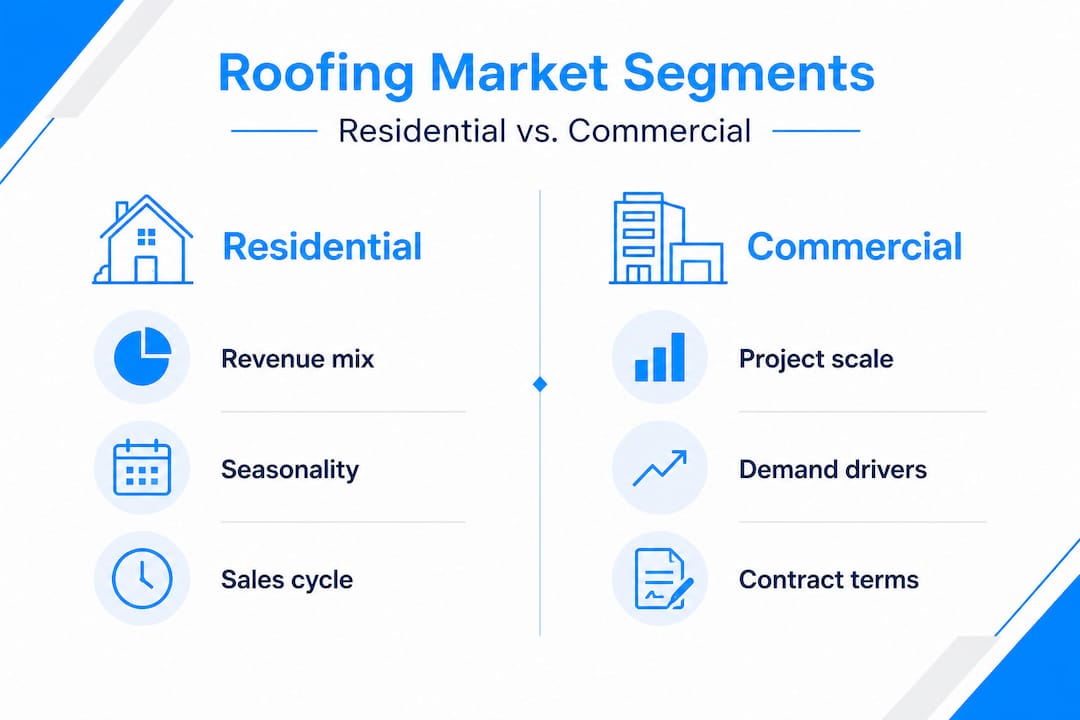
| Segment analyzed | Key insights it reveals |
|---|---|
| Residential vs. commercial | Revenue mix, seasonality, and sales cycle differences |
| Reroofing vs. new construction | Demand stability and susceptibility to housing market shifts |
| Material type (asphalt, metal, TPO) | Profit margins, installation complexity, and upsell potential |
| Geography (metro, suburban, rural) | Competition density, average ticket size, and travel costs |
| Storm vs. non-storm markets | Insurance claim volume, sales process, and customer urgency |
Competitive dynamics often get analyzed using frameworks like Porter’s Five Forces, which examines supplier power, buyer power, threat of substitutes, threat of new entrants, and rivalry among existing competitors. For roofing contractors, this translates to practical questions: How easily can a national franchise move into your market? Are material suppliers squeezing your margins? Can homeowners easily switch to a cheaper competitor mid-project?
One of the most important empirical findings from industry research is that reroofing dominates activity, with storm damage and aging housing stock serving as the primary demand drivers for contractor revenue. This is a big deal operationally. It means your marketing strategy should lean heavily into replacement and storm response, not new construction unless you’re intentionally targeting that niche.
Here’s a practical numbered approach to conducting a basic market analysis for your service area:
- Pull local permit data from your county or city building department to see actual roofing permits issued over the past 12 to 24 months. This tells you real volume, not estimates.
- Map housing stock age using U.S. Census data. Homes built before 2000 are prime reroofing candidates.
- Analyze storm history through NOAA or insurance industry data to understand where hail and wind events create repeatable demand spikes.
- Count active competitors using Google Maps, local business directories, and contractor licensing databases.
- Benchmark pricing by getting quotes as a mystery shopper or reviewing publicly posted pricing on competitor sites.
- Identify market gaps such as underserved commercial segments, material specialties no one else offers, or areas where response times are poor.
Pro Tip: Don’t confuse materials market reports with contractor opportunity. When you read that the U.S. roofing materials market is growing at a certain rate, that growth often reflects manufacturer and distributor revenue, not what’s available to install contractors. Always tie your best roofing marketing strategies to contractor-level demand data, not materials-level forecasts.
Benchmarking and contractor sentiment: Unlocking actionable insights
Raw market data tells you what is happening. Contractor sentiment and benchmarking tell you how operators are experiencing it in the field. Both are necessary. Relying on only one is like reading a weather forecast but ignoring the actual storm on your radar.
The 2025 State of the Roofing Industry Report confirms that market analysis for exterior-service providers can and should include operator-level benchmarking and contractor sentiment from industry surveys to sharpen lead generation strategies and positioning. In plain terms, when you know what other contractors are struggling with, you know where to position yourself differently.
Here’s the kind of data points you should be watching in contractor sentiment surveys:
| Metric tracked | What it tells you |
|---|---|
| Average revenue per contractor | Whether your business is above or below market average |
| Top reported challenge (economy, labor, material costs) | Where competitors are most vulnerable |
| Tech adoption rate (CRM, drones, AI estimating) | Where early adopters are gaining an edge |
| Percentage of revenue from replacement vs. new | How market mix is shifting |
| Lead source breakdown (referrals, digital, storm chasing) | Where your marketing budget should focus |
A statistic that stands out consistently across industry surveys: replacement and reroofing work typically represents over 70% of contractor revenue in mature residential markets. That single data point reframes how you should allocate your marketing spend. If you’re putting most of your advertising budget toward new construction leads, you’re chasing a fraction of available demand.
Here’s how benchmarking directly guides lead generation and market positioning:
- Identify underpromised niches where competitors are weak, such as commercial flat roofing in a mostly residential market
- Adjust your messaging when surveys show homeowners cite “trust and reviews” as the top decision factor
- Prioritize faster response when sentiment data shows customers are frustrated by slow quote turnaround times
- Budget defensively when material cost pressures are widespread and competitors may be cutting corners on quality
This is exactly why lead generation for home services works best when it’s informed by real market data, not just ad platform best practices. And when your marketing partner offers transparent reporting, you can track whether your positioning is actually resonating with the demand patterns your analysis revealed.

Connecting analysis to growth: Turning insights into lead generation
Market analysis without action is just an interesting reading exercise. The real payoff comes when you take what the data says and build a marketing and sales system around it.
Connecting macro drivers to operational reality is critical for contractors seeking data-driven lead gen and positioning. What does that look like practically? It means your Google Ads campaigns target zip codes with high concentrations of 20-plus-year-old homes. It means your Facebook Ads trigger storm response messaging within 48 hours of a major hail event in your service area. It means your sales script addresses material cost concerns that your sentiment benchmarking flagged as the top homeowner objection.
Here’s a step-by-step process for translating market analysis into a lead generation strategy:
- Identify your highest-demand segment using permit data, storm history, and housing age analysis.
- Map where competition is thinnest by cross-referencing competitor density with demand zones.
- Build geo-targeted campaigns that concentrate your ad spend in high-opportunity areas.
- Customize your messaging to address the specific concerns your sentiment benchmarking revealed.
- Track conversion rates by territory and segment to see which analysis-backed bets are paying off.
- Reinvest in what works and pull back from segments where your cost per lead is outpacing market potential.
Technology adoption is now a genuine competitive differentiator in this market. Contractors using CRM software, drone-based roof measurements, and AI-powered estimating tools are shortening their sales cycle and improving their close rates. If your market analysis shows that most local competitors are still doing manual estimates, early technology adoption becomes a positioning advantage you can market explicitly.
Pro Tip: Match your market analysis scope to your actual business model. If you’re a residential reroofer, focus your analysis on aging housing stock, storm frequency, and homeowner insurance patterns. If you’re commercial-focused, analyze lease renewal cycles, building code updates, and facility manager decision timelines. Don’t try to analyze everything. Analyze what drives your revenue.
Targeted ads for roofing contractors perform at a completely different level when they’re backed by market analysis rather than generic audience targeting. The difference between a $40 cost per lead and a $120 cost per lead often comes down to whether the targeting was informed by real demand data.
A smarter market analysis mindset: What most roofers miss
Here’s the uncomfortable truth that most articles on this topic skip entirely: most contractors who attempt market analysis do it wrong. Not because they lack intelligence, but because they look at the wrong data and draw the wrong conclusions.
The most common mistake is treating materials or manufacturer market data as a proxy for contractor opportunity. When a report says the asphalt shingles segment is growing at 4% annually, that’s a manufacturer-level metric. It tells you almost nothing about whether your market has room for another reroofer or whether demand in your zip codes is contracting. This single confusion leads contractors to feel optimistic about their market when the real local picture may be very different.
The second major trap is getting seduced by headline market size numbers and CAGR (compound annual growth rate) projections without asking what those numbers mean for a contractor operating with a specific crew size, in a specific geography, against specific competitors. A $60 billion national market means nothing if your serviceable area has four dominant competitors and three national franchise brands already fighting over the same pool of leads.
“The contractors who consistently outperform their market are the ones who treat market analysis as an ongoing operational discipline, not a one-time report they read and file away.”
The smartest operators triangulate three data sources continuously: hard industry data (permits, housing age, storm records), survey sentiment from their peer contractor community, and direct customer feedback from their own sales conversations. Very few contractors do all three consistently. That gap is where your competitive advantage lives.
Visit our roofing marketing expert guide for a deeper look at how to build this kind of ongoing market intelligence into your business operations.
Take your market analysis further and fuel better leads
Understanding your market is only half the equation. Executing on those insights with precision marketing is where contractors actually win more jobs and grow revenue.

At Results Digital, we work exclusively with roofing and exterior contractors to build lead generation systems grounded in local market data, not guesswork. Our approach to digital advertising, SEO, and website design is built around the same market analysis framework this article covers. When you know your market, your marketing dollars work harder and every campaign targets real demand. Explore our lead generation workflow for contractors to see how data-driven strategy translates into booked jobs, and check out our lead generation tips for trades to start applying these principles today.
Frequently asked questions
What is the main purpose of roofing market analysis?
Roofing market analysis estimates size and growth, maps competitive dynamics, and identifies where real demand is so contractors can target growth opportunities and plan smarter strategies.
How does market segmentation impact roofing contractors?
Segmentation helps you focus marketing and operations on the most profitable client types and geographies. Breaking the market into segments by roofing type, material, and installation type reveals where your dollars will generate the strongest return.
Why is benchmarking contractor sentiment useful?
Tracking contractor sentiment highlights demand shifts and common operational challenges, so you can adjust your positioning and messaging before your competitors do.
How can contractors apply market analysis to lead generation?
By connecting macro drivers to local realities, including tech adoption, housing age, and storm patterns, contractors can target the right clients more precisely and improve close rates significantly.
What’s a common mistake in roofing market analysis?
Many contractors rely on materials market data to gauge contractor opportunity, but manufacturer revenue growth and local install demand are entirely different metrics that can point in opposite directions.
