
TL;DR:
- Split testing enables roofing businesses to optimize ads and landing pages by comparing performance data between variations. It improves lead generation, reduces ad costs, and provides insights into what messaging resonates with homeowners. Relying on continuous testing rather than assumptions leads to a more effective, data-driven marketing strategy and business growth.
Most roofing contractors run one ad, build one landing page, and hope the phone rings. When leads slow down, they guess at fixes, change the headline, tweak the image, or kill the entire campaign before it had a real chance. That guesswork is expensive. Split testing, also called A/B testing, gives you a smarter alternative: run two versions of an ad or page simultaneously, compare the results, and let real performance data tell you what works. This article explains what split testing is, why it matters specifically for roofing businesses, and how you can use it to generate more leads and stop burning ad budget on campaigns that underperform.
Table of Contents
- What is split testing and why does it matter for roofing marketing?
- How split testing improves lead generation for roofers
- Common mistakes roofing contractors make without split testing
- Simple split tests every roofing business should try
- The truth most roofers miss about marketing ‘best practices’
- Ready to grow your roofing business with proven marketing?
- Frequently asked questions
Key Takeaways
| Point | Details |
|---|---|
| Data over guessing | Split testing uses real data—not assumptions—to optimize roofing marketing and boost leads. |
| Mistakes cost money | Skipping split testing leads to wasted ad spend and missed sales opportunities for roofers. |
| Small changes, big results | Even changing a few words or images can significantly improve your conversion rate. |
| Test, learn, improve | Successful roofers continually test, measure, and adjust their marketing to stay ahead. |
What is split testing and why does it matter for roofing marketing?
Split testing means showing two different versions of an ad or webpage to different groups of visitors at the same time. Version A might use the headline “Storm damage? Get a free roof inspection today.” Version B might say “Licensed local roofer, free estimates, fast service.” Every other element stays the same. After enough traffic hits both versions, you compare metrics like clicks, form fills, and phone calls to determine which version wins.
For roofing contractors, this process is a direct path to better ROI. When you spend money on Google Ads or Facebook Ads, every dollar should be working as hard as possible. Without testing, you’re essentially buying lottery tickets and hoping one pays off. Split testing empowers marketers to make decisions based on real performance data rather than assumptions, and that shift alone can transform a struggling campaign into a consistent lead machine.
Elements you can test include:
- Headlines on your landing page or ad copy
- Images showing completed roofs, storm damage, or your crew at work
- Call-to-action buttons (wording, placement, and color)
- Form layouts (short two-field forms vs. longer multi-step forms)
- Trust signals like review counts, years in business, or guarantee badges
Pro Tip: You don’t need a massive marketing budget to benefit from split testing. Even changing a single button from “Submit” to “Get My Free Quote” can significantly lift your conversion rate. Start small and build from there.
The core principle here is that you stop guessing about what your customers respond to and start knowing. That knowledge compounds over time. Every test you run gives you a clearer picture of your audience, making your next campaign smarter and more cost-effective than the last.
How split testing improves lead generation for roofers
Once you understand what split testing is, it becomes easier to see how it directly changes your lead volume and quality. Roofing is a competitive local market. Your competitors are often targeting the same zip codes, the same search terms, and the same homeowners. The contractor who wins is usually the one with the more persuasive message and the more friction-free experience, and split testing is how you discover what that looks like for your market.
Optimizing landing pages through split testing can significantly increase lead submissions for local service providers. A roofing company that converts 2% of landing page visitors into leads is leaving 98% of its paid traffic on the table. Small, tested improvements to headlines, layout, and CTAs can push that number to 4% or 5%, which means twice or two-and-a-half times the leads from the same ad spend.
Here’s a before-and-after comparison of what split testing can look like in practice for a typical roofing campaign:
| Metric | Before split testing | After split testing |
|---|---|---|
| Landing page conversion rate | 2.1% | 4.8% |
| Cost per lead | $98 | $43 |
| Monthly leads from same budget | 18 | 41 |
| Lead quality (quote request rate) | 35% | 62% |
| Monthly revenue attributed to ads | $18,000 | $49,000 |
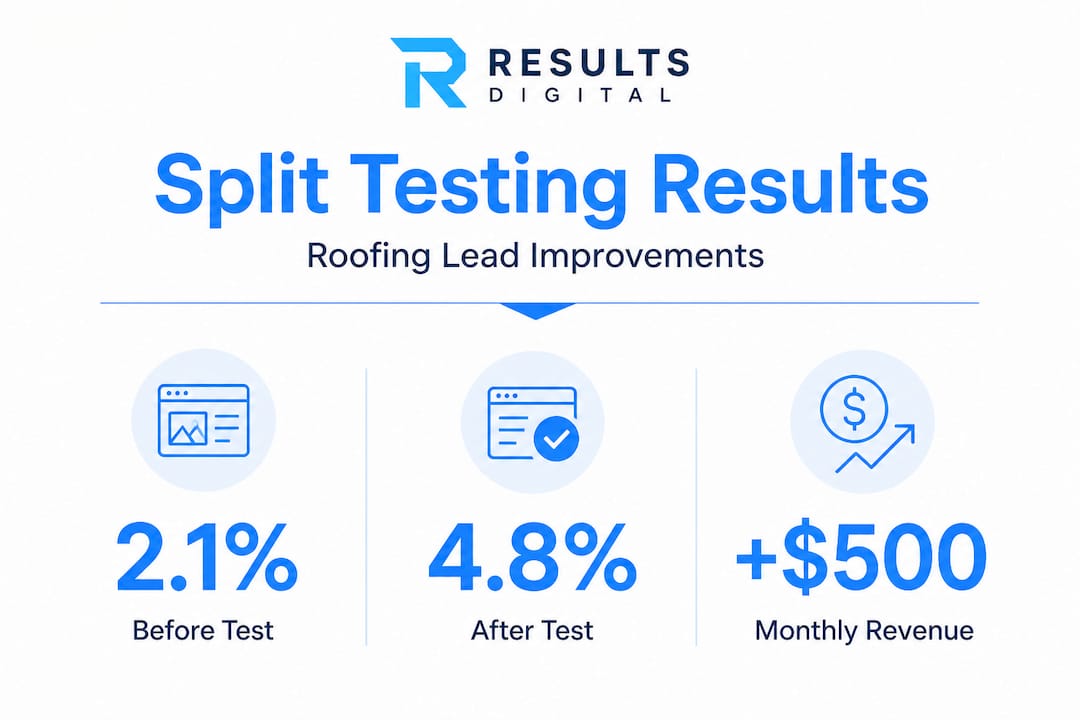
These numbers aren’t invented for effect. They reflect the kind of improvement roofing contractors experience when they commit to ongoing testing rather than set-and-forget campaigns. The drop in cost per lead alone, from $98 to $43 in this scenario, means the same $2,000 monthly ad budget delivers more than double the leads.
Strong roofing website optimization plays a key role here too. A well-structured site that loads quickly and presents a clear offer is the foundation your split tests run on. If the page itself is slow or confusing, even a winning headline variation won’t save it.
The most impactful split tests for lead generation usually involve the headline, the hero image, and the primary call-to-action. Those three elements carry the most weight in a visitor’s first impression. If you can nail those through testing, you’ll see compounding improvements across every paid campaign you run.
Common mistakes roofing contractors make without split testing
Understanding split testing’s value makes it equally important to recognize what can go wrong if you skip it. Many digital marketing for roofers campaigns fail not because the traffic is wrong, but because the experience on the landing page or in the ad itself hasn’t been refined through any testing process.
Here are the most common mistakes contractors make when they skip split testing:
- Using one landing page for every campaign. A homeowner searching “roof repair after storm” has a different intent than someone searching “best roofer near me.” Sending both to the same generic page wastes relevance and trust.
- Not tracking conversion data. If you don’t know how many visitors become leads, you can’t measure improvement. Contractors often track clicks but ignore what happens after the click.
- Changing too many things at once. If you redesign your entire landing page and leads improve, you still don’t know which change made the difference. That makes it impossible to repeat your success.
- Relying entirely on gut feeling. Experienced roofers often have strong opinions about what messaging works based on years in the field, but customer behavior online rarely matches those assumptions.
As we’ve seen, “roofing companies often pour money into ads and websites without knowing what really works, leading to missed sales opportunities.” That quote captures exactly why so many contractors feel like their marketing is a black box where money goes in and unpredictable results come out.
“The biggest mistake isn’t running the wrong ad. It’s running any ad without a system to learn from it.” This mindset shift is what separates roofing contractors who scale from those who stay stuck.
Pro Tip: When you start split testing, change only one element at a time. If you test a new headline on Monday and also swap the background image, you’ll never know which change drove the result. One variable per test keeps your data clean and your conclusions reliable.
These mistakes aren’t just minor inefficiencies. A contractor spending $3,000 per month on Google Ads without any conversion testing could easily be generating 50% fewer leads than a competitor spending the same amount but running regular A/B tests. Over a year, that gap turns into hundreds of thousands of dollars in missed revenue.
Simple split tests every roofing business should try
Now that the risks of guesswork are clear, here’s how to apply split testing to actually improve results. You don’t need expensive software or a full-time marketing team to start. You need a clear hypothesis, one change at a time, and enough traffic to draw a reliable conclusion.
Testing different offers, headlines, and calls to action can quickly reveal what produces more qualified leads for home service businesses. Here are five split tests that roofing contractors can run right now:
- Headline test. Write two versions of your landing page headline. One focuses on urgency (“Storm season is here, protect your home today”) and one focuses on trust (“Over 500 five-star reviews from local homeowners”). Run both and see which drives more form fills.
- CTA button color and text. Try an orange button that says “Get a Free Estimate” against a green button that says “Schedule My Inspection.” Color and copy both matter, but test one at a time.
- Hero image swap. Compare a before-and-after photo of a roof replacement against a photo of your actual crew in uniform working on a local home. Real photos often outperform stock images significantly.
- Form length test. A short form asking for name and phone number often converts better at the top of the funnel. A longer form that captures damage type and preferred contact time may produce better quality leads. Test both to find your sweet spot.
- Trust signal placement. Move your review count and certifications from the bottom of the page to directly below the form. Many contractors see a measurable lift just by repositioning existing social proof.
Here’s a simple before-and-after data table from a headline split test on a roofing company’s landing page:
| Version | Headline tested | Visits | Leads | Conversion rate |
|---|---|---|---|---|
| A (original) | “Request a free roof inspection” | 320 | 9 | 2.8% |
| B (challenger) | “Most trusted roofer in [City]: free inspection this week” | 318 | 21 | 6.6% |
Version B more than doubled the conversion rate with a single headline change. That’s the power of testing. The traffic cost was identical. The outcome was dramatically different.
For Facebook ad split tests, you can use Facebook’s built-in A/B testing tool to compare audiences, ad creatives, and placements without any third-party software. If you’re unsure where to start, reviewing what top roofing marketing agencies are testing in their campaigns can give you a useful reference point for the types of variables worth prioritizing.
Run each test for at least one to two weeks or until you have a few hundred visitors on each variation. Ending a test early because one version looks like it’s winning is a common trap. Early data can be misleading, and patience here protects your decisions from random noise.
The truth most roofers miss about marketing ‘best practices’
Here’s an uncomfortable perspective worth sitting with. Most “best practices” in roofing marketing are recycled advice based on what worked for someone else, in a different market, at a different time, with a different audience. Following them without testing is like wearing another roofer’s work boots and wondering why they don’t fit.
We see this constantly. Contractors copy a competitor’s landing page layout because it looks professional. They use the same three-step process graphic every other roofing site uses. They write ad copy that sounds exactly like everyone else in their market. None of that is wrong on its own, but none of it will give you an edge either.
The contractors who consistently grow their businesses treat every campaign like an experiment. They form a hypothesis, run a test, read the results, and adjust. They don’t get emotionally attached to a headline they liked writing. They let the data decide. That’s a fundamentally different mindset from “set up the campaign and see what happens.”
Targeted roofing ads built on split-tested insights perform better not just because the creative is stronger, but because the contractor running them actually understands their audience at a granular level. They know which image resonates with homeowners in their zip code. They know whether urgency messaging or trust messaging drives more calls. No competitor can easily replicate that knowledge because it was earned through their specific tests on their specific audience.
The real mistake isn’t following best practices. It’s stopping there. Best practices are a starting point, not a ceiling. Use them to get your campaigns off the ground, and then test your way to something genuinely better than what everyone else is doing.
Ready to grow your roofing business with proven marketing?
Split testing is one of the highest-leverage marketing activities a roofing contractor can invest in, but it works best when it’s part of a broader, well-structured digital marketing strategy. Knowing what to test is only half the battle. You also need campaigns that drive enough quality traffic to produce reliable results, and landing pages built to convert from the start.
Results Digital specializes exclusively in helping roofing and exterior contractors build exactly that kind of system. From high-converting websites to data-driven ad campaigns, our roofing marketing resources are built around one goal: more leads, more calls, and more booked jobs for your business. Whether you’re exploring proven roofing marketing strategies or looking for a dedicated roofing marketing agency to run your campaigns, Results Digital works exclusively with one contractor per market so your competitive advantage is always protected. Don’t wait for a competitor to figure this out first.
Frequently asked questions
What’s the fastest way to start split testing for my roofing website?
Begin with one simple change, like your homepage headline, and use website analytics tools to track which version gets more leads. Testing different headlines and calls to action can quickly reveal what produces more qualified leads.
How do I know when a split test result is reliable?
Wait for a statistically significant sample size, usually a few hundred visitors per variation, before acting on the results. Split testing landing pages properly requires patience to avoid making decisions based on random early fluctuations.
Which ad platforms are best for split testing roofing campaigns?
Google Ads and Facebook Ads both have built-in A/B testing tools that let you compare campaign versions head-to-head and identify which one generates more roofing leads in your local market.
Does split testing cost a lot more than traditional roofing marketing?
Split testing requires more setup time upfront, but it saves money over time by directing your budget toward the ads and pages that actually convert. Wasting budget on untested campaigns is ultimately far more expensive than structured testing.
What tools do most roofing companies use for split testing?
Most roofing contractors use Google Optimize, the built-in split testing features in Facebook Ads Manager, or dedicated landing page platforms like Unbounce or Instapage that include A/B testing as a core feature.
Recommended
- Marketing For Roofing Company | Results Digital
- Best Roofing Marketing: 7 Strategies to Dominate 2026
- Roofer Digital Marketing Agency | Results Digital
- 7 Essential Roofing Marketing Tips 2025 for Local Growth
- Your Marketing Budget Is Leaking Revenue | Attorney Assistant | Attorney Assistant
- Blog | spherescout.io – B2B Lead Generation Insights
