
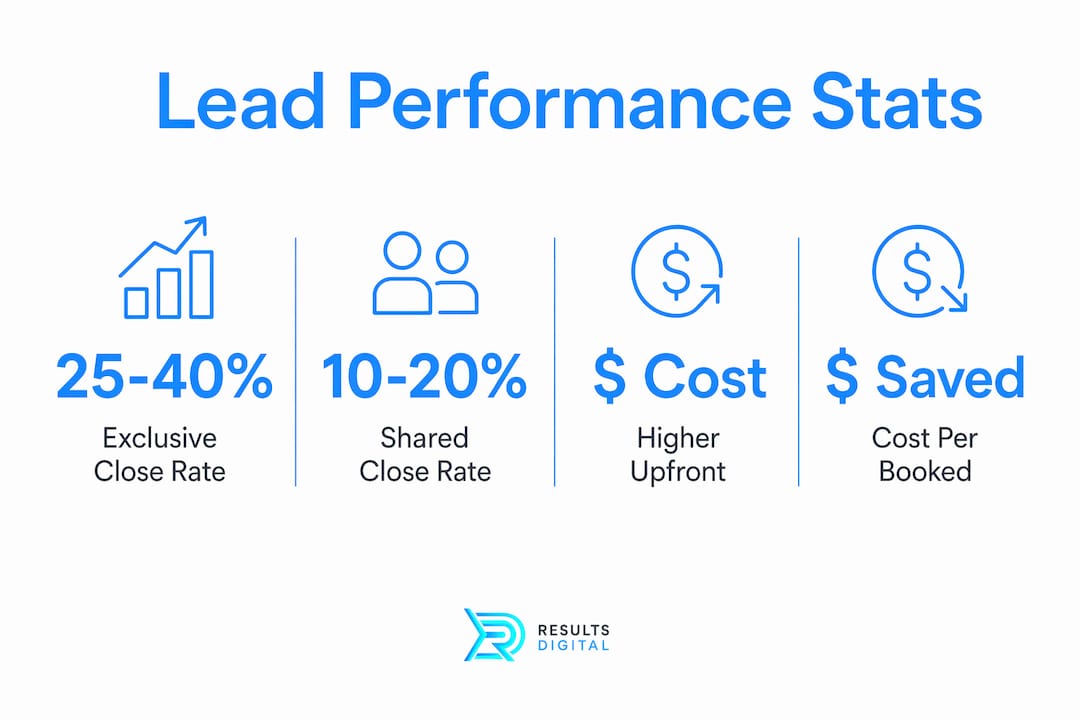
Exclusivity in marketing is defined as a contractor’s sole right to receive leads, campaigns, or territory coverage from a marketing partner, with no competitors sharing the same pipeline. This model is the single most effective contractor marketing strategy for improving close rates, protecting margins, and winning jobs on reputation rather than price. Exclusive leads close at 25–40% compared to 10–20% for shared leads. That gap is not a minor edge. It is the difference between a business that grows and one that grinds. Understanding why contractors need exclusivity in marketing starts with understanding what shared leads actually cost you.
Why exclusive leads outperform shared leads for contractors
Exclusive leads deliver a structural sales advantage that shared leads cannot replicate. When a prospect contacts only your business, the conversation starts from a position of trust, not competition. You are not racing three other roofers to the phone. You are the only option on the table.
The math is clear. Home-service contractors close exclusive leads at a rate of 25–40%, while shared leads close at just 10–20%. That means for every 10 exclusive leads, you book 3–4 jobs. With shared leads, you book 1–2 jobs from the same spend. The cost per booked job with shared leads is often double or triple what it appears on the surface.
Exclusivity also protects your average job value. Shared leads create a race to the bottom on price because homeowners receiving multiple quotes almost always choose the lowest bid or the most aggressive sales pitch. That dynamic cuts your margins on every job. Exclusive leads let you compete on quality, reviews, and reputation instead.

| Lead Type | Close Rate | Price Competition | Cost Per Booked Job |
|---|---|---|---|
| Exclusive leads | 25–40% | Low | Lower overall |
| Shared leads | 10–20% | High | Higher overall |
| Inbound SEO leads | Varies | Low to moderate | Low with time |
| Pay-per-lead (shared) | 10–15% | Very high | Often highest |
Pro Tip: Track your cost per booked job, not just your cost per lead. Exclusive leads often cost more upfront but produce a lower cost per booked job when you account for close rate differences.
What problems do shared leads cause for contractors?
Shared leads create a specific, painful pattern that most contractors recognize immediately. You buy a lead, call within minutes, and discover two other contractors already left voicemails. The prospect is now comparing three bids before you even get a word in. This is the “callback sprint,” and it burns time, energy, and money.
Exclusive leads eliminate the callback sprint, removing the frantic race to contact a prospect before a competitor does. That pressure changes how you sell. When you are not competing for attention, you can slow down, ask better questions, and position yourself as an advisor rather than a vendor. That shift alone improves close rates.
Shared leads also carry a qualification problem. Lead aggregators sell the same inquiry to multiple contractors regardless of whether the prospect is a serious buyer or someone casually browsing prices. You pay the same rate for a tire-kicker as you do for a homeowner ready to sign. Exclusivity filters that noise because your marketing targets and captures prospects who are already aligned with your service area, trade, and price range.
Here is what shared leads cost you beyond the invoice:
- Wasted call time chasing prospects who have already chosen a competitor
- Margin erosion from price wars on every multi-quote job
- Brand damage when a rushed sales call goes poorly under pressure
- Low morale for your sales team or yourself when close rates stay flat
- No relationship building because the conversation starts defensively
Exclusivity resolves each of these problems by giving you the first and only conversation with a qualified prospect.
Pro Tip: Redirect your marketing budget away from shared lead platforms and toward channels you control, such as Google Local Services Ads, local SEO, and your own website. These channels generate leads that belong only to you.
Exclusive vs. shared marketing: which approach fits your business?
Not every contractor is in the same position, so the right marketing model depends on your market, your team size, and your growth goals. That said, the long-term ROI case for exclusivity is strong for most contractors in competitive trade areas.
Smaller contractor operations benefit most from exclusivity because a one or two-person crew cannot respond to shared leads as fast as a large company with a dedicated call center. Exclusivity levels that playing field. You get the lead without the sprint.
| Attribute | Exclusive marketing | Shared/open lead sources |
|---|---|---|
| Lead volume | Lower, more consistent | Higher, less predictable |
| Cost per lead | Higher upfront | Lower upfront |
| Competition per lead | None | 2–5 competitors |
| Conversion likelihood | High (25–40%) | Low (10–20%) |
| Price negotiation pressure | Low | High |
| Long-term margin impact | Positive | Negative |
| Best for | Growth-focused contractors | Volume-testing new markets |
Exclusive marketing integrates naturally with Google Local Services Ads, which position verified contractors prominently in search results and generate inbound calls from high-intent prospects. When you combine Google Local Services Ads with local SEO and a strong review profile, you build a lead pipeline that competitors cannot tap into. That combination is the foundation of effective marketing for contractors who want to grow without constantly outbidding rivals on lead platforms.
Exclusive lead generation shifts the model from chasing volume to delivering steady, qualified, job-ready prospects. Quality over quantity is not a slogan. It is a financial strategy that compounds over time as your reputation grows and your referral rate increases.
How do contractors secure exclusivity in marketing partnerships?
Securing exclusivity starts with asking the right questions before you sign anything. Most marketing agencies and lead providers will offer exclusivity if you ask directly. Many contractors never ask. That is a costly oversight.
Effective exclusivity agreements require clear definitions of territory, services covered, and lead types assigned exclusively to your business. A vague agreement creates conflicts. A specific one protects your investment. Before signing, confirm the following in writing:
- Geographic territory: Which zip codes or counties are yours exclusively?
- Trade scope: Does exclusivity cover all your services or only specific ones?
- Lead types: Are inbound calls, form fills, and Google Ads leads all included?
- Competitor policy: Will the agency work with a direct competitor in your market?
- Reporting access: Can you see lead source data and call recordings?
Once you have an exclusive arrangement in place, measure its impact monthly. Track booked jobs per lead source, average job value by lead type, and close rate by channel. These numbers tell you whether the exclusivity is delivering. If your close rate on exclusive leads is not outperforming your shared lead history, the issue is usually follow-up speed or sales process, not the lead itself.
Complement your exclusive lead strategy with local SEO for contractors, a review generation program, and a referral incentive for past customers. These channels reinforce each other. A strong Google Business Profile with 50-plus reviews makes every exclusive lead easier to close because the prospect already trusts you before the first call.
Exclusive marketing also lets you build trust earlier in the sales process. When a prospect contacts only you, they have not yet been conditioned to compare prices. You can guide the conversation toward value, timeline, and fit before they ever think about getting a second quote.
Key Takeaways
Exclusivity in contractor marketing is the most direct path from volume chasing to consistent, margin-protecting growth built on lead quality and reputation.
| Point | Details |
|---|---|
| Close rate advantage | Exclusive leads close at 25–40% versus 10–20% for shared leads. |
| Margin protection | Exclusivity removes price wars, letting you compete on quality and reputation. |
| Callback sprint eliminated | You reach prospects first and only, enabling advisory selling instead of defensive pitching. |
| Small crews benefit most | One or two-person operations gain the biggest edge by removing the speed disadvantage. |
| Contracts need specifics | Define territory, trade scope, and lead types in writing before committing to any exclusivity deal. |
The real shift exclusivity creates for contractors
Working with contractors across roofing, siding, gutters, and general construction, the pattern is consistent. The ones who struggle most are not the ones with the smallest budgets. They are the ones buying shared leads and wondering why their close rate stays flat no matter how much they spend.
The uncomfortable truth is that shared leads are not a lead generation problem. They are a business model problem. When you buy the same lead as your competitor, you have already lost the positioning battle before you dial the phone. You are not selling your expertise. You are defending your price.
The contractors who shift to exclusivity describe the same experience: the conversations change. Prospects are calmer. They ask fewer “what’s your best price?” questions. They listen. That is not a coincidence. It is what happens when a homeowner contacts one contractor instead of five. They are looking for a solution, not a bidding war.
The hesitation I hear most often is cost. Exclusive leads and exclusive agency partnerships cost more upfront. That is true. But the math always works out when you track cost per booked job instead of cost per lead. A $300 exclusive lead that closes 35% of the time costs you $857 per booked job. A $100 shared lead that closes 12% of the time costs you $833 per booked job before you factor in the time wasted on the other eight calls. The numbers are closer than most contractors expect, and the exclusive model wins on margin every time.
If you are hesitant, start by auditing your current close rate by lead source. The data will tell you what to do next.
— Results
How Resultsdigitalus helps contractors win with exclusive marketing
Resultsdigitalus was built specifically for contractors who are done competing on price and ready to compete on reputation. The agency partners with only one contractor per trade per market, which means every campaign, keyword, and ad dollar works exclusively for your business.
Preston Toor and the Resultsdigitalus team deliver SEO, Google Ads, Meta Ads, and custom website design engineered for contractor lead generation. One Florida roofing client grew from 3 crews to 18 and sold for $60 million. That result came from a focused, exclusive marketing model that prioritized lead quality over lead volume. If you are a roofing, siding, gutter, or general contracting business ready to build that kind of pipeline, contractor digital marketing services from Resultsdigitalus are built for exactly that goal.
FAQ
What is exclusivity in contractor marketing?
Exclusivity in contractor marketing means your marketing partner works only with your business in your trade and territory. No competitor receives the same leads, campaigns, or keyword coverage.
How much better do exclusive leads perform than shared leads?
Exclusive leads close at 25–40% compared to 10–20% for shared leads. That gap translates directly to more booked jobs per marketing dollar spent.
Are exclusive leads worth the higher upfront cost?
Yes, when you measure cost per booked job rather than cost per lead. Higher close rates on exclusive leads typically produce a lower cost per booked job than cheaper shared leads with low conversion rates.
Which contractors benefit most from exclusive marketing?
Smaller operations with one or two crews gain the most because they cannot compete with large companies on callback speed when leads are shared. Exclusivity removes that disadvantage entirely.
What should an exclusive marketing agreement include?
A solid agreement defines your geographic territory, the specific services covered, the types of leads included, and a clear policy preventing the agency from working with direct competitors in your market.
