
PPC for roofers works when it’s built around one metric: booked jobs. Not impressions, not clicks, not even raw leads. When you tie every paid dollar to a closed estimate, the math becomes clear fast. A roofing company with a $12,000 average job value, a typical gross margin around one-third, and a moderate close rate characteristic of the industry can sustain a cost per lead well above $200 and still profit on every campaign dollar spent.
The benchmarks back that up. LocaliQ’s 2025 home services data puts the average cost per lead for roofing and gutters at $228.15, according to LocaliQ’s 2025 data — notably higher than most other home services categories. That number scares off contractors who are used to thinking in clicks. It shouldn’t. The job economics absorb it easily when your close rate and landing page are doing their job.
Three actions to take before you spend a dollar:
- Set up call tracking (CallRail works well) and map every lead source to a CRM stage: lead, estimate scheduled, job booked.
- Launch Google Local Services Ads and one high-intent search campaign targeting your top two or three service types.
- Build a dedicated landing page for each campaign, not a homepage redirect.
Budget starting points by market:
- Smaller local market: a monthly budget in the lower thousands range
- Mid-market: a monthly budget in the mid thousands range
- Dense metro: a monthly budget in the higher thousands range
Pro Tip: Accounts spending less than a low thousands amount per month rarely generate enough conversion volume to optimize. If you can’t commit to at least $2,000/month, hold off until you can, or you’ll be flying blind on data that never reaches statistical significance.
Table of Contents
- Why PPC works differently for roofing than for other trades
- What does PPC actually cost for a roofing company?
- How to structure your roofing PPC campaigns for consistent lead flow
- Which keywords to bid on and which to block
- Ad formats and extensions that turn searches into phone calls
- Landing pages, call tracking, and CRM setup that measure booked jobs
- Bidding strategies and budget pacing: when to use which approach
- Common PPC mistakes roofers make and how to fix them fast
- Which KPIs actually tell you if your roofing PPC is working
- Your 30- and 90-day plan to launch roofing PPC that books jobs
- What Results Digital’s roofing clients have learned from real campaigns
- Key Takeaways
- Why niche expertise in roofing PPC changes what’s possible
- Resultsdigitalus manages roofing PPC so your budget books jobs, not just clicks
- Useful sources and further reading
Why PPC works differently for roofing than for other trades
Roofing is a high-ticket, low-frequency purchase. A homeowner might hire a roofer once every 15–20 years. That means the window to capture them is narrow, the urgency is often high, and the job value justifies a much higher acquisition cost than most contractors realize.
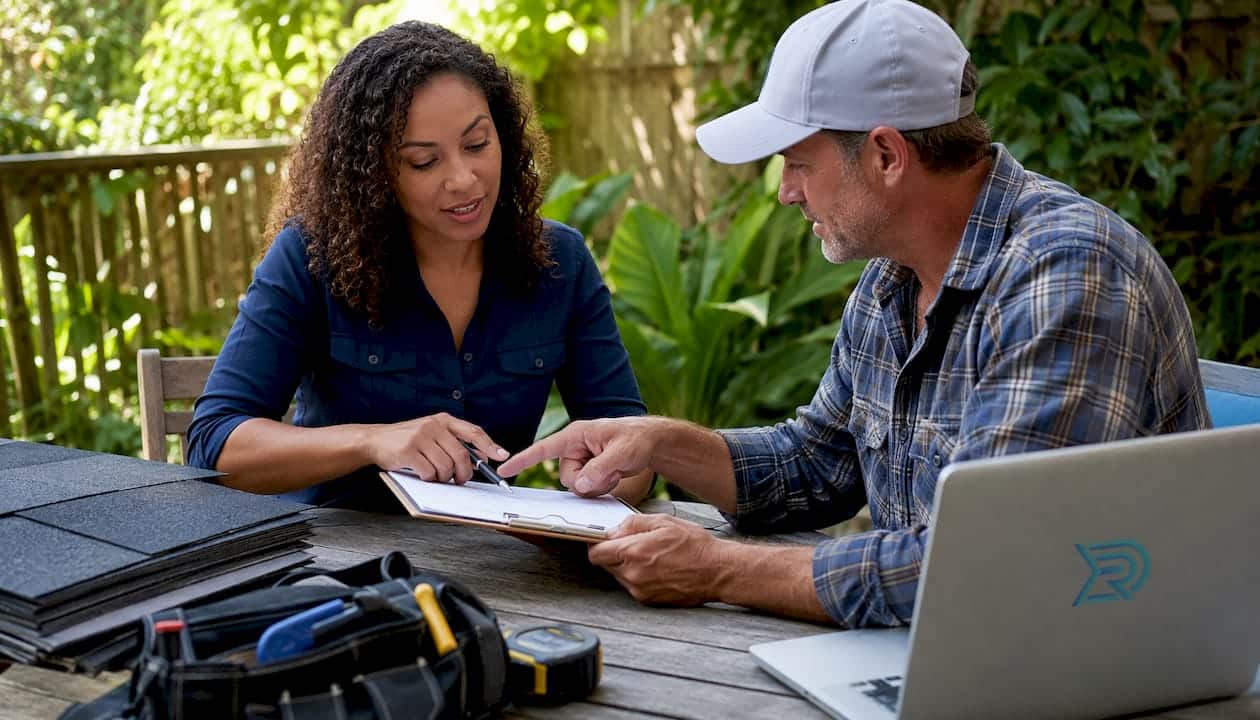
Here’s the math that changes how you think about campaigns. If your average replacement job is $14,000 and your gross margin is 35%, you’re generating $4,900 in gross profit per job. With a moderate close rate characteristic of the industry on estimates, you need roughly 3.3 leads to book one job. That means a $300 cost per lead produces a $990 cost per booked job, leaving $3,910 in gross profit before overhead. Most contractors panic at a $300 CPL. The math says it’s fine.
Storm damage and insurance restoration amplify this further. When hail hits a neighborhood, homeowners aren’t browsing, they’re searching with urgency. Paid search captures that demand in real time. No other channel responds as fast.
Business benefits of roofing PPC done right:
- Fills your pipeline within days of launch, not months like SEO
- Lets you target specific ZIP codes, counties, or storm-affected areas precisely
- Gives you campaign-level data to test offers (free inspection, insurance assistance, financing) against each other
- Scales up or down with your crew capacity and season
The mindset shift most contractors need is moving from “how many leads did we get?” to “how many jobs did we book and at what cost?” Tying ad spend to booked jobs through call tracking and CRM reconciliation is what separates profitable campaigns from expensive click-buying.
Pro Tip: Speed-to-lead is an operational KPI, not just a marketing one. Leads not called within five minutes convert at a fraction of the rate of those called immediately. Brief your office staff before you launch, not after.
What does PPC actually cost for a roofing company?
Costs vary by market density, season, and campaign type. The table below gives realistic ranges based on industry benchmarks.
| Channel / Lead Type | Typical CPL Range | Notes |
|---|---|---|
| Google Local Services Ads | $25–$95 | Pay per lead; highest booked-job conversion rate |
| High-intent Google Search | $125–$228 | Varies by market; industry average $228 |
| Non-branded search campaigns | approximately $124 based on non-branded campaign averages in early 2026 | |
| Meta Ads (storm/mid-funnel) | $25–$95 | Lower CPL, requires stronger CRM follow-up |
| Commercial roofing keywords | Higher end | CPCs can reach $35–$50 per click |
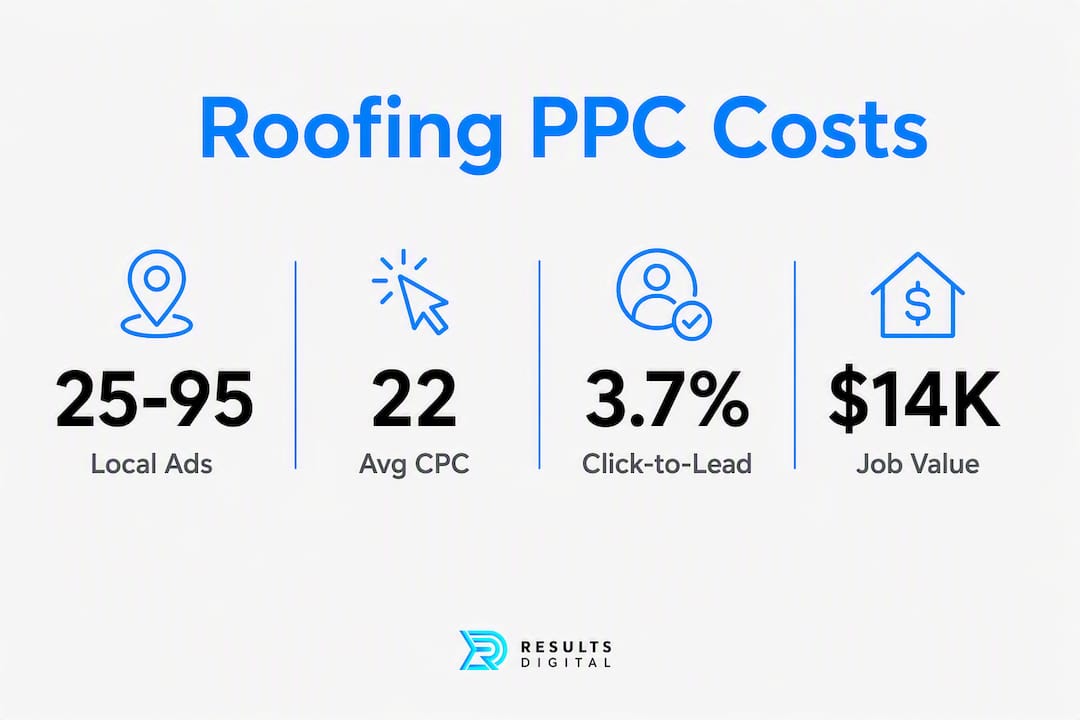
The industry average click-to-lead rate for roofing is 3.7%, with average click costs around $22 across typical accounts. Top commercial keywords push $35–$50 per click, which is why budget discipline matters from day one.
A simple ROI example:
Say you spend $4,000/month on Google Search and generate 20 leads at $200 CPL. With a moderate close rate characteristic of the industry, you book 6 jobs. At $10,000 average job value, that’s $60,000 in revenue from $4,000 in ad spend. Even after a typical gross margin around one-third, you’re looking at $21,000 gross profit against $4,000 spent.
What to expect by timeline:
- Days 1–30: Data collection. Expect higher CPLs while the algorithm learns and you build negative keyword lists.
- Days 31–60: CPL begins to stabilize. Identify top-performing keywords and pause waste.
- Days 61–90: Enough conversion data to test automated bidding and A/B landing pages.
CPLs in dense metros like Houston, Atlanta, or Phoenix run higher than rural or suburban markets. Insurance-driven demand after a storm event can temporarily spike both volume and CPL. Budget for variability, not just averages.
How to structure your roofing PPC campaigns for consistent lead flow
Account architecture determines whether your budget works efficiently or bleeds into irrelevant clicks. The goal is to separate intent, control spend by service type, and give each campaign a matched landing page.
Recommended campaign structure:
- Emergency Repairs (40–50% of budget): “roof leak repair near me,” “emergency roofer [city]” — highest urgency, highest close rate
- Roof Replacement (25–30% of budget): “roof replacement cost [city],” “new roof installation [zip]”
- Insurance / Storm Damage (10–15% of budget): “hail damage roof repair,” “insurance roof claim [city]”
- Brand Defense (5–10% of budget): your company name + city, prevents competitors from stealing branded searches
- Remarketing (5–10% of budget): past site visitors who didn’t convert; lower CPCs, warm audience
Local Services Ads run separately from your Google Ads account and should be active alongside search campaigns. LSA CPLs typically run $25–$95, and their Google Guarantee badge lifts contact rates meaningfully.
Geo-targeting rules that prevent wasted spend:
- Use ZIP code or county targeting, not broad radius, unless you’ve verified your service area covers the full radius
- Apply bid modifiers (+15–25%) to your highest-revenue ZIP codes
- Exclude ZIPs where you don’t operate, even if they’re geographically close
- Split campaigns by service area if you cover multiple cities with different competitive landscapes
Ad schedule: Run ads during hours your phones are answered. If your office closes at 6 PM, either pause ads after 6 or route calls to an answering service. A lead that hits voicemail at 7 PM rarely converts.
Pro Tip: Start with manual CPC and exact-match keywords for the first 30 days. Automated bidding needs 15–30 conversions per month to work reliably. Launch it too early and Google’s algorithm optimizes for the wrong signals.

Which keywords to bid on and which to block
Keyword selection is where most roofing PPC budgets either work or get wasted. The principle is simple: bid on transactional intent, block everything else.
High-priority keyword themes:
- Emergency/repair: “roof leak repair [city],” “emergency roof repair near me,” “roof repair contractor [zip]”
- Replacement: “roof replacement [city],” “new roof cost [city],” “reroof [city]”
- Storm/insurance: “hail damage roof repair,” “storm damage roofer,” “insurance roof claim help [city]”
- Inspection: “roof inspection [city],” “free roof inspection near me”
- Commercial: “commercial roofing contractor [city],” “flat roof repair [city]”
Transactional keyword targeting with service + city or service + “near me” formats consistently produces higher-quality leads than broad informational terms. Avoid bidding on “roofing” alone. It attracts suppliers, job seekers, DIYers, and students, not homeowners ready to hire.
Match type strategy:
- Start with exact match on your top 10–15 converting terms
- Add phrase match once you’ve confirmed which exact-match terms convert
- Test broad match only after you have strong negative keyword lists and at least 60 days of data
Negative keyword list to add on day one:
- Jobs/careers: “roofing jobs,” “roofing careers,” “roofer salary,” “hiring roofers”
- DIY/supplies: “roofing shingles,” “roofing materials,” “how to roof,” “DIY roof repair”
- Training: “roofing certification,” “roofing school,” “roofing license course”
- Price shoppers: “free roof,” “cheap roofing,” “roofing grants”
- Unrelated: “metal roofing screws,” “roofing nail gun,” “roofing underlayment”
Pro Tip: Review your search terms report every week for the first 60 days. Broad match keywords and thin negative keyword lists are the single biggest source of wasted spend in roofing accounts. Add negatives aggressively and early.
Ad formats and extensions that turn searches into phone calls
Launching ads without solid creative assets is like sending a sales rep out without a business card or a pitch. The ad is your first impression, and for roofing, the goal is always a phone call or a form submission, not a click for its own sake.
Sample ad copy by campaign type:
- Emergency repair (call-only): “Roof Leaking? We’re On It Today | Licensed & Insured | Call Now — Free Estimate”
- Replacement estimate: “New Roof in [City] | Free Estimate | GAF Certified | Financing Available”
- Insurance claim: “Hail Damage? We Handle Insurance Claims | Free Inspection | [City] Roofers”
Keep headlines under 30 characters where possible. Use the city name in at least one headline. Include a trust cue (licensed, insured, certified, years in business) and a clear call to action.
Extensions every roofing campaign needs:
| Extension Type | Why It Matters for Roofing |
|---|---|
| Call extension | Puts your phone number directly in the ad; critical for mobile searchers |
| Lead form extension | Captures name, phone, and zip without requiring a landing page visit |
| Sitelink extensions | Links to specific services (repairs, replacement, inspections) |
| Location extension | Shows your address; builds local trust and improves Quality Score |
| Callout extensions | Short trust phrases: “24/7 Emergency Service,” “Insurance Claims Specialist” |
Mobile-first matters. Most roofing searches happen on phones. Call-only ads remove the landing page entirely and route the searcher directly to your phone line. For emergency and repair campaigns, call-only ads often outperform standard text ads because they eliminate friction.
For ad copy guidance tailored to roofing, the ad copywriting guide for roofers covers templates and offer testing in detail.
Pro Tip: Test at least two offers per campaign: one urgency-based (“Same-Day Response”) and one value-based (“Free Insurance Claim Inspection”). Let the data pick the winner after 200–300 impressions per variant.
Landing pages, call tracking, and CRM setup that measure booked jobs
Sending paid traffic to your homepage is one of the most common and costly mistakes in roofing PPC. Your homepage is designed for everyone. Your landing page should be designed for one person: the homeowner who just searched for what you offer.
Implementation checklist:
- Build a dedicated landing page for each campaign type (emergency repair, replacement, insurance).
- Match the landing page headline to the ad headline exactly.
- Install call tracking with dynamic number insertion (DNI) so each traffic source gets a unique phone number.
- Set up UTM parameters on every ad URL to track source, medium, and campaign in Google Analytics.
- Connect your call tracking tool (CallRail is a widely used option) to your CRM.
- Map CRM fields to pipeline stages: lead received, estimate scheduled, estimate completed, job booked, job completed.
- Tag every inbound call and form submission with its originating campaign and keyword.
Conversion event priority:
| Lead Event | Pipeline Stage | Attribution Weight |
|---|---|---|
| Inbound phone call (60+ sec) | Lead received | Primary conversion |
| Form submission | Lead received | Primary conversion |
| Call-back request | Lead received | Secondary conversion |
| Estimate scheduled | Estimate stage | Revenue attribution |
| Job booked | Booked job | Full CPA calculation |
Landing page UX that converts:
- Headline matches the ad (if the ad says “Hail Damage Repair in Dallas,” the page says the same)
- Short form: name, phone number, ZIP code, service needed (four fields maximum)
- Trust bar above the fold: Google review rating, manufacturer certifications (GAF, Owens Corning), years in business
- Financing and insurance claim language if relevant to the campaign
- One clear call to action, not three competing ones
Landing page optimization can move conversion rates from around 6% to 14%, reducing CPL by roughly 38% without increasing spend. That’s the fastest CPL reduction available to most roofing accounts.
For a deeper walkthrough of attribution setup, the roofing call tracking guide covers DNI, CRM mapping, and reporting in detail.
Bidding strategies and budget pacing: when to use which approach
Bidding strategy selection depends on one thing: how much conversion data you have. The wrong strategy at the wrong time wastes money just as surely as the wrong keywords.
Target CPA formula:
Target CPA = (Average Job Value × Gross Margin × Close Rate)
Example: $12,000 job value × 35% margin × a moderate close rate characteristic of the industry = $1,260 gross profit per booked job. Divide by the number of leads needed per booking (roughly 3.3 at a moderate close rate characteristic of the industry) and your maximum sustainable CPL is around $382. Most roofers are spending well under that ceiling.
When to use each bidding approach:
- Manual CPC: Use for the first 30 days on every new campaign. Gives you full control while you identify which keywords actually convert.
- Max Conversions: Switch to this once you have 15–20 conversions in a 30-day window. Lets Google optimize delivery without a CPL constraint.
- Target CPA: Use after 30+ conversions per month. Set your target CPA at your calculated maximum sustainable CPL and let the algorithm work within that ceiling.
- Target ROAS: Best for accounts with high conversion volume and reliable revenue data tied to specific campaigns.
Budget pacing tips:
- Set daily budgets at monthly budget ÷ 30.4, then check actual spend weekly for over-delivery.
- Don’t increase daily budget more than 20% at a time. Larger jumps reset the learning phase.
- Before scaling spend, confirm your landing page conversion rate is above 8%. Scaling a 4% conversion rate just means paying more for the same CPL.
- Pause campaigns before increasing budget if your CRM shows leads aren’t being followed up within 24 hours.
Pro Tip: Never move to automated bidding before hitting the conversion threshold. Google’s algorithm needs data to work. Feed it too little and it optimizes for the wrong signals, often driving cheaper but lower-quality clicks that never become estimates.
Common PPC mistakes roofers make and how to fix them fast
Most roofing PPC accounts that underperform share the same handful of problems. Here’s what to look for and what to do about each one.
The most common pitfalls:
- Broad match keywords with no negatives: Ads show for “roofing jobs,” “roofing shingles,” and “roofing school.” Fix: switch to exact and phrase match, add a negative keyword list on day one.
- Sending traffic to the homepage: Conversion rates drop to 1–2% because the page isn’t relevant to the search. Fix: build dedicated landing pages per campaign, matched to ad copy.
- No call tracking: You can’t tell which keywords produce calls, which produce jobs, or whether the campaign is profitable. Fix: install CallRail or a similar tool before spending a dollar.
- Slow lead response: Leads called after five minutes convert at a fraction of the rate of immediate callbacks. Fix: set up call routing and brief your team before launch.
- Underfunding the test budget: Spending $800/month produces too few leads to optimize. Fix: commit to at least $2,000/month or wait until you can.
- Ignoring the search terms report: Wasted spend accumulates silently. Fix: review search terms weekly and add negatives continuously.
When to pause or cut:
- A keyword has spent 3× your target CPL with zero conversions. Pause it.
- A campaign’s CPL is 2× your target for 30 consecutive days with no improvement. Restructure before adding budget.
- Your close rate on PPC leads drops below 15%. The problem is likely lead quality (keyword targeting) or speed-to-lead (operations), not the campaign itself.
For a full diagnostic checklist, the common roofing marketing mistakes guide covers both campaign-level and operational fixes.
Which KPIs actually tell you if your roofing PPC is working
Vanity metrics are the enemy of profitable campaigns. Impressions, clicks, and click-through rate tell you almost nothing about whether your ad spend is generating revenue.
The metrics that matter:
- Cost per lead (CPL): Total ad spend ÷ total leads. Your primary efficiency metric.
- Click-to-lead rate: Leads ÷ clicks. Measures landing page performance. Industry average is 3.7% for roofing.
- Lead-to-booked-job rate: Booked jobs ÷ total leads. Measures sales and speed-to-lead performance.
- Cost per booked job (CPA): Total ad spend ÷ booked jobs. The metric that ties to revenue.
- Return on ad spend (ROAS): Revenue from booked jobs ÷ ad spend. Target 5:1 or higher for roofing.
- Lifetime value (LTV): Accounts for referrals, repeat work, and reviews generated from each booked job.
Sample monthly report layout:
| Report Section | What to Include |
|---|---|
| Executive summary | Total spend, leads, booked jobs, CPL, CPA, ROAS |
| Top keywords | Top 5 by conversion volume and CPL |
| Channel breakdown | Google Search, LSA, Meta Ads CPL comparison |
| Booked-job attribution | Which campaigns and keywords produced closed revenue |
| Recommendations | What to scale, pause, or test next month |
Metrics to ignore: Impressions, average position, and click-through rate in isolation. A 10% CTR on a broad keyword that never converts is worse than a 3% CTR on an exact-match term that books jobs every week.
CRM reconciliation is the final step. Pull your booked jobs from the CRM monthly, match them to their originating campaign and keyword in your call tracking tool, and calculate true CPA per channel. Without this step, you’re making budget decisions on incomplete data.
Your 30- and 90-day plan to launch roofing PPC that books jobs
A phased launch prevents the most common early mistakes: spending before tracking is ready, scaling before conversion data exists, and adding budget before the landing page converts.
Days 1–30: Foundation
- Install call tracking with DNI and connect it to your CRM.
- Set up Google Ads conversion tracking for calls (60+ seconds) and form submissions.
- Build dedicated landing pages for your top two campaign types.
- Launch Google Local Services Ads and verify your Google Business Profile.
- Launch one high-intent search campaign (Emergency Repairs or Roof Replacement) on manual CPC with exact-match keywords.
- Add your full negative keyword list before the first dollar spends.
- Brief your office team on lead response protocol: call back within five minutes.
- Set a weekly calendar reminder to review the search terms report.
Days 31–60: Optimize
- Review conversion volume. If you have 15+ conversions, test switching to Max Conversions.
- Identify the top three converting keywords and increase bids by 15–20%.
- Pause any keyword that has spent 3× your target CPL with zero conversions.
- Launch a remarketing campaign targeting past site visitors.
- Begin A/B testing landing page headlines and form layouts.
Days 61–90: Scale
- If CPL is at or below target, increase monthly budget by 20–25%.
- Add a second campaign type (Insurance/Storm Damage or Brand Defense).
- Test Meta Ads for storm-event targeting or mid-funnel awareness if your CRM follow-up is solid.
- Move to Target CPA bidding if you have 30+ monthly conversions.
- Review booked-job attribution in CRM and calculate true ROAS by channel.
Staffing note: Designate one person to own lead follow-up and CRM tagging. Campaigns that generate leads no one follows up on are the most expensive kind. If your team can’t respond within five minutes during business hours, consider a live answering service before scaling spend.
For a deeper look at why campaigns stall after launch, the roofing ads underperformance guide covers the most common post-launch failure points.
What Results Digital’s roofing clients have learned from real campaigns
The most consistent finding across roofing PPC accounts is that the technical setup determines 80% of outcomes before a single ad runs. Campaigns that fail almost always share the same root causes: no call tracking, traffic sent to the homepage, and no negative keyword list.
What the turnaround typically looks like:
- Tracking overhaul first: Install CallRail, connect it to the CRM, and map every lead event to a pipeline stage. Without this, you’re optimizing for clicks, not jobs.
- Campaign restructure: Separate emergency repair, replacement, and insurance campaigns into distinct ad groups with matched landing pages. Mixing intent in one campaign inflates CPL and confuses the algorithm.
- Landing page rebuild: Short form, headline match, trust bar with reviews and certifications. This single change often produces the largest CPL reduction.
- LSA prioritization: Many roofing accounts were running Google Search only. Adding LSAs alongside search typically lowers the blended CPL and increases the booked-job rate because of the Google Guarantee badge.
Resultsdigitalus helped one Florida roofing company grow from a multi-fold increase in crews before the business sold for a multi-million-dollar sale price. The growth wasn’t accidental. It came from treating every campaign dollar as an investment with a measurable return, not a marketing expense.
Lessons any roofing contractor can replicate:
- Measure booked jobs, not leads. CPL is a proxy. CPA per booked job is the real number.
- Negative keywords are not a one-time setup. They require weekly maintenance, especially in the first 60 days.
- LSAs are underused by most roofers. The Google Guarantee badge and pay-per-lead model make them the highest-ROI starting point for most markets.
- Speed-to-lead is an operational problem that kills marketing results. Fix the follow-up process before scaling the budget.
Key Takeaways
Profitable roofing PPC requires call tracking, CRM attribution, and a minimum viable budget before a single optimization decision means anything.
| Point | Details |
|---|---|
| Set up tracking first | Install call tracking and CRM mapping before spending; without it, you can’t measure booked-job CPA. |
| Launch LSAs alongside search | LSA CPLs run $25–$95 with higher booked-job rates; run them in parallel with high-intent search campaigns. |
| Budget to the viable minimum | Accounts under $2,000/month rarely generate enough data to optimize; mid-market campaigns need a monthly budget in the mid thousands range. |
| Measure booked-job CPA, not CPL | CPL is a proxy; the real metric is cost per booked job tied to closed revenue in your CRM. |
| Resultsdigitalus for roofing PPC | Resultsdigitalus manages Google Ads, LSAs, Meta Ads, and landing pages exclusively for contractors, with one client per market and no long-term contracts. |
Why niche expertise in roofing PPC changes what’s possible
The conventional wisdom in digital marketing is that a good PPC manager can run campaigns for any industry. That’s technically true and practically wrong for roofing.
Roofing has a specific search behavior pattern that generic agencies consistently misread. The urgency curve is steep: a homeowner with a leaking roof searches, calls, and books within hours. A homeowner considering a replacement shops for weeks. Those two buyers need completely different campaigns, different landing pages, different follow-up sequences, and different bidding strategies. An agency that doesn’t know this distinction will blend them into one campaign and wonder why the CPL is high.
The negative keyword list alone takes months to build from scratch in a new vertical. A roofing-focused agency walks in with it on day one. The same applies to storm-event playbooks, insurance claim ad copy, and manufacturer certification trust signals. These aren’t things you figure out over time. They’re the difference between a 90-day learning curve and a 14-day launch.
Resultsdigitalus’s exclusivity model adds another layer. When you partner with one agency per trade per market, your campaign data, your keyword wins, and your landing page tests don’t get shared with a competitor two ZIP codes away. That’s not a minor detail. In competitive roofing markets, the difference between a $180 CPL and a $280 CPL often comes down to who has the better negative keyword list and the faster landing page.
Veteran-owned and contractor-focused since 2015, Resultsdigitalus has built its entire operation around one question: what does it take to book more roofing jobs from paid search? The answer is always the same: better tracking, tighter targeting, faster follow-up, and a partner who already knows the playbook.
Resultsdigitalus manages roofing PPC so your budget books jobs, not just clicks
Most roofing contractors who come to Resultsdigitalus have already spent money on PPC without a clear picture of what it produced. The diagnostic usually reveals the same three problems: no call tracking tied to the CRM, traffic going to the homepage, and a negative keyword list that was never built.
Resultsdigitalus handles the full stack: Google Ads management for roofing contractors, Local Services Ads setup, conversion-optimized landing pages, CallRail integration, and CRM field mapping so every lead is tracked from first click to closed job. The diagnostic covers your current CPL, landing page conversion rate, and the three fastest wins available in your account.
The exclusivity model means Resultsdigitalus works with one roofing contractor per market. Your campaigns, your data, your competitive edge. No long-term contracts. Every month has to earn the next one.
If you’re ready to see what your current ad spend is actually producing, request a PPC diagnostic and get a clear picture of where the budget is going and what it would take to cut your cost per booked job.
Useful sources and further reading
- LocaliQ 2025 Home Services Benchmark (CPL data) — backs the $228.15 average CPL for roofing and gutters
- Roofing Google Ads & PPC: A Lead-Generation Guide — covers LSA CPL ranges, booked-job mindset, and CRM integration
- Google Ads for Roofing Companies: Complete Strategy Guide — click-to-lead benchmarks, CPC ranges, and speed-to-lead data
- Roofing Paid Ads Playbook (Google, Facebook & LSA) — multi-platform strategy, Facebook CPL ranges, landing page CRO data
- PPC for Roofers: A Guide to Transactional Leads — transactional keyword strategy and demand-capture framework
- Resultsdigitalus: Google Ads Management for Roofers — service details, campaign structure, and what a managed account includes
- Resultsdigitalus: Digital Marketing Services for Roofers — full overview of SEO, paid ads, and website services for roofing contractors
- Resultsdigitalus: Roofing Call Tracking Guide — technical setup for DNI, CRM mapping, and lead attribution
- Resultsdigitalus: Local Lead Generation for Roofing Contractors — complements PPC with Maps and local strategy context
