
Roofing market exclusivity is a business arrangement where a single contractor or distributor receives exclusive rights to a defined territory, lead source, or supply channel, eliminating direct competition within that scope. Understanding how roofing market exclusivity works separates contractors who compete on price from those who compete on position. Platforms like Elevarus and services like Resultsdigitalus have built entire business models around this principle, and the contractors who grasp the mechanics of exclusivity agreements are the ones consistently winning higher-margin jobs. This guide breaks down the contract terms, market dynamics, and negotiation tactics you need to make exclusivity work for your business.
How do roofing exclusivity agreements work?
A roofing exclusivity agreement is a formal contract that grants one contractor sole access to a lead source, geographic territory, or product distribution channel for a defined period. The agreement removes competing contractors from the same pool, which directly improves your close rate and cost per acquisition. Think of it as owning a lane on the highway instead of fighting for position in traffic.
The core elements of any exclusivity agreement include:
- Territory definition: The geographic boundary where exclusivity applies, typically defined by ZIP codes, counties, or metro areas.
- Duration clause: The length of the exclusive period. Exclusivity agreements must define duration and service exclusions clearly to avoid long-term inflexibility and to allow commercial flexibility.
- Service or product scope: What specific services or products fall under the exclusive arrangement. A contract that covers asphalt shingles may not cover metal roofing.
- Termination and performance clauses: Conditions under which either party can exit the agreement, including performance benchmarks you must hit to maintain exclusivity.
- Resell restrictions: This is where most contractors get burned. Most “exclusive” contracts cap recency, not total resell count. That means a lead sold to you “exclusively” today can legally be resold to three competitors next month if the contract lacks a lifetime resell cap.
The difference between exclusive and shared lead agreements comes down to one question: how many contractors receive the same lead? Shared leads go to multiple contractors simultaneously, usually within a short window. Exclusive leads go to you alone. The problem is that the word “exclusive” in a contract does not automatically mean what you think it means.
Pro Tip: Before signing any lead agreement, demand two specific clauses: a lifetime resell cap that prohibits the vendor from ever reselling your leads to competitors, and source-level exclusivity that locks out competitors at the data origin point, not just at the point of delivery.

What are the benefits and drawbacks of exclusivity for roofing contractors?
Exclusivity is not a universal solution. It is a strategic tool that rewards contractors with strong conversion systems and punishes those who are not ready to maximize every lead they receive.
Advantages of exclusive roofing arrangements
Exclusive distribution agreements support stable pricing, brand growth, and strategic territory development without destructive price competition. For roofing contractors, this translates directly to three measurable gains:
- Better pricing power: When you are the only contractor receiving leads in a territory, you negotiate from strength. Homeowners cannot pit you against a competitor who received the same lead five minutes ago.
- Higher ROI per lead: Exclusive lead systems require strong business processes because lead volume is lower, but quality and profit per job are higher compared to shared leads. Fewer leads at higher conversion rates beats more leads at lower margins every time.
- Confident marketing investment: Exclusive distribution agreements promote confident marketing investment by removing the fear of price undercutting. You invest in your brand knowing competitors cannot immediately undercut you in the same territory.
Drawbacks to plan around
| Factor | Exclusive leads | Shared leads |
|---|---|---|
| Lead volume | Lower | Higher |
| Cost per lead | Higher upfront | Lower upfront |
| Conversion rate | Higher (no competition) | Lower (multiple contractors) |
| Profit per job | Higher | Lower |
| Risk if processes are weak | High (wasted spend) | Moderate |
| Best market fit | Retail replacement | Storm/insurance restoration |
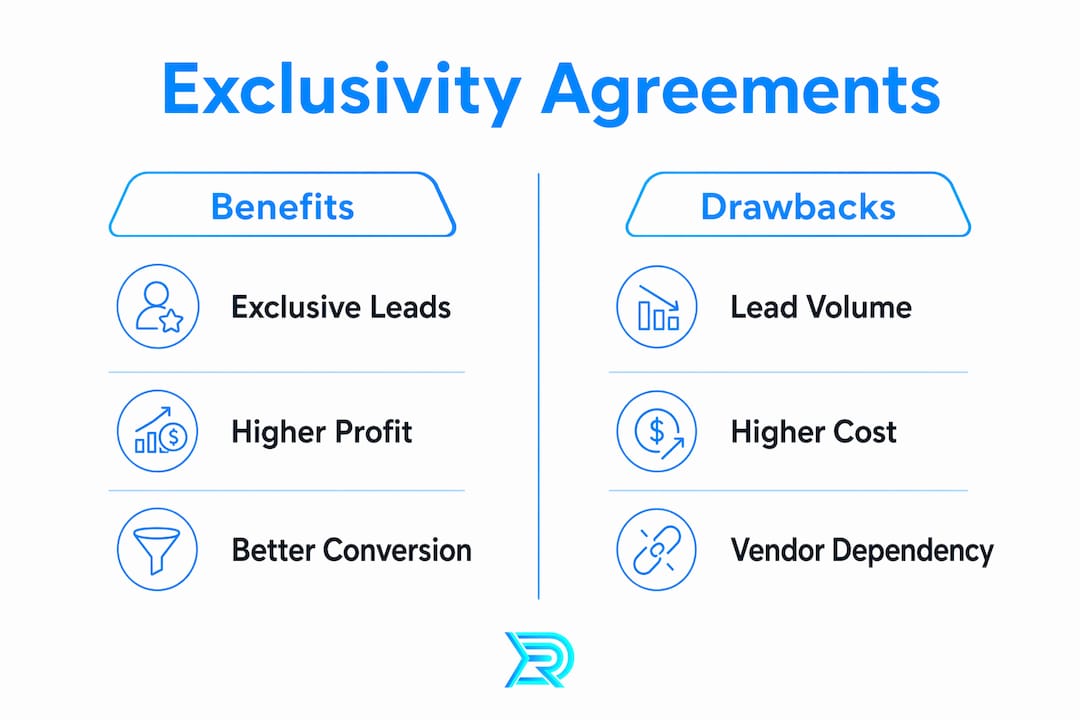
The primary risk with exclusivity is dependency. If your single lead source dries up or the vendor raises prices, you have limited fallback. Contractors who rely entirely on purchased exclusive leads without building their own roofing lead generation infrastructure are renting their pipeline instead of owning it.
How does market type affect your exclusivity strategy?
Your local market type determines whether exclusivity is a competitive weapon or an expensive mistake. The two dominant market types in roofing are insurance restoration (storm-driven) and retail replacement, and they operate on completely different lead economics.
-
Insurance restoration markets are driven by weather events. Hail hits a neighborhood, and hundreds of homeowners need roofs within weeks. Decision timelines compress to days. Homeowners call multiple contractors, and speed wins. In this environment, insurance markets have compressed decision windows where shared leads can still convert well because urgency overrides comparison shopping.
-
Retail replacement markets operate on longer decision cycles. A homeowner noticing granule loss in the gutters is not in crisis mode. They research, compare, and take weeks or months to decide. In this environment, exclusive leads are far more profitable because the homeowner is not racing to sign with whoever calls first.
-
Mixed markets require a split strategy. If 60% of your jobs are insurance claims and 40% are retail replacements, you may benefit from shared leads for storm work and exclusive leads for retail pipeline.
-
Callback speed matters in every market. Calling a lead within five minutes converts 21 times better than calling after 30 minutes. This statistic applies to both shared and exclusive leads. Even with exclusivity, a slow response destroys the advantage you paid for.
Pro Tip: Pull your last 12 months of closed jobs and categorize each as insurance restoration or retail replacement. If retail replacement accounts for more than 40% of your revenue, exclusive leads will almost certainly deliver a better return than shared leads in your market.
What steps should you take to negotiate and leverage exclusivity agreements?
Knowing that exclusivity exists is not enough. You need a clear process for evaluating agreements, negotiating terms, and converting leads at a rate that justifies the premium you pay.
Before you sign any exclusivity agreement, verify these contract terms:
- The geographic territory is defined by specific ZIP codes or county names, not vague language like “your local area.”
- The duration is fixed with a defined renewal process, not an auto-renewing clause that locks you in indefinitely.
- A lifetime resell cap is written into the contract, prohibiting the vendor from reselling your leads at any point.
- Source-level exclusivity is confirmed, meaning the lead is not shared at the data collection stage before it reaches you.
- Performance review clauses give you an exit if lead quality drops below a defined threshold.
- Legal counsel has reviewed the agreement before you sign. Exclusivity agreements require legal counsel before signing to protect against long-term inflexibility.
After you secure exclusivity, maximize every lead with these tactics:
- Build a dedicated response protocol. Assign a specific team member to handle exclusive leads within five minutes of receipt.
- Use call tracking software to measure response times and conversion rates by lead source.
- Align your capacity before scaling lead volume. Exclusive lead systems suit contractors with refined conversion systems. If your sales process is not dialed in, exclusivity amplifies waste, not profit.
- Diversify beyond purchased leads. Use Google Ads, SEO, and a high-converting website to build a lead funnel you own outright. Purchased exclusivity is a rental. Owned digital infrastructure is an asset.
One more point worth making: exclusivity can carry legal risk when misused. GAF faced antitrust litigation over price control using exclusivity and certification programs in the roofing market. The lesson for contractors is that exclusivity must be structured around competitive advantage, not market manipulation. Keep your agreements focused on territory and lead access, not pricing coordination.
Key takeaways
Roofing market exclusivity works when contractors combine airtight contract terms, strong conversion processes, and the right market fit to turn sole access into measurable profit.
| Point | Details |
|---|---|
| Define contract terms precisely | Demand lifetime resell caps and source-level exclusivity before signing any lead agreement. |
| Match exclusivity to market type | Retail replacement markets benefit most from exclusive leads; storm markets can work with shared leads. |
| Speed determines conversion | Responding to a lead within five minutes converts 21 times better than waiting 30 minutes. |
| Build owned lead infrastructure | Purchased exclusivity is a rental; SEO, Google Ads, and a strong website create assets you own. |
| Legal review is non-negotiable | Have counsel review exclusivity agreements to avoid inflexibility and anticompetitive exposure. |
Why exclusivity is only as strong as the system behind it
Here is what I have seen working with roofing contractors across the country: exclusivity agreements get oversold as a magic fix. A contractor pays a premium for exclusive leads, gets fewer calls than expected, and blames the model. The real problem is almost never the exclusivity itself. It is the conversion system behind it.
The contractors who win with exclusivity treat every lead like it cost them $500, because it often did. They have a CRM, a follow-up sequence, a trained sales rep, and a website that closes the deal before the rep even shows up. The ones who fail treat exclusive leads like shared leads and wonder why the math does not work.
The other thing I would push back on is the idea that purchased exclusivity is a long-term strategy. It is a bridge. The goal should always be to build your own roofing marketing infrastructure so that leads come to you directly through Google, through your reputation, and through referrals. When you own your lead generation, no vendor can raise prices on you, no contract can expire, and no competitor can buy their way into your territory.
Exclusivity from a vendor is a tactic. Owning your market through SEO and paid search is a strategy. The contractors who understand the difference are the ones who scale.
— Results
Build your own exclusive lead system with Resultsdigitalus
Resultsdigitalus was built specifically for roofing contractors who want to stop renting leads and start owning their market. The agency’s exclusivity model means only one roofing contractor per market gets access to every SEO keyword, Google Ads campaign, and custom website strategy. No shared campaigns. No split attention.
Resultsdigitalus delivers roofing digital marketing services including SEO, Google Ads, Meta Ads, and custom website design engineered for contractor lead generation. The results are documented: one Florida roofing company grew from 3 crews to 18 and sold for $60 million. If you are ready to build a lead funnel you own outright, Resultsdigitalus works without long-term contracts because the results speak for themselves. Check whether your market is still available and take the first step toward owning your territory.
FAQ
What is roofing market exclusivity?
Roofing market exclusivity is a contractual arrangement granting one contractor sole rights to a defined territory, lead source, or product channel, eliminating direct competition within that scope. It applies to both purchased lead agreements and supply distribution contracts.
What is a lifetime resell cap in a roofing lead contract?
A lifetime resell cap is a contract clause that permanently prohibits a lead vendor from reselling your leads to any other contractor at any point in the future. Without this clause, most “exclusive” lead contracts only guarantee a short exclusive window before reselling is permitted.
Are exclusive roofing leads worth the higher cost?
Exclusive leads deliver higher profit per job and better conversion rates than shared leads, but only for contractors with strong sales processes and fast response systems. If your conversion rate on shared leads is already low, exclusive leads will not fix the underlying problem.
How does market type affect whether exclusivity makes sense?
Storm-driven insurance restoration markets favor shared leads because compressed decision timelines reward speed over exclusivity. Retail replacement markets favor exclusive leads because longer decision cycles give you time to build trust without competing against contractors who received the same lead.
Can exclusivity agreements create legal problems for roofing contractors?
Yes. Exclusivity arrangements structured around pricing coordination or market manipulation carry antitrust risk, as demonstrated by litigation involving roofing manufacturers. Contractors should keep exclusivity agreements focused on territory and lead access, and always have legal counsel review terms before signing.
