
Digital marketing for roofers is the structured integration of local SEO, paid advertising, reputation management, and conversion systems designed to generate consistent leads and grow revenue. This is not a collection of random tactics. It is an operating system where each component feeds the next. The local map pack captures 42% of all search clicks, making Google Business Profile optimization your highest-priority starting point. A well-built roofing website converts at 12–18% versus 2–3% for poorly built sites. This digital marketing for roofers simple growth plan breaks down every pillar so you can build it right the first time.
How does a digital marketing for roofers simple growth plan start?
Local SEO and Google Business Profile (GBP) optimization are the foundation of every effective roofing growth plan. GBP signals account for 32% of local ranking factors, making full profile optimization the single highest-return activity you can do before spending a dollar on ads. Contractors who neglect their GBP miss a critical competitive edge. Your GBP often acts as the new homepage before a homeowner ever visits your website.
Optimizing your Google Business Profile
Start with the basics and go deep on each one:
- Primary category: Set it to “Roofing Contractor,” not a generic trade category.
- Service listings: Add every service you offer, including roof repair, replacement, storm damage, and gutters, with individual descriptions.
- Photos: Upload job-site photos weekly. Profiles with fresh photos get significantly more direction requests and calls.
- Posts: Publish at least one GBP post per week covering seasonal tips, recent jobs, or local storm alerts.
- Review responses: Reply to every review, positive or negative, within 24 hours.
Pro Tip: Add your service area cities directly inside your GBP service area settings. This tells Google exactly where you work and improves your map pack visibility in those zip codes.
On-site local SEO for roofing contractors
Your website needs dedicated pages for each city and each service you target. A single “Services” page does not rank for “roof repair in Katy, TX.” Each city page needs unique content, a local phone number, and a clear call to action. NAP consistency, meaning your name, address, and phone number formatted identically across your website, GBP, and every directory listing, is non-negotiable. Schema markup for local businesses tells search engines exactly who you are and where you serve. Building local citations on roofing-specific directories like HomeAdvisor and Angi reinforces your geographic authority.

What paid advertising strategies work best for roofers?
Paid advertising delivers leads while your SEO compounds in the background. The most effective approach uses a three-layer Google Ads strategy: Local Service Ads, standard Search Ads per service, and pre-built storm-response campaigns. Each layer serves a different purpose and a different stage of the buying cycle.
- Local Service Ads (LSAs): These appear above standard paid search results and carry the Google Guaranteed badge. Cost per lead runs $30–$75, and you pay only when a homeowner contacts you directly. LSAs build instant trust because Google has verified your license and insurance.
- Search Ads per service: Run separate campaigns for “roof replacement,” “roof repair,” and “storm damage roof” with dedicated landing pages for each. Mixing all services into one campaign dilutes your quality score and raises your cost per click.
- Storm-response campaigns: Pre-build these campaigns in draft form, geo-targeted to your service area. When a major storm hits, you activate them within hours. Pre-built storm campaigns maximize ROI during peak demand windows that close fast.
Pro Tip: Never send paid traffic to your homepage. Build a dedicated landing page for each service and city combination. A page built specifically for “hail damage roof repair in Houston” will convert at a far higher rate than a generic homepage.
Social media ads work best for post-storm awareness in a specific neighborhood. Run Facebook and Instagram ads with photos of local storm damage and a clear offer like a free inspection. Keep the geo-targeting tight, within 10–15 miles of the impacted area, for the best cost per lead. SEO generates compounding organic traffic over time, while paid ads stop the moment your budget does. Running both together creates a lead flow that never fully shuts off.
How does reputation management boost rankings and win more jobs?
Reviews are not a nice-to-have. They are a ranking signal and a trust signal that directly affect whether a homeowner calls you or your competitor. Automated review requests sent within 24 hours of job completion produce the highest review rates and the most recent timestamps, both of which Google weighs heavily.
A repeatable review system looks like this:
- Trigger: Job marked complete in your CRM.
- Action: Automated SMS sent within 24 hours with a direct link to your Google review page.
- Follow-up: A second email sent 48 hours later if no review was left.
- Response: A team member responds to every new review within one business day.
Negative reviews require a calm, professional response that acknowledges the concern and offers to resolve it offline. Never argue publicly. A well-handled negative review often builds more trust than a perfect five-star average because it shows you stand behind your work. AI-powered search tools like Google’s AI Overviews and Perplexity increasingly pull from review content when recommending local contractors. A high volume of recent, detailed reviews positions your company as the obvious recommendation.
Why does your roofing website need to be built for conversion?
Your website is your best salesperson. Over 70% of roofing website visitors leave without engaging, which means most of your traffic is wasted if your site is not built to capture leads. 72% of roofing searches happen on phones, so mobile-first design with load times under two seconds is the baseline requirement.
Every high-converting roofing website shares these characteristics:
- A sticky click-to-call button visible on every page, on every device.
- A primary CTA above the fold, such as “Schedule Your Free Roof Inspection,” with a short form requiring only name, phone, and zip code.
- Trust signals on the homepage: license numbers, insurance certificates, manufacturer certifications, and financing badges.
- Dedicated pages for each service and each city, not a single generic page that tries to rank for everything.
Pro Tip: Add an AI chatbot to your site that qualifies leads in real time. A visitor who arrives at 9:00 PM and gets an instant response is far more likely to book than one who waits until morning. Connect the chatbot to your CRM so every conversation is logged and followed up automatically.
Launching ads without a solid website is like sending a sales rep out without a business card or a pitch. The website design for roofing companies must be built to convert, not just to look professional.
How do you build a repeatable growth plan for your roofing business?
A repeatable growth plan moves through three phases. Each phase builds on the last and adds capacity without adding chaos.
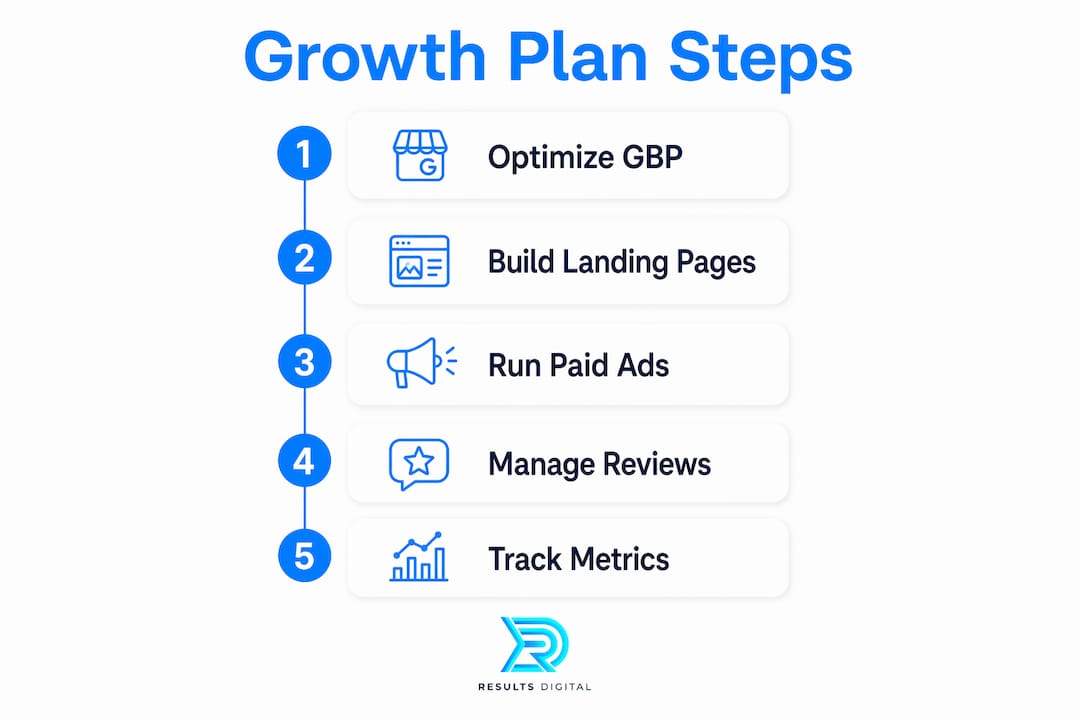
- Foundation (months 1–3): Claim and fully optimize your GBP. Build or rebuild your website with mobile-first design and conversion-focused pages. Set up call tracking and connect your CRM. Launch LSAs and one Search Ad campaign for your primary service.
- Expanded reach (months 4–6): Add city-specific landing pages and service-specific ad campaigns. Launch your automated review request system. Begin publishing two to four GBP posts per week and one blog post per month targeting local keywords.
- Multi-location brand build (months 7–12): Add new service area pages. Build out storm-response ad campaigns in draft. Launch referral and annual inspection email sequences to past customers. Review your funnel metrics monthly.
Connecting marketing source to proposal and sales outcomes is what separates contractors who grow from those who stay flat. Tracking clicks alone tells you nothing. Track booked inspections, proposal count, close rate, and revenue per lead source. That data tells you where to put more budget and where to cut.
| Metric to track | Why it matters |
|---|---|
| Cost per booked inspection | Shows true ad efficiency, not just click volume |
| Lead-to-close rate by source | Reveals which channels send quality leads |
| Review count and average rating | Tracks reputation health and ranking signal strength |
| Website conversion rate | Measures how well your site turns visitors into leads |
| Response time to new leads | Faster response directly increases close rate |
Sustainable year-round SEO combined with storm-response channels creates a resilient lead flow. Storm channels can spike your pipeline dramatically during peak weather events. Steady SEO and reputation channels keep 20–40 leads per month flowing when the weather is calm. You need both to build a business that scales beyond one crew. A well-integrated marketing funnel connects every touchpoint from first click to signed contract, giving you full visibility into what is working.
Key Takeaways
A digital marketing growth plan for roofers works when local SEO, paid ads, reputation management, and a conversion-focused website operate as one connected system, not as separate activities.
| Point | Details |
|---|---|
| GBP is your top priority | Google Business Profile signals drive 32% of local rankings, making it your highest-ROI starting point. |
| Layer your paid campaigns | Run LSAs, service-specific Search Ads, and pre-built storm campaigns together for balanced lead flow. |
| Automate review requests | Send SMS review requests within 24 hours of job completion to maximize volume and recency. |
| Build for mobile conversion | 72% of roofing searches happen on phones, so fast load times and sticky CTAs are non-negotiable. |
| Track business outcomes | Measure booked inspections and close rate by source, not just clicks, to allocate budget correctly. |
What I’ve learned running roofing marketing for over a decade
Most roofing contractors treat marketing as a collection of separate tasks. They run some ads here, post on social media there, and hope the phone rings. That approach does not scale. The contractors who grow from three crews to eighteen, and some who eventually sell their companies for life-changing numbers, treat marketing as an operating system where every component is connected and measured.
The biggest mistake I see is neglecting the GBP while spending heavily on ads. Your GBP is often the first thing a homeowner sees. If it has outdated photos, no recent reviews, and incomplete service listings, your ad spend is working against a weak first impression. Fix the profile before you run a single dollar in paid traffic.
The second mistake is ignoring response time. A lead that does not get a call or text within five minutes is a lead that called your competitor. Automation solves this. An AI chatbot or an automated SMS response sent the moment a form is submitted keeps the conversation alive until your team can follow up.
The future of roofing marketing runs through AI search recommendations, voice search, and hyper-local content. Contractors who build deep review libraries and city-specific content today will dominate those channels tomorrow. Consistent execution, monthly funnel reviews, and data-driven budget decisions are what separate the companies that grow from the ones that stay stuck.
— Results
How Resultsdigitalus helps roofers build a marketing system that works
Resultsdigitalus is a veteran-owned agency built exclusively for roofing contractors, gutter companies, siding companies, and general contractors across the United States. Every service, from roofing SEO to Google Ads to custom website design, is engineered for contractor lead generation, not generic marketing. The exclusivity model means Resultsdigitalus works with only one roofing company per market, so your campaigns never compete against another client.
Resultsdigitalus helped a Florida roofing company grow from 3 crews to 18 before it sold for $60 million. That result came from a connected system of digital marketing services built around local SEO, paid ads, reputation management, and conversion-focused websites. No long-term contracts. Results earned every month.
FAQ
What is the most important first step in roofing digital marketing?
Fully optimizing your Google Business Profile is the highest-ROI first step. GBP signals account for 32% of local ranking factors, and the map pack captures 42% of all search clicks.
How much do Local Service Ads cost for roofers?
LSA cost per lead typically runs $30–$75 for roofing contractors. You pay only when a homeowner contacts you directly, and the Google Guaranteed badge increases trust significantly.
How many reviews does a roofing company need to rank well?
Review volume and recency both matter as ranking signals. Sending automated review requests within 24 hours of job completion is the most effective way to build a strong, current review profile.
How long does roofing SEO take to produce leads?
Local SEO typically takes three to six months to produce consistent organic leads. Running paid ads simultaneously fills the pipeline while SEO compounds in the background.
What metrics should roofers track in their marketing funnel?
Track booked inspections, proposal count, close rate by lead source, and cost per booked inspection. Measuring business outcomes rather than clicks gives you an accurate picture of true marketing ROI.
