
A roofing SEO company gets you to page one by stacking five specific tactics: Google Business Profile dominance, hyperlocal service area pages, project galleries with geotagged photos, timely storm-response content, and insurance claim pages targeting high-intent searches. Generic SEO agencies do not build this way. They publish blog posts, swap city names into templates, and call it local SEO. The difference shows up in your call volume, not your monthly report.
Organic roofing SEO takes 6–12 months to generate meaningful leads. Anyone promising results in 30–60 days is selling Google Ads dressed up as SEO. The contractors who commit to the full process end up with leads costing a reasonable range per lead, climbing month over month, with no ad spend required to sustain them.
Here is what a real roofing SEO strategy looks like in practice:
- Google Business Profile optimization: reviews, photos, weekly posts, and accurate service area data
- Hyperlocal service area pages: one full page per city you actually serve, written for that specific market
- Project galleries: before/after photos geotagged to the neighborhoods where you work
- Storm-response content: published within 24 hours of a weather event hitting your market
- Insurance claim pages: targeting high-intent searches like “roof claim denied” or “hail damage inspection”
What roofing SEO actually is and why it matters more than paid ads
Roofing SEO is the practice of getting your business to appear at the top of Google search results when homeowners in your area search for roofing services. It pulls together on-page optimization, technical website health, local citations, and content tailored to roofing-specific search intent. That last part is what separates it from generic local SEO, which treats every trade the same way.
The roofing industry has unique challenges that generic SEO ignores: seasonal demand spikes, storm-driven urgency, insurance claim complexity, and a buying cycle that can go from zero to “I need someone here today” in under an hour. A roofer’s SEO strategy has to account for all of it.
Paid ads stop the moment you stop spending. Referrals are unpredictable. SEO builds a compounding asset. Once your service area pages rank and your Google Business Profile earns consistent reviews, that visibility keeps generating calls without a per-click cost. The Local Map Pack captures roughly 60% of clicks for searches like “roofer near me” and “roofing contractor [city].” That is where the phone rings.
Key components of roofing SEO:
- Google Business Profile: the single highest-impact local asset for map pack placement
- Service area pages: dedicated pages per city with unique, locally relevant content
- On-page optimization: title tags, headers, and meta descriptions with localized keywords
- Citations and NAP consistency: your name, address, and phone number matching across every directory
- Review velocity: a a steady stream of new reviews regularly
- Content strategy: project galleries, storm-response pages, and insurance claim content
How roofing keyword research actually drives qualified leads
The goal of keyword research for roofing is not to find the highest-volume terms. It is to find the terms that signal a homeowner is ready to hire. “Roof repair cost” and “roofing contractor near me” convert at far higher rates than “types of roofing materials” because the searcher’s intent is transactional, not informational.

Aligning keyword targeting with homeowner buying intent means prioritizing terms like “roof replacement [city],” “emergency roof repair,” and “hail damage inspection” over broad terms that attract researchers rather than buyers. Tools like Semrush, Ahrefs, and Moz help you evaluate search volume and competition difficulty, but the intent behind the keyword matters more than the volume number.
Hyperlocal targeting is where most roofing companies leave money on the table. Ranking for “roofing contractor Houston” is harder and less profitable than ranking for “roof replacement Katy TX” or “storm damage repair Pearland.” Neighborhood-level keywords have lower competition and attract homeowners who are geographically ready to call you. For a deeper breakdown of which terms move the needle, roofing keyword strategy is worth reviewing before you build your page structure.
Strategic keyword research steps for roofers:
- Start with buying-intent terms: “roof repair cost,” “roofing contractor near me,” “roof replacement [city]”
- Layer in hyperlocal modifiers: neighborhood names, suburb names, county names
- Target insurance clusters: “roof insurance claim denied,” “hail damage inspection [city],” “how to file roof claim with State Farm”
- Evaluate search volume and difficulty: prioritize terms with clear local intent over generic high-volume terms
- Map each keyword to a specific page: one keyword focus per page, never multiple services competing on one URL
On-page SEO best practices for roofing websites
The most common mistake on roofing websites is a single “Services” page trying to rank for roof repair, roof replacement, storm damage, gutters, and commercial roofing all at once. Google cannot rank one page effectively for five different search queries. Each service needs its own dedicated page, optimized for the specific terms homeowners use when they need that service.
Dedicated service pages with thorough detail each, focused on a single roofing service, consistently outperform pages that bundle multiple services together. Each page should answer the questions homeowners actually ask: What does this cost? How long does it take? What materials do you use? What does the process look like? Real answers to real questions signal to Google that your page is genuinely useful.
Title tags, H1 headings, and meta descriptions all need localized keywords. “Roof Replacement in [City] | Licensed Roofing Contractor” outperforms “Roof Replacement Services” every time. Mobile-friendly design and fast load speeds are not optional. 71% of Google Business Profile interactions come from mobile devices, so a site that loads slowly on a phone loses the lead before the homeowner ever reads a word. Adding RoofingContractor schema markup makes your pages eligible for AI Overviews and enhanced search features, which are increasingly how homeowners find service businesses.
Pro Tip: Build your service area pages as standalone content assets, not copies of your main service pages with the city name swapped in. Include local landmarks, neighborhood names, permit requirements, and 3–5 real project examples with photos from that specific area. Google ranks unique, city-specific content far above templated pages.
On-page SEO checklist for roofing websites:
- One service per page: roof repair, roof replacement, storm damage, inspections, and commercial each get their own URL
- 500–700 words minimum per page: answer cost, process, materials, and timeline questions
- Localized title tags and H1s: include the city name and primary service
- Schema markup: add RoofingContractor and Service schema to every relevant page
- Mobile performance: target under 3 seconds load time on mobile
- Internal linking: connect service pages to relevant service area pages and project galleries
Local SEO tactics that put your roofing business on the map
Your Google Business Profile is the most important local asset you own. Profiles with many photos generate significantly more calls than profiles with fewer than 10. Every job site, every before/after, every crew photo counts. Upload weekly, not monthly.

Review velocity matters as much as review count. Businesses generating a steady stream of new reviews monthly and posting weekly outrank competitors within 90 days. An automated review request sent after every completed job produces far more responses than a manual ask. The contractors consistently hitting the map pack treat reviews as a system, not an afterthought.
Hyperlocal service area pages built with unique content for each city outperform generic templated pages that only swap the city name. A real service area page includes neighborhood names the homeowner recognizes, local weather and roof type context, permit requirements specific to that jurisdiction, and actual project examples from that area. One lump-sum “service areas” page listing 40 cities in a bulleted list ranks for nothing. For a full breakdown of how to structure these pages, roofing service area pages covers the architecture in detail.
Storm-response content is a category most roofers ignore until it is too late. Publishing a storm-response page within 24 hours of a weather event hitting your market captures urgent, high-intent searches while competitors scramble. “Plano hail damage roof inspection” published Wednesday morning after Tuesday’s storm can rank within days because the competition is thin and the demand is immediate.
Actionable local SEO steps for roofers:
- Optimize your Google Business Profile completely: accurate NAP, service areas, categories, and a keyword-natural description
- Upload photos weekly: job sites, before/after shots, crew photos, and drone footage
- Generate 8–15 reviews per month: automate the request after every completed job
- Post weekly Google updates: recent jobs, seasonal advice, neighborhood-specific work
- Build one full service area page per city: unique content, local references, real project photos
- Maintain NAP consistency: your name, address, and phone must match across Google, Yelp, Angi, HomeAdvisor, the Better Business Bureau, and Bing Places
- Publish storm-response content within 24 hours: target the specific weather event and city
What roofing SEO professionals know that generic agencies do not
The agencies that actually move roofing companies to page one share a few practices that generic SEO shops never implement. The first is treating every job as a content asset. Every roof you replace produces photos, a project story, and a geographic data point. Most roofers dump those photos in a folder and never use them again. That is the highest-leverage content asset in the industry sitting unused.
E-E-A-T signals — Experience, Expertise, Authoritativeness, and Trustworthiness — carry real weight in Google’s current ranking environment, especially for local service businesses. Verified team bios, industry certifications, years in business, and manufacturer credentials all signal to Google that your company is the real thing. A roofing website with a generic “About Us” paragraph and no credentials loses trust signals to a competitor who lists their GAF Master Elite certification, their team photos, and their 15 years of local experience.
Stat callout: Profiles with 100+ photos generate over 500% more calls than profiles with fewer than 10 photos. Weekly uploads are not a nice extra — they are a core ranking driver.
Project galleries built with geotagged photos and embedded location data in the file metadata serve as trust signals that competitors cannot replicate. Pairing those galleries with your Google Business Profile uploads compounds the effect. The intent-driven SEO approach that works in roofing is built around matching your content to what a ready-to-hire homeowner is actually searching, not what sounds good in a monthly report.
Expert-endorsed actions for roofing SEO:
- Stop churning generic blog posts: 4–8 high-quality, locally specific pages per month outperform 30 templated posts
- Add verified credentials to your website: certifications, manufacturer partnerships, and team bios with real names and photos
- Geotag every project photo: include neighborhood name in file metadata and alt text
- Build a project page per job: street name (not number), roof type, materials, and outcome
- Write insurance claim content from the contractor’s perspective: document damage, read Xactimate estimates, explain the adjuster process
- Answer your own Google Q&A: do not let competitors or wrong answers fill that space
The step-by-step process a roofing SEO company uses from audit to execution
A roofing SEO company starts with a full audit before touching a single page. That means capturing baseline rankings, map pack visibility, lead flow, and technical health across all five categories: Google Business Profile, technical site health, local content architecture, link authority, and conversion readiness. Flying blind without that baseline means you cannot measure what actually moved performance later.
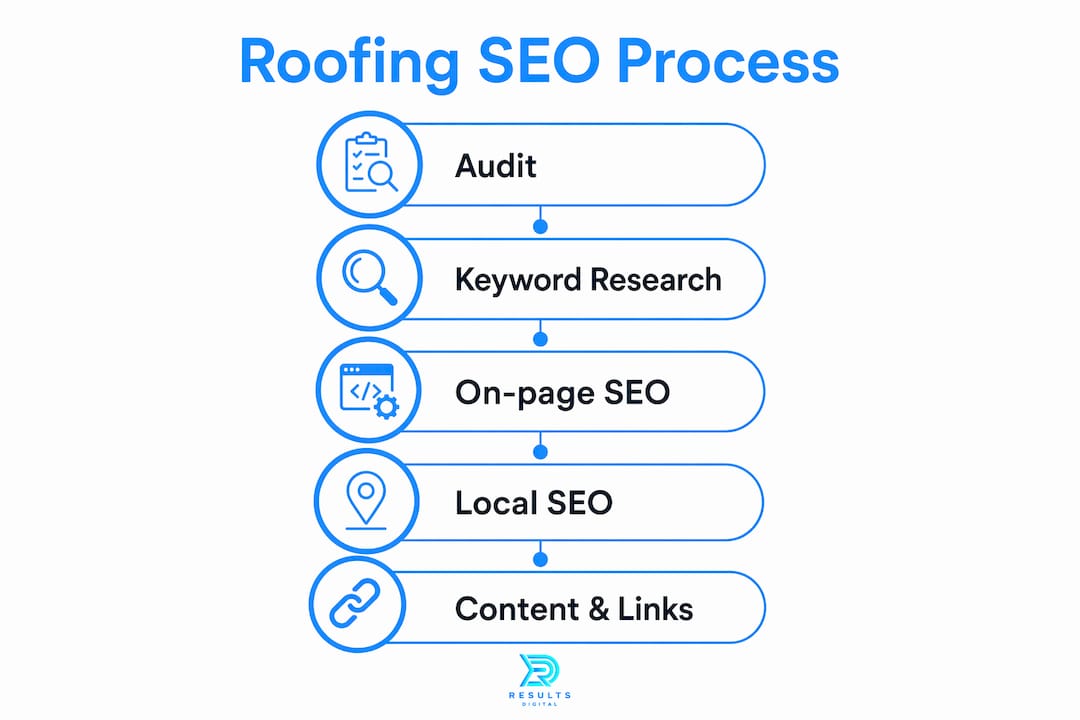
The first two weeks focus on quick wins: Google Business Profile category selection, NAP consistency across directories, and page speed on mobile. These fixes are fast, and they drive 60–70% of early local search wins for roofing contractors. From there, the work shifts to structural improvements: service area page creation, schema markup, and internal linking architecture. These take longer but compound over months.
A realistic timeline looks like this:
- Months 1–2: technical cleanup, Google Business Profile optimization, first 5–10 service area pages live
- Months 3–4: project gallery buildout, weekly content publishing, review velocity climbing
- Months 5–6: first map pack movement, long-tail organic rankings appearing
- Months 7–9: first booked jobs from SEO, typically 3–8 per month
- Months 10–12: SEO leads at reasonable cost per lead, improving over time
Content and backlink authority come after the local foundation is solid. Publishing blog content before your service area pages and Google Business Profile are dialed in wastes budget. The SEO services for roofers that produce real results follow this sequence without skipping phases.
How roofing SEO companies measure and report performance and ROI
Tracking roofing SEO performance means measuring what actually drives revenue, not just what looks good on a dashboard. Rankings matter, but booked jobs matter more. A roofing SEO company should report on map pack position for primary keywords, organic traffic to service area pages, call volume from Google Business Profile, and cost per lead from organic search.
Google Search Console shows which keywords are driving impressions and clicks to your pages. It also surfaces indexing errors and crawl issues before they hurt rankings. Pair that with call tracking software to attribute phone calls to specific pages and keywords. Without call tracking, you are flying blind on which pages are actually generating revenue.
Review growth week over week is a direct ranking signal and should be tracked separately. A drop in review velocity often precedes a drop in map pack position. Monthly reporting should show the correlation between review acquisition, photo uploads, and local search visibility so you can see the levers working in real time. Ask your agency three direct questions: What is the photo upload cadence on my Google Business Profile? How many real service area pages with unique project examples will you publish in 90 days? Will you write insurance claim content for my market? If they cannot answer clearly, they are running a generic playbook.
What a successful roofing SEO campaign actually looks like
Resultsdigitalus helped a Florida roofing company scale from 3 crews to 18 before the business sold for $60 million. That growth did not happen through paid ads alone. It required building a local search presence that generated inbound calls from qualified homeowners consistently, filling the estimate calendar without relying on door-knocking or storm chasing.
The pattern in successful roofing SEO campaigns follows a consistent structure. A roofing company in a competitive market starts with fewer than 10 keywords ranking in Google’s top 10. After a content pruning audit, enhanced location pages with unique project photos and local reviews, and consistent Google Business Profile management, that number climbs to hundreds of top-10 rankings. The key variable is always the same: unique, locally specific content paired with review velocity and photo uploads.
One practical example: a roofing contractor serving Columbus, Ohio builds a homepage optimized for “Columbus roofing company” and then creates dedicated service area pages for every suburb. Each page includes real project photos from that neighborhood, local permit context, and reviews from customers in that specific city. Ranking well for suburb queries has driven online leads up by more than 30% for roofing clients who execute this strategy fully. The contractors who skip the suburb pages and rely on one homepage never see those numbers.
Ready to stop losing leads to competitors who started earlier?
Resultsdigitalus is a veteran-owned agency built exclusively for roofing contractors, gutter contractors, siding companies, and general contractors across the United States. Founded in 2015 by Preston Toor in Montgomery, Texas, the agency partners with only one roofing company per market. Your strategy, your keywords, your campaign. No shared playbooks, no conflicts of interest.
No long-term contracts. Results Digital earns your business every single month.
If you are ready to build the kind of local search presence that generates inbound calls from ready-to-hire homeowners, roofing SEO services from Resultsdigitalus are built for exactly that. Or start with the full picture at digital marketing for contractors.
Key Takeaways
Roofing SEO companies get you to page one by stacking Google Business Profile optimization, hyperlocal service area pages, project galleries, storm-response content, and insurance claim pages into a compounding local search system that delivers qualified leads within 6–12 months.
| Point | Details |
|---|---|
| Google Business Profile drives 60% of clicks | Profiles with a very high number of photos generate significantly more calls; post weekly and generate 8–15 reviews monthly. |
| One page per city, not a list | Dedicated service area pages with unique local content outrank templated city pages that swap names. |
| Storm-response content wins urgent searches | Publish a storm-specific page within 24 hours of a weather event to capture high-intent local demand. |
| SEO takes 6–12 months for meaningful leads | Quick wins appear in weeks 2–4; booked jobs from SEO typically start in months 7–9. |
| E-E-A-T signals build ranking trust | Verified bios, certifications, and years in business signal authority to Google in competitive local markets. |
