
Winning consistent local roofing leads starts in one place: the Google Business Profile map pack. Roofing local SEO succeeds or stalls based on GBP optimization, review velocity, and a small set of well-built service and city pages, in that order. Get GBP and reviews right, and you can see map-pack movement in weeks. Roll out service pages and fix mobile speed, and organic leads compound over the following months.
TL;DR:
- Prioritize setting up and optimizing your Google Business Profile, focusing on categories, service areas, and fresh photos to see map-pack movement within weeks.
- Focus on review velocity by prompting homeowners for reviews immediately after work, and respond promptly to enhance local rankings.
- Build core service pages and location pages for neighborhoods with existing job volume, including local details, genuine photos, and schema markup for better ranking.
- Accelerate website speed by compressing images, optimizing server response time, and ensuring mobile load times meet fast standards to improve conversions.
- Secure essential local backlinks from manufacturer listings, chambers, and local news to strengthen authority and improve local SEO performance.
Table of Contents
- Winning Roofing Local SEO Starts With Your Google Business Profile
- Which Service and City Pages Should You Build First?
- Is Your Roofing Website Fast Enough to Rank and Convert?
- Why NAP Consistency Still Breaks Rankings
- Build Storm and Insurance Pages Before You Need Them
- What Local Links Actually Move Roofing Rankings?
- What Should Your 90-Day Local SEO Roadmap Look Like?
- Why a Roofing-Specialist Agency Shortens Time to Leads
- The Roofing Local SEO Advice Nobody Wants to Hear
- Ready to Put This Roadmap to Work?
- Sources
Winning Roofing Local SEO Starts With Your Google Business Profile
Your Google Business Profile carries more weight per hour invested than almost anything else in roofing local SEO. It’s the asset Google shows first when someone searches “roof repair near me,” and GBP changes typically show map-pack movement within a few weeks, far faster than content or link building.
Start with these fundamentals:
- Set your primary category to Roofing Contractor, add secondary categories only if they’re genuinely accurate, and list every service you actually perform.
- Define your service areas precisely. If you don’t have a public storefront, set up as a service-area business and list the general areas you cover, not just your home base.
- Upload new job photos weekly. Completed roofs, crews in action, before-and-afters. Stale profiles with photos from 2023 lose ground to competitors posting fresh work.
- Use GBP posts for storm alerts, seasonal promotions, and finished projects, and answer the Q&A section yourself before a competitor plants a misleading answer there.
Review velocity, not total review count, drives map-pack rankings. The highest-converting workflow is simple: your crew lead texts a review link to the homeowner within an hour of finishing the job, while the work is still fresh in their mind. A short SMS with a direct Google review link consistently outperforms delayed email requests sent days later.
Respond to every review promptly. Thank positive reviewers by name and mention the job type; for anything negative, acknowledge the issue, state what you’re doing about it, and take detailed conversations offline.
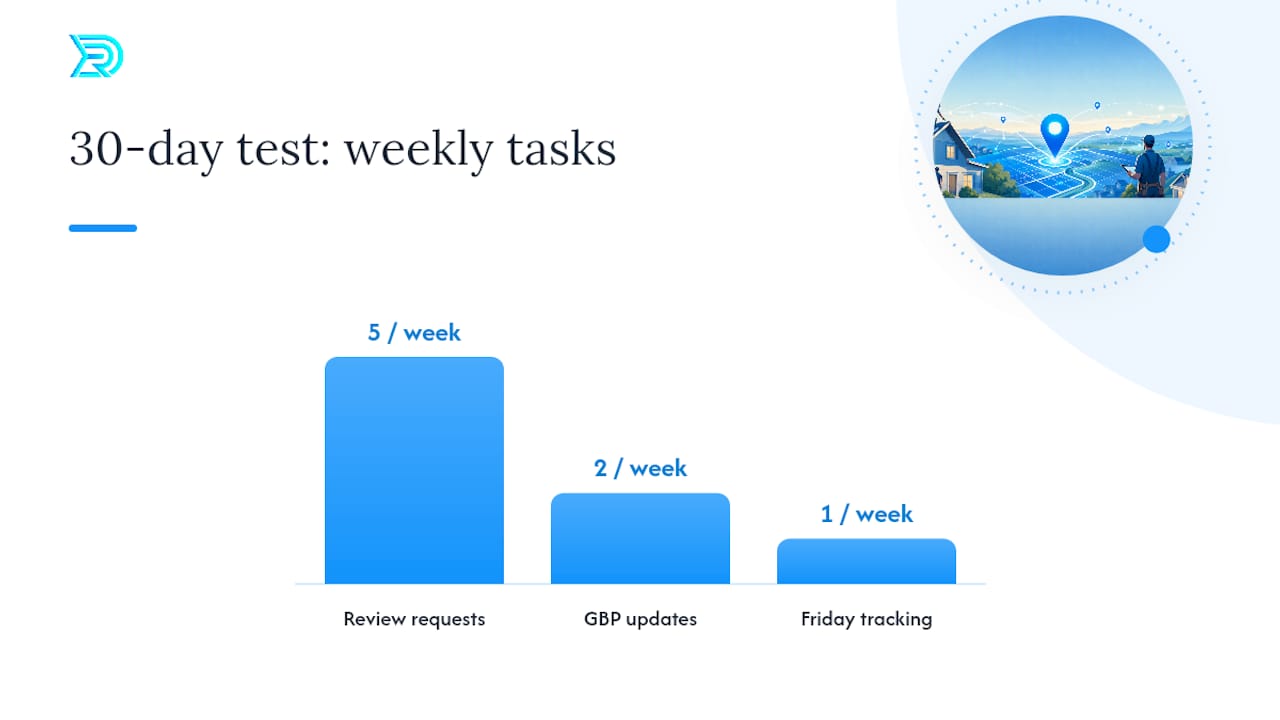
Pro Tip: Build a repeatable 30-day test: ask for five reviews per week, post two GBP updates per week, and track map-pack position for your top three keywords every Friday. Small, consistent inputs beat sporadic pushes.
Which Service and City Pages Should You Build First?
Not every service or suburb deserves its own page. Build pages for your core services first: roof repair, roof replacement, storm damage, inspections, and gutters if you offer them. For location pages, prioritize suburbs where you already have job volume or clear capacity to serve, not every town in your service radius.
Each page needs the same anatomy to rank and convert:
- A clear headline naming the service and location
- A description of the work, process, and realistic timeline
- Honest price ranges, even broad ones, to pre-qualify leads
- Warranty details and manufacturer certifications
- Real job photos from that specific service or city, never stock images
- Local landmarks or neighborhood references that prove you actually work there
- LocalBusiness and Service schema markup
- Internal links to related service and location pages
The single biggest mistake roofing companies make with city pages is duplicating the same 400 words with the city name swapped out. Google recognizes this pattern instantly, and so do homeowners comparing you against a competitor with real local detail. Link every new page back to your homepage and to your GBP profile description so authority flows both directions, and structure your roofing SEO near me strategy around depth over volume.
Is Your Roofing Website Fast Enough to Rank and Convert?
A slow site loses calls before a homeowner ever sees your reviews. Aim for fast mobile load times, tested on an actual phone over cellular data, not just a lab tool on office WiFi.
Quick technical wins that move the needle:
- Compress every image before upload; oversized job photos are the most common speed killer on roofing sites
- Load critical CSS first and defer everything else
- Check server response time (TTFB); cheap shared hosting often adds a full second of delay
- Add LocalBusiness, Service, Review, and Offer schema to your homepage and service pages
- Make your phone number a tap-to-call button above the fold on every page
- Keep contact forms to four fields or fewer
- Confirm your XML sitemap is submitted and clean in Search Console, and check for canonicalization errors on duplicate URLs
Pro Tip: Run your top five pages through PageSpeed Insights monthly. A single bloated header image can quietly undo a month of SEO progress.
Why NAP Consistency Still Breaks Rankings
Inconsistent name, address, and phone number data across the web confuses Google’s local algorithm and erodes trust signals that took months to build. A roofer using “Smith Roofing LLC” on one directory and “Smith Roofing Co.” on another sends conflicting signals that dilute map-pack authority.
Priority citation targets for roofers include industry-specific directories, the Better Business Bureau, Angi, HomeAdvisor, Yelp, and your local chamber of commerce listing. Manufacturer dealer-locator pages count too, and they carry extra weight because they’re harder for competitors to fake.
- Audit your current listings with a citation tracking tool and list every discrepancy
- Fix your GBP and website first, then update citations to match exactly
- Claim unclaimed listings before a competitor or scraper does it for you
- Recheck quarterly, since directories quietly re-scrape and reintroduce old data
Clean citations reinforce the same trust signals that reviews and GBP completeness build, so fix these in tandem rather than treating them as a separate project.
Build Storm and Insurance Pages Before You Need Them
Roofing demand is spiky by nature. Search volume for terms like “hail damage roof repair” spikes immediately after severe weather, and companies with pages already live and indexed capture that traffic while competitors scramble to write content mid-crisis.
- Publish a storm damage response page year-round, not just during hurricane or hail season, with your emergency contact process front and center.
- Build an insurance claim walkthrough page covering the adjuster process, typical timelines, and what documentation homeowners need.
- Add a cost and materials page with honest, ranged pricing; this mirrors the kind of transparent pricing content homeowners already research on sites like Angi and builds trust before the first call.
- Update these pages every season and push fresh versions into GBP posts and local Facebook groups when a forecast turns severe.
Pro Tip: Include exact job details, real neighborhood names, and specific insurer workflow notes on your storm pages. Generic advice gets summarized and skipped by AI search overviews; a page describing your actual claim process in a specific county does not.
This kind of seasonal content planning is what separates local roofers from out-of-town storm-chasers who publish reactively after the damage is already done.
What Local Links Actually Move Roofing Rankings?
Not every backlink helps. Roofing companies get the most value from manufacturer dealer-locator listings, supplier partner pages, chamber of commerce directories, and local news coverage after major storms.
- Pitch yourself as an expert source to local news outlets covering storm damage; reporters need quotes and often link back
- Write an insurance-claim explainer and offer it to community Facebook groups or neighborhood association newsletters
- Sponsor a local youth sports team or community event and request a link from their site, not just a logo
- Track brand mentions with a free alert tool and follow up asking unlinked mentions to add a link
Smaller operations should focus on manufacturer listings and one or two chamber links first; larger companies with marketing staff can run ongoing press outreach after every significant storm.
What Should Your 90-Day Local SEO Roadmap Look Like?
Track a short list of numbers instead of vanity metrics: GBP call volume, leads by page, map-pack position for your top keywords, form conversion rate, and leads per month measured against average job value.
- Weeks 1 to 4: Complete GBP fields, launch the SMS review-ask workflow, and fix the worst mobile speed issues.
- Weeks 5 to 8: Publish core service pages and your top three city pages with real photos.
- Weeks 9 to 12: Clean up citations, launch storm/insurance pages, and start local link outreach.
- Months 4 to 12: Expand city pages, build ongoing content, and compound review velocity.
Most roofing campaigns show meaningful map-pack movement within 60 to 90 days and organic lead growth in 3 to 6 months, with monthly investment typically ranging from a moderate to a high amount depending on market competition. If a vendor promises page-one rankings in two weeks or refuses to show you a sample 90-day plan before you sign, treat that as a red flag and ask for a short pilot sprint instead.
Why a Roofing-Specialist Agency Shortens Time to Leads
A generalist marketing agency treats a roofing company like any other local business. A specialist knows that storm surges, insurance timelines, and seasonal crew capacity change what “priority” means month to month. That’s the gap Results Digital built its model around: veteran-owned since 2015, working with only one company per trade per market, with a case study that took a Florida roofing client from three crews to eighteen before it sold for $60 million.
When you evaluate any agency proposal, ask for a sample 90-day plan, verified case-study metrics, and references you can actually call. A specialist should be able to show you exactly how GBP, review velocity, and storm-page timing fit together for your market.
The Roofing Local SEO Advice Nobody Wants to Hear
Most roofing SEO content treats every tactic as equally urgent: build backlinks, write blog posts, optimize meta descriptions, chase featured snippets. That’s backward. The data is clear that GBP and reviews move fastest, and everything else should be sequenced behind them, not run in parallel from day one.
The bigger blind spot is seasonality. Roofers who wait until a storm hits to write about storm damage are competing for attention during the worst possible week to build a new page from scratch. The roofers who win are the ones with the insurance walkthrough and storm response page already indexed, already earning trust signals, weeks before the first hailstorm of the season even shows up on radar.
Vanity metrics are the other trap. Ranking first for a keyword that generates zero calls means nothing. Track leads per page and leads against job value, not position alone. If you take one thing from this playbook, take the sequence: GBP and reviews first, storm pages before storm season, everything else after.
— Results
Ready to Put This Roadmap to Work?
This agency offers a direct route to executing everything in this playbook without hiring a generalist agency or building an in-house marketing team from scratch. Because this agency partners with only one roofing company per market, the strategy, keywords, and storm-page calendar built for your business never gets shared with a competitor down the street.
The team handles GBP management, review workflow setup, service and city page builds, and Google Ads campaigns that fill gaps while organic rankings climb, all without locking you into a long-term contract. If you want a specific starting point, the digital marketing services page breaks down what a first 90 days typically includes, and comparing agency proposals before you commit is worth the extra hour it takes. Request an audit of your current GBP profile and website speed to get a clear picture of where fast leads might be sitting untapped.
Sources
- SEO for Roofing Contractors: Storms, Replacements, and the Insurance Cycle | SEO Brothers
- SEO for Roofers in 2026: How Roofing Companies Get Found on Google | Frontend Horizon
