
Wasted ad spend is the single biggest profit killer in roofing PPC campaigns. Most roofing contractors running Google Ads are paying for clicks from job seekers, DIYers, and out-of-area browsers who will never pick up a phone. The fix is not spending more money. The fix is spending smarter. This guide covers the exact strategies to stop budget waste, lower your cost per lead, and turn Google Ads for roofers into a predictable lead machine. Non-branded roofing campaigns averaged $124 per lead in Q1 2026, down sharply from a $228.15 benchmark in 2025. That gap proves that disciplined campaign management, not bigger budgets, drives results.
What causes wasted ad budget in roofing Google Ads campaigns?
Poor keyword targeting is the root cause of most wasted roofing ad spend. When you run broad match keywords without a negative keyword list, Google shows your ads to anyone searching anything remotely related to roofing. That means clicks from people searching “roofing jobs near me,” “how to patch a roof myself,” or “roofing material prices.” None of those people are buying.
The damage is measurable. Implementing a negative keyword list can reduce wasted spend by 20–35%. That is money that goes back into reaching actual buyers instead of funding irrelevant clicks. Most contractors who come to Resultsdigitalus have never built a proper negative list. It is the fastest lever you can pull.

Geographic targeting is the other silent drain. If your service area covers three counties but your campaign targets the entire state, you are paying for clicks you can never convert. Proper geographic targeting combined with a tight negative keyword list can cut wasted spend by up to 30%. That is not a minor tweak. That is a third of your budget recovered.
Here is what to audit first:
- Broad match keywords with no negatives. These attract low-intent browsers and non-buyers at full cost per click.
- Loose geographic targeting. Campaigns set to “presence or interest” instead of “presence only” pull in out-of-area traffic.
- Generic keywords. Terms like “roofing” or “roof” attract researchers, not buyers. High-intent phrases like “emergency roof repair” convert.
- Mixed intent traffic. Combining commercial and residential keywords in one campaign dilutes data and inflates cost per lead.
Pro Tip: Build your negative keyword list before you launch. Start with terms like “jobs,” “DIY,” “how to,” “free estimate template,” and “roofing materials cost.” Add to it every week based on your search term report.
How to structure roofing campaigns and keywords to maximize ROI
Campaign structure is where most roofing contractors leave money on the table. Running one campaign with all services lumped together makes it impossible to know which keywords drive booked jobs. You need separation to see what works.
Follow this structure to get control of your spend:
- Start with exact and phrase match keywords. Launch with terms like “roof leak repair near me,” “roof replacement cost,” and “storm damage roof repair.” These signal buying intent. Broad match comes later, after you have conversion data.
- Segment campaigns by service bucket. Build separate campaigns for emergency repair, full replacement, and storm damage. Each has different urgency, different close rates, and different bid values.
- Use manual CPC bidding at launch. Manual CPC with exact match keywords keeps you in control until you hit at least 30 conversions per month. Only then does Google’s smart bidding have enough data to work effectively.
- Consolidate early. Fewer campaigns and ad groups help you reach 15–30 conversions per month faster, which feeds the algorithm and improves automated bidding performance.
- Separate residential and commercial. Residential leads close at 20–25%, while commercial leads close at only 8–12% with longer sales cycles. Mixing them in one campaign skews your data and your bids.
Pro Tip: Write ad copy that matches the keyword intent exactly. An ad for “emergency roof repair” should mention same-day service and a direct phone number. An ad for “roof replacement estimate” should highlight your warranty and financing options.
What is the right budget size for roofing Google Ads?
Budget size determines whether your campaign can generate enough data to improve. Underspending is not playing it safe. It is guaranteeing poor results.
Contractors spending less than $1,500 per month typically generate only 3–6 leads. That volume is too low to optimize bids, test ad copy, or feed Google’s algorithm. You are essentially paying to run an experiment with no way to reach a conclusion.
The minimum viable budget for meaningful roofing PPC volume is $3,000–$5,000 per month. At that level, you generate enough leads to identify what is working and make data-driven adjustments. Below that threshold, you are flying blind.
| Budget Level | Expected Monthly Leads | Optimization Potential |
|---|---|---|
| Under $1,500 | 3–6 leads | Very limited; insufficient data |
| $1,500–$3,000 | 7–15 leads | Moderate; some pattern visibility |
| $3,000–$5,000 | 15–30 leads | Strong; algorithm learning begins |
| $5,000+ | 30+ leads | Full smart bidding capability |
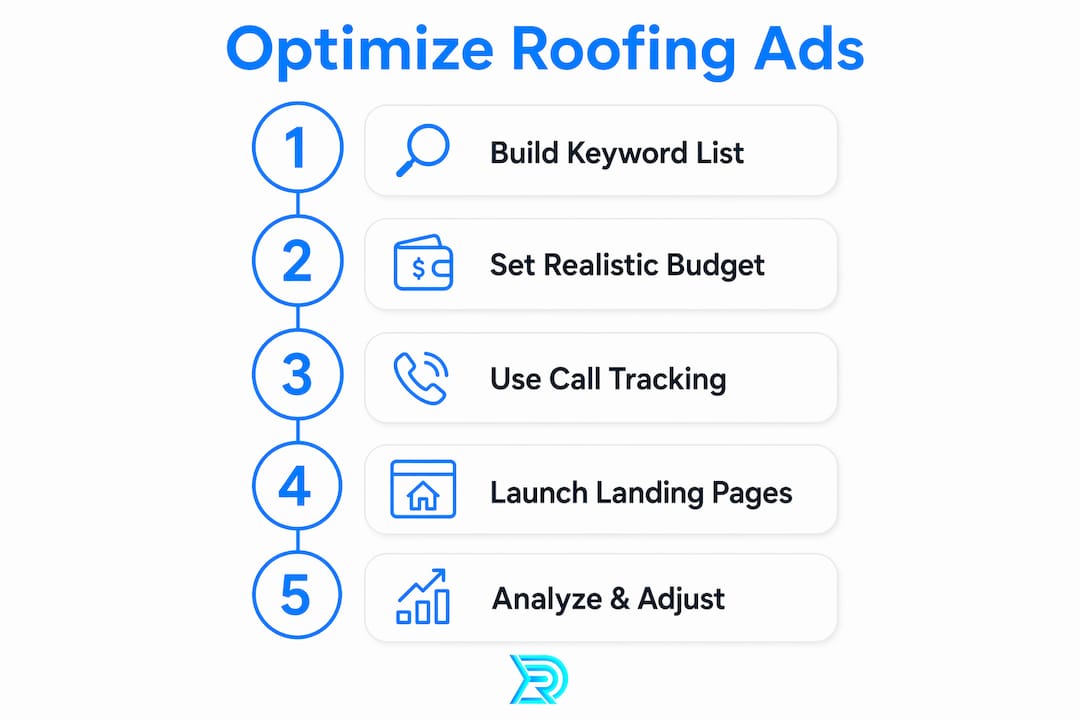
Allocate roughly 65% of your budget to high-intent keywords like “roof replacement near me” and “emergency roof repair.” Reserve about 30% for Local Services Ads once you have 20 or more reviews. Do not increase your total budget until your landing page conversion rate and negative keyword list are both dialed in. Spending more into a broken funnel just accelerates the waste.
How do tracking and landing pages reduce wasted roofing ad spend?
You cannot cut waste you cannot see. Call tracking and dedicated landing pages are the two tools that make every other optimization possible.
Call tracking tools like CallRail assign unique phone numbers to each keyword or ad group. That tells you exactly which searches produce booked jobs, not just calls. Up to 35–50% of roofing ad budget can go to non-converting traffic without this visibility. Once you know which keywords drive revenue, you shift budget toward them and cut the rest.
Landing pages matter just as much. The industry average landing page conversion rate is 3.7%. A well-built page with strong trust signals, a clear call to action, and a simple form hits 8–10%. That difference means you get two to three times more leads from the same ad spend. Sending traffic to your homepage instead of a dedicated landing page is like sending a sales rep to a job site without a pitch. Check out roofing website design principles that support this kind of conversion lift.
Here is what every roofing landing page needs:
- A headline that matches the ad. If the ad says “Storm Damage Roof Repair,” the page headline must say the same thing.
- Social proof above the fold. Star ratings, review counts, and photos of completed jobs build trust fast.
- One clear call to action. A phone number and a short form. No navigation menu. No distractions.
- Mobile optimization. Most roofing searches happen on phones. A slow or cluttered mobile page kills conversions.
Speed-to-lead is the final piece. Leads not called within 5 minutes convert 80% less. That is not a small drop. Set up instant lead notifications and assign someone to respond immediately during business hours. For effective lead nurturing after the first contact, a structured follow-up sequence keeps warm leads from going cold.
Pro Tip: Connect your call tracking data back to your CRM. Tag every lead with the keyword that drove it. After 90 days, you will know exactly which search terms produce closed jobs, not just calls.
How do storm damage campaigns reduce wasted spend and boost close rates?
Storm damage campaigns are the highest-ROI opportunity in roofing Google Ads. The key is building them before you need them.
Follow this activation sequence:
- Build the campaign in advance. Create a dedicated storm damage campaign with ad copy, landing pages, and keywords ready. Keep it paused until you need it.
- Set a weather trigger. Monitor local weather events. When a hail storm or high-wind event hits your market, activate the campaign immediately.
- Increase your budget by 50–100%. Storm leads close at 67% compared to 33% for standard replacement leads. The higher close rate justifies the higher spend.
- Geofence to affected zip codes. Narrow your targeting to the specific neighborhoods hit by the storm. This keeps spend focused on the highest-intent, most urgent buyers.
The contractors who win after a storm are the ones who were ready before it hit. Waiting to build a campaign after the event means you miss the first 48 hours, which is when urgency and close rates peak. You can also use Google Ads for roofing scripts or third-party automation tools to adjust bids dynamically based on weather triggers, removing the manual step entirely.
Key Takeaways
Stopping wasted roofing ad spend requires tight keyword control, realistic budgets, dedicated landing pages, and call tracking tied directly to booked jobs.
| Point | Details |
|---|---|
| Negative keywords cut waste fast | A proper negative keyword list reduces wasted spend by 20–35% immediately. |
| Budget below $1,500 stalls learning | Spending under $1,500 per month produces only 3–6 leads, too few to optimize. |
| Landing pages double conversion rates | Well-built pages convert at 8–10% vs the 3.7% industry average. |
| Speed-to-lead is non-negotiable | Calling a lead within 5 minutes improves conversion by over 80%. |
| Storm campaigns need pre-built assets | Paused storm campaigns activated at the right moment close leads at 67%. |
What I have learned after years of running roofing PPC campaigns
The most common mistake I see roofing contractors make is treating budget increases as the solution to poor performance. If your cost per lead is too high, spending more does not fix it. It amplifies the problem. The issue is almost always structural: wrong keywords, no negatives, weak landing pages, or zero call tracking.
The second mistake is impatience in the early weeks. Google’s algorithm needs data before it can work for you. Contractors who panic and restructure campaigns after two weeks never let the system learn. Discipline in the first 60 days, combined with tight manual CPC bidding, sets the foundation for everything that follows.
Negative keyword management is the unglamorous work that separates profitable campaigns from money pits. I review search term reports weekly. Every irrelevant search that triggers an ad is a dollar wasted. Over a month, those dollars add up to hundreds. Over a year, they add up to jobs you never got to bid on.
The contractors who get the best results treat their Google Ads management like a job site. They show up consistently, check the numbers, and fix what is broken. PPC is not a set-it-and-forget-it channel. It rewards the contractors who pay attention.
— Results
How Resultsdigitalus helps roofers get more from every ad dollar
Resultsdigitalus builds and manages Google Ads campaigns exclusively for roofing contractors, gutter companies, siding contractors, and general contractors across the United States. Every campaign includes tight keyword segmentation, a built-out negative keyword list from day one, call tracking setup, and dedicated landing pages matched to ad intent.
The agency’s exclusivity model means your campaign never competes with another roofer in your market. Founder Preston Toor and the team have helped contractors scale from small operations to multi-crew businesses, including a Florida roofing company that grew from 3 crews to 18 before selling for $60 million. If you are ready to stop wasting your ad budget and start generating consistent, trackable leads, explore Resultsdigitalus’s Google Ads services for roofers and see what a purpose-built campaign looks like.
FAQ
What is a good cost per lead for roofing Google Ads?
Non-branded roofing Google Ads campaigns averaged $124 per lead in Q1 2026. Your actual CPL depends on your market, competition, and landing page quality.
How much should a roofing contractor spend on Google Ads per month?
The minimum viable budget is $3,000–$5,000 per month. Budgets under $1,500 typically produce only 3–6 leads, which is too few to optimize or scale.
What is the fastest way to reduce wasted roofing ad spend?
Build a negative keyword list before you launch. Removing irrelevant search terms like “roofing jobs” and “DIY roof repair” can cut wasted spend by 20–35% immediately.
When should I switch from manual CPC to automated bidding?
Switch to smart bidding only after your campaign generates at least 30 conversions per month. Below that threshold, Google’s algorithm lacks enough data to bid effectively on your behalf.
Why do roofing storm damage campaigns have higher close rates?
Storm damage leads close at 67% compared to 33% for standard replacement leads because urgency is high and homeowners need immediate help. Activating a pre-built, geofenced campaign within hours of a storm captures that demand at its peak.
