
Roofing call tracking is the technology that assigns unique phone numbers to marketing campaigns and website visitors to identify exactly which efforts generate inbound phone leads. Phone calls account for 30–60% of total conversions for home service businesses like roofing. That means if you are not tracking calls, you are missing the majority of your lead data. Dynamic Number Insertion (DNI) is the industry-standard method powering this attribution, and Resultsdigitalus builds it into every roofing marketing campaign it manages. Understanding how roofing call tracking works is the first step toward spending your ad budget where it actually produces jobs.
How does roofing call tracking work behind the scenes?
Call tracking works by placing a small JavaScript tag on your website. That tag detects where each visitor came from, then swaps the phone number displayed on your site with a unique tracking number assigned to that traffic source. The swap happens in real time, and the visitor never notices it.
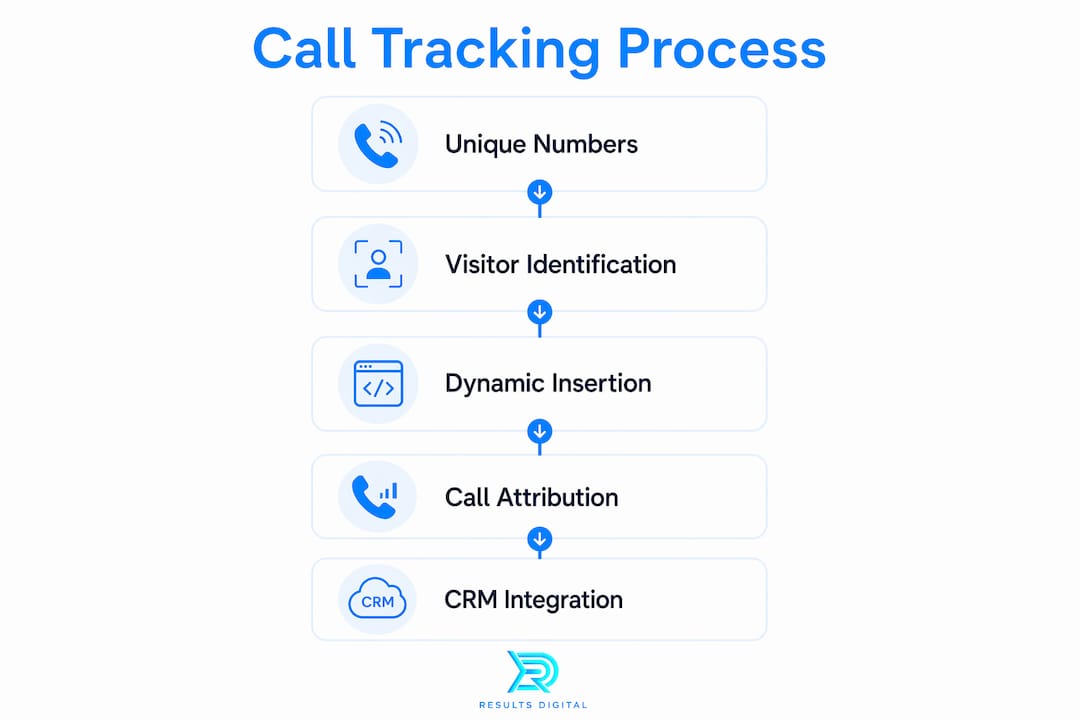
Here is the step-by-step process:
- A visitor lands on your site. The JavaScript tag fires and reads the traffic source, whether that is a Google Ads click, an organic search, a Facebook ad, or a direct visit.
- A tracking number is pulled from a pool. The system assigns one of the numbers in your tracking pool to that visitor’s session. That number stays assigned for the duration of the visit.
- The visitor calls the displayed number. The call routes to your real business line with no interruption. The tracking platform captures the source data, keyword, duration, and outcome in the background.
- The data is logged. Every call is recorded against the original traffic source, giving you a complete picture of which campaigns drove that lead.
This mechanism is called Dynamic Number Insertion, and it is the backbone of accurate roofing lead attribution.
Pool size matters more than most contractors realize

Tracking number pools of 15–20 numbers balance attribution accuracy and cost effectively for most roofing contractors. If your pool is too small relative to your traffic volume, numbers get reused before the previous session ends. That overlap corrupts your data. A site receiving 100 visitors per hour with only 10 numbers in the pool means each number handles 10 sessions per hour, creating significant overlap and misattribution.
Pro Tip: If your site gets heavy traffic during storm season, increase your pool size temporarily. A pool that works fine in January may fall short in April when hail hits your market.
One important limitation: DNI only works on your website. Static numbers on your Google Business Profile, yard signs, or print ads require separate dedicated tracking numbers assigned permanently to each source.
What are the key benefits of call tracking for roofing businesses?
Call tracking does not just count calls. It tells you which marketing dollars produced those calls, which ones wasted your budget, and which leads are worth pursuing. The benefits are direct and measurable.
- Conversion lift. Integrating call tracking can boost reported conversions by 20–60% by revealing leads that were previously invisible in your analytics.
- Budget reallocation. 20% of campaigns drive 80% of phone leads in most contractor marketing. Call tracking shows you exactly which 20% so you can cut waste and double down on what works.
- Offline attribution. Call tracking assigns unique numbers to offline sources like yard signs, direct mail, and billboards. You finally know whether that $3,000 mailer generated any real calls.
- Lead qualification. AI call scoring classifies calls as qualified leads, existing customers, or spam automatically. Your sales team stops wasting time on junk calls.
- Google Ads optimization. Call tracking platforms pass call conversion data back to Google Ads using GCLID, which feeds Smart Bidding algorithms with real offline conversion signals.
Phone calls generally carry higher conversion rates and higher order values than form submissions. A roofing job booked over the phone is worth far more than a contact form that never gets followed up. Ignoring call tracking means your marketing data is built on an incomplete foundation, and every budget decision you make from that data is compromised.
Resultsdigitalus integrates call tracking into every paid campaign it runs for roofing contractors because incomplete marketing data leads directly to bad budget decisions. Strong call-to-action design on your landing pages also plays a role in driving those calls. Effective CTAs directly influence whether a visitor picks up the phone or bounces.
What are common mistakes in roofing call tracking?
Most roofing contractors who set up call tracking make the same handful of errors. These mistakes do not just reduce accuracy. They can make your data actively misleading.
Pro Tip: Audit your call tracking setup every quarter. Pool sizes, traffic volumes, and campaign mixes all change, and your configuration needs to keep up.
The most common pitfalls include:
- Undersized tracking pools. A pool that is too small causes number reuse, which degrades attribution accuracy and makes high-performing campaigns look weaker than they are.
- Missing offline sources. Contractors often track website calls but forget to assign dedicated numbers to their Google Business Profile, yard signs, or truck wraps. Those sources then show zero call data.
- Ignoring call quality. Raw call volume is a vanity metric. Spam calls and wrong numbers inflate your numbers. AI scoring filters these out so you measure real leads, not noise.
- No CRM integration. Tracking calls without connecting that data to your CRM means your sales team has no context when they follow up. The lead source disappears the moment the call ends.
- Skipping Google Ads integration. Without passing call conversions back to Google Ads, your Smart Bidding campaigns optimize on incomplete data and underperform. This is one of the most common reasons roofing ads underperform, and it is entirely fixable.
If you want to see the full picture of what kills roofing ad performance, the common roofing marketing mistakes contractors make go well beyond call tracking alone.
How does call tracking data improve your CRM workflow?
Call tracking data becomes most powerful when it flows directly into your CRM. Without that connection, you know a call came in from a Google Ads campaign, but your sales team has no record of it, no follow-up trigger, and no way to close the loop.
When call tracking integrates with a roofing CRM, the workflow looks like this:
| CRM Action | What Call Tracking Enables |
|---|---|
| Automatic lead creation | Every tracked call creates a new contact record with source data attached |
| Lead prioritization | Calls from high-value campaigns get flagged for immediate follow-up |
| Conversion sync | Call outcomes push back to Google Ads to improve Smart Bidding signals |
| Follow-up automation | Qualified lead tags trigger automated email or SMS sequences |
| Unified reporting | Online and offline lead sources appear in one dashboard |
Integrating call tracking with roofing CRMs dramatically improves sales workflow efficiency by automating lead qualification and attribution. Your sales team stops manually logging calls and starts focusing on closing. Resultsdigitalus builds these integrations as a standard part of its contractor marketing setups, not as an afterthought.
A well-built CRM workflow for roofing leads turns call tracking data into a repeatable sales process. Every lead gets logged, scored, and followed up on schedule, regardless of which crew member answered the phone.
Key Takeaways
Roofing call tracking works because Dynamic Number Insertion links every inbound call to its exact marketing source, giving contractors the data they need to cut waste and close more jobs.
| Point | Details |
|---|---|
| DNI is the core technology | JavaScript swaps displayed numbers in real time to match each visitor’s traffic source. |
| Pool size determines accuracy | Pools of 15–20 numbers prevent overlap and protect attribution quality for most roofing sites. |
| Calls drive the majority of leads | Phone calls represent 30–60% of home service conversions, making tracking non-negotiable. |
| CRM integration closes the loop | Connecting call data to your CRM automates follow-up and keeps lead source data intact. |
| Offline sources need dedicated numbers | Google Business Profile, yard signs, and mailers each require their own static tracking number. |
What I have learned running call tracking for roofing contractors
Most contractors I talk to assume call tracking is just a reporting tool. They think it tells them how many calls they got. That is the least interesting thing it does.
The real value shows up when you connect call data to ad spend and start seeing which campaigns are actually producing revenue, not just clicks or impressions. I have seen contractors cut their cost per lead significantly after realizing that one campaign was generating 70% of their qualified calls while another was eating budget and producing mostly spam. Without call tracking, both campaigns looked similar in Google Ads because form conversions were roughly equal. The calls told a completely different story.
The contractors who get the most from call tracking are the ones who treat it as a business intelligence tool, not a marketing checkbox. They review call recordings weekly. They use AI scoring to filter out junk. They push call conversion data back to Google Ads and let Smart Bidding do its job with real signals. That combination is what produces the kind of cost-per-acquisition improvements that actually move the needle on a roofing business.
The technology is not complicated. The discipline to use it consistently is where most contractors fall short.
— Results
Roofing call tracking done right, from day one
Running call tracking without a proper setup is like putting a GPS in your truck but never turning it on. The technology only works when it is configured correctly, connected to your ad platforms, and reviewed regularly.
Resultsdigitalus builds call tracking into every roofing marketing campaign it manages, from Google Ads and Meta Ads to SEO and website design. The agency works exclusively with roofing contractors and similar trades, which means every configuration is built for your traffic patterns, your sales cycle, and your market. If you are ready to see exactly which campaigns are producing your phone leads, roofing digital marketing services from Resultsdigitalus give you the full setup, ongoing optimization, and the reporting that makes every dollar accountable.
FAQ
What is Dynamic Number Insertion in roofing call tracking?
Dynamic Number Insertion is a JavaScript-based method that swaps the phone number displayed on your website based on where each visitor came from. It is the standard technology behind accurate roofing lead attribution.
How many tracking numbers do roofing contractors need?
Most roofing contractor websites need a pool of 15–20 tracking numbers to maintain accurate attribution without excessive cost. High-traffic sites or storm-season surges may require larger pools temporarily.
Does call tracking work for offline marketing like yard signs?
Yes. Offline sources like yard signs, direct mail, and billboards each get a dedicated static tracking number. This lets you measure which offline channels drive calls without relying on DNI.
Can call tracking improve my Google Ads performance?
Call tracking platforms pass call conversion data back to Google Ads using GCLID. That data feeds Smart Bidding algorithms with real phone lead signals, which improves campaign efficiency over time.
What happens to call tracking data if I do not use a CRM?
Without CRM integration, call source data exists only inside your tracking platform. Your sales team has no record of the lead source, follow-up automation cannot trigger, and the data never connects to revenue outcomes.
