
Roofing contractor online reputation management is the strategic practice of actively collecting, monitoring, and responding to customer feedback across platforms like Google Business Profile, Angi, and the Better Business Bureau to build trust and convert more leads. Contractors with strong reputations report close rates 30 to 50 percent higher than competitors at similar pricing. That gap exists because homeowners treat your review profile the same way they treat a referral. The industry term for this discipline is online reputation management (ORM), and for roofing businesses it goes far beyond chasing five-star ratings. It is a system, and this guide shows you exactly how to build one.
How roofing contractor online reputation management works
ORM for roofing contractors operates across three connected activities: review acquisition, reputation monitoring, and response management. Each one feeds the others. A contractor who collects reviews consistently but never monitors them is flying blind when a damaging complaint surfaces. One who monitors but never responds signals to future customers that no one is home.

Google Business Profile reviews are the dominant signal influencing local pack rankings, weighted by volume, average rating, recency, and photos. This means your Google profile is not just a trust signal. It is a direct ranking factor that determines whether homeowners find you at all. Angi and the BBB carry secondary weight, but they matter in specific contexts. The BBB, for example, influences insurance adjuster recommendations and local regulatory trust in ways that Google cannot replicate.
Facebook reviews add social proof for homeowners who discover you through paid ads or community groups. The practical takeaway is that you need a presence and a response strategy on all four platforms, with Google as your primary focus and the others maintained consistently.
Why review volume and recency matter more than star ratings
Homeowners read dozens of reviews before choosing a roofing contractor. What they are actually evaluating is not the average star rating in isolation. Volume and recent activity inspire more trust than a perfect score with only eight reviews from three years ago. A contractor with a 4.6 rating and 200 recent reviews will consistently outperform a competitor with a 4.9 rating and 22 reviews from 2022.
This matters for your roofing business reputation strategies because it reframes the goal. You are not trying to achieve perfection. You are trying to build statistical authority through consistent volume. Homeowners subconsciously apply the same logic a researcher would: a larger sample size is more credible than a small one, regardless of the mean score.
Recency signals that your business is active and that your current team delivers quality work. A review from 18 months ago tells a homeowner nothing about the crew showing up at their house next Tuesday. Prioritize getting new reviews every single month, not just after large jobs.
Pro Tip: Set a monthly review target based on your job volume. If you complete 20 jobs per month, aim for at least 8 to 10 new reviews. Treat it like a KPI, not an afterthought.
What systems and tools actually drive review acquisition
The mechanics of gathering reviews come down to timing, channel, and friction reduction. Ask for a review immediately after job completion, while the customer’s satisfaction is at its peak. Waiting 48 hours cuts response rates significantly because the emotional high of a finished roof fades fast.
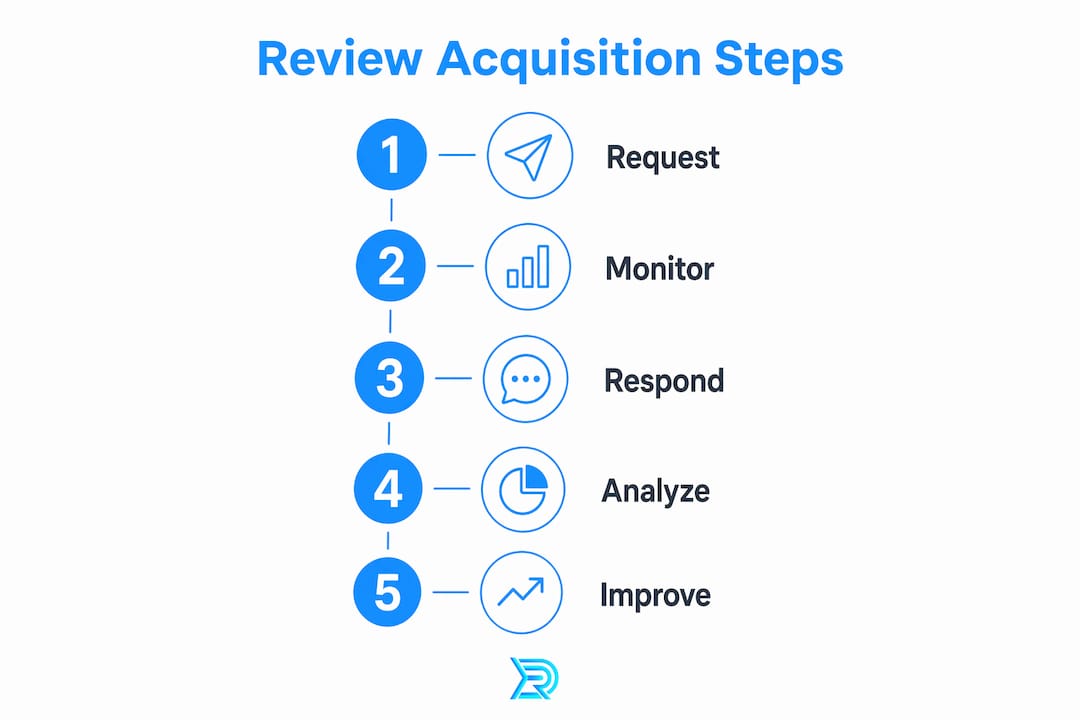
Here is a proven four-step review acquisition system for roofing contractors:
- Complete the job and do a final walkthrough with the homeowner. Confirm they are satisfied before you leave the property.
- Send an SMS review request within two hours of completion. Include a direct deep link to your Google Business Profile review form. Deep links remove the friction of searching for your business and dramatically increase completion rates.
- Follow up with an email the next morning if no review has been submitted. Keep it short, personal, and include the same direct link.
- Log the request in your CRM so you can track response rates by crew, job type, and neighborhood.
SMS and email together produce a 60 to 80 percent higher response rate than either channel alone. That is not a marginal improvement. It is the difference between building a review profile in six months versus two years. SMS-based requests alone generate approximately 40 percent higher response rates than email campaigns, which confirms that mobile-first outreach is the right default for roofing contractors whose customers are typically at home and on their phones.
Pro Tip: Use tools like Birdeye, NiceJob, or Podium to automate review requests and monitor incoming feedback across all platforms from a single dashboard. Automation removes the dependency on individual staff motivation.
| Platform | Primary Benefit | Response Priority |
|---|---|---|
| Google Business Profile | Local pack rankings and search visibility | Respond within 24 hours |
| Angi | High-intent homeowner leads | Respond within 48 hours |
| Better Business Bureau | Insurance adjuster and regulatory trust | Resolve complaints within 72 hours |
| Social proof for ad audiences | Respond within 48 hours |
Review acquisition should be a consistent system independent of individual staff motivation or turnover. If your review volume drops every time a project manager leaves, your system is broken. Build the process into your CRM workflow so it runs regardless of who is on the team.
How to integrate reputation management into roofing operations
The contractors who build the strongest reputations do not just manage reviews. They use reviews as a diagnostic tool. Patterns in negative feedback reveal operational problems that no amount of marketing can fix. If three separate customers mention that your crew left debris in the yard, that is not a review problem. It is a cleanup protocol problem.
Successful contractors use negative feedback to identify recurring complaints and fix root causes rather than masking them with positive reviews. This approach compounds over time. Fix the cleanup protocol, and the complaints stop. Stop the complaints, and your average rating climbs without any additional effort.
Here is what operational reputation infrastructure looks like in practice:
- Pricing transparency: Provide detailed written estimates before work begins. Surprise charges are the single most common trigger for one-star reviews in the roofing industry.
- Crew consistency: Assign the same crew lead to a job from start to finish. Homeowners build trust with individuals, and crew changes mid-project create anxiety and complaints.
- Follow-up calls: Call every customer 30 days after completion to check for any issues. This catches problems before they become public reviews and signals that you stand behind your work.
- Documentation: Photograph every job before, during, and after. This protects you in disputes and gives you content for your Google Business Profile.
Avoid purchasing fake reviews or suppressing negative feedback. Google’s algorithm detects review velocity anomalies and can suspend your profile. More importantly, fake reviews do not fix the operational issues that generate real complaints. Focus on building what the industry calls reputation infrastructure: the combination of systems, habits, and service standards that naturally generate authentic positive feedback at scale. Pair this with consistent online branding for roofers and you create a compounding trust advantage that competitors cannot easily replicate.
Common mistakes that damage roofing reputation online
Most reputation problems are self-inflicted. The errors below are predictable, preventable, and costly.
Responding defensively to negative reviews. Emotional or defensive responses to negative feedback damage reputation more than the original complaint. Future customers reading your response are not evaluating whether the complainer was right. They are evaluating how you handle pressure. A calm, professional, resolution-focused reply to a one-star review tells thousands of future customers that you are accountable and steady.
The best public responses to negative reviews do not aim to convince the complainer. They aim to show calm professionalism to every future customer who reads the thread. (Silvermine.ai)
Additional mistakes to avoid:
- Inconsistent review acquisition. Bursts of reviews followed by months of silence look suspicious to both homeowners and Google’s algorithm. Steady monthly volume is always better than spikes.
- Ignoring platform-specific nuances. A BBB complaint requires a formal written response and documented resolution, not the same casual reply you might post on Google. Slow BBB complaint resolution directly damages your rating and can cost you insurance adjuster referrals.
- Failing to respond to positive reviews. Responding only to negative reviews signals that you only engage when forced to. Acknowledge positive feedback with a brief, specific thank-you. It takes 30 seconds and reinforces the relationship.
- Storm-chaser credibility gaps. After major weather events, out-of-state contractors flood local markets. Homeowners become skeptical of all roofing companies. Your volume of local, recent, verified reviews is the fastest way to establish credibility when trust is lowest across the entire category.
Responding within 48 hours to every one, two, and three-star review is the minimum standard. Anything slower signals indifference, and indifference is the reputation killer that no marketing budget can overcome.
Key takeaways
Roofing contractor online reputation management requires consistent review acquisition, platform-specific response strategies, and operational fixes that eliminate the root causes of negative feedback.
| Point | Details |
|---|---|
| Volume beats perfection | Many recent reviews outperform a perfect rating with few entries in both trust and search rankings. |
| SMS plus email wins | Combining both channels increases review response rates by 60 to 80 percent over either alone. |
| Operations drive reputation | Recurring complaints reveal process flaws. Fix the process, and the reviews improve automatically. |
| Responses are public marketing | Every reply to a negative review is read by future customers. Stay calm, specific, and professional. |
| Fake reviews carry real risk | Google detects velocity anomalies and can suspend your profile. Build authentic systems instead. |
What I’ve learned about reputation after working with roofers for a decade
At Resultsdigitalus, we have worked with roofing contractors across the country since 2015, and the pattern is consistent: the contractors who struggle most with reputation are not bad at roofing. They are bad at systems. They do the work well but have no process for capturing that goodwill in a public, searchable format.
The most common fix we implement is not a software tool. It is a conversation with the owner about what happens in the 24 hours after a job closes. In almost every case, nothing happens. No review request, no follow-up call, no documentation. The customer is happy, but that happiness evaporates before it ever becomes a Google review.
We also see contractors who treat reputation management as a marketing function separate from operations. That framing is wrong. If your crews are leaving job sites messy, no review automation tool will save you. The software just accelerates the feedback loop, positive or negative. Get the operations right first, then build the system around them.
The contractors who grow fastest are the ones who treat their review profile the same way they treat their equipment. They maintain it, invest in it, and check it regularly. Reputation is not a vanity metric. It is a lead generation asset that compounds every month you work on it.
— Results
How Resultsdigitalus helps roofing contractors build stronger reputations
Resultsdigitalus is a veteran-owned digital marketing agency built exclusively for roofing contractors, gutter companies, siding businesses, and general contractors. We do not run generic campaigns. Every strategy we build is engineered for contractor lead generation in your specific market.
Our roofing digital marketing services include reputation monitoring, review acquisition systems, Google Business Profile optimization, and SEO built around the signals that actually move local rankings. We helped one Florida roofing company grow from 3 crews to 18 before selling for $60 million. If you are ready to turn your reputation into a lead generation engine, explore our roofing SEO services or reach out to talk through your market.
FAQ
How does online reputation management work for roofers?
Roofing reputation management works by systematically collecting reviews after each job, monitoring feedback across Google Business Profile, Angi, BBB, and Facebook, and responding to all reviews within 48 hours. The goal is to build a high-volume, recent review profile that ranks well locally and converts skeptical homeowners into paying customers.
What is the best platform for roofing contractor reviews?
Google Business Profile is the most important platform because its reviews directly influence local pack rankings and homeowner trust. BBB matters for insurance adjuster referrals and regulatory credibility, while Angi and Facebook support lead generation and social proof.
How many reviews does a roofing contractor need?
There is no fixed number, but volume and recency matter more than reaching a specific count. Homeowners trust contractors with many recent reviews over those with a perfect rating and few entries, so the practical goal is consistent monthly acquisition tied to your job volume.
Should I respond to every roofing review?
Yes. Respond to every review, positive and negative. Defensive or emotional responses to negative feedback damage your reputation more than the original complaint, so keep replies calm, specific, and resolution-focused. Future customers read your responses as a preview of how you handle problems.
Can fake reviews hurt my roofing business?
Purchasing fake reviews or suppressing negative feedback carries real risk. Google detects unusual review velocity and can suspend your Business Profile entirely. Build a system that generates authentic reviews from real customers instead.
