
TL;DR:
- Ranking for broad roofing keywords often attracts unqualified visitors, leading to low conversions and wasted SEO efforts.
- Focusing on high-intent, location-specific, and service-related keywords significantly increases qualified leads and booked jobs.
Ranking for the wrong roofing keywords is one of the most expensive mistakes a contractor can make. You spend time optimizing your website, updating your Google Business Profile, and building citations, only to attract visitors who never call. The hard truth is that most generic keywords don’t bring real customers, no matter how high you rank for them. This guide breaks down exactly why keyword selection is so critical to local SEO success, what traps to avoid, and how to build a keyword strategy that fills your schedule with qualified jobs.
Table of Contents
- The real impact of roofing keywords on local SEO
- Common roofing keyword mistakes (and how to avoid them)
- Choosing high-converting roofing keywords: what works best?
- How the right keywords drive more leads (real-world results)
- Our take: Why most roofing keyword advice misses the mark
- Ready to maximize your roofing leads?
- Frequently asked questions
Key Takeaways
| Point | Details |
|---|---|
| Intent is critical | Keywords must match what qualified local roofing customers are actually looking for, not just bring clicks. |
| Generic keywords waste budget | Broad keywords deliver weaker leads and higher bounce rates, diminishing your ROI. |
| Keyword stuffing is risky | Overusing keywords can get your Google Business Profile suspended and hurt search presence. |
| Specialize for more leads | Location- and service-specific keywords attract ready-to-buy prospects and boost local rankings. |
| Regular reviews pay off | Update keyword lists often to stay ahead of market trends and maintain strong lead flow. |
The real impact of roofing keywords on local SEO
Not all roofing keywords are created equal. Understanding why SEO matters for roofers starts with recognizing that keyword intent drives the entire lead generation process. A homeowner whose roof is actively leaking searches very differently than someone casually reading about roofing materials. If your website shows up for the wrong intent, you get clicks but no calls.
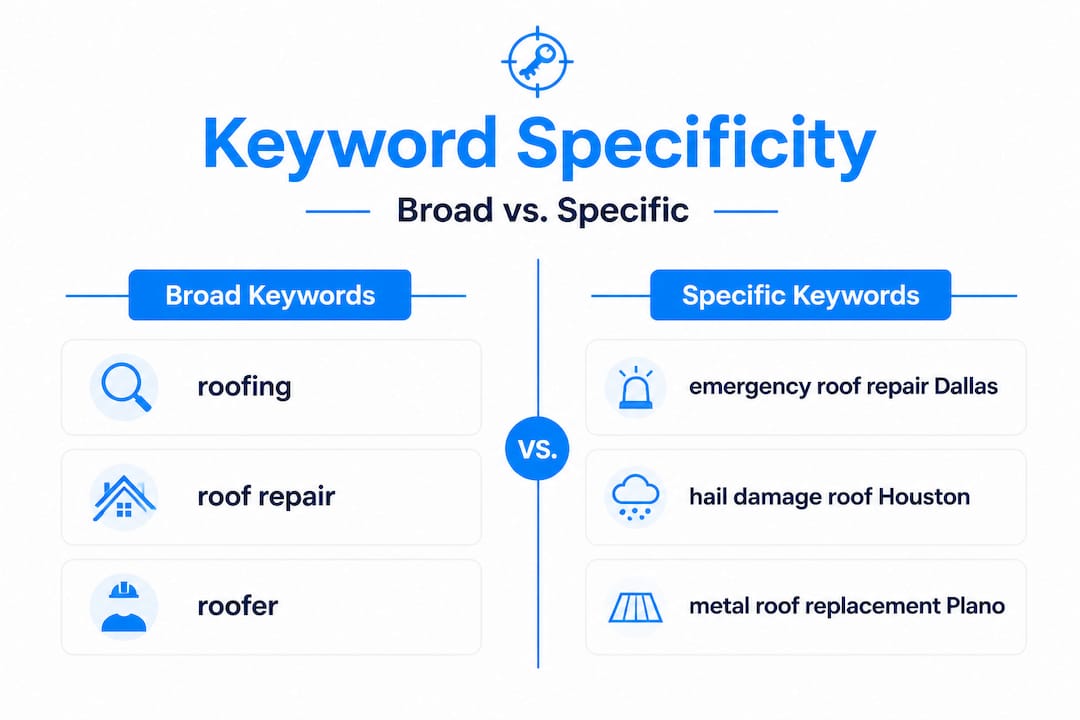
Keyword intent is the “why” behind a search query. When someone types “roofing company near me” or “emergency roof repair in Houston,” they are ready to hire. When someone types “types of roofing materials” or just “roofing,” they are usually researching, not buying. Targeting the second group fills your analytics with traffic that bounces right off the page.
Broad keywords like “roofing” or “roofer” pull in an enormous mix of users: students doing school projects, homeowners in states you don’t serve, competitors scoping out the market. Your roofing local SEO guide performance depends entirely on whether you’re reaching people who need a contractor in your actual service area, right now.
Poor keyword choices don’t just waste traffic. They signal to Google that your page doesn’t satisfy search intent, which pushes up your bounce rate and signals low relevance. Over time, broad keywords fail to convert and drag down the overall ranking authority of your site.
Here’s a quick comparison of keyword types and how they typically perform:
| Keyword | Intent | Likely result |
|---|---|---|
| Roofing | Informational/mixed | Low conversions, high bounce |
| Roofing company | Partial buying intent | Moderate conversions |
| Roofing company near me | High buying intent | Strong local leads |
| Emergency roof repair in Dallas | Urgent buying intent | Very high conversion rate |
| Metal roof installation in Austin | Service + location specific | Consistent, qualified leads |
“Intent mismatch is one of the fastest ways to burn your SEO budget. Ranking for a keyword with 10,000 monthly searches means nothing if zero of those searchers are ready to hire a roofer in your city.”
The table above tells a clear story. Specificity wins. The more your keyword reflects what a ready-to-hire homeowner actually types, the more your phone rings. Generic terms might look impressive in a keyword tool, but they rarely translate into booked jobs.
Common roofing keyword mistakes (and how to avoid them)
Understanding the dangers of the wrong keywords, contractors must watch out for a few common traps that cost both money and rankings.
Here are the most damaging mistakes we see roofing contractors make with their keyword strategy:
- Using overly broad terms like “roofing” or “contractor” that attract random visitors with no local buying intent
- Keyword stuffing in website pages, meta descriptions, and especially Google Business Profile listings
- Ignoring local phrases that real customers in your city actually use, such as neighborhood names or regional landmarks
- Skipping service specificity by targeting “roofing” instead of “roof replacement” or “storm damage roof repair”
- Not considering user intent by optimizing for research-stage queries rather than decision-stage searches
- Copying big-city keyword strategies without adjusting for your specific market size and competition level
Keyword stuffing deserves special attention because the consequences go beyond just poor rankings. Stuffing keywords aggressively can lead to a Google Business Profile suspension, which can effectively make your business invisible in local search overnight. Many contractors don’t realize their GBP is suspended until calls dry up completely. A suspension is difficult to reverse and can take weeks to resolve even with a clean appeal.
Understanding the roofing SEO terms explained properly helps you avoid accidental stuffing. Terms like keyword density, semantic relevance, and latent semantic indexing all point toward one principle: write naturally for humans, not robots.
Pro Tip: Focus your keyword selection on buyer intent. Think about what a homeowner types when they’ve already decided they need a roofer and are just choosing which one to call. Phrases like “emergency roof repair in [your city],” “licensed roofer near [neighborhood],” or “roof replacement estimate [city]” are the kinds of terms that generate actual revenue. Build your roofing website optimization workflow around these buyer intent phrases first, then expand from there.
Long-tail keywords, which are three to six word phrases that are highly specific, consistently outperform short generic terms in conversion rate. They have lower search volume, but the people searching them know exactly what they want. Ranking for twenty long-tail buyer intent phrases will generate more revenue than ranking for one broad term with ten times the monthly searches.

Choosing high-converting roofing keywords: what works best?
So, how do you balance avoiding common mistakes with picking keywords that deliver the best results? The answer lies in a simple, repeatable framework you can apply to any market.
Here is how top-performing roofing keywords stack up across three categories:
| Keyword type | Example | Click quality | Lead quality | Competition |
|---|---|---|---|---|
| Generic | Roofing | Low | Very low | Very high |
| Location-specific | Roofing company in Phoenix | Medium | Medium-high | Medium |
| Service + location | Metal roof replacement Phoenix | High | Very high | Lower |
| Intent + location | Emergency roof repair near me | Very high | Highest | Varies |
Follow these steps to build a keyword list that actually converts:
-
List your top five services. Start with what makes you the most revenue: roof replacement, storm damage repair, new construction, gutters, or siding. Each service deserves its own keyword cluster.
-
Add your city, county, and key neighborhoods. “Roof replacement in Atlanta” and “roof replacement in Buckhead” can both bring leads. Cover your full service radius with location modifiers.
-
Check competition and search volume. Use Google Search Console, Google’s autocomplete, or a tool like Semrush to gauge how difficult each keyword is to rank for. Prioritize high-intent terms with manageable competition.
-
Layer in “near me” and emergency modifiers. Phrases like “roofer near me” and “24-hour roof repair” capture people who are actively searching in the moment of need.
-
Map each keyword to a specific page. One keyword cluster per service page. Never try to rank one page for every service you offer, because it dilutes relevance signals.
-
Review roofing SEO trends regularly. Search behavior evolves, and staying current gives you a competitive edge that contractors running a set-it-and-forget-it strategy will never have.
Pro Tip: Update your keyword strategy after major local weather events. If a hailstorm hits your area, terms like “hail damage roof repair in city]” will spike dramatically in search volume. Contractors who update their pages within 24 to 48 hours of a storm event consistently capture leads that slower competitors miss. [Broad keywords fail to convert during these spikes because they lack the specificity that storm-affected homeowners are searching for.
Seasonality also matters more than most guides admit. Flat-roof contractors in northern climates should emphasize snow load and ice dam keywords in winter. Florida roofers should push hurricane preparation terms before storm season. Matching your keyword strategy to your customers’ seasonal concerns keeps your pages fresh and relevant year-round.
How the right keywords drive more leads (real-world results)
With a process in hand, what does putting the right keyword strategy into action look like on the ground?
Here is a step-by-step sequence from keyword audit to booked jobs:
-
Audit your current keywords. Pull your top five pages from Google Search Console and see what queries are driving impressions versus clicks. High impressions with low clicks usually signal a mismatch between your title tag and what the searcher actually wants.
-
Identify your weakest performers. Any page with a bounce rate above 70% likely has a keyword intent problem. Visitors land, don’t find what they expected, and leave immediately.
-
Swap generic terms for service and location combos. Rewrite page titles, headers, and the first paragraph to reflect buyer intent phrases you identified in the previous section.
-
Update your Google Business Profile. Make sure your primary category, services, and business description reflect the same high-intent terms. Avoid stuffing, but be specific and clear about what you do and where.
-
Track leads, not just traffic. Set up call tracking and form tracking so you can see which keyword-driven pages are actually generating calls and quote requests.
The real-world difference is significant. Consider a roofing contractor in the suburbs of a mid-sized city who was ranking well for “roofing company” but getting almost no calls from organic traffic. After switching page titles and headers to service-plus-location phrases like “roof replacement in [suburb] TX” and “storm damage repair in [suburb],” call volume from organic search increased noticeably within two months. More importantly, the leads were higher quality: homeowners with real jobs ready to go, not tire-kickers asking vague questions.
This outcome makes sense when you understand what the research shows. Targeting buyer intent consistently increases lead quality because the people clicking are further along in the decision process. They’ve already decided they need a roofer. They’re just deciding which one.
Your roofer digital marketing guide approach should treat keyword optimization as an ongoing process, not a one-time task. Run a quick audit right now: pull up your five most important roofing pages and ask whether each keyword reflects the intent of a homeowner ready to hire. If the answer is no for even one page, you’re leaving jobs on the table every single week.
Our take: Why most roofing keyword advice misses the mark
Most keyword guides for roofers are built around spreadsheets. They rank keywords by monthly search volume, assign a difficulty score, and tell you to target the ones in the sweet spot. That framework is not wrong, but it’s deeply incomplete.
Volume-focused advice ignores the single most important variable: your actual market. A keyword that works brilliantly for a roofing contractor in a major metro area may be nearly useless for a contractor in a secondary suburb forty miles away. The search behavior, the competition, and the customers are all different. Applying a big-city keyword list to a smaller market often means ranking for terms nobody in your service area is actually searching.
What we’ve seen across real lead generation campaigns is that the contractors who win consistently are the ones who know their customers well enough to anticipate the exact phrases those customers type. They know which neighborhoods feed them the most jobs. They know which roof types are most common in their area. They know the name of the storm that hit three years ago and still drives insurance claim searches today. That contextual knowledge, not a keyword spreadsheet, is what separates a contractor with a full schedule from one who wonders why their website isn’t working.
The other piece of advice most guides skip is this: your keyword strategy should map directly to your most profitable services. If flat roof replacement is your highest-margin job, that’s where your keyword investment should be concentrated. Chasing volume for services that barely move your bottom line is a distraction.
We coach contractors to review actual local roofing SEO insights monthly, not quarterly. Traffic numbers are a lagging indicator. Lead quality is what tells you whether your keywords are actually working. If your calls are mostly people asking for quick patches on cheap jobs, your keywords are attracting the wrong buyers. Fix the keywords first, and the call quality follows.
Ready to maximize your roofing leads?
Keyword strategy is the foundation of every successful roofing SEO campaign, but building that foundation correctly takes more than a list of terms. It takes a system that connects the right keywords to the right pages, tracks real lead quality, and adapts to what your market is actually searching for.
Results Digital works exclusively with roofing and exterior contractors to build keyword strategies that generate real calls and booked jobs, not just website traffic. If you want to go deeper, start with our detailed breakdown of SEO techniques for local contractors and then explore our contractor SEO tips to see exactly how we help contractors turn search rankings into revenue. No long-term contracts. Just measurable results.
Frequently asked questions
What happens if I use generic roofing keywords?
Generic roofing keywords typically fail to convert because they attract visitors with no buying intent, which increases your bounce rate and signals poor relevance to Google. Your rankings and lead quality will both suffer over time.
How does keyword stuffing impact my roofing business?
Keyword stuffing can trigger a Google Business Profile suspension, which removes your listing from local search results and can cost you weeks of lost leads while you work through the reinstatement process.
What are high-converting roofing keywords?
High-converting keywords combine a specific service with a location and buying intent, such as “emergency roof repair in Dallas” or “new roof installation near me,” because they match exactly what a ready-to-hire homeowner types.
How often should I update my roofing keywords?
Review and refresh your keywords at least twice a year, and also after major local weather events, new product offerings, or significant Google algorithm updates that shift how local searches are ranked.
Do location-specific keywords really make a difference?
Yes, significantly. Location-specific keywords attract homeowners who are actively searching for help in your service area, which consistently produces higher quality leads and better close rates compared to broad, non-local terms.
