
TL;DR:
- Retargeting is essential for roofing companies because over 90% of website visitors leave without converting. Implementing timely, behavior-based, and segmented retargeting campaigns significantly increases lead recovery and sales. Proper execution, tracking, and integration with sales processes maximize return on advertising investment.
Most roofing websites convert between 1% and 3% of visitors into leads. That means for every 100 homeowners who land on your site, up to 99 of them leave without calling, filling out a form, or booking an inspection. Understanding why roofing companies need retargeting starts with that uncomfortable number. Over 90% of potential leads are lost without a retargeting strategy in place. These aren’t cold strangers. They already found you, looked at your services, and then got distracted or moved on. Retargeting is the mechanism that brings them back before they sign with someone else.
Table of Contents
- Key Takeaways
- Why roofing companies need retargeting
- Retargeting strategies that actually work for roofers
- How retargeting fits within your full marketing system
- Common retargeting mistakes roofers make
- Measuring and optimizing retargeting performance
- My take on retargeting in roofing
- Take your roofing lead generation further
- FAQ
Key Takeaways
| Point | Details |
|---|---|
| Most visitors don’t convert | Up to 97% of roofing website visitors leave without taking action, making retargeting critical to recovery. |
| Timing determines results | Launching retargeting within 72 hours of a visit or storm event produces significantly higher conversion rates. |
| Segmentation beats generic ads | Targeting visitors by specific behavior, such as pricing page views, increases conversions by 25% to 40%. |
| Retargeting complements full-funnel marketing | Pairing retargeting with SEO and Google Ads compounds lead quality and volume over time. |
| Revenue-first attribution matters | Tracking retargeting performance by closed deals, not just clicks, gives you an accurate picture of ROI. |
Why roofing companies need retargeting
Retargeting is a digital advertising method that serves ads to people who have already visited your website or interacted with your brand online. On Google, it runs through the Display Network and YouTube. On Meta, it uses the Facebook and Instagram ad platforms. Programmatic networks extend reach across thousands of third-party websites. All three channels rely on tracking pixels placed on your website to identify and follow visitors as they browse elsewhere online.
For roofing contractors, this matters for one specific reason: homeowners do not make fast decisions about roof replacements or repairs. A hailstorm hits on a Tuesday. The homeowner pulls up your site that same evening, reads through your storm damage page, and then closes the browser to make dinner. They wake up Wednesday with six other things on their mind. Without retargeting, you are invisible to that homeowner by Thursday morning. With retargeting, your ad appears on their Facebook feed, on a news site they visit during lunch, and on YouTube before a video they watch that night.
The importance of retargeting in roofing becomes even more obvious when you look at what you are paying to drive traffic in the first place. Google Ads for roofing keywords can cost $30 to $80 per click in competitive markets. If you are spending that kind of money to get someone to your site and then letting them walk away without any follow-up, you are paying full price for a fraction of the potential return.
Here is what makes retargeting different from cold advertising:
- Warm audience: These visitors already know your name and have seen your services.
- Higher intent: Someone who visited your “free inspection” page is far closer to booking than a random homeowner scrolling social media.
- Lower cost per lead: Retargeting CPMs (cost per thousand impressions) run significantly cheaper than prospecting campaigns because the audience is smaller and more defined.
- Message control: You can serve different creative to different audience segments based on exactly what they viewed.
Pro Tip: Set up your Meta Pixel and Google Tag before running any paid traffic. Without these pixels firing correctly across all key pages, you cannot build the custom audiences that retargeting depends on.
Retargeting strategies that actually work for roofers
Knowing retargeting exists and actually running it well are two different things. Most roofing companies that dabble in retargeting serve the same generic “Call us today!” ad to everyone who visited their homepage. That approach produces mediocre results. These are the strategies that move the needle.
-
Segment by page behavior. A visitor who read your blog post about “signs your roof needs replacing” is in research mode. A visitor who started filling out your quote form and then quit is one nudge away from converting. Behavioral segmentation in campaigns increases conversion rates by 25% to 40% when you match the message to the specific action someone took.
-
Launch within 72 hours of a storm event. This is where roofing retargeting strategies separate from everything else. Retargeting within 72 hours of a homeowner’s first contact produces 42% higher conversion rates because the urgency is real. Homeowners in crisis mode prioritize speed over price. Miss that window and you are competing on a level playing field again.
-
Use geofencing around storm-affected zip codes. Geofencing campaigns deployed rapidly after a storm, within 24 to 48 hours, improve click-through rates by 25% and drive a measurable lift in booked inspections. You are not waiting for homeowners to find you. You are showing up where they already are, in the neighborhoods where damage occurred.
-
Match ad creative to funnel stage. Early-stage visitors respond to educational content and trust signals, like crew photos, certifications, and local reviews. Late-stage visitors who abandoned a lead form need urgency and simplicity. A single-click call button or a “Claim Your Free Inspection” offer with a 48-hour deadline converts that audience far better than a brand awareness message.
-
Reference compliance and certifications in your copy. This one surprises most contractors. Ads referencing FM Approved labels or IBC-compliant work reduce pricing pushback by 37% and accelerate scheduling by 22%. Homeowners trust contractors who speak the language of standards and approvals. It positions you above competitors who lead with discount offers.
-
Allocate budget specifically for retargeting windows. Most roofing ad budgets dump everything into prospecting. Reserve 20% to 30% of your paid media budget for retargeting audiences. The cost per lead is lower and the close rate is higher. After a major storm event, consider temporarily shifting that ratio even further toward retargeting.
Pro Tip: Create separate retargeting audiences for homeowners who visited your storm damage page versus those who viewed your general services page. The messaging for each should be completely different in tone, urgency, and offer.
How retargeting fits within your full marketing system
Retargeting does not replace your other marketing channels. It completes them. Think of it as the follow-up system that makes everything else you spend more productive.

Local SEO gets your website ranked when homeowners search “roofing contractor near me.” Google Ads puts you at the top of the page immediately for high-intent searches. But both of those channels get you traffic. What happens to that traffic after the visit determines whether you convert leads or just collect analytics data. That is where retargeting does its work.
Combining retargeting with local SEO and AI-powered follow-up automation creates a compounding system. Each channel reinforces the others. Your SEO brings in organic traffic, your Google Ads capture the high-intent searchers, and your retargeting campaigns keep both groups engaged through the decision-making process. You can also learn more about maximizing local ad spend and its effect on qualified lead volume.
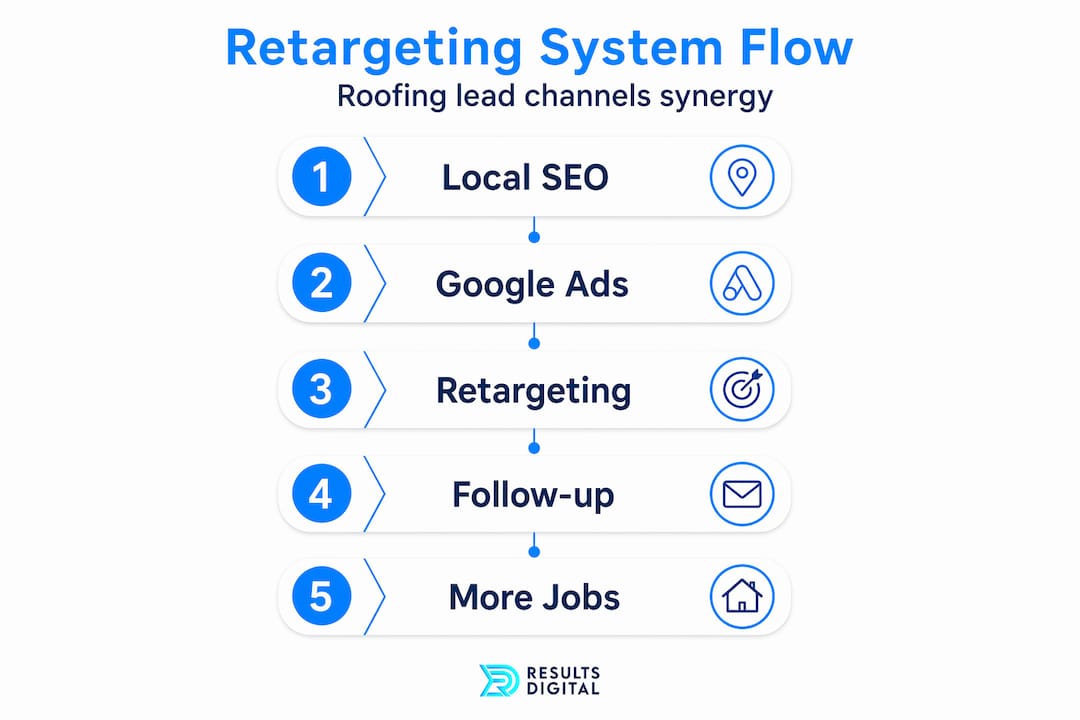
Here is a direct comparison of how the major lead generation channels stack up for roofing companies:
| Channel | Lead Temperature | Cost Per Lead | Speed to Result | Best For |
|---|---|---|---|---|
| Local SEO | Warm to hot | Low (long-term) | 3 to 6 months | Sustainable inbound leads |
| Google Ads (PPC) | Hot | Medium to high | Immediate | High-intent purchase searches |
| Facebook/Instagram Ads | Cold to warm | Low to medium | Fast | Brand awareness and storm events |
| Retargeting | Warm to hot | Low | Fast | Re-engaging visitors and increasing conversion |
| Cold outreach / canvassing | Cold | High | Variable | Brand presence in neighborhoods |
Retargeting consistently delivers the best cost-per-lead among paid channels because the audience is already familiar with you. Behavioral segmentation combined with multi-channel retargeting delivers three to four times higher conversions than prospecting campaigns by aligning message timing with buyer readiness.
If you want to improve overall site performance alongside your retargeting campaigns, reviewing your website conversion fundamentals for roofing contractors is a solid starting point.
Common retargeting mistakes roofers make
The benefits of retargeting for roofing are real, but they disappear fast when the execution is off. These are the mistakes that drain budget without producing results.
-
Skipping pixel verification. Tracking pixel installation errors prevent you from building custom audiences entirely. Before any campaign goes live, verify that your Meta Pixel and Google Tag are firing correctly on your homepage, services pages, and thank-you pages.
-
Using one ad for every visitor. Generic messaging across all audience segments is the most common performance killer in roofing retargeting. Someone who spent 45 seconds on your pricing page needs a different ad than someone who bounced from your homepage after 10 seconds.
-
Ignoring frequency caps. Showing the same ad to the same person 20 times in a week creates negative brand associations. Set frequency caps at 3 to 5 impressions per person per week to stay visible without becoming annoying.
-
Underfunding post-storm windows. Only 23% of roofing firms capture more than 30% of available storm-related revenue. A major reason is pulling back on ad spend exactly when homeowner urgency peaks.
-
Measuring the wrong metrics. Clicks and impressions tell you almost nothing about whether retargeting is working. Revenue-first attribution links ad activity to actual closed jobs. Without that connection, you risk cutting campaigns that are producing revenue and keeping ones that are just generating clicks.
Pro Tip: Run a weekly pixel audit using Google Tag Assistant or Meta’s Events Manager to catch tracking errors before they silently kill your audience building.
Measuring and optimizing retargeting performance
Once your retargeting campaigns are running, the work shifts to measurement and adjustment. These are the metrics that actually reflect how retargeting boosts roofing sales:
- Cost per qualified lead: Not cost per click. Filter by leads that actually booked a consultation or provided a valid phone number.
- Lead-to-close rate from retargeting traffic: Compare this to your cold traffic close rate. Most contractors see a 30% to 60% higher close rate from retargeted leads.
- Return on ad spend (ROAS) by audience segment: If your pricing-page retargeting segment costs $40 per lead and closes at 35%, while your homepage retargeting segment costs $90 per lead and closes at 12%, that data tells you exactly where to shift budget.
- Time to conversion: How many days between first visit and conversion? This helps you define your retargeting window length.
Use UTM parameters on every retargeting ad so your CRM can track exactly which campaign, audience, and ad creative produced each lead. Without UTM tracking, you are guessing. With it, you can see that your storm damage retargeting campaign on Facebook drove 18 booked inspections in a single month, while your general awareness retargeting drove 4.
AI-driven automation platforms can now adjust retargeting bids and rotate ad creative in real time based on engagement signals. For roofing companies scaling past a few hundred thousand in annual revenue, this level of optimization is worth the investment.
My take on retargeting in roofing
I’ve worked with enough roofing companies to see a clear pattern. The ones that treat retargeting as optional are the same ones asking why their Google Ads cost keeps climbing while their close rate stays flat. They are paying to fill a leaky bucket.
What I’ve found is that retargeting works best when it is tightly integrated with your sales process. The ad gets someone back to your site or to call your office. What happens on that call determines whether the campaign converts or not. I’ve seen retargeting campaigns driving 25-plus qualified leads per month for roofing contractors, only to have those leads handled poorly because the sales team didn’t know where the lead was coming from or what message they had seen.
The roofing companies that win with retargeting treat it as part of an end-to-end system. The ad, the landing page, the call handler, and the follow-up sequence all need to align. When they do, the results are hard to argue with.
— Results
Take your roofing lead generation further
If this article made one thing clear, it’s that retargeting is not a luxury. It’s the mechanism that turns your existing ad spend into actual closed jobs.
Resultsdigital works exclusively with roofing and exterior contractors to build integrated marketing systems that include retargeting, Google Ads, Facebook Ads, and local SEO. Every campaign is built around booked jobs, not vanity metrics. If you want to see how a properly built retargeting system fits into your digital marketing for roofing contractors, or want a full picture of how the lead generation workflow ties everything together, Resultsdigital is ready to build it with you.
FAQ
Why do roofing companies need retargeting?
Because over 90% of website visitors leave without converting on the first visit. Retargeting re-engages those warm prospects during their decision-making process, dramatically increasing the chance they return and book with you.
How soon should a roofer launch retargeting after a storm?
Within 24 to 72 hours. Homeowners are in urgency mode during that window, and rapid retargeting deployment produces 42% higher conversion rates compared to delayed campaign launches.
What platforms are best for roofing retargeting?
Google Display Network, Facebook, and Instagram are the three core platforms. Each reaches homeowners at different points in their research. Running all three in coordination produces the strongest results, especially when behavioral segmentation is applied.
How does retargeting improve roofing sales ROI?
By targeting warm audiences who already showed interest, retargeting lowers cost per lead significantly compared to cold prospecting. Pairing it with revenue-first attribution ensures your budget goes toward campaigns that produce actual closed deals.
What is the biggest mistake roofers make with retargeting?
Using the same generic ad for every visitor regardless of behavior. Segmenting by funnel stage and matching message to intent is what separates profitable retargeting campaigns from wasted ad spend.
