
Most roofing contractors assume retargeting means banner ads that follow people around the internet. That picture is incomplete. What is roofing retargeting, really? It’s a paid advertising strategy, formally called remarketing inside most ad platforms, that re-engages homeowners who already visited your website but left without booking an estimate. These are warm prospects, not cold audiences, and they convert at dramatically higher rates than first-touch traffic. This guide breaks down how the technology works, which platforms to use, how to segment your audiences, and how to measure results without flying blind.
Table of Contents
- Key Takeaways
- What is roofing retargeting and how it works
- Platform setup for Google and Meta
- Audience segmentation and creative strategy
- Measuring and optimizing your campaigns
- My honest take on roofing retargeting
- Ready to put this to work for your roofing company?
- FAQ
Key Takeaways
| Point | Details |
|---|---|
| Retargeting targets warm audiences | You’re re-engaging homeowners who already showed interest, not starting from scratch. |
| Pixel and tag setup is non-negotiable | Without proper tracking installed, you cannot build the audiences your campaigns depend on. |
| Segment audiences by intent level | Homepage bouncers need trust messaging; pricing page visitors need urgency and offers. |
| Budget 15 to 20 percent of PPC spend | Allocate a focused portion of your paid budget to retargeting for reliable returns. |
| Rotate creatives every 2 to 3 weeks | Stale ads cause fatigue and hurt your brand with the exact people you want to convert. |
What is roofing retargeting and how it works
Roofing retargeting is a paid ad strategy that targets homeowners who previously interacted with your roofing business online, with the goal of bringing them back to request an estimate or schedule an inspection. The industry standard term is remarketing, which is how Google Ads and Meta label it internally. Both terms describe the same core mechanism: you track a visitor, place them in an audience, and serve them ads across the web and social media.
Here is the technical sequence, simplified:
- A homeowner searches “roof replacement cost” and lands on your service page.
- Your tracking pixel or tag fires and drops an anonymous cookie in their browser.
- They leave without filling out your contact form.
- Your ad platform recognizes that cookie and shows your ad to that specific person on YouTube, Google Display, Facebook, or Instagram.
- The homeowner sees your ad, remembers your company, and comes back to book.
The tracking happens through two main tools: the Google Ads tag (or linked Google Analytics 4 property) and the Meta Pixel. Each one records specific user behaviors, called events, such as page views, form starts, and form completions. Audience building takes 24 to 48 hours after your tag is live, assuming you have sufficient traffic volume.
Where retargeting gets powerful is audience segmentation based on intent level. Not all website visitors are created equal. Someone who spent 90 seconds on your financing page is far closer to converting than someone who bounced off your homepage in 10 seconds. Your ad platform uses the event data from your pixel to sort visitors into behavioral buckets you can target with different messaging. That segmentation is what separates a retargeting campaign that pays for itself from one that burns through budget with nothing to show.
Pro Tip: Most roofing websites only fire a generic page view event. Set up custom events for specific high-intent actions like viewing a service page, clicking your phone number, or starting a contact form. This data is the foundation of any effective segmentation strategy.
Platform setup for Google and Meta
Getting retargeting right on Google and Meta requires different approaches. Here is what to set up on each platform:
Google Ads remarketing setup:
- Install the Google Ads tag site-wide on your roofing website, or link your Google Analytics 4 property directly to your Google Ads account.
- Define your audience lists inside Google Ads under “Audience Manager,” creating separate lists for homepage visitors, service page visitors, and form starters.
- Set membership duration based on your sales cycle. For roofing, 30 to 60 days covers most decision timelines without paying to chase cold leads.
- Layer these audiences onto your Display and Search campaigns, adjusting bids by intent tier.
- Exclude your converted leads (form completers and call conversions) to avoid wasting impressions on people who already booked.
Tracking and privacy limitations can shrink your audience sizes in Google Ads, especially as cookie-based tracking faces increasing browser restrictions. If your lists look smaller than expected, verify your tag is firing correctly using Google Tag Assistant.
Meta retargeting setup:
Meta requires both the Meta Pixel and the Conversions API for accurate audience building. After Apple’s iOS privacy changes, the Pixel alone undercounts form submissions and other lead events. The Conversions API sends event data from your server rather than the user’s browser, recovering that lost signal. Combine both, with event deduplication enabled, to get complete lead data.
Meta retargeting windows can range from 7 to 180 days. For roofing, a 30-day window captures recent high-intent visitors, while a 90-day window works well for brand awareness retargeting among those still in the research phase.

Pro Tip: Match your Meta retargeting window to where you are in the funnel. Use a 7 to 14-day window for your hottest, highest-intent offers like free inspection promotions. Use a 60 to 90-day window for softer trust-building content like project photos and homeowner testimonials.
Audience segmentation and creative strategy
Segmentation is where most roofing companies fail. Using one generic audience and one generic ad is the number one reason retargeting budgets get wasted. Here is the tiered approach that actually works:
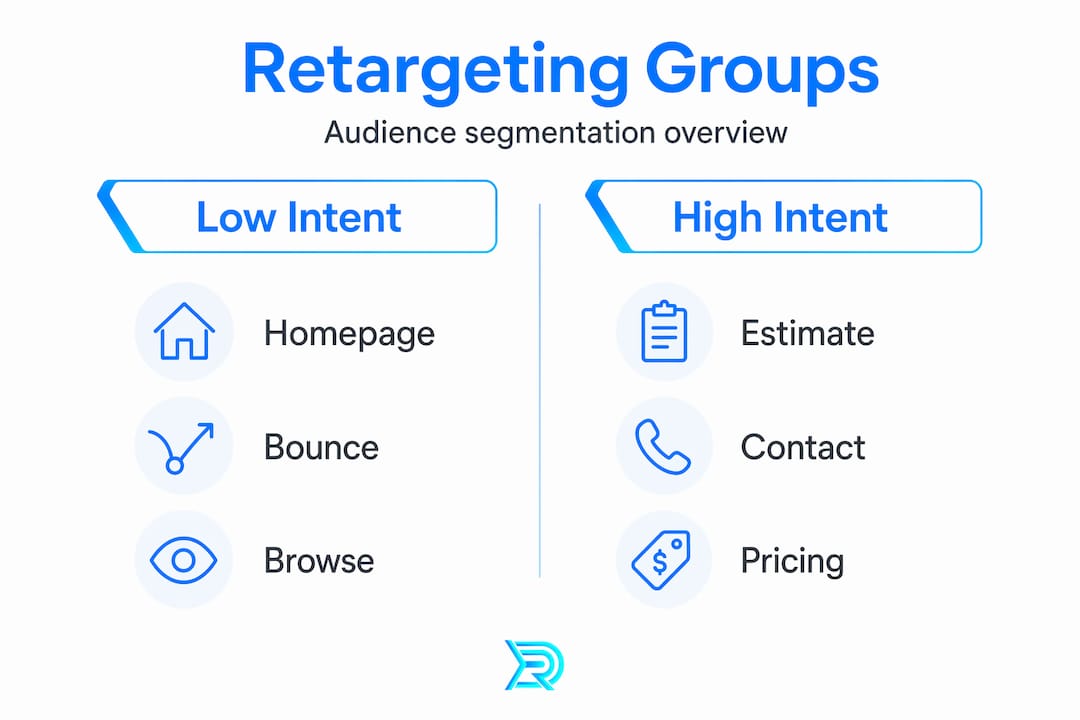
| Audience Segment | Behavior Signal | Recommended Ad Creative |
|---|---|---|
| Homepage bouncers | Viewed homepage, left in under 30 seconds | Brand awareness: company story, local credibility, “We serve [City]” |
| Service page visitors | Viewed roofing services page | Trust-building: before/after photos, certifications, manufacturer ratings |
| Pricing or estimate page visitors | Viewed pricing or estimate page | Urgency: limited offer, free inspection CTA, financing availability |
| Form starters | Started but did not submit a contact form | Direct re-engagement: “You almost reached out. We’re ready when you are.” |
| Recent converters | Submitted a form or called | Exclude from all campaigns. Do not advertise to people you’re already talking to. |
Match your ad creative to the intent level of each segment. A homeowner who browsed your homepage is not ready for a “Call Now for a Free Estimate” hard sell. They need to see your company name, your local projects, and a reason to trust you. A homeowner who spent time on your pricing page, though, is ready for a specific offer.
Local proof converts. Real photos of completed roofs in your service area outperform stock images every time. Testimonials from recognizable local neighborhoods add credibility that generic ad copy cannot replicate.
Frequency caps of 3 to 5 impressions per user per day prevent you from burning out the very audience you’re trying to win over. Showing your ad 20 times in two days does not increase conversions. It damages your brand with the people most likely to hire you.
Budget allocation for retargeting should sit at 15 to 20 percent of your total PPC spend. If you’re running $5,000 per month in Google Ads, set aside $750 to $1,000 specifically for retargeting audiences. This focused spend, aimed at people who already know your company, typically delivers a lower cost per lead than any cold traffic campaign.
Measuring and optimizing your campaigns
Once your campaigns are live, the work shifts to weekly review and ongoing optimization. The metrics that matter most for retargeting for roofing businesses are not the same as cold traffic campaigns.
- View-through conversions: A user saw your ad but converted via another channel. Google and Meta track this differently, so reconcile both dashboards.
- Cost per lead (CPL): Your retargeting CPL should be lower than cold campaign CPL. If it is not, your segmentation or creative needs work.
- Frequency: Watch this weekly. Frequency above 7 to 10 impressions per person per week on Meta is a signal to rotate your creative or expand your audience.
- Audience size: Small audience sizes (under 1,000 people) mean your pixel is not firing correctly or traffic volume is too low. Fix the technical issue before spending.
Creative rotation every 2 to 3 weeks prevents ad fatigue. When your click-through rate drops more than 30 percent from its launch-week baseline, that creative is worn out. Swap in new project photos, updated testimonials, or a different offer.
Google and Meta use different attribution windows, which means the same lead can appear in both platforms’ reports. Google’s default attribution gives credit to the last click, while Meta often uses a 7-day click and 1-day view model. Use your CRM or call tracking software as your source of truth, not each platform’s self-reported numbers.
For scaling, start with your highest-intent segment (pricing or estimate page visitors) and prove out your CPL there first. Once that segment is profitable, expand budget to service page visitors, then to homepage traffic. Build your retargeting program from the bottom of the funnel up.
My honest take on roofing retargeting
I’ve watched roofing companies spend thousands on cold traffic while their retargeting audiences sit unused. That’s budget going to cold strangers when there are warm prospects on the table who already visited the site and came close to reaching out.
The most common failure I see is treating retargeting as an afterthought. Someone sets up one audience, runs one ad, and calls it done. When it underperforms, they declare retargeting “doesn’t work” for roofing. What actually didn’t work was the execution.
In my experience, the creative is where most campaigns live or die. A real photo of a completed Timberline shingle job in a local neighborhood with a homeowner testimonial will outperform any designed graphic. Homeowners want proof, not polish. When you pair that with the right audience segmentation strategy, you’re not just running ads. You’re having the right conversation with the right person at the right time.
Don’t expect retargeting to produce instant returns in week one. Think of it as a compounding system. Every month you run it, your brand recognition in your market grows, your cost per lead drops, and your close rate improves because prospects already feel like they know you before they ever pick up the phone.
— Results
Ready to put this to work for your roofing company?
Understanding roofing retargeting at a conceptual level is a solid start. Executing it well across Google and Meta, with proper pixel setup, tight audience segmentation, and creative that actually converts, requires both technical precision and hands-on experience with the roofing market specifically.
At Resultsdigitalus, we build and manage Google Ads campaigns for roofers that include retargeting as a core part of the strategy, not a tacked-on add-on. We’ve helped roofing contractors go from minimal digital presence to market leaders, including a Florida roofing company that scaled from 3 crews to 18 before selling for $60 million. You can see the specifics behind that kind of result in our roofing marketing case studies. If you’re serious about converting the warm traffic you’re already generating, we work exclusively with one roofing company per market. No long-term contracts required.
FAQ
What is the difference between retargeting and remarketing?
Retargeting and remarketing describe the same practice of re-engaging past website visitors with paid ads. Google labels it remarketing internally while the broader industry often uses retargeting, but both terms refer to re-engaging warm prospects rather than cold audiences.
How long should a roofing retargeting audience window be?
For high-intent visitors like those who viewed your estimate page, a 30-day window captures the hottest prospects. Meta retargeting windows range from 7 to 180 days, so match the window to the prospect’s stage in the decision process.
How much should a roofing company spend on retargeting?
Allocate 15 to 20 percent of your total PPC budget to retargeting campaigns. On a $5,000 monthly Google Ads budget, that means $750 to $1,000 dedicated to re-engaging past website visitors.
Why is my Google Ads retargeting audience too small?
Small audience sizes usually mean your Google Ads tag is not firing correctly, your traffic volume is too low, or privacy-related tracking limitations are shrinking your list. Verify tag setup with Google Tag Assistant and check your GA4 event data.
Do I need both Meta Pixel and Conversions API?
Yes. After iOS privacy changes, the Pixel alone undercounts form submission events, which means your retargeting audiences are smaller than they should be. Running both with deduplication enabled gives you the most accurate audience data for your roofing lead campaigns.
