
Most contractors assume Google Ads is either too complicated, too expensive, or something only big companies can use effectively. That assumption costs them jobs every month. Understanding what is contractor Google Ads management means recognizing it as a system for putting your business in front of homeowners who are actively searching for exactly what you offer, right now, in your service area. This guide breaks down how it works, what it costs, how Local Services Ads fit in, and what separates contractors who generate consistent leads from those who burn through budget and quit.
Table of Contents
- Key takeaways
- What contractor Google Ads management actually is
- How Local Services Ads work for contractors
- AI-powered bidding and what it means for your ROI
- Understanding costs and fee structures
- Best practices for managing contractor ads
- My take after years of managing contractor campaigns
- Ready to put your ads to work for you?
- FAQ
Key takeaways
| Point | Details |
|---|---|
| PPC targets active buyers | Google Ads reach high-intent searchers already looking for your service, improving lead quality significantly. |
| LSA charges per lead, not click | Local Services Ads use a pay-per-lead model, making costs more predictable than traditional PPC campaigns. |
| AI can cut cost per lead by 40% | AI-driven management paired with human oversight reduces wasted spend and increases conversion rates. |
| Response speed affects LSA ranking | Responding to leads within 5 minutes directly improves your ad placement and lowers what you pay per lead. |
| Management fees vary widely | Freelancers charge $50 to $200 per hour, while agency packages range from $500 to over $2,000 monthly depending on scope. |
What contractor Google Ads management actually is
Contractor Google Ads management is the ongoing process of building, monitoring, and improving paid search campaigns so your business appears when someone types “roof replacement near me” or “siding contractor in [your city].” It is not a one-time setup. It is active work performed daily or weekly to control your cost per lead, maintain ad visibility, and convert clicks into phone calls and form fills.
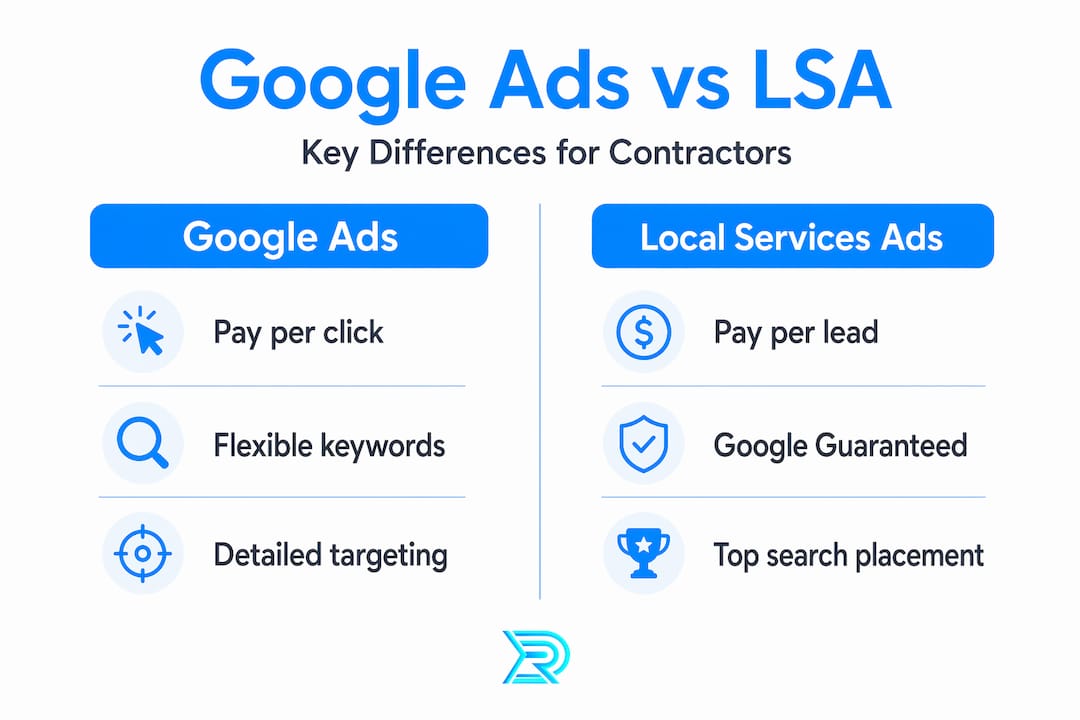
The foundation of it all is the pay-per-click model. You bid on keywords related to your services. When a homeowner clicks your ad, you pay. When they do not click, you pay nothing. This means your budget goes toward people who showed interest, not passive viewers scrolling past a billboard.
Here is what a complete Google Ads campaign for a contractor actually includes:
- Keywords: Specific search terms you want to trigger your ads, such as “emergency roof repair” or “gutters installed cost”
- Ad copy: The headline and description text that show in search results
- Landing page: The page someone lands on after clicking, which should match the ad and push them toward calling or booking
- Bidding strategy: How aggressively you compete for top positions
- Conversion tracking: The code that tells Google when a call or form submission happens, so the system learns what is working
Google Ads reach homeowners who are actively searching, which is a critical difference from social media advertising where you interrupt someone’s feed. With PPC, the intent is already there. Your ad just needs to be the right answer at the right moment.
Conversion costs for contractors typically run $20 to $25 per lead with potential for 10 to 20 conversions weekly when campaigns are set up and managed properly. That math matters when you are evaluating whether Google Ads fits your budget.
Pro Tip: Set up call tracking from day one. Without it, you are flying blind. You will not know which keywords are generating calls, and you cannot optimize toward what is actually working.
How Local Services Ads work for contractors
Local Services Ads, commonly called LSA, sit above regular Google Ads in search results. They display your business name, rating, phone number, and a critical badge that most homeowners now look for before calling anyone.
That badge is the Google Guaranteed designation. To earn it, contractors must pass Google’s background check, submit proof of licensing and insurance, and complete an eligibility review. For homeowners, it signals that Google has vetted your business and backs the work with a reimbursement guarantee of up to $2,000. That trust signal alone separates you from competitors running only traditional ads.
The billing model is also completely different. LSA charges per verified lead, not per click. If someone calls you through LSA and it turns out to be the wrong service area or a spam call, you can dispute it and get a credit. This makes lead costs far more predictable than standard PPC.
Here is how to rank well and control costs inside the LSA system:
- Respond fast. Responding within 5 minutes significantly boosts your ranking and lowers your cost per lead. Google measures response time and rewards contractors who pick up quickly.
- Collect reviews consistently. Review volume and quality are top-three ranking factors in LSA. Ask every satisfied customer to leave a Google review the same day the job closes.
- Dispute invalid leads. This is where many contractors leave money on the table. If a lead does not meet the criteria, file the dispute. It adds up over a month.
- Set your service areas accurately. Tight, accurate service areas prevent you from paying for leads you cannot realistically serve.
- Keep your profile complete. Photos, job types, and business hours all signal credibility to both Google and homeowners.
Pro Tip: LSA and traditional Google Ads are not either/or. Running both together gives you more real estate on the search results page and two separate chances to capture the same homeowner’s attention.
AI-powered bidding and what it means for your ROI
Google’s ad platform has shifted heavily toward machine learning. Today, much of contractor PPC management involves configuring smart bidding strategies rather than manually setting bids for every keyword. The practical question is whether these tools actually save money or just spend it faster.

When configured correctly, AI-driven bidding works well. Optimized campaigns can achieve ROI between 3:1 and 5:1, and AI-powered management can reduce cost per lead by 40% while doubling conversion rates in some cases. The mechanism behind this is real-time bidding. Google’s system evaluates hundreds of signals per auction, including the searcher’s device, location, time of day, and past behavior, and adjusts your bid in milliseconds to win the impressions most likely to convert.
AI-powered platforms leverage historical performance and live market signals to push budget toward the highest-converting impressions. This means less money wasted on searches that never lead to booked jobs.
That said, there are pitfalls to avoid:
- Never let automation run without supervision. Smart bidding needs conversion data to work. In the first 30 to 60 days, it is still learning, and without human checks it can spend aggressively on irrelevant clicks.
- Do not skip negative keywords. Automation will not automatically block irrelevant searches. Building a strong negative keyword list is still manual work.
- Watch your search term reports weekly. Even with AI bidding active, you need to review what searches are actually triggering your ads. Without this habit, budgets drift toward wasted spend.
- Set target CPA or ROAS goals based on real data. Feeding the algorithm unrealistic targets early on leads to underspending or erratic behavior.
The best contractor advertising strategies combine AI bidding with regular human oversight. Think of AI as a junior analyst who processes data faster than any human, but still needs a manager to set the strategy and catch mistakes.
Understanding costs and fee structures
When contractors ask about Google Ads management, pricing is usually the first sticking point. There are two separate costs you need to budget for: ad spend and management fees.
Ad spend is what you pay Google directly. Management fees are what you pay the person or agency running the campaigns.
| Fee Type | Typical Range | Incentive Alignment |
|---|---|---|
| Freelancer hourly rate | $50 to $200 per hour | Focused on billable hours, not necessarily results |
| Agency fixed monthly fee | $500 to $2,000+ per month | Aligned with performance and retention |
| Agency % of ad spend | 10% to 20% of monthly spend | Can incentivize higher spend, not efficiency |
Freelancers typically charge $50 to $200 per hour, while monthly agency packages range from $500 to over $2,000 based on campaign complexity. The fee structure matters as much as the number.
Percentage-based management fees can misalign incentives because an agency charging 15% of ad spend earns more when you spend more, regardless of whether that spend is generating quality leads. A fixed fee model ties the agency’s value to your results, not your budget size. Ask about this directly before signing anything.
Viewing management fees as strategic infrastructure rather than overhead changes how you evaluate the cost. If a $1,500 monthly management fee generates 20 qualified leads at $25 each, and you close 30% of them at an average job value of $8,000, the math justifies the expense quickly.
Pro Tip: Before hiring anyone to run your Google Ads, ask to see reporting dashboards they use for current clients. If they cannot show you clean, transparent data on cost per lead and conversion rate, walk away.
Best practices for managing contractor ads
Whether you manage your own campaigns or hire it out, these practices separate contractors who get consistent leads from those who get inconsistent results.
- Align campaign goals with real business goals. Are you targeting emergency calls or larger remodel projects? The keywords, ad copy, and landing pages are different for each. Define this before launching anything.
- Use tight geographic targeting. Set your campaign radius based on where you actually send crews, not the widest possible area. Broad targeting wastes spend on leads you cannot serve profitably.
- Build dedicated landing pages. Sending ad traffic to your homepage is like sending a referral to your voicemail. A focused landing page with one clear call to action converts significantly better.
- Monitor performance weekly. Check your cost per lead, conversion rate, and search term report every week. Campaigns that go unwatched for a month can bleed budget fast.
- Combine ads with SEO. Integrating paid ads with organic search and reputation management produces better long-term visibility than either strategy alone.
- Vet your agency with specific questions. Ask what your current cost per lead is, what keywords are driving the most conversions, and what changes were made last month. Vague answers are a red flag.
You can explore Google Ads strategies for general contractors or see how these same principles apply to siding contractor campaigns to understand how targeting and structure vary by trade.
My take after years of managing contractor campaigns
I have seen more contractors lose money on Google Ads because of the setup than because of the platform itself. People launch campaigns with the wrong match types, send traffic to a homepage with no clear call to action, and then blame Google when no leads come in. The tool works. The execution is where most people fall short.
The other mistake I see constantly is treating Google Ads as a faucet you turn on and walk away from. It is not. The first 60 to 90 days are the learning period. You are feeding the algorithm data, cutting what does not work, and building a campaign that understands your market. Contractors who give up in month two almost always would have seen results by month four.
What I have learned is that human judgment and AI automation are not opponents. The contractors who win pair smart bidding strategies with a real person reviewing the data weekly. AI handles the auction-level decisions. You handle the strategy, the budget, and the goals.
And one more thing I will say directly: if you are paying an agency and you do not know your cost per lead, your conversion rate, or what keywords are driving your calls, you are not managing your ads. You are funding someone else’s activity with no accountability. Demand those numbers. Every month. Without hesitation.
— Results
Ready to put your ads to work for you?
If reading this made you realize your current Google Ads setup is underperforming, or if you have been curious about starting but not sure where to begin, that is exactly where Resultsdigitalus comes in.

Resultsdigitalus is a veteran-owned agency built exclusively for contractors. Every campaign is built for your trade, your market, and your business goals. No generic templates, no shared strategies with your competitor down the street. The agency partners with only one contractor per trade per market, which means your budget works for you alone. From campaign architecture to weekly optimization to transparent reporting, the team handles everything while you focus on running crews and closing jobs. If you want to see what a campaign built specifically for your business looks like, explore contractor PPC management or check out the full digital marketing program for general contractors.
FAQ
What is contractor Google Ads management?
Contractor Google Ads management is the ongoing process of building, optimizing, and monitoring paid search campaigns specifically for trade contractors to generate leads from homeowners actively searching for services.
How much does contractor PPC management cost?
Management fees typically range from $500 to over $2,000 per month for agency packages, while freelancers charge $50 to $200 per hour, separate from your actual ad spend with Google.
What is the difference between Google Ads and Local Services Ads?
Traditional Google Ads charge per click regardless of outcome, while Local Services Ads charge per verified lead, making lead costs more predictable and allowing contractors to dispute invalid charges.
How do I know if my Google Ads are working?
Track cost per lead, conversion rate, and call volume weekly. If your agency cannot provide clean data on these three metrics, your campaigns are not being managed with accountability.
Can AI really improve my contractor ad results?
Yes. AI-driven bidding can reduce cost per lead by 40% and double conversion rates, but only when paired with human oversight and a solid campaign structure from the start.
