
The highest-impact roofing website content ideas are not blog posts about roofing history. They are service-location pages, cost transparency pages, storm-damage claim guides, local case studies, before/after project galleries, seasonal maintenance checklists, insurance walkthrough guides, and FAQ pages optimized for featured snippets. Publish those eight content types first and you will cover the majority of buyer intent searches in your market. Understanding why roofing content marketing matters helps you prioritize that list before you write a single word.
Your 7-day quick-start checklist:
- Publish one cost page targeting your primary city (e.g., “Roof replacement cost in [City], [State]”)
- Add one neighborhood project gallery with a before/after slider to your highest-traffic service page
- Draft one residential case study using the template in Section 8
ServiceTitan’s list of 100 roofing blog topics confirms the breadth of content opportunities available to contractors. The real constraint is not ideas. It is knowing which ones to publish first.
Key Takeaways
The single highest-priority page to publish first is a localized cost and service page with a clear estimate CTA. That one page, properly optimized, typically generates more qualified leads than a dozen generic blog posts.
| Point | Details |
|---|---|
| Publish cost pages first | Localized cost pages match high-intent searches and produce the most qualified calls. |
| Map content to buyer stage | Service pages close decisions; case studies build consideration; how-to posts capture awareness. |
| Track four core KPIs | Leads by page, conversion rate, local impressions, and phone-call tracking tell you what is working. |
| Repurpose every asset | Turn each blog post into a social clip, email snippet, and FAQ insert to extend reach at no extra cost. |
| Resultsdigitalus | Contractor-exclusive SEO, paid ads, and website design built to turn content into predictable lead flow. |
Table of Contents
- Which content formats work best at each stage of the buyer journey
- Your ready-to-publish idea bank: 30+ title templates and briefs
- Where each content piece should live on your site
- How to promote each content type so it converts
- KPIs to track and tests to run so content pays off
- A production workflow small crews can actually run
- Mini case studies that prove content drives real leads
- Why tactical content beats generic posts every time
- Resultsdigitalus turns roofing content into predictable lead flow
- Sources
Which content formats work best at each stage of the buyer journey
The short answer: service pages close decisions, case studies build consideration, and how-to content captures awareness. Each format serves a different buyer, and publishing the wrong format at the wrong stage wastes both budget and traffic.
Awareness stage buyers are homeowners who just noticed a leak or saw storm damage on their street. They search “how to tell if my roof needs replacing” or “what does hail damage look like on shingles.” Short how-to blog posts, video walkthroughs, and seasonal maintenance checklists meet them there. These pages rarely convert directly, but they feed your retargeting audiences and build brand recall.
Consideration stage buyers are comparing contractors. They want proof: photos, reviews, timelines, and cost ranges. Case studies, neighborhood project galleries, and cost comparison pages do the heavy lifting here. Wp PiP’s 50+ roofing website ideas documents how homepage trust badges, project galleries, and before/after sliders directly improve conversion rates for visitors at this stage.
Decision stage buyers are ready to call. They need a clear service page with a phone number above the fold, a specific CTA, and a short proof block. Nothing else.
Residential vs. commercial content requires a different emphasis entirely. Residential buyers care about aesthetics, cost, timeline, and whether you work with their insurance company. Commercial buyers, typically facility managers or property owners, need documented ROI, maintenance plan options, and evidence-based case studies showing long-term performance. ServiceTitan notes that commercial roofing content should lead with case studies and maintenance guides rather than cost-per-square pricing.
Prospelle recommends mapping every content piece to a keyword-stage journey and maintaining a regular publishing schedule of quality posts each month to build consistent organic momentum.
Your ready-to-publish idea bank: 30+ title templates and briefs
Prioritize cost pages, neighborhood galleries, case studies, and storm guides. They produce the most qualified calls per published page.
15 residential title templates
- “How much does a [material] roof replacement cost in [City], [State]?” — 800–1,200 words, include cost range table, CTA to free estimate
- “Asphalt shingles vs. metal roofing: which is right for [City] homes?” — comparison post, 700 words, link to service page
- “What does hail damage look like on a roof? [Photo guide]” — photo-heavy, 500 words, CTA to inspection request
- “Spring roof maintenance checklist for [State] homeowners” — seasonal, 600 words, downloadable PDF lead magnet
- “How to file a homeowner’s insurance claim for roof damage” — step-by-step, 900 words, CTA to claim-assist service
- “Before and after: [Neighborhood] roof replacement gallery” — gallery page, 300 words, embed slider
- “How long does a roof replacement take? [City] contractor explains” — FAQ-style, 500 words
- “Top 5 signs your [City] home needs a new roof this year” — listicle, 600 words, CTA to inspection
- “What to expect during a roof replacement: day-by-day timeline” — process post, 700 words
- “Best roofing materials for [State]’s climate” — educational, 800 words, link to material service pages
- “How to choose a roofing contractor in [City]: 7 questions to ask” — trust-builder, 700 words
- “Storm damage roof repair in [City]: what to do in the first 48 hours” — urgency post, 600 words
- “How much does a roof inspection cost in [City]?” — cost page, 400 words, CTA to free inspection
- “Roof replacement financing options for [City] homeowners” — financial, 600 words
- “GAF vs. Owens Corning shingles: which holds up better in [State]?” — brand comparison, 700 words
15 commercial title templates
- “TPO vs. EPDM for warehouse roofs: 10-year cost comparison” — data-driven, 1,000 words, CTA to commercial estimate
- “Flat roof maintenance plan for [City] property managers” — service-focused, 800 words
- “How to budget for commercial roof replacement: a facility manager’s guide” — financial, 900 words
- “Case study: [Company type] in [City] extends roof life by [X] years with preventive maintenance” — proof post, 600 words
- “Commercial roof inspection checklist: what to look for before winter” — seasonal, 700 words
- “Metal roofing for commercial buildings: ROI over 20 years” — ROI-focused, 900 words
- “How to evaluate a commercial roofing contractor: RFP checklist” — B2B trust, 800 words
- “Emergency commercial roof repair in [City]: response time and process” — urgency, 500 words
- “Roof coating vs. full replacement for commercial buildings: cost analysis” — comparison, 800 words
- “How often should a commercial roof be inspected in [State]?” — FAQ, 400 words
- “Green roofing options for commercial buildings in [City]” — trend post, 700 words
- “What does commercial roof replacement cost per square foot in [City]?” — cost page, 600 words
- “How to document storm damage for a commercial insurance claim” — process, 700 words
- “Preventive maintenance contracts: what’s included and what it costs” — service page, 600 words
- “Case study: multi-building HOA roof replacement in [City]” — proof post, 500 words
3 lead-magnet templates
- Roof inspection checklist PDF: “Download our 12-point roof inspection checklist before you call a contractor.” Opt-in CTA: “Get the free checklist.”
- Insurance claim photo guide: “Photograph your storm damage the right way. Download our step-by-step photo guide.” CTA: “Download the guide.”
- Roofing budget spreadsheet: “Plan your roof replacement budget with our free estimator.” CTA: “Get the spreadsheet.”
Equipter’s 25 roofing blog topic ideas and GrindSuccess’s broader topic pool confirm that mixing formats, how-tos, listicles, case studies, and interviews, keeps content calendars full and SEO freshness high. For roofing project photo guidance that supports your gallery pages, that resource covers exactly what to shoot on every job.
Where each content piece should live on your site
Money pages live on service pages. Discovery content lives on the blog or a resources hub. Proof lives in case studies and project galleries. Get that architecture wrong and your best content will never rank.
StructureM recommends localizing high-intent pages with city names in the URL and linking blog content directly to service pages for compounding SEO impact. A clean directory structure signals topical authority to Google and makes it easier for local searchers to find the exact page that matches their intent.
| Content Type | Page Type | Recommended URL Pattern | Primary CTA |
|---|---|---|---|
| Roof replacement service | Service (money) page | /services/roof-replacement-[city] | Call or free estimate |
| Cost transparency page | Service/blog hybrid | /roofing-cost-[city] | Free estimate form |
| Before/after gallery | Project gallery | /projects/[city]-[material]-replacement | View more projects |
| Case study | Case study page | /case-studies/[city]-[project-type] | Contact us |
| Seasonal checklist | Blog post | /blog/spring-roof-checklist-[city] | Schedule inspection |
| Storm damage guide | Blog post | /blog/storm-damage-roof-repair-[city] | Emergency contact |
| Lead magnet landing page | Landing page | /resources/[lead-magnet-name] | Download now |
Internal linking priorities: every blog post should link to at least one service page. Neighborhood galleries belong on the relevant city service pages, not buried in a standalone gallery section. Case studies should surface on the homepage and on the service pages they support. This structure is the backbone of a high-converting roofing website.
How to promote each content type so it converts
The most effective promotion mix for roofing content is local SEO combined with targeted paid ads, email remarketing, and social proof amplification. No single channel does the job alone.
Organic SEO channel:
- Add LocalBusiness and Service schema markup to every service page
- Optimize your Google Business Profile with the same city and service keywords used in your URLs
- Build citations on Angi, HomeAdvisor, and local chamber directories to reinforce local authority
Google Ads tips for top-intent pages: cost pages and storm-damage guides convert best when paired with a matching paid search ad. Keep the landing page headline identical to the ad headline. A dedicated roofing PPC campaign targeting “roof replacement cost [city]” with a cost-page landing page typically outperforms a generic homepage campaign.
Social and video promotion recipes:
- Clip a 30-second before/after video from a job site and post it to Facebook and Instagram with a neighborhood tag
- Share case studies to LinkedIn when targeting commercial property managers
- Turn a seasonal checklist post into a short Reel or TikTok walkthrough
Trade and partnership channels for commercial content:
- Co-market maintenance guides with property management companies
- Share storm-damage claim guides with local insurance agents who can distribute them to policyholders
- Partner with general contractors on commercial case studies for mutual referral traffic
For a full breakdown of roofing marketing ideas that combine these channels, that resource maps each tactic to a specific lead source.
KPIs to track and tests to run so content pays off
The four metrics that matter most for roofing content are leads by page, conversion rate per page, local search impressions, and phone-call tracking attribution. Everything else is secondary.
| Metric | How to Track | Benchmark Guidance |
|---|---|---|
| Leads by page | GA4 goals tied to form submissions | Identify top 3 lead-generating pages monthly |
| Conversion rate | GA4 conversion events per session | Cost pages typically outperform general blog posts |
| Local search impressions | Google Search Console + Google Business Profile | Track city-specific keyword rankings weekly |
| Phone-call tracking | CallRail or similar call-tracking software | Tag calls by source to identify which pages drive calls |
4 small tests to run:
- A/B headline test: run two versions of a cost-page headline for 30 days and compare form submissions
- CTA placement test: move the estimate CTA above the fold on one service page and measure conversion rate change over 60 days
- Page load speed test: compress images on your gallery pages and measure bounce rate change
- Neighborhood page test: publish two city-specific pages and compare organic traffic growth at 90 days
Measure at 30, 60, and 90-day intervals. Do not act on data from fewer than 100 sessions per page. Small sample sizes produce misleading signals.
A production workflow small crews can actually run
The minimum viable content process is one brief, one draft, one published asset, one repurpose. That cycle, repeated consistently, builds more organic traffic than sporadic long-form posts.
Content brief template:
- Title: [working title with target keyword]
- Target keyword: [primary + one secondary]
- Word count: [400–1,000 depending on format]
- Required assets: [photos, video, before/after images]
- CTA: [form, phone number, download]
- Internal links: [2–3 target pages]
- Publish date: [specific date, not “soon”]
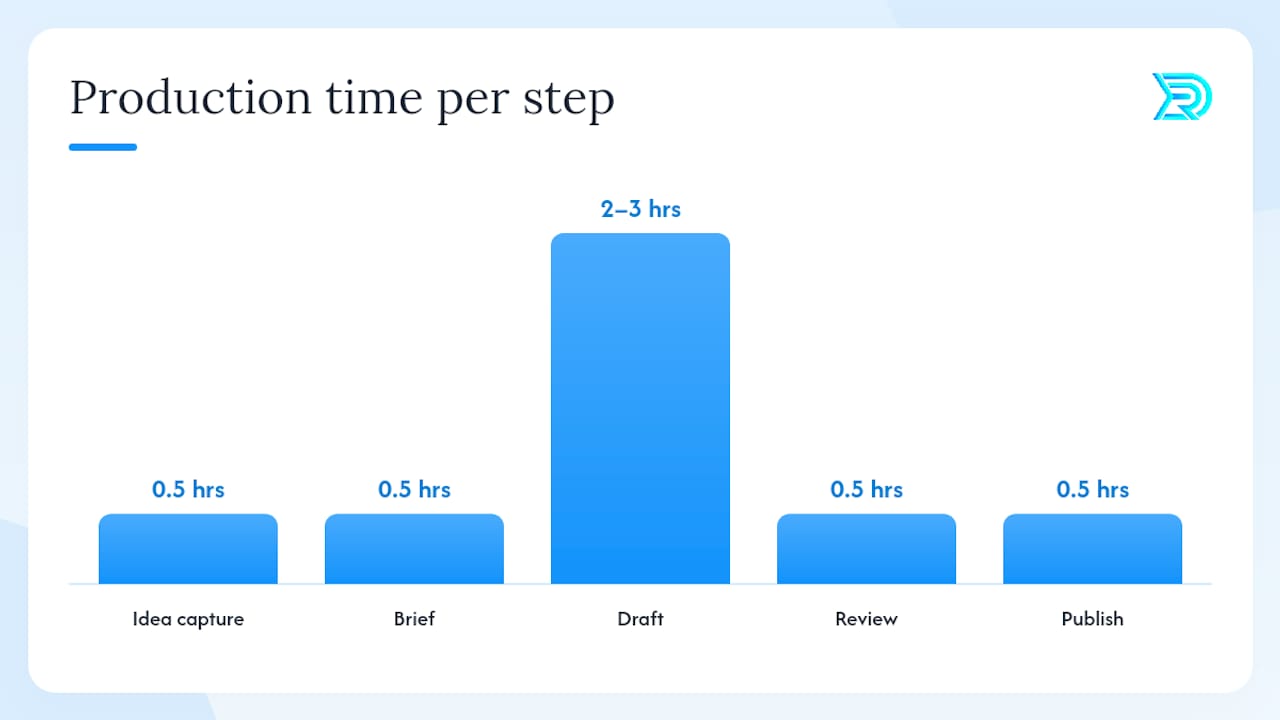
5-step production cadence (estimated hours per step):
- Idea capture (0.5 hrs): CSR or field tech submits a question they heard this week
- Brief (0.5 hrs): marketer or owner fills out the brief template above
- Draft (2–3 hrs): writer produces the post using the brief
- Review (0.5 hrs): owner or lead tech checks for accuracy
- Publish (0.5 hrs): upload, add schema, internal links, and submit to Google Search Console
Pro Tip: Interview your CSRs and field techs every two weeks. Ask them: “What question did a homeowner ask this week that you had to explain twice?” That question is your next blog post. ServiceTitan’s research confirms that CSR and field-team input surfaces the exact buyer objections that close jobs.
Repurposing checklist:
- Clip a 60-second video from a job site walkthrough and post it to social
- Pull three bullet points from a blog post and send them as an email tip to past clients
- Add the post’s FAQ section to your website’s main FAQ page
Mini case studies that prove content drives real leads
Content investment produces measurable results when it is paired with the right site architecture and promotion.
Results Digital helped a Florida roofing company scale from 3 crews to 18 crews before the business sold for $60 million. The growth was driven by a combination of SEO, targeted paid ads, and conversion-focused website content built specifically for contractor lead generation.
Residential case study template (collect these metrics):
- Before: monthly organic leads, top-ranking pages, conversion rate
- Actions taken: published X cost pages, added Y neighborhood galleries, launched Z blog posts
- After (90 days): organic lead volume change, top new ranking pages, cost per lead from organic
Commercial case study template (collect these metrics):
- Before: number of commercial inquiries per month, average deal size
- Actions taken: published maintenance-plan pages, added commercial case studies, targeted facility-manager keywords
- After (6 months): commercial inquiry volume, average contract value change
Which content types produce the most qualified calls: cost pages and storm-damage guides consistently generate the highest call volume because they match high-intent searches at the decision stage. Neighborhood galleries produce strong conversion rates because they reduce buyer anxiety by showing local proof.
Testimonial script template: “We replaced your roof in [Month]. Would you be willing to answer three quick questions on camera? We’ll keep it under two minutes. Your story helps other [City] homeowners make a confident decision.”
Why tactical content beats generic posts every time
Generic roofing blog posts, “10 things to know about your roof,” do not generate leads. Tactical, intent-aligned content does. The reason is simple: roofing is a high-consideration, often insurance-driven purchase where buyers search with specific local intent. A homeowner in Tampa after a hurricane is not searching for roofing history. They are searching for “emergency roof repair Tampa” or “how to file a roof insurance claim in Florida.” Content that answers those exact questions, with a clear CTA and local proof, converts. Content that does not match that intent gets ignored. Prioritize case studies and cost transparency pages above all else. Then build the blog around the questions your CSRs hear every week. The production workflow and case study templates in this article give you the operational structure to do that consistently.
Resultsdigitalus turns roofing content into predictable lead flow
Resultsdigitalus is a veteran-owned digital marketing agency built exclusively for roofing contractors across the United States. The core offer is contractor-specific SEO, Google Ads, Meta Ads, and conversion-focused website design, all engineered to generate leads, not just traffic.
The services most relevant to this article are SEO for roofing companies, roofing PPC advertising, and website design built for roofers. Resultsdigitalus partners with one roofing company per market, so every strategy works solely for your business. No long-term contracts. One client helped scale from 3 crews to 18 before a $60 million exit. If you want content and campaigns that produce that kind of result, request a strategy call today.
Sources
These sources were selected for their practical industry lists, agency playbooks, and contractor-focused SEO guidance.
