
Roof replacement lead value is defined as the total financial return a roofing contractor can expect from a single lead indicating a full roof replacement need, including direct job revenue, referrals, and upsell opportunities. Unlike repair leads, replacement projects average $11,000–$15,000 for standard jobs and $15,000–$25,000 or more for storm and insurance-driven work. That scale changes how you should think about every dollar you spend on marketing. Knowing what a lead is actually worth lets you set a defensible cost per lead (CPL), pick the right channels, and stop leaving money on the table.
What is roof replacement lead value, and what drives it financially?
Roof replacement lead worth is determined by four core financial variables: average job size, close rate, gross margin, and lifetime customer value. Get these numbers wrong and you will either overspend on leads or, more commonly, underspend and lose market share to competitors who understand the math.
Here is how each variable works in practice:
-
Average job size. Replacement ticket sizes run $11,000–$15,000 for standard residential projects and climb to $25,000 or more on storm and insurance claims. Repair leads rarely exceed $2,000. That gap is why replacement leads command a premium.
-
Close rate. Your close rate is the percentage of leads you convert to signed contracts. A 25% close rate means you need four leads to book one job. A 33% close rate means you need three. Every point of improvement here directly reduces your effective cost per acquisition.
-
Gross margin. Industry practice places roofing gross margin at roughly 40% of the job total. On a $12,000 job, that is $4,800 in gross profit before overhead. Knowing your margin tells you the maximum you can spend on lead acquisition and still run a profitable business.
-
Lifetime customer value (LTV). A replacement customer is not a one-time transaction. Replacement leads generate $10,000–$20,000 in lifetime revenue over two to three years through referrals and upsells like gutters, insulation, and skylights. That latent value is almost always underestimated.
The math in action: A $300 lead sounds expensive until you run the numbers. Closing 1 in 4 leads at $300 each costs $1,200 to acquire one customer. On a $12,000 job at 40% gross margin, you earn $4,800 gross profit. Subtract $1,200 in acquisition cost and you net $3,600 per booked job. Add referral revenue and that number climbs further.
Pro Tip: Track gross profit per lead source, not just CPL. A channel with a $250 CPL that closes at 30% beats a channel with a $100 CPL that closes at 8% every single time.

How does lead quality and exclusivity affect roof replacement lead worth?
Lead quality is the single biggest variable most contractors ignore when evaluating the value of roof leads. Two leads priced at $150 each can produce wildly different outcomes depending on whether they are exclusive or shared.
Here is what separates the two:
-
Exclusive leads go to one contractor only. Exclusive leads book at 35–40%, meaning roughly one in three calls turns into a scheduled appointment. The CPL is higher, but the cost per booked job is lower because you are not racing four other contractors to answer the phone first.
-
Shared leads are sold to multiple contractors simultaneously. Shared leads book at only 8–15%. That means you need six to twelve leads to book one job. At $80 per shared lead, your cost per booked job can easily exceed $600 to $900, which is worse than paying $250 for an exclusive lead that books at 38%.
-
Lead intent matters. A homeowner who filled out a form after a storm hit their neighborhood is more motivated than someone who clicked a generic ad. Higher intent leads convert faster and require less follow-up, which reduces your sales cost per job.
-
Speed to contact is critical. With shared leads, the contractor who calls within five minutes wins most of the time. If your team cannot respond that fast, shared leads will underperform regardless of price.
-
Low CPL is not the same as low cost per booked job. This is the trap that costs contractors thousands of dollars per month. Chasing the cheapest leads without tracking booking rates is flying blind. You need both numbers to make a sound decision.
Pro Tip: Calculate your cost per booked job for every lead source, not just CPL. Divide total spend on a channel by the number of appointments booked. That number tells you the real cost of filling your calendar.
What are the 2026 benchmarks for cost and value of roof replacement leads?
Current market data gives you a clear baseline for evaluating your own numbers. 2026 roofing CPL ranges from $60 to $220 depending on market size, lead type, and timing. Small markets sit at $60–$100, mid-sized metros run $85–$140, large metros land at $110–$175, and major metros push up to $220 per lead.
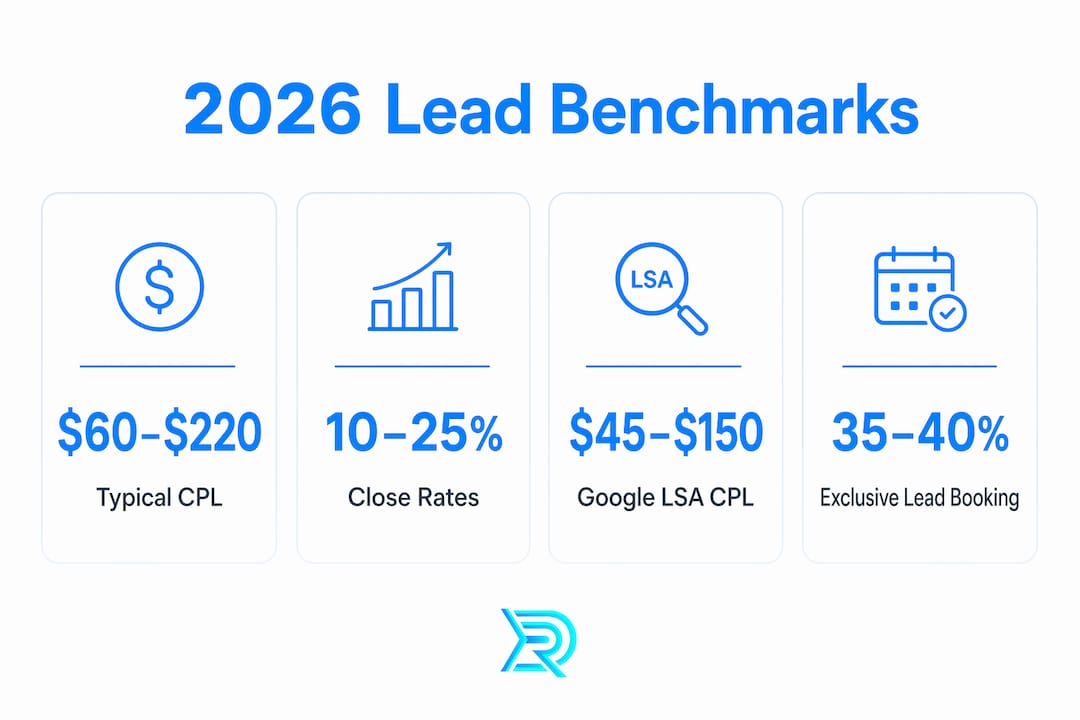
Channel performance varies significantly. Google Ads roofing leads average $124 CPL with close rates of 10–15%. Google Local Service Ads (LSAs) offer $45–$150 CPL with close rates of 15–25%, making them one of the most cost-efficient channels when managed correctly.
| Lead channel | Typical CPL | Booking rate | Est. cost per booked job |
|---|---|---|---|
| Google Local Service Ads | $45–$150 | 15–25% | $180–$1,000 |
| Google Ads (PPC) | $100–$175 | 10–15% | $667–$1,750 |
| Exclusive lead providers | $150–$300 | 35–40% | $375–$857 |
| Shared lead aggregators | $40–$100 | 8–15% | $267–$1,250 |
| Organic SEO | Low ongoing cost | 20–35% | Varies by investment |
Seasonal timing also shifts CPL. Storm season drives demand and can push CPL up in affected markets. Contractors who maintain campaigns year-round through slower months typically pay lower average CPLs than those who turn campaigns on only after a weather event.
How can roofing contractors calculate and optimize their lead ROI?
Calculating your maximum affordable CPL is the foundation of any profitable roofing lead generation strategy. The formula is straightforward: divide your target number of booked jobs by your booking rate to find how many leads you need, then divide your budget by that number to find your max CPL.
Follow these steps to run the calculation for your business:
-
Set a monthly job target. Decide how many replacement jobs you want to book per month. Start with a realistic number based on your crew capacity.
-
Identify your booking rate by channel. Pull data from your CRM or call tracking software. If you do not have this data yet, use the industry benchmarks above as a starting point.
-
Calculate leads needed. Divide your target booked jobs by your booking rate. If you want 10 jobs and your booking rate is 25%, you need 40 leads.
-
Set your max CPL. Divide your lead generation budget by the number of leads needed. If your budget is $6,000 and you need 40 leads, your max CPL is $150.
-
Compare against gross profit. Verify that your cost per booked job leaves enough gross profit after overhead. On a $12,000 job at 40% margin, you have $4,800 gross profit. A $600 cost per booked job leaves $4,200 before overhead.
| Metric | Example value | What it tells you |
|---|---|---|
| Monthly lead budget | $6,000 | Total spend available for lead acquisition |
| Booking rate | 25% | Share of leads that become appointments |
| Leads needed for 10 jobs | 40 | Budget divided by this equals max CPL |
| Max CPL | $150 | Ceiling price per lead to stay profitable |
| Gross profit per job | $4,800 | Revenue available after direct job costs |
Winning contractors diversify their channel mix across Google LSAs as a primary source, supported by PPC and organic SEO. This approach balances cost and lead quality across storm seasons and slower months. Contractors who rely on a single channel are exposed to price spikes and volume drops that a mixed funnel absorbs naturally.
Improving your booking rate is often more profitable than reducing CPL. A contractor who moves from a 20% to a 30% booking rate on the same lead volume books 50% more jobs without spending an extra dollar on advertising. Train your team on fast response times, scripted first calls, and clear next-step scheduling to capture that gain.
Key takeaways
Roof replacement lead value is determined by job size, close rate, gross margin, and lifetime customer revenue, not by CPL alone.
| Point | Details |
|---|---|
| Lead value exceeds the job ticket | Referrals and upsells add $10,000–$20,000 in lifetime revenue beyond the initial project. |
| Exclusivity changes the math | Exclusive leads book at 35–40% versus 8–15% for shared leads, lowering cost per booked job. |
| Benchmarks vary by market | 2026 CPL ranges from $60 in small markets to $220 in major metros across all lead types. |
| Use the max CPL formula | Divide your budget by leads needed (target jobs ÷ booking rate) to set a profitable CPL ceiling. |
| Booking rate beats CPL as a metric | Improving booking rate from 20% to 30% books 50% more jobs without increasing ad spend. |
The real cost of chasing cheap leads
Contractors ask me all the time why their lead costs feel high. My honest answer is usually that their lead costs are not the problem. Their booking rates are. I have seen roofing businesses spending $80 per shared lead and wondering why they cannot fill their schedule, while a competitor down the road pays $250 per exclusive lead and books two jobs for every three calls they take.
The false economy of cheap leads is one of the most expensive habits in this industry. A low CPL feels like discipline. It is usually the opposite. When you buy shared leads, you are paying for the privilege of competing with three other contractors on the same phone call. The homeowner already has four tabs open. You are not a preferred vendor. You are an option.
The lifecycle value of replacement leads changes the entire conversation. A customer whose roof you replaced in the spring refers two neighbors by fall. One of those neighbors adds gutters. The other calls you back for insulation two years later. None of that revenue shows up in your CPL calculation, but all of it came from that first lead. Contractors who track LTV make better channel decisions because they are working with the full picture.
My recommendation is to avoid common marketing mistakes by building a tracking system before you scale spend. Know your CPL, booking rate, close rate, and average job size by channel. Then make decisions based on cost per booked job and gross profit per lead source. That is the only number that actually tells you whether a channel is working.
— Results
How Resultsdigitalus helps roofing contractors get more from every lead
Resultsdigitalus is a veteran-owned digital marketing agency built exclusively for roofing contractors, gutter companies, siding contractors, and general contractors across the United States. Every campaign is built around one goal: booked jobs, not just leads.

The agency runs Google Ads, Local Service Ads, Meta Ads, and SEO tuned specifically for roof replacement lead generation. Resultsdigitalus works with only one roofing company per market, so your budget works entirely for you. Founder Preston Toor and his team helped a Florida roofing company scale from 3 crews to 18 before it sold for $60 million. If you want leads that actually book jobs, see what Resultsdigitalus delivers for roofing contractors in your market.
FAQ
What is a good cost per lead for roof replacement?
2026 benchmarks place roofing CPL at $60–$220 depending on market size and lead type. A good CPL is one where your cost per booked job leaves sufficient gross profit after overhead.
How do I calculate the value of a roof replacement lead?
Multiply your average job size by your gross margin, then subtract your cost per acquisition. A $12,000 job at 40% margin yields $4,800 gross profit, so any acquisition cost below that number is profitable.
Are exclusive leads worth the higher price?
Yes. Exclusive leads book at 35–40% compared to 8–15% for shared leads, which typically produces a lower cost per booked job despite the higher upfront CPL.
What channels produce the best roof replacement leads?
Google Local Service Ads deliver 15–25% close rates at $45–$150 CPL, making them one of the strongest channels. A mix of LSAs, Google Ads, and organic SEO produces the most consistent year-round lead volume.
How much lifetime revenue does a replacement customer generate?
Replacement customers generate $10,000–$20,000 in lifetime revenue over two to three years through referrals and upsells including gutters, insulation, and skylights.
