
A contractor lead generation model is the system you use to consistently attract homeowner inquiries and convert them into booked jobs through a mix of owned digital channels and paid advertising. Most contractors rely on word-of-mouth until it stops working. A structured model replaces that unpredictability with a repeatable pipeline built on Google Business Profile optimization, local SEO, referral programs, and targeted paid ads. Optimized GBP listings generate 60–80% of total leads for contractors at virtually zero ongoing cost once established. That single fact changes how you should think about where your marketing budget goes.
What is a contractor lead generation model?
A contractor lead generation model is the structured framework that defines how you attract, capture, and convert potential clients at every stage of the sales funnel. The industry term for this broader concept is a lead acquisition system, and it covers everything from how a homeowner first finds you online to how quickly your team responds to an inquiry. Understanding what is lead generation in construction means recognizing that it is not a single tactic. It is a deliberate combination of channels, processes, and conversion tools working together.
The shift from passive word-of-mouth to proactive digital channels is the defining change in contractor marketing over the past decade. Homeowners now search Google before they call a neighbor for a recommendation. Your Google Business Profile, your website’s local SEO, and your paid ad presence are the first things they see. A well-built model accounts for all three and assigns each a specific role in your pipeline.

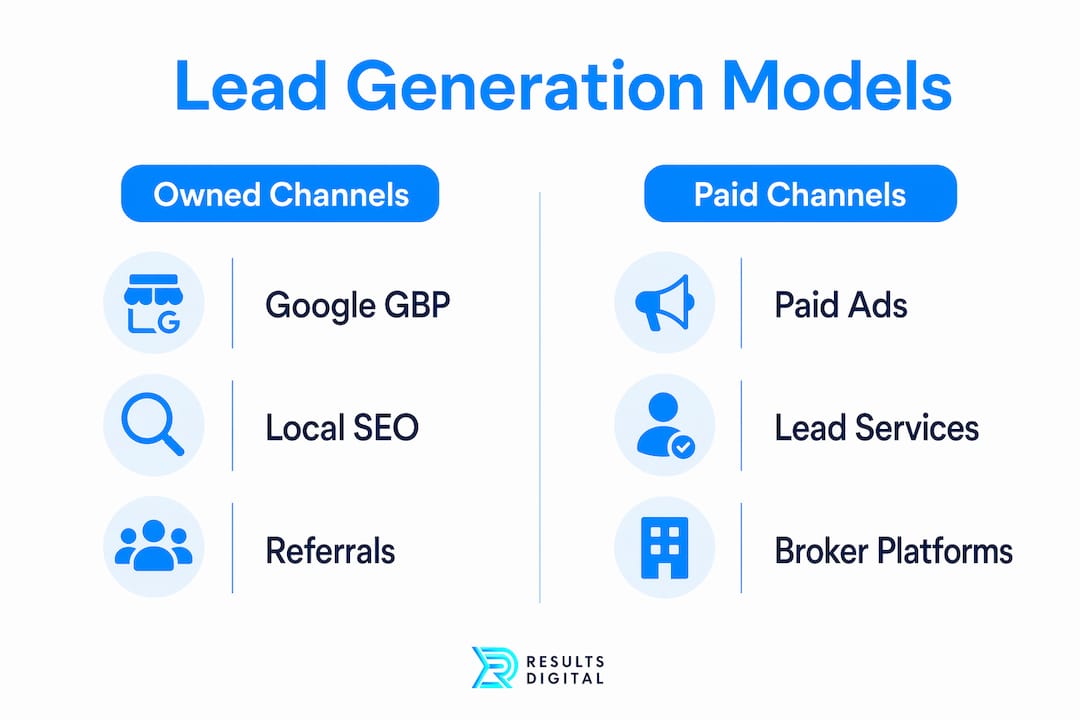
The most effective contractor lead generation strategy separates lead sources into two categories: owned channels and paid channels. Owned channels include your GBP listing, your website’s organic rankings, and your referral program. Paid channels include Google Ads, Local Services Ads, and third-party lead platforms. The model tells you how much to invest in each, when to use them, and how to measure what they actually produce.
What are the main contractor lead generation business models?
Three primary lead generation business models exist for contractors: Broker, Partnership, and Full-Stack. Each carries a different risk profile, margin potential, and skill requirement.
- Broker model: You buy leads wholesale from a third-party platform and work them yourself. Risk is low because you only pay per lead, but control is minimal. Leads are often sold to three to five contractors simultaneously, which forces you to compete on price and speed rather than quality.
- Partnership model: You share leads and revenue with another contractor or marketing partner, typically splitting work and profit 50/50. This reduces your upfront cost but also cuts your margin and creates dependency on a partner’s performance.
- Full-Stack model: You own the entire chain from ad spend to closed sale. You run your own ads, capture leads on your own landing pages, and manage the follow-up process internally. This requires the most skill and upfront investment, but it produces the highest margin and the most control.
The comparison below shows how each model stacks up across the metrics that matter most to a small or medium-sized contracting business.
| Model | Control | Risk | Margin | Skills required |
|---|---|---|---|---|
| Broker | Low | Low | Low | Basic sales |
| Partnership | Medium | Medium | Medium | Sales and coordination |
| Full-Stack | High | High | High | Paid media, CRM, sales funnel |
Full-Stack requires deep expertise in paid media, landing page optimization, CRM integration, and sales funnel management. That makes it the highest-risk and highest-reward option. For most contractors running one to five crews, Full-Stack is the right long-term target because it eliminates the middleman and builds an asset you own.
Which marketing channels form the foundation of a contractor lead generation strategy?
Owned channels are the foundation of any contractor lead acquisition system because their cost per lead drops over time while paid channels maintain or increase costs. Contractors see cost per lead fall annually in owned channels as their GBP listing accumulates reviews and their website climbs local search rankings. That compounding effect is what makes owned channels worth prioritizing before you spend a dollar on ads.
Google Business Profile is the single highest-ROI owned channel for most contractors. A GBP with 50+ reviews and complete information, including correct categories, photos, and regular posts, can generate close rates of 20–35% on inbound leads. That close rate is significantly higher than what most paid lead platforms produce.
Local SEO drives organic discovery by homeowners searching for services in your area. When your website ranks for terms like “roof replacement in [city]” or “siding contractor near me,” you capture high-intent traffic without paying per click. The local lead generation benefits compound over months and years, not days.
Referral programs are the most underused owned channel in contracting. A systematic referral program, where you ask every satisfied customer for a referral and offer a clear incentive, produces leads with the highest close rates in the industry. These leads arrive pre-sold on your reputation.
The core owned channel checklist looks like this:
- Complete and verify your Google Business Profile with accurate categories, service areas, and photos
- Publish weekly GBP posts and respond to every review within 24 hours
- Build location-specific service pages on your website targeting your top three to five cities
- Create a written referral program with a defined incentive and a consistent ask process
Pro Tip: Respond to every GBP inquiry and review within two hours. Speed of response is one of the strongest signals Google uses to rank local listings, and it directly increases your close rate on inbound leads.
How to integrate paid advertising and lead services effectively
Paid advertising works best as a fill mechanism, not a foundation. When your owned channels are producing steady volume, paid ads cover the gaps during slow seasons or when you want to push into a new service area. Treating paid ads as your primary source creates the revenue rollercoaster that kills contractor businesses.
- Start with Google Local Services Ads (LSAs). LSAs charge per lead, not per click, and display a “Google Guaranteed” badge that increases homeowner trust. They work well for contractors with close rates above 25–30%.
- Add Google Search Ads for high-intent keywords. Terms like “emergency roof repair” or “siding replacement quote” signal immediate buying intent. Google Ads PPC for contractors produces the fastest results of any paid channel when campaigns are built around job-specific keywords.
- Avoid shared lead platforms as a primary source. Leads sold to three to five contractors simultaneously force a race-to-the-bottom on price. These platforms work as a short-term supplement, not a long-term strategy.
- Track cost per booked job, not cost per lead. A $30 lead that closes 5% of the time costs $600 per booked job. A $90 lead that closes 30% of the time costs $300 per booked job. The cheaper lead is the more expensive one.
Pro Tip: Set a maximum cost per booked job threshold before you launch any paid campaign. If a channel cannot hit that number within 60 days, pause it and reallocate the budget to your owned channels.
Paid lead services work best for contractors with close rates above 25–30%. Below that threshold, the cost per acquisition climbs fast enough to eliminate your margin on most jobs.
What role does lead conversion play in your lead generation model?
Lead conversion is where most contractor marketing budgets leak. You can generate 100 leads a month and still lose money if your conversion process is broken. Fast response times and simple quote requests are as important as the lead source itself. A homeowner who submits a form at 7 PM and hears nothing until the next afternoon has already called two other contractors.
The conversion layer of your model has four components:
- Speed: Call or text every inbound lead within 15 minutes during business hours. After hours, use an automated text confirmation so the homeowner knows you received their request.
- Clarity: Your website’s call-to-action must be a single, obvious step. One phone number. One form. No confusion about what happens next.
- Mobile usability: More than half of homeowner searches happen on a phone. If your website loads slowly or your form is hard to fill out on mobile, you are losing leads before they contact you.
- Follow-up sequence: Most contractors give up after one or two contact attempts. A three to five touch follow-up sequence, combining calls, texts, and email, recovers a significant portion of leads that do not respond immediately.
Conversion process investments yield higher returns than spending more on lead volume. Fixing a broken conversion process is always cheaper than buying more leads to compensate for the ones you are losing.
How to build a balanced and sustainable lead generation system
A balanced contractor lead generation system uses owned channels as the foundation and paid channels as the fill. This structure prevents the revenue volatility that comes from depending on a single source. A cohesive lead system with diversified sources is more resilient to platform changes and reduces the risk of schedule gaps.
- Build your owned foundation first. Get your GBP fully optimized, publish consistent content on your website, and launch a referral program before you spend money on ads. This takes 90–180 days to produce results, but those results compound.
- Add paid channels as a fill layer. Once your owned channels are producing, use Google Ads or LSAs to cover slow periods or new service areas. Set a monthly budget cap and a cost-per-booked-job target.
- Include partner leads. Relationships with local builders, property managers, and insurance adjusters produce a steady stream of referred work that costs nothing per lead. These relationships take time to build but deliver some of the highest-margin jobs in contracting.
- Track every channel separately. Use call tracking numbers and UTM parameters to attribute every booked job to a specific source. Flying blind on channel performance means you cannot cut what is not working.
- Review and adjust quarterly. Your lead mix should shift as your business grows. A contractor adding a second crew needs more volume. A contractor raising prices needs higher-quality leads. Adjust your channel mix to match your current goal.
The table below shows a practical channel allocation for a small to medium contracting business.
| Channel | Role | Cost structure | Review frequency |
|---|---|---|---|
| Google Business Profile | Foundation | Time investment | Monthly |
| Local SEO | Foundation | Agency or in-house | Quarterly |
| Referral program | Foundation | Incentive cost | Monthly |
| Google Ads / LSAs | Fill | Per click or per lead | Weekly |
| Partner relationships | Supplement | Relationship time | Quarterly |
Tracking cost per booked job by channel is the single most important measurement habit in contractor marketing. A contractor closing 10 jobs from 50 leads outperforms one closing 8 jobs from 100 leads, even though the second contractor generated more raw volume.
Key Takeaways
The most effective contractor lead generation model combines owned channels as the foundation, paid advertising as the fill, and a fast conversion process to turn inquiries into booked jobs.
| Point | Details |
|---|---|
| Own your lead sources | GBP, local SEO, and referrals produce the lowest cost per lead over time. |
| Full-Stack delivers the best margin | Owning the full chain from ad to sale eliminates the middleman and builds a lasting asset. |
| Conversion speed matters | Responding within 15 minutes dramatically increases your close rate on inbound leads. |
| Track cost per booked job | Raw lead volume is a vanity metric; profitability comes from closing rate by channel. |
| Diversify to avoid volatility | Contractors who rely on one source face schedule gaps when that source changes or fails. |
What I have learned after years of contractor lead generation
Most contractors I talk to are not failing because they cannot generate leads. They are failing because they are measuring the wrong thing. They count leads instead of booked jobs. They celebrate a busy inbox while their close rate sits at 8%. That is not a lead generation problem. That is a conversion and measurement problem.
The other mistake I see constantly is over-reliance on shared lead platforms. Buying leads that go to four other contractors in your market is not a strategy. It is a bidding war you will eventually lose to someone willing to work for less. The contractors who build real businesses own their digital presence. They invest in their GBP, their website, and their referral network. Those assets appreciate. Shared lead subscriptions do not.
One more thing worth saying directly: AI-driven search is changing how homeowners find contractors. Emerging AI search tools are reshaping how contractors appear in local results. Contractors who invest in structured FAQ content, complete GBP data, and consistent reviews will show up in AI-generated answers. Those who do not will become invisible to a growing segment of homeowners. The contractors I work with who are winning in 2026 treat their digital presence as a business asset, not a marketing expense.
— Results
How Resultsdigitalus helps contractors build a lead generation system that works
Resultsdigitalus builds digital marketing for general contractors that is engineered specifically for the trades, not adapted from a generic agency playbook. Every campaign, keyword, and landing page is built around one goal: booked jobs, not just leads.

The agency handles SEO, Google Ads, Meta Ads, and custom website design for roofing contractors, siding companies, gutter contractors, and general contractors across the United States. Resultsdigitalus works with only one contractor per trade per market, so your budget works exclusively for you. No long-term contracts. Results speak for themselves: one Florida roofing client grew from 3 crews to 18 before selling for $60 million. If you are ready to build a lead generation system you actually own, Resultsdigitalus is the place to start.
FAQ
What is a contractor lead generation model?
A contractor lead generation model is the structured system a contractor uses to attract homeowner inquiries and convert them into booked jobs through owned channels, paid advertising, and referral programs.
What is the best lead generation model for small contractors?
The Full-Stack model delivers the highest margin and control, but contractors should build their owned channels first before investing heavily in paid advertising.
How do I generate contractor leads without paying for them?
Optimize your Google Business Profile, build location-specific pages on your website for local SEO, and run a systematic referral program asking every satisfied customer for a referral.
Why do shared lead platforms often underperform?
Shared platforms sell the same lead to three to five contractors simultaneously, forcing price competition and reducing your close rate and margin on every job.
How should I measure my contractor lead generation success?
Track cost per booked job by channel, not raw lead volume. A lower lead count with a higher close rate produces more profit than a high volume of low-quality leads.
