
Month-to-month SEO is ongoing search engine optimization billed on a rolling monthly basis with no long-term contract, meaning you can cancel with standard notice rather than being locked into a 12-month commitment. For most small businesses and contractors, it’s a smart starting point: you get continuous SEO work, clear monthly deliverables, and the ability to hold your provider accountable every 30 days. It’s less ideal if you’re competing in a high-stakes enterprise market that demands a dedicated, deeply resourced team from day one.
Here’s the quick read before you go deeper:
- Flexibility wins: You can test a provider, pause during slow seasons, or switch if results stall, without paying out a long contract.
- Accountability is built in: A good month-to-month retainer forces the provider to show completed work every month or risk losing your business.
- Patience still required: No-contract doesn’t mean fast results. Measurable ranking and traffic gains typically take several months regardless of contract length.
Key Takeaways
Month-to-month SEO works best when paired with a defined monthly scope, realistic timelines, and a provider who specializes in your industry rather than serving every vertical at once.
| Point | Details |
|---|---|
| Start with the foundation | Run a one-time technical audit before committing to monthly work so you’re building on a clean base. |
| Expect 3–6 months for results | Measurable ranking and traffic gains take time; early months deliver technical wins, not top rankings. |
| Require written monthly scope | Vague deliverables protect the provider, not you. Insist on specific outputs before signing. |
| Watch the contract details | Avoid notice periods over 30 days, vendor content ownership clauses, and guaranteed ranking promises. |
| Resultsdigitalus fits contractors | No long-term contracts, one client per trade per market, and monthly sprints built around contractor lead generation. |
Table of Contents
- What does month-to-month SEO actually mean?
- What should a solid monthly SEO plan include?
- How much does month-to-month SEO cost, and when will you see results?
- Month-to-month vs. one-time SEO vs. in-house: how do you choose?
- How do you evaluate a month-to-month SEO provider?
- What contract language should you watch in a month-to-month SEO agreement?
- When is month-to-month SEO the wrong choice?
- How Resultsdigitalus approaches month-to-month SEO for contractors
- Results Digital’s no-contract SEO model is the right fit for contractors who want accountability without lock-in
- The part most month-to-month SEO guides won’t tell you
- Sources
What does month-to-month SEO actually mean?
The industry term for this model is an ongoing SEO retainer, billed monthly with no fixed end date. What separates it from a traditional retainer is the cancellation clause: instead of committing to 6 or 12 months upfront, you pay month to month and can exit with 30 days’ notice (or whatever the agreement specifies).
Marketing agency retainers exist because marketing moved from episodic campaigns to always-on disciplines. SEO compounds over time, so a retainer structure keeps momentum rather than restarting from zero every quarter. Three billing models show up most often:
Fixed monthly scope
A defined set of deliverables at a flat monthly fee. You know exactly what you’re paying and what gets done. Best for businesses that want predictability and a clear scope to measure against.
Flexible hourly or pay-as-you-go
Hours are purchased in blocks or billed as used. Works well for businesses with variable needs month to month, like a contractor who needs heavy content production in spring and lighter maintenance in winter.
Productized or subscription-based platforms
Pre-packaged SEO tiers at published price points, often with automated reporting and fixed output levels. Entry-level tiers from these platforms can start below $500/month, but you’re buying a standardized process, not a custom strategy.
The smartest sequence for most small businesses: Start with a one-time foundation audit and technical cleanup, then move to a monthly retainer for compounding growth. Skipping the cleanup phase and jumping straight into monthly content work is like painting over rust — the surface looks better, but the structure underneath is still failing.
Pro Tip: If a vendor pitches you straight into a monthly retainer without first auditing your site’s technical health, ask why. A responsible provider will want to know what they’re working with before committing to monthly deliverables.
What should a solid monthly SEO plan include?
A monthly SEO plan should cover five core pillars. If a vendor’s proposal doesn’t address all five, you’re looking at a partial service, not a full program.
The five core pillars:
- Technical monitoring and fixes: Crawl errors, page speed issues, broken links, indexing problems caught and resolved. Google Search Console is the baseline tool here, and month-one technical wins often come directly from acting on its coverage and performance reports.
- On-page optimization: Title tags, meta descriptions, header structure, internal linking, and content depth improvements on priority pages.
- Content production and refresh: New blog posts, service page updates, or location pages targeting keywords your site doesn’t yet rank for.
- Link acquisition: Outreach for editorial mentions, local citations, and off-site credibility signals that build domain authority over time.
- Analytics and reporting: Monthly delivery of rankings, organic traffic, conversion metrics, and a log of completed work.
A strong monthly SEO plan ties internal linking, content depth, off-site credibility, and transparent reporting together into a single coherent program, not a list of disconnected tasks.
What measurable monthly outputs look like
- Pages optimized with updated title tags, headers, and internal links (several per month depending on site size)
- New content pieces published (a few blog posts or location pages)
- Technical issues resolved from the crawl queue (target: all critical, plus a batch of warnings)
- Links earned or citations built (several quality placements)
- Monthly report delivered showing rankings, traffic, and completed work log
What a transparent monthly scope looks like on a proposal
A vague proposal says: “Monthly optimization and ongoing SEO work.” A transparent one says: “Month 1: technical audit and fix of all critical crawl errors, optimization of 5 priority service pages, 2 blog posts targeting [specific keywords], 3 local citation submissions, and a ranking/traffic report delivered by the 5th of the following month.”
If you can’t hold the vendor to a specific deliverable, the scope isn’t defined well enough.
How much does month-to-month SEO cost, and when will you see results?
Price and timeline are the two questions every small business owner asks first. Here’s the honest breakdown.
Price ranges by provider type
Freelancers and solo consultants typically charge various rates for local or small-site SEO. Small agencies with a defined process charge a moderate monthly fee for most small businesses. Mid-market agencies with dedicated account teams and content writers generally charge higher monthly fees. Productized or subscription platforms offer entry-level tiers starting at lower monthly prices, but those fixed output levels reflect the price point.
What drives cost upward: a large or technically complex site, a highly competitive national market, aggressive content production needs, difficult link acquisition targets, or a local market with strong established competitors. A roofing contractor in a mid-size metro competing against three well-funded local operators needs a different investment than a gutter company in a rural market with thin competition.
Realistic timeline to results
| Phase | Timeframe | What to expect |
|---|---|---|
| Foundation | Months 1–3 | Technical fixes resolved, on-page improvements deployed, baseline rankings tracked, early indexing gains visible |
| Early growth | Months 3–6 | Measurable ranking improvements on target keywords, organic traffic beginning to climb, first conversion signals from SEO |
| Compounding | Months 6–12+ | Sustained traffic growth, lead volume increasing, domain authority building, content library producing ongoing returns |
Monthly SEO compounds through ongoing content, link acquisition, and iterative adaptation to algorithm changes. A one-time project fixes the foundation; monthly work is what builds durable ranking improvements on top of it.
Measuring ROI on monthly SEO: Track qualified phone calls, form submissions, and revenue tied to organic traffic, not just rankings. Rankings are a leading indicator. Leads and revenue are the actual business outcome.
Month-to-month vs. one-time SEO vs. in-house: how do you choose?
The right model depends on where your business is right now, not on which option sounds most appealing.
| Dimension | Month-to-month SEO | One-time SEO project | In-house SEO |
|---|---|---|---|
| Monthly cost | $500+ | One-time cleanup fees vary widely | Salary plus tools costs vary widely |
| Core deliverables | Technical, content, links, reporting monthly | Audit, fixes, on-page optimization | Varies by hire’s skill set |
| Reporting cadence | Monthly KPI dashboard | End-of-project report | Internal, self-directed |
| Timeline to results | 3–6 months for measurable gains | Weeks for technical fixes, no ongoing growth | 6–12 months to build competency |
| Flexibility | Cancel with notice | Fixed scope, single engagement | Long-term commitment (employment) |
| Industry expertise | Varies by provider | Varies by provider | Rare to find contractor-specific expertise |
The six-question decision checklist:
- Does your site have significant technical problems (crawl errors, slow load times, broken pages)? If yes, start with a one-time audit and fix before committing to monthly work.
- Are you in a competitive local market where rankings directly drive leads? Monthly SEO is the right model.
- Is your business seasonal, with predictable slow periods? Month-to-month gives you the option to reduce scope or pause.
- Do you have the budget for a full-time hire plus tools? In-house makes sense only at that scale.
- Do you need industry-specific expertise (contractor keywords, local service area pages, trade-specific content)? A specialized agency beats a generalist every time.
- Are you testing a new provider after a bad experience? Month-to-month lets you verify performance before committing.
For most contractors, the answer is: fix the foundation first with a one-time audit, then move to a monthly retainer for compounding growth. Off-season periods are actually a smart time to start, because you can build ranking momentum before peak season demand hits.
How do you evaluate a month-to-month SEO provider?
The difference between a provider that delivers and one that collects a check while doing minimal work often comes down to how clearly they answer these questions before you sign.
Questions to ask every provider:
- What specific deliverables will I receive each month, and how are they documented?
- Who on your team will actually do the work? (Ask for the person’s name and background, not just the agency’s credentials.)
- Can you show me a sample monthly roadmap or a real client report with identifying details removed?
- How do you build links, and can you describe your outreach methodology?
- Who owns the content you produce? Does ownership transfer to me immediately?
- What reporting do I receive, and on what date each month?
- What’s your cancellation policy, and is there a notice period?
Red flags that should stop you from signing:
- Guaranteed ranking positions. No ethical SEO provider guarantees specific rankings because Google’s algorithm is not within their control.
- Vague deliverables like “monthly optimization” with no specifics attached.
- Refusal to share sample work, references, or a real client report.
- IP or content ownership clauses that keep your content if you cancel.
- Reporting that shows only rankings with no traffic, conversion, or work-completed data.
- A provider who can’t name the person doing your SEO work.
No-contract SEO can underdeliver when a provider does only minimal monthly work to maintain revenue without the pressure of a longer commitment. The way to protect yourself is to require a written monthly scope before you pay the first invoice.
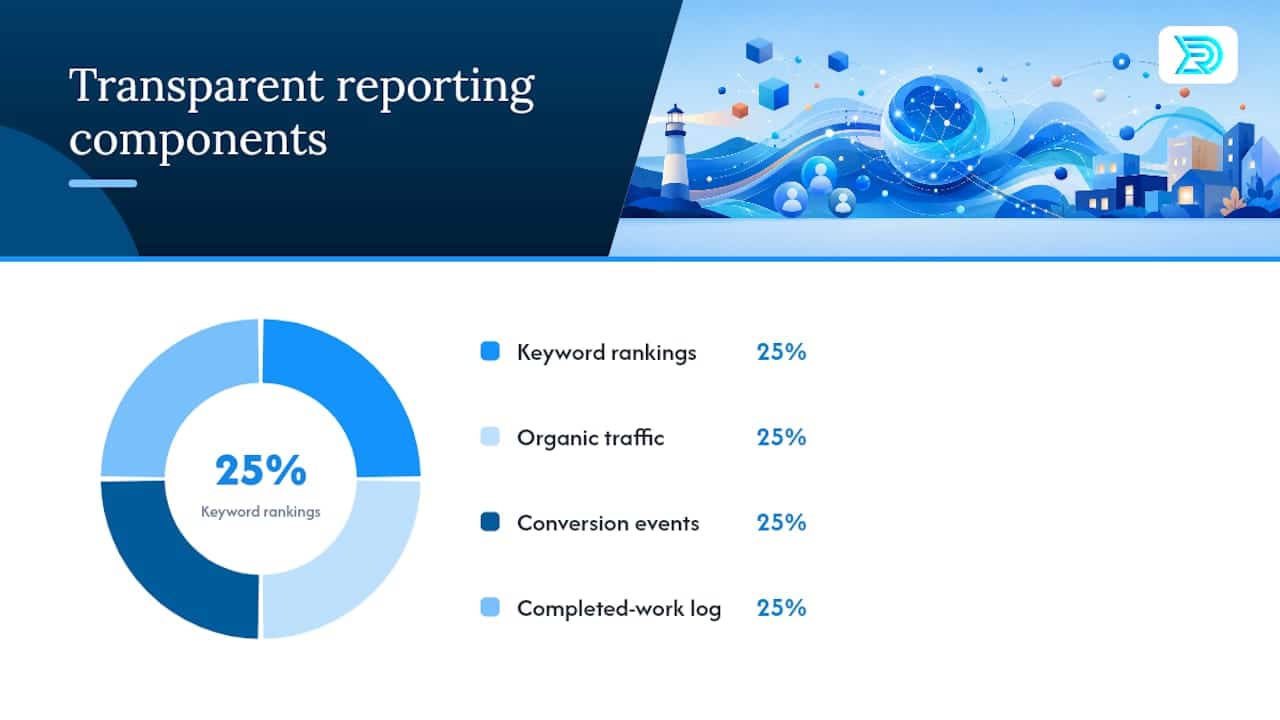
Transparent reporting should include: keyword rankings for your target terms, organic traffic by page and source, conversion events (calls, form fills), and a completed-work log showing exactly what was done that month. If a provider can’t deliver all four, you’re flying blind on your own investment.
What contract language should you watch in a month-to-month SEO agreement?
“Month-to-month” doesn’t automatically mean clean, simple terms. The contract details matter as much as the billing model.
Good terms to look for:
- 30-day cancellation notice with no penalty beyond that month’s fee
- Content ownership transfers to you immediately upon creation
- Deliverables defined per month in writing, either in the contract or a monthly scope document
- Billing tied to a fixed scope, with any extra work quoted separately before it’s started
- No automatic rate escalations without 30-day written notice
Red-flag clauses to avoid:
- Notice periods longer than 30 days that require you to pay for months of work you didn’t request
- Vendor retains rights to content drafts, website changes, or link placements if you cancel
- Automatic annual rate increases buried in the renewal language
- “Minimum commitment” language that effectively creates a 3–6 month lock-in despite the “month-to-month” label
- Setup fees that are non-refundable but not tied to any specific deliverable
On ranking guarantees: Any provider who promises a specific ranking position in their contract is either misinformed or misleading you. Google explicitly states that no one can guarantee rankings. A contract that includes guaranteed positions is a red flag, not a selling point.
Practical negotiation approach: before you sign, convert every vague line in the contract into a specific deliverable. “Monthly SEO work” becomes “4 pages optimized, 2 blog posts published, 3 links acquired, report delivered by the 5th.” If the provider won’t agree to that specificity, that tells you something important about how they plan to operate.
One operational note: Providers who refuse to define deliverables in writing typically rely on the ambiguity to justify minimal output. Specificity in the contract protects you and holds the provider to a standard they agreed to.
When is month-to-month SEO the wrong choice?
Month-to-month SEO works well for most small businesses, but there are situations where a different model fits better.
- High-competition enterprise markets: If you’re competing nationally against brands with dedicated SEO teams and multi-year content libraries, a month-to-month arrangement often can’t match the resource depth required. A longer-term retainer with a committed team allocation is more appropriate.
- Sites with significant technical debt: A site with thousands of pages, duplicate content problems, or a broken site architecture needs a focused remediation project before monthly growth work makes sense. Trying to run monthly content sprints on a technically broken site produces poor returns.
- Organizations requiring guaranteed resource allocation: Some businesses need contractually committed team hours across a multi-month program, particularly when internal stakeholders require that level of certainty for budget approval.
- Regulated industries with long onboarding requirements: Healthcare, legal, and financial services often require compliance review of every piece of content before publication. That onboarding and review process is better suited to a structured, longer-term engagement than a rolling monthly arrangement.
If any of these situations describe your business, the right move is a one-time project first, or a structured retainer with a defined program length, rather than a month-to-month arrangement that may not give the provider enough runway to deliver meaningful results.
How Resultsdigitalus approaches month-to-month SEO for contractors
Resultsdigitalus is a veteran-owned agency built exclusively for roofing contractors, gutter contractors, siding companies, and general contractors across the United States. The model is straightforward: no long-term contracts, one client per trade per market, and every strategy built around contractor lead generation rather than generic traffic.
What the model produces: A Florida roofing company that partnered with Resultsdigitalus grew from 3 crews to 18 before selling for $60 million. That kind of growth doesn’t happen from a one-time project. It comes from compounding monthly SEO work, targeted paid campaigns, and a website built to convert contractor leads.
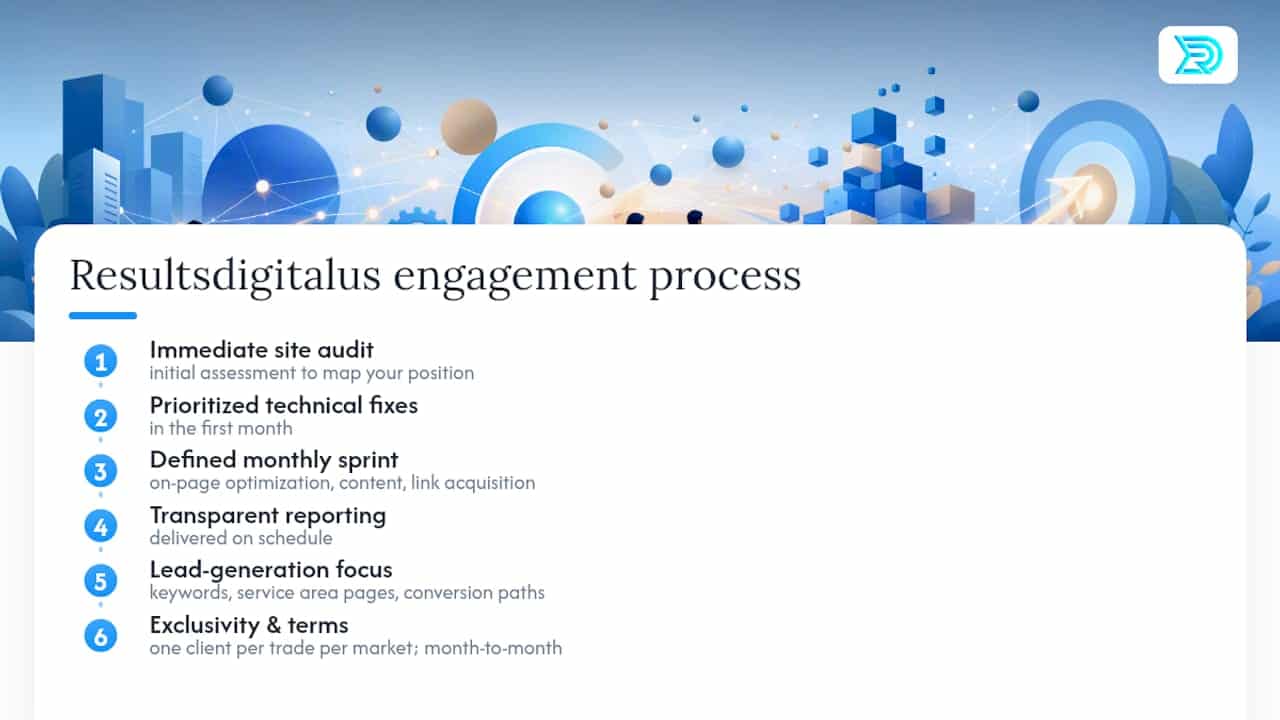
A Resultsdigitalus engagement starts with an immediate site audit, followed by prioritized technical fixes in the first month. From there, each month runs as a defined sprint: on-page optimization, content production targeting local service keywords, link acquisition, and a transparent report delivered on schedule. The exclusivity model means the strategy works solely for your company in your market, not for a competitor two miles away.
SEO services for contractors from Resultsdigitalus are built around the keywords, service area pages, and conversion paths that actually generate qualified calls, not vanity traffic metrics.
Pro Tip: If you’re a contractor evaluating SEO providers, ask specifically whether they work with any of your direct competitors in your market. An agency that serves multiple roofing companies in the same city is optimizing against itself. Exclusivity isn’t a marketing line; it’s a structural advantage.
For contractors who want to understand how SEO fits into a broader contractor lead generation model, Resultsdigitalus offers an initial assessment to map your current position and identify the fastest path to qualified leads.
Results Digital’s no-contract SEO model is the right fit for contractors who want accountability without lock-in
Month-to-month SEO works when the provider delivers defined work every month and you can measure the output against real business results. The research is consistent on this: no-contract SEO succeeds when expectations are realistic and the scope is specific, and it fails when either side treats the arrangement as low-stakes.

Resultsdigitalus offers exactly what this article describes: a no-long-term-contract digital marketing engagement built for contractors, with defined monthly deliverables, transparent reporting, and an exclusivity model that means your market is yours alone. If you’re a roofing, gutter, siding, or general contracting company ready to test a provider without a 12-month commitment, request an assessment at Resultsdigitalus and see what a contractor-specific monthly SEO sprint looks like in practice.
The part most month-to-month SEO guides won’t tell you
The conventional advice on month-to-month SEO focuses almost entirely on flexibility: no lock-in, cancel anytime, test before you commit. That framing is accurate but incomplete, and for contractors it can be actively misleading.
Flexibility without accountability is just a slow way to waste money. The real value of a month-to-month arrangement isn’t the exit clause. It’s the pressure it puts on the provider to deliver something measurable every single month or lose the account. Most small businesses never use that pressure because they don’t know what to demand. They accept vague reporting, celebrate minor ranking bumps, and stay with a provider for 18 months without a single qualified lead to show for it.
The providers who perform best on month-to-month contracts are the ones who would perform well on a 12-month contract too. The contract length isn’t the variable that determines quality. The scope specificity, the reporting transparency, and the provider’s actual expertise in your industry are what determine whether you get results or get a monthly invoice for work you can’t verify.
For contractors specifically, generic SEO from a generalist agency is a common and expensive mistake. A roofing company’s SEO needs are fundamentally different from a software company’s: local service area pages, storm-damage content, seasonal keyword patterns, and Google Business Profile optimization all require trade-specific knowledge that most agencies don’t have. The month-to-month model gives you the freedom to find the right specialist and leave the wrong one. Use that freedom deliberately.
Sources
Why these sources matter: Each link below backs a specific claim in this article and gives you a primary source to verify independently, rather than taking any single provider’s word for it.
