
A correct onboarding delivers baseline metrics, a documented 90-day strategy, and at least one live or in-review deliverable within 30 days. Your immediate move is simple: countersign the SOW, pay the initial invoice, and complete the intake form within 5 business days. From there, Results Digital and other contractor-focused agencies follow a repeatable sequence to get your campaigns off the ground.
TL;DR:
- Agencies should deliver baseline metrics, a 90-day strategy, and at least one live or reviewable deliverable within 30 days of onboarding.
- Providing full access to Google Analytics, Search Console, CMS, ad accounts, and brand assets early prevents delays and enables accurate audits and launches.
- A structured kickoff meeting, with clear KPIs, timelines, communication norms, and assigned roles, is essential for a smooth onboarding process.
- Initial reporting should document current traffic, conversion rates, and lead costs within the first week, with ongoing dashboards and strategic reviews monthly.
- Fix onboarding issues promptly by escalating incomplete access, untracked campaigns, or slipping timelines, and rely on shared project workspaces for clarity.
Table of Contents
- What Does the First 30 Days of Onboarding an Agency Look Like?
- What Access and Assets Does Your Agency Need From You?
- What Should Happen in the Kickoff Meeting?
- What Reporting and KPIs Should You Expect Early On?
- How Do You Fix Common Onboarding Problems Fast?
- What Should You Expect for Communication and Response Times?
- How Should Your Data Be Protected During Onboarding?
- How Does an Agency Audit Your Existing Marketing?
- How Should Contracts and Billing Be Set Up?
- Why Contractor-Focused Onboarding Speeds Real Growth
- How Results Digital Handles Onboarding for Contractors
- Sources
What Does the First 30 Days of Onboarding an Agency Look Like?
Onboarding a marketing agency isn’t a single event. It’s a sequence, and the sequence has a rhythm you can hold your agency accountable to. Most complete onboarding processes finish within 2 to 4 weeks and end with a documented 30-day review. If your agency hasn’t given you a written timeline with dates, that’s your first sign to ask for one.
Here’s the checklist to run against, whether you’re evaluating a proposal or already three days into the process:
- Day 0 (pre-start): Signed SOW, initial payment processed, welcome email sent, intake form delivered with a 5 business day deadline attached.
- Days 1 to 3: Internal admin. The agency sets up your project workspace, assigns your onboarding lead, and briefs its internal team on your trade, service area, and goals.
- Days 3 to 7: Kickoff call happens here. Expect alignment on KPIs, timeline, and communication norms, not a sales pitch rehash.
- Week 2: Tool setup and audits. Analytics, tracking, and CMS access get configured; the agency runs its first look at your existing site, ads, and SEO position.
- Weeks 2 to 4: First deliverables move into draft or review. This could be a website mockup, an ad account structure, or initial keyword targets.
- Day 30: Formal review. You should walk away with baseline metrics documented, a 90-day strategy brief in hand, and proof that at least one deliverable is live or actively in review.
A practical 10-step onboarding model built around welcome packages, structured intake, and automated reminders shows that agencies using this exact sequence reduce first-month delays substantially. That’s not a minor detail. Delays in month one tend to compound, since paid ads and content calendars both depend on the audit work finishing on schedule.
Judge onboarding by what gets built, not by whether leads are already flowing. Real campaign results typically show up in month two, once tracking and baseline metrics are confirmed. If your agency promises “leads by week two,” ask exactly what tracking is in place to prove those leads are real.
What Access and Assets Does Your Agency Need From You?
Nothing stalls a contractor onboarding faster than a founder who’s slow to hand over logins. Your agency can’t audit what it can’t see, and it can’t launch what it can’t track. Gather these before your kickoff call, not after:
- Countersigned contract and SOW
- GA4 (Google Analytics) admin or editor access
- Google Search Console access
- CMS admin login (WordPress, Wix, or whatever runs your site)
- Google Ads and Meta Business Manager access, even if you’ve never run a campaign
- CRM export or login, if you track leads anywhere
- Domain registrar access or at least the ability to update DNS records
- Brand assets: logo files, color codes, past photos, testimonials
- Past marketing reports or invoices from any previous agency
Share credentials through a password manager like 1Password, LastPass, or Bitwarden rather than email or text. Set permission levels so your agency gets editor access, not full ownership transfer, on anything you’ll eventually want back.
Pro Tip: Set a hard deadline for asset delivery and stick to a reminder sequence: a polite nudge on Day 1, an escalation email on Day 3, and a phone call by Day 5. Missed access windows are the single most common reason kickoff calls get pushed back a full week.
Recommended dashboard tools like Google Looker Studio and AgencyAnalytics depend entirely on this access being granted early. The faster you hand over credentials, the faster your baseline numbers get documented.
What Should Happen in the Kickoff Meeting?
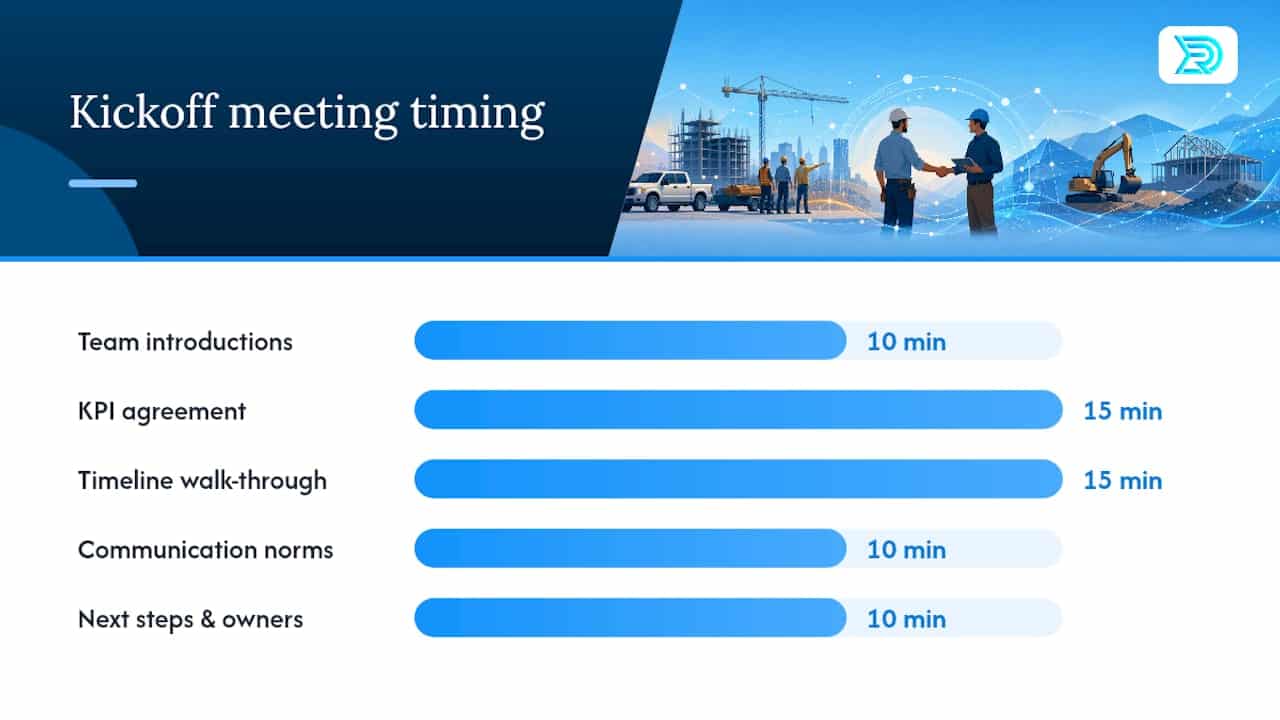
A kickoff call runs about 60 minutes, and a good one has a fixed agenda, not a loose conversation. If your agency’s call rambles past an hour without landing on specifics, that’s worth flagging.
- Minutes 0 to 10: Team introductions. You should meet your named onboarding lead by name, not “the team.”
- Minutes 10 to 25: KPI agreement. Cost per lead, conversion rate, and lead volume targets get defined here, in writing.
- Minutes 25 to 40: Timeline walk-through. The agency confirms the 30/60/90 milestones and who owns each one.
- Minutes 40 to 50: Communication norms. Weekly check-in day, preferred channel (email, Slack, phone), and escalation contact.
- Minutes 50 to 60: Next steps and owner assignments, with dates attached.
On roles: your agency should assign a single named onboarding lead, not a rotating cast. On your side, appoint one internal point of contact, ideally the owner or office manager, who can brief your crew leads within 48 hours of kickoff. Two decision-makers giving conflicting instructions is the fastest way to stall a campaign build.
The 30/60/90 plan you receive afterward should include baseline metrics, channel priorities (SEO first, paid ads second, or vice versa depending on your market), a content calendar outline, a few quick wins targeted for the first 30 days, and a measurement plan showing exactly how success gets tracked. If the plan is a vague paragraph instead of a document with dates and numbers, ask for a revision before you approve it. Owners comparing scope across trades may find it useful to review contractor-specific marketing packages for what a complete plan typically includes.
What Reporting and KPIs Should You Expect Early On?
Week one should produce a documented baseline: current traffic, conversion rate, cost per lead, monthly lead volume, and ROAS if you’re already running paid ads. Without this baseline, you have no way to measure whether month three is actually better than month one.
Expect a reporting rhythm with three layers:
- Weekly: A short written recap, not just a call. You want something you can reference later.
- Monthly: A strategic review covering what worked, what didn’t, and what changes next.
- Ongoing: Live dashboard access through a tool like Looker Studio or AgencyAnalytics so you’re not waiting for a call to check numbers.
Watch for these red flags during the first 30 days: no conversion tracking installed, reports that list activity (“we posted 12 times”) instead of outcomes, slow replies to simple questions, or no documented 90-day plan by the end of month one. Agencies that launch paid campaigns before conversion tracking is verified are spending your budget blind, and a reputable partner won’t do it.
How Do You Fix Common Onboarding Problems Fast?
Most onboarding breakdowns fall into three categories, and each has a specific fix rather than a vague “give it time.”
- Incomplete access: Pause the kickoff call rather than run it half-blind. Escalate internally and log every missing item in the shared project workspace so nothing gets lost in email threads.
- Missing tracking: Insist campaigns stay paused until conversions are measurable, and require a written remediation plan with dates, not a verbal promise.
- Slipping timelines: Request a formal SOW amendment or timeline update. Get the new dates recorded in the shared workspace, not just mentioned on a call.
Pro Tip: Treat your shared project workspace, not your inbox, as the single source of truth. Verbal agreements on a call are easy to forget; a dated task in ClickUp or Asana isn’t.
What Should You Expect for Communication and Response Times?
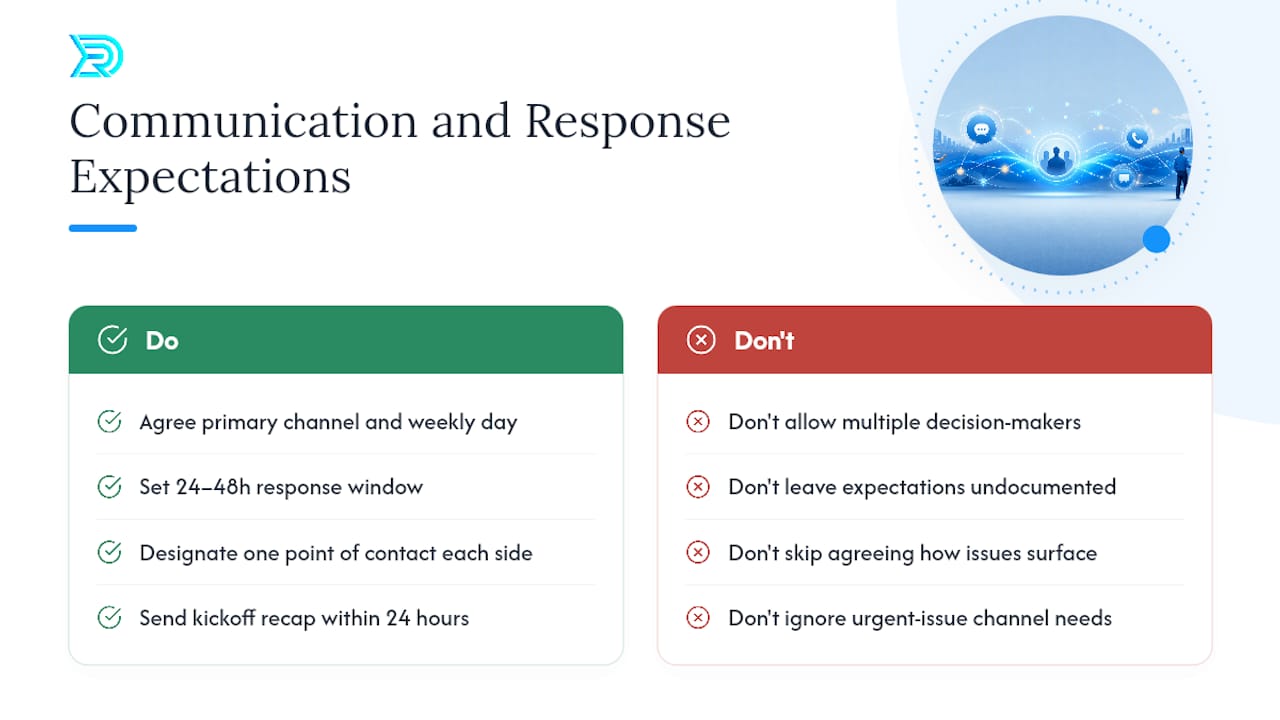
Set expectations early, because ambiguity here causes more friction than any missed deadline. Agree on a primary communication channel, a weekly check-in day, and a realistic response window, typically 24 to 48 hours for non-urgent questions.
Your agency should tell you upfront who your single point of contact is and what happens if that person is out. You should tell your agency the same: one internal decision-maker, not three foremen weighing in independently. Conflicting direction from multiple people on your side is one of the quieter ways onboarding gets derailed, since the agency ends up building toward inconsistent goals.
Put expectations in writing during kickoff, even briefly. A short recap email confirming “we talk every Tuesday, you respond within one business day, urgent issues go to [phone number]” prevents the slow drift into radio silence that kills a lot of contractor and agency relationships by month two. Agencies that send a kickoff recap within 24 hours of the call are demonstrating exactly the discipline you want to see repeated every week after.
Also agree on how disagreements get handled. Will you flag concerns on the weekly call, or do you need a faster channel for urgent issues, like a lead form breaking? Contractors who skip this conversation often find themselves frustrated a month in, not because the strategy failed, but because nobody agreed on how problems would surface.
How Should Your Data Be Protected During Onboarding?
Handing over analytics, CMS, and ad account access means handing over a fair amount of exposure if it’s done carelessly. Treat credential sharing with the same seriousness you’d apply to giving someone a key to your office.
Never send passwords over email or text. Use a credential vault like 1Password, LastPass, or Bitwarden, and grant permission at the editor or admin level your agency actually needs, not full account ownership. If your agency asks for ownership transfer of your domain or Google Business Profile, that’s worth a direct question about why and what happens if you part ways.
Ask your agency who on their team has access to your data and whether they use role-based permissions internally. A shop where every team member has blanket access to every client account is a weaker security posture than one where access is scoped by role. It’s a fair question to ask before you sign, not after something goes wrong.
Confirm what happens to your data and credentials if the relationship ends. Since Resultsdigitalus works without long-term contracts, a clean offboarding process matters as much as onboarding. You should know in writing that access reverts to you, not that it lingers indefinitely in someone else’s dashboard.
How Does an Agency Audit Your Existing Marketing?
Before anything new gets built, a competent agency audits what you already have. This isn’t busywork. It’s the difference between building on a foundation and building over cracks nobody checked.
The audit should cover your current website’s technical health, existing SEO rankings and backlink profile, past ad account structure and spend history if you’ve run campaigns before, your Google Business Profile status, and your review volume and rating across platforms. It should also look at your competitors, specifically which contractors in your service area are outranking or outbidding you.
You should receive this audit as a document, not a verbal summary. A rigorous audit phase produces the performance baseline and documented strategy specific to your business that everything else gets built from. If your agency skips straight to “let’s launch ads” without showing you what they found first, you’re missing the step that makes the rest of the plan defensible.
Pay attention to whether the audit reflects your specific trade. A gutter company’s competitive landscape looks nothing like a general contractor’s, and a generic audit template dropped into your file is a sign the agency isn’t customizing for your market. Owners preparing for this stage often benefit from reviewing what to have ready before an agency starts digging in, since a faster handoff means a faster, more accurate audit.
How Should Contracts and Billing Be Set Up?
Nothing should start before a countersigned contract and your initial payment are both in place. This isn’t agency bureaucracy. It’s a standard that protects both sides and sets the tone for how the relationship runs.
Your SOW should spell out deliverables by phase, payment terms and due dates, what happens if either side wants to pause or exit, and how scope changes get approved. If a change comes up mid-onboarding, whether it’s added ad spend or a new service, insist it gets documented as a written amendment rather than a verbal “sure, we’ll add that in.”
Ask specifically about contract length. Some agencies lock you into 6 or 12-month terms; others operate month to month with no long-term contract required. That distinction affects how much leverage you retain if onboarding goes sideways. A month-to-month structure means your agency has to keep earning the relationship every 30 days, which tends to keep early deliverables moving rather than slipping.
Billing setup should also clarify what’s included in your monthly fee versus what’s billed separately, like ad spend itself, which typically flows through your own Google Ads or Meta account rather than the agency’s invoice. Get this distinction in writing before your first invoice arrives, so there’s no confusion later about whose card is funding your campaigns.
Why Contractor-Focused Onboarding Speeds Real Growth
Generic agencies onboard every industry the same way. Contractor-focused shops prioritize different assets from day one, tracking service-area keywords and crew capacity instead of generic e-commerce metrics. A one-trade-per-market exclusivity model means your onboarding data does not double as a competitor’s roadmap. One Florida roofing client grew significantly before selling for a substantial amount, proof that disciplined early setup compounds. No long-term contracts keep agencies accountable every 30 days.
— Results
How Results Digital Handles Onboarding for Contractors
This agency specializes in serving roofing, siding, gutter, and general contracting companies, and that specialization shows up from your very first call. Because this agency partners with only one company per trade per market, your onboarding data, keyword targets, and campaign strategy never get recycled for a competitor down the street.

Onboarding here follows the same disciplined sequence covered above: signed SOW and initial payment first, a named onboarding lead assigned to your account, full access collected within days, and a documented 30-day review with baseline metrics and a 90-day plan. There’s no long-term contract locking you in, so every month has to earn your continued business on its own merits.
If you’re ready to start, the first step is simple: request a call, and come prepared with your current site login, Google Analytics access if you have it, and a rough sense of your service area and monthly lead goals. That’s enough for a productive first conversation. From there, Resultsdigitalus’s digital marketing team can walk you through what a tailored 30/60/90 plan looks like for your trade, whether that’s roofing SEO, Google Ads management, or a new contractor website build.
Sources
For a deeper look at agency onboarding structure, the Pitchsite onboarding checklist covers pre-start through month-one phases with templates. The 10-step onboarding sequence offers automation tips and reminder timing. For a granular task-by-task view, the 34-point onboarding checklist breaks down kickoff through the first 30 days. For general criteria on vetting any agency partner, see these 7 selection criteria.
- Agency Client Onboarding Checklist 2026: The Complete Step-by-Step Guide | Pitchsite
- 10-Step Client Onboarding Checklist for Agencies 2026
- What to Expect from a Marketing Agency: A Month-by-Month Look at What Actually Happens | Sproutbox
