
AI search doesn’t hand a searcher ten blue links anymore. It picks two or three contractors to recommend and moves on. Winning that shortlist starts with a fully built-out Google Business Profile and one service or project page written so an AI engine can lift facts straight off it. Success looks like AI citations, branded searches, and qualified leads rather than raw rankings.
TL;DR:
- Completing and regularly updating your Google Business Profile with detailed services, photos, and current hours enhances AI citation chances and visibility.
- Building a system for collecting specific, recent reviews and adding schema markup to your site significantly increases the likelihood of being quoted by AI summaries.
- Developing focused service, project, and location pages, with structured FAQs and clear headings, improves AI extraction and ranking in local queries.
- Maintaining a fast, secure, and schema-rich website, alongside consistent NAP information across directories, boosts your chances of appearing in AI outputs.
- Monitoring AI mentions, impression divergence, and branded search growth monthly, along with adapting content based on AI citation signals, measures real progress.
Table of Contents
- What Is AI SEO for Contractors, and Why Did Discovery Change?
- High-Impact AI SEO Tactics Contractors Must Implement
- How Should Contractors Structure Content for AI Extraction?
- What Technical Fixes Improve AI Trust in Your Website?
- How Do You Measure AI Visibility and Track Real Progress?
- Your 90-Day AI SEO Implementation Plan
- Strategies for Automating SEO Tasks With AI Tools
- Using AI for Keyword Research and Content Ideas in Contracting
- Targeting High-Value Local Markets With AI Analytics
- Benchmarking Your SEO Against Other Contractors
- Ethical Considerations When Using AI for Contractor SEO
- Why the Old SEO Playbook No Longer Cuts It
- How Results Digital Can Help You Win the AI Recommendation
- Where to Verify These AI SEO Practices Yourself
- Sources
What Is AI SEO for Contractors, and Why Did Discovery Change?
AI SEO for contractors means structuring your online presence so tools like Google’s AI Overviews, ChatGPT, Perplexity, and Gemini pull your business into their answers instead of leaving you buried under ten organic links. These systems synthesize a response from dozens of sources and display it above the traditional results, which means a homeowner searching “best roofer near me” may never scroll past the summary at the top.
AI models reward concise, factual content, structured data, and consistent signals across the web. A vague “about us” page doesn’t get quoted. A page stating your average roof replacement timeline, service area, and licensing details does. Contractor searches are also overwhelmingly local and urgent. Someone with a leaking roof isn’t browsing ten sites; they want a fast, credible answer.
That creates a new middle layer between the searcher and your website:
- AI Overviews and chat assistants now appear before organic listings on many local queries.
- These tools prefer businesses with clean, extractable facts over long marketing copy.
- Being “chosen” by the AI often matters more than ranking third or fourth organically.
High-Impact AI SEO Tactics Contractors Must Implement
Four moves account for most of the visibility gains contractors see in AI-driven results. Do these before anything else.
- Complete your Google Business Profile entirely. List every service, upload real job photos, keep hours current, and post updates monthly. Google Business Profile powers the map pack and feeds AI recommendation engines directly, so a half-filled profile is leaving visibility on the table.
- Build a review request system. Ask every completed job for a review, using language specific to the service performed (“gutter guard installation,” not just “great job”). Recent, detailed reviews carry extra weight with AI recommendation systems, and businesses with a large number of recent, specific reviews get recommended significantly more often.
- Add schema markup. LocalBusiness, Service, FAQ, and AggregateRating schema give AI engines a structured way to confirm what you do and where.
- Publish dedicated service and location pages. Each core service deserves its own 800 to 1,500 word page, and each city or county you serve deserves its own unique page rather than one generic “service area” list.
Pro Tip: Skip the temptation to write one giant “services” page covering everything you do. AI engines pull facts more reliably from focused pages than from a page trying to be six pages at once.
How Should Contractors Structure Content for AI Extraction?
Structure your site around trade hubs, not random blog posts. A roofing hub page should link out to supporting pages: individual services (repair, replacement, inspection), finished project write ups, and FAQ content, all pointing back to the hub. That clustering signals topical depth to both traditional crawlers and AI systems.
Project pages do heavier lifting than most contractors realize. A page describing a real job, complete with scope, timeline, rough cost range, and photos, gives AI engines exactly the kind of extractable fact it wants to cite. Publishing project narratives with concrete details like an eight week bathroom transformation produces the kind of specific, factual content AI engines prefer to quote over generic marketing prose.
FAQ content needs a different shape than a blog post. Keep each answer to two or four sentences, formatted as a direct question followed by a direct answer, and add FAQ schema to every service and location page.
AI Overviews now appear across a large share of local service queries, and short, direct Q and A pairs are more likely to get quoted than long paragraphs buried in a wall of text. Break your headings into digestible chunks so each section can stand alone as an answer block.
- Build one hub page per trade, linking to service, project, and FAQ pages beneath it.
- Write project pages with scope, timeline, cost range, and photos.
- Format every FAQ as a tight two to four sentence answer with schema attached.
- Chunk headings so each section reads as a self-contained answer.
What Technical Fixes Improve AI Trust in Your Website?
Structured data only works if it’s implemented correctly, and a slow, broken site undermines everything else you build. A handful of technical basics separate contractors who show up in AI answers from those who don’t.
Start with schema. Implementing detailed LocalBusiness, trade-specific, Service, FAQ, and Review schema helps AI engines extract authoritative facts rather than guessing from unstructured text, and Google’s Rich Results Test will confirm whether your markup is actually valid before you assume it’s working.
- Add GeneralContractor, Service, FAQ, and Review schema, then verify each page with Google’s Rich Results Test.
- Hit solid Core Web Vitals scores and secure your site with HTTPS. Mobile speed matters more here than desktop.
- Submit an XML sitemap and treat structured data as a living asset, updated on a version-controlled schedule rather than set once and forgotten.
- Audit your name, address, and phone number across every directory listing and fix inconsistencies. A mismatched suite number or old phone line confuses AI models the same way it confuses a customer.
A redesigned, fast-loading website gives all of this technical work somewhere solid to live.
How Do You Measure AI Visibility and Track Real Progress?
You can’t manage what you don’t track, and AI visibility shows up differently than traditional rankings. The clearest early signal is often a gap between impressions and clicks: when AI Overviews summarize your business without a click, your impressions rise while click volume lags behind, which is itself a sign you’re being cited.
Watch these signals on a monthly cadence:
- Manual query monitoring: search your own core terms in ChatGPT, Perplexity, and Google’s AI Overview to see if you’re mentioned.
- Impression versus click divergence in Google Search Console.
- Branded search growth, meaning more people searching your company name directly.
- Local pack appearances and review velocity month over month.
Pro Tip: Keep a simple log of exact queries where you get mentioned by an AI tool, dated. Six months from now, that log is the clearest proof you have that the strategy is working.
Playbooks that combine Google Business Profile completion, schema, review growth, and project pages together tend to produce visible AI citation gains within several weeks to a few months. Set that window as your baseline expectation, document early wins as they appear, and resist judging the strategy before the 45 day mark.
Your 90-Day AI SEO Implementation Plan
Turn all of the above into a sequence you can actually execute without getting overwhelmed by trying to do everything at once.
- Days 0 to 7: Complete your Google Business Profile fully, publish one optimized service or project page, and set up a review request workflow.
- Weeks 2 to 6: Publish three project pages and four FAQ-rich posts, adding schema to each as you go.
- Weeks 6 to 12: Build unique location pages for your priority service areas and submit your business to authoritative local directories.
- Ongoing: Maintain a steady review cadence, monitor for AI citations monthly, and refine content based on which queries actually produce mentions.
| Phase | Primary Action | Expected Outcome |
|---|---|---|
| Days 0 to 7 | GBP completion, one service page, review system | Foundation live, first reviews arriving |
| Weeks 2 to 6 | 3 project pages, 4 FAQ posts, schema added | AI extraction candidates published |
| Weeks 6 to 12 | Location pages, directory submissions | Broader local footprint established |
| Ongoing | Review cadence, citation tracking, iteration | Compounding AI visibility |
Strategies for Automating SEO Tasks With AI Tools
Contractors run lean teams, and AI tools exist to close that gap, not replace judgment on strategy. Use AI to draft first versions of content, but treat every draft as a starting point that needs your expertise layered in before it publishes.
Practical automation opportunities worth adopting now:
Content drafting tools can generate a first pass of a service page outline based on your job types, freeing up the hour you’d otherwise spend staring at a blank page. Schema generators can produce valid JSON-LD markup for LocalBusiness or Service schema in minutes rather than requiring a developer for every page. AI-powered rank tracking and query monitoring tools can flag when your business starts appearing in AI Overview summaries, cutting down the manual search checking described earlier.
Review management platforms increasingly use AI to draft response suggestions to incoming reviews, which matters because response speed and specificity both factor into how AI systems weigh review signals. Even a basic AI writing assistant can help you turn a technician’s rough job notes into a publishable project page paragraph in minutes instead of an afternoon.
The mistake to avoid is treating automation as a substitute for accuracy. An AI tool doesn’t know your actual warranty terms, your real service area boundaries, or your licensing details. It can draft the structure. You still have to verify every fact before it goes live, because a wrong detail published at scale is worse than no page at all.
Using AI for Keyword Research and Content Ideas in Contracting
Generic keyword tools built for e-commerce or SaaS don’t understand the difference between “roof replacement cost” and “roof repair emergency,” but AI-assisted research can surface the phrasing your actual customers use if you point it at the right questions.
Feed an AI tool the specific jobs you complete most often and ask it to generate the variations a homeowner might search: “how much does gutter replacement cost in [region],” “signs you need a new roof after a storm,” “how long does siding installation take.” These long-tail, intent-specific phrases tend to match exactly what an AI Overview is trying to answer when it summarizes a local query.
Use AI to draft first-pass content around these phrases, then edit heavily with details only you know: your actual crew size, typical project timelines, materials you use, and warranty terms. A generic AI-written paragraph about “quality roofing materials” convinces no one. A paragraph naming the specific shingle brands you install and why you chose them does.
The strongest content still comes from pairing AI-generated structure with contractor-specific substance. Ask AI to identify gaps, meaning topics your competitors haven’t covered, like maintenance schedules for specific siding materials or financing options for larger jobs, then fill those gaps with real answers pulled from your own job history.
Targeting High-Value Local Markets With AI Analytics
Not every neighborhood in your service area generates the same lead value, and AI-powered analytics tools can help you figure out where to focus without guessing. Platforms that analyze permit data, home values, and roof or siding age by zip code can flag which areas are due for replacement work in the next few years.

Combine that with search trend data by geography. If a specific suburb shows rising search volume for “storm damage roof repair” following a recent weather event, that’s a market worth a dedicated location page and possibly a short-term ad push. AI-assisted analytics can process this kind of pattern across dozens of zip codes far faster than manually checking each one.
The goal isn’t chasing every signal. It’s identifying the two or three areas where demand and your service capacity actually line up, then building location-specific content and directory listings for those areas first. A location page for a zip code with genuine, data-backed demand outperforms ten generic pages spread thin across your entire coverage map.
Benchmarking Your SEO Against Other Contractors
You can’t know if your AI SEO investment is working without knowing what competitors in your market are doing. AI-assisted competitive analysis tools can pull a rival’s review count, review recency, schema implementation, and content depth in a fraction of the time manual research would take.
Run the same query you’d expect a customer to search, then check which contractors appear in the AI Overview or chat assistant response. If a competitor consistently shows up and you don’t, examine their Google Business Profile completeness, their review volume and recency, and whether they have dedicated project pages you lack. That gap analysis tells you exactly where to invest next, rather than spreading effort evenly across every tactic in this guide.
Some AI tools can also flag content gaps at scale, showing you which service topics competitors cover that you haven’t published on. Treat this as a prioritization tool, not a copying exercise. The point is identifying where demand exists and you’re currently invisible, then closing that specific gap with your own original content and project documentation.
Ethical Considerations When Using AI for Contractor SEO
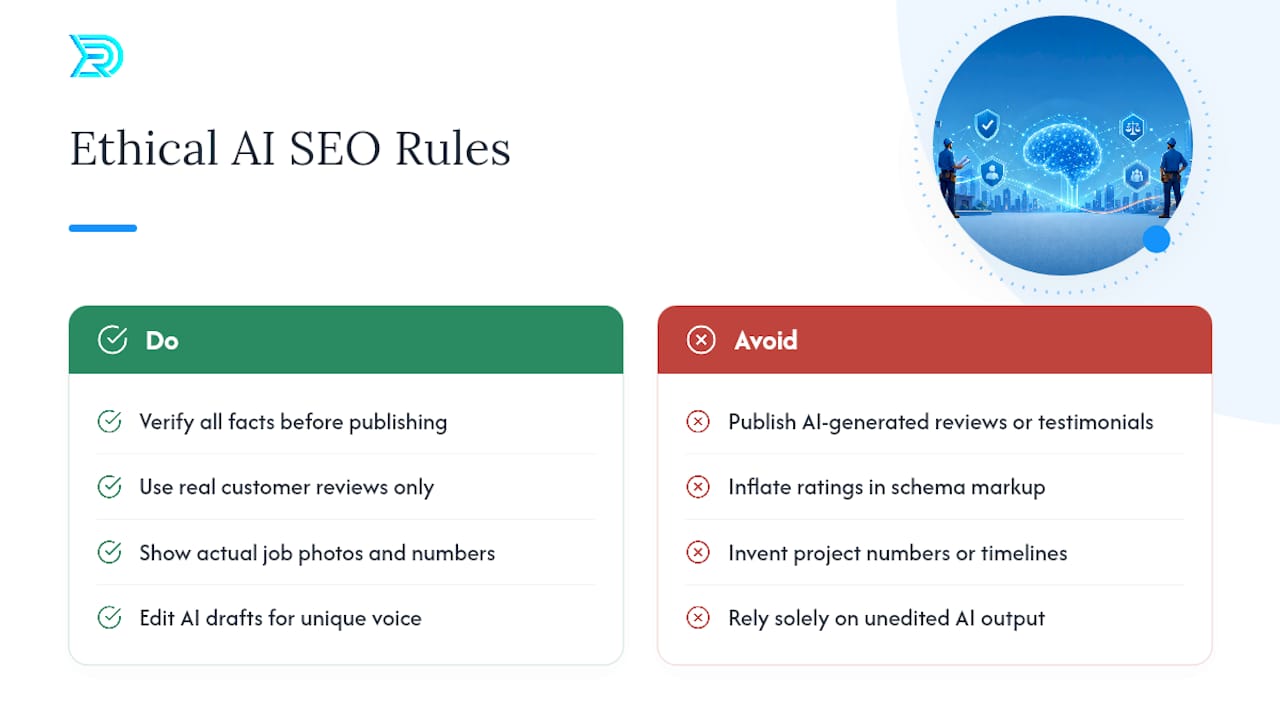
AI tools speed up content production, but speed creates real risk when accuracy slips. Publishing AI-drafted content with fabricated statistics, invented certifications, or exaggerated timelines doesn’t just risk a bad review. It can expose you to legitimate legal and reputational consequences if a customer relies on false claims.
Never let an AI tool generate reviews, testimonials, or case study numbers on your behalf. Every review on your Google Business Profile needs to come from a real customer, and every project page number, cost range, timeline, square footage, needs to reflect an actual completed job. AI-generated fake reviews or manufactured “success stories” violate Google’s policies and erode the exact trust signals this whole strategy depends on.
Be equally careful with schema markup. AggregateRating schema should reflect your real, current review average, not an inflated number. Misrepresenting ratings in structured data can get your listing penalized or removed entirely.
There’s also a subtler risk: over-relying on AI-generated content until your site sounds like every other contractor’s site. AI models learn from existing content, which means unedited AI output tends toward generic phrasing that doesn’t differentiate you from the next roofer in your market. The contractors winning the AI recommendation game right now are the ones using AI to speed up production while keeping the specific, verifiable details, actual job photos, actual timelines, actual crew experience, front and center.
Why the Old SEO Playbook No Longer Cuts It
Most contractor marketing advice still treats SEO like a numbers game: publish more blog posts, chase more keywords, build more backlinks. That approach worked when the goal was ranking in ten blue links. It doesn’t work as well when the goal is getting selected by an AI system that reads three sources and ignores the rest.
The contractors gaining ground right now aren’t the ones publishing the most content. They’re the ones publishing the most verifiable content: real project details, real review language, real service specifics that an AI model can lift and trust. A 2,000 word blog post stuffed with generic advice about “choosing the right roofer” does less for you than a 400 word project page describing an actual job with actual numbers.
The other overlooked piece is review velocity. Contractors chase five-star ratings and stop there, but recency and specificity matter as much as the star count. A profile with 40 reviews from the last six months, each mentioning a specific service, tends to outperform a profile with 200 reviews that stopped accumulating two years ago. That’s a genuinely underrated lever, and it’s one most contractors can start pulling this week without hiring anyone.
None of this replaces solid craftsmanship or fair pricing. AI SEO amplifies a good reputation faster than it used to. It also exposes a thin one faster too.
— Results
How Results Digital Can Help You Win the AI Recommendation
You’ve seen the playbook: Google Business Profile, schema, project pages, review velocity. Building all of it correctly, and maintaining it month after month, is a full-time job most contractor owners don’t have room for between running crews and managing bids. A digital marketing agency exists to run that program for you, exclusively, with only one client per trade per market so your competitor down the street never gets the same strategy.
An engagement with this agency covers SEO, Google Business Profile optimization, AI-powered website design, and paid advertising across Google, Meta, and other platforms, built specifically for contractor lead generation rather than adapted from generic small-business marketing. The agency was founded in 2015 around one idea: contractors need marketing partners who understand crews, bids, and seasonal demand, not just click-through rates. Contracts are structured based on ongoing performance and monthly trust rather than long-term commitments.
If you want a done-for-you version of this AI SEO playbook running behind the scenes while you focus on the jobs themselves, start with the digital marketing services built for general contractors and see what a full first-90-day plan looks like for your market.
Where to Verify These AI SEO Practices Yourself
Before rolling any of this out, cross-check the specifics against primary sources rather than taking secondhand summaries at face value:
- Fokal’s contractor SEO guide for a deeper look at Google Business Profile’s role in local and AI visibility.
- Digital Footprint Solutions’ AI search optimization playbook for schema and timeline benchmarks.
- Emet Digital’s AI SEO strategies for FAQ formatting guidance.
- Google’s own Rich Results Test for validating your schema markup before it goes live.
- The Build’s contractor workflow tools for turning SEO-driven leads into scheduled, profitable projects once they start coming in.
Sources
- SEO for Contractors: Rank Higher and Win More Local Jobs | Fokal Guides
- AI Search Optimization for Contractors 2026 | Digital Footprint Solutions
- AI SEO Strategies That Get Contractors More Leads | Emet Digital
