
Start with simple before/after and testimonial videos, batch them monthly, and publish to YouTube, Google Business Profile, and short-form social with direct-dial calls to action. This roofing video marketing approach doesn’t require a production crew or a big budget. It requires one hour a month and a plan. The rest of this guide gives you the scripts, calendar, and benchmarks to run it.
TL;DR:
- Short, recurring videos like before/after shots and testimonials are most effective on social platforms for building trust and demonstrating results.
- Filming should use simple tools like a smartphone with stabilization, good audio, and proper lighting, with permissions secured beforehand.
- Consistent batching saves time and creates multiple content assets weekly, which can be repurposed across YouTube, social media, and landing pages.
- Videos should be tailored to specific homeowner personas, focusing on quick storm damage responses or detailed educational content depending on customer needs.
- Incorporating clear calls to action, including phone numbers and location in videos, and tracking engagement metrics are crucial for converting views into leads.
Table of Contents
- Why Roofing Video Marketing Actually Moves the Needle
- High-Impact Video Types Every Roofer Should Make
- Low-Cost Production Checklist for Roofing Crews
- The 60-Minute Monthly Batching Workflow
- Where to Publish Roofing Videos for Maximum Leads
- Turning Video Views Into Phone Calls
- Results Digital’s Track Record With Contractor Video
- Compliance and Legal Considerations for Roofing Video Content
- Storytelling Techniques That Resonate With Roofing Customers
- Using Customer Personas to Guide Your Video Content
- Making Video Work With Your Other Marketing
- The Author’s Quick-Start Priority List
- Get Your Roofing Video Strategy Built and Running
- Sources
Why Roofing Video Marketing Actually Moves the Needle
A roof replacement costs thousands of dollars, and homeowners don’t hand that decision to a stranger. Video closes the trust gap faster than photos or testimonials in text ever will, because it shows a real crew doing real work. Industry guides consistently report that adding video to a landing page produces a meaningful conversion lift compared to text and static images alone.
That lift matters most in two very different sales situations. A storm-damaged homeowner searching at 11 p.m. wants proof you show up fast and handle insurance paperwork. A homeowner planning a proactive replacement six months out wants education, not urgency. Video content should address both stages of that journey rather than treating every viewer like an emergency lead.
Video shortens the sales cycle for high-ticket roofing work because it answers the objections a phone call can’t. A short job walkthrough does more to reassure a skeptical homeowner than a longer sales pitch.
High-Impact Video Types Every Roofer Should Make
You don’t need twenty video ideas. You need six formats, shot well and repeated often.
- Before-and-after transformation reels: Short clips shot from the same angle in similar light, set to a quick cut or slow pan. These perform best on Instagram Reels and TikTok.
- Customer testimonial clips: Ask three questions on camera: “What was the roof like before we started?” “Why did you choose us?” “How did the crew treat your property?” Keep the whole clip under 60 seconds.
- Process and explainer videos: Walk through an inspection, explain the difference between a repair and a full replacement, or break down how an insurance claim actually gets approved.
- Storm-response videos: Record short, localized clips naming the neighborhood or town where damage occurred, framed around urgency and same-week scheduling.
- Team and community videos: Crew intros, a charity build, a sponsorship at the local ball field. These build the kind of reputation that gets you referred by name.
- Time-lapse job highlights: A tear-off through final shingle placement compressed into 30 seconds, ideal for YouTube Shorts and website embeds.
Low-Cost Production Checklist for Roofing Crews
You already own the most important piece of gear: a smartphone with a decent camera. The rest of the kit is inexpensive and reusable across every shoot.
- Stabilize the shot. An inexpensive phone stabilizer or a simple tripod eliminates the shaky-cam look that kills credibility.
- Frame for vertical and horizontal. Shoot key clips both ways so you can repurpose one moment for YouTube and for Reels without reshooting.
- Fix your audio. An affordable clip-on lavalier microphone improves audio quality significantly, especially outdoors near wind or traffic.
- Check exposure before you roll. Face the sun, not away from it, and avoid filming straight into a bright sky.
- Get written permission before you film on someone’s property or feature their face, even for a quick testimonial.
Pro Tip: Keep a laminated shot list in the truck. Crews forget to grab footage far more often than they forget to grab materials, and a five-item checklist fixes that.
Drones and professional crews are useful for big commercial jobs or occasional brand videos rather than weekly content. For fast, polished storm-response and before/after visuals between real shoots, AI-assisted image-to-video tools can turn still photos into short, motion-rich reels at a fraction of the cost of a production crew. Just remember that actual insurance documentation still needs real photos or drone footage, not an AI reconstruction.
The 60-Minute Monthly Batching Workflow
One focused hour beats a scattered ten minutes a day. Here’s how to structure it.
- Minutes 0 to 10: Pick three topics from real customer questions asked that month, such as “How do I know if I need a repair or a full replacement?”
- Minutes 10 to 35: Record three separate 60 to 90 second clips answering each question directly to camera, plus one before/after pair from a recent job.
- Minutes 35 to 50: Record a 30 to 60 second testimonial with a recent customer, if one is available on-site or by video call.
- Minutes 50 to 60: Log filenames and topics in a shared document so editing has clear direction.
Each clip then splits into four assets: a vertical short for Instagram and TikTok, a YouTube Short or full upload, a website embed on the relevant service page, and a still-frame thumbnail for your next email newsletter.
A simple four-week cadence keeps this sustainable:
- Week 1: Publish the explainer video to YouTube and the website.
- Week 2: Push the before/after reel to Instagram and TikTok.
- Week 3: Post the testimonial to Google Business Profile and Facebook.
- Week 4: Repurpose the strongest clip into a paid ad test.
Where to Publish Roofing Videos for Maximum Leads
Each platform plays a different role in your funnel, and mismatching content to platform wastes good footage.
- YouTube rewards search-first optimization: a keyword-rich title, chapters for longer explainer videos, and captions for viewers who watch on mute. Educational content thrives here because people search “roof repair vs replacement” the way they’d search on Google.
- Google Business Profile videos are short and trust-focused. A 20-second crew intro or job highlight next to your reviews increases the odds a local search click turns into a call.
- Facebook, Instagram, and TikTok favor short-form, hook-first creative, especially for storm-response and local ad targeting. Given the audience size across these platforms, spreading the same clip across all three costs nothing extra and multiplies reach.
- Website landing pages should embed video above the fold with a direct-dial button or a scheduling link visible without scrolling, paired with proper tracking and page design built for contractor lead flow.
- Paid ads work best when the video itself is geo-targeted, naming the storm or town in the first three seconds to stop the scroll of someone who just lost shingles.
Turning Video Views Into Phone Calls
A video with ten thousand views and zero calls is a failed video. Placement of your call to action matters as much as the content itself.
Put your phone number and a service-area landing page link in three places: burned into the video frame as text, in the first line of the description, and pinned as the top comment. Watch time and CTA placement are two of the strongest predictors of whether a viewer actually calls, more so than raw view count.
Track four numbers monthly:
- Watch time, which signals whether your hook in the first ten seconds is working.
- Engagement rate (likes, comments, shares) as an early trust indicator.
- Click-to-call rate from the video description or landing page.
- Video-driven conversion rate, meaning calls or form fills traceable to a specific video.
Run one A/B test at a time. Swap the CTA phrasing first, then the thumbnail, then try trimming a video’s length by 20 percent. If click-to-call sits below 1% for a video with solid watch time, the CTA placement is usually the problem, not the content.
Results Digital’s Track Record With Contractor Video
Results Digital has built and managed marketing campaigns exclusively for roofing, siding, gutter, and general contractors since 2015, which means every recommendation here comes from work run inside this exact trade, not generic marketing theory.
One Florida roofing client used a video-forward, multi-channel approach alongside paid campaigns to grow from 3 crews to 18 before selling the business for $60 million. The core tactics: consistent proof-of-work video paired with localized paid targeting, conversion-tracked landing pages, and a batching cadence similar to the one outlined above.
Solo-owner contractors can’t run 18-crew budgets, but the same structure scales down cleanly: fewer clips per month, smaller ad spend, same batching discipline and CTA placement.
Compliance and Legal Considerations for Roofing Video Content
Filming on rooftops and in customer neighborhoods creates real legal exposure if you skip a few basic steps.
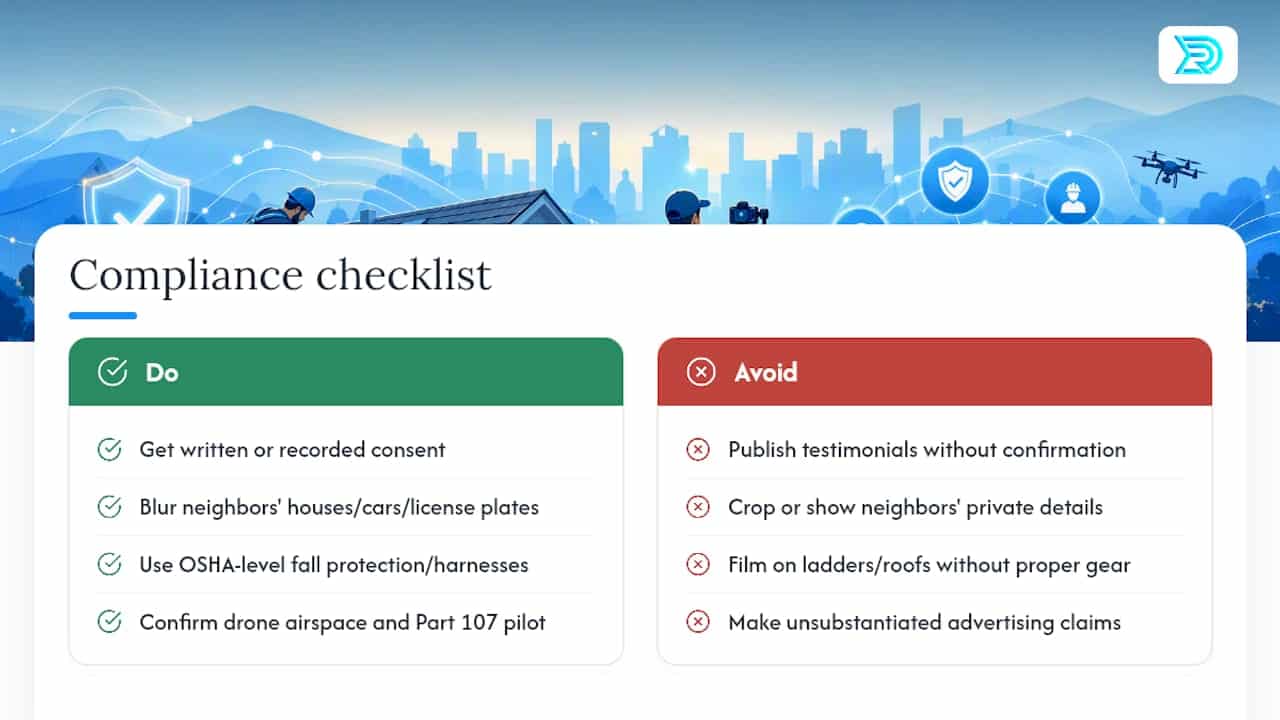
Get written or recorded verbal consent before filming a homeowner’s property, face, or voice for marketing use. A quick release, even a text message confirmation, protects you if a customer later objects to being featured. Never publish a testimonial without that confirmation, and never crop in a neighbor’s house, car, or license plate without blurring it.
Roof access carries its own liability. Anyone filming from a ladder or roof surface needs the same fall-protection gear OSHA requires for the trade itself; a phone in one hand is not an excuse to skip harnesses on steep or high pitches. If you use a drone, check local airspace restrictions near airports and confirm your pilot holds an FAA Part 107 certificate for commercial use.
Advertising claims need to hold up, too. If a video implies a specific price, timeline, or warranty term, that claim needs to match what’s in your actual contract. The Federal Trade Commission treats exaggerated or unsubstantiated advertising claims as deceptive regardless of the medium, and a viral video makes a bad claim spread faster, not slower.
Displaying your license number, insurance carrier, and any manufacturer certification directly on screen, not just in a caption, removes a major point of hesitation for homeowners doing due diligence. Skip this and you’ll lose comparison-shopping customers who never tell you why they went with a competitor.
Finally, if a testimonial mentions specific dollar figures or insurance settlement amounts, confirm the homeowner is comfortable with that detail being public before you publish.
Storytelling Techniques That Resonate With Roofing Customers
Roofing customers aren’t buying shingles. They’re buying peace of mind after the worst storm of the year, or relief from a leak that’s been dripping into a bedroom ceiling for weeks. Stories that acknowledge that emotional starting point outperform stories that jump straight to the technical fix.
Structure every customer-facing video around a before, during, and after arc, even in 30 seconds. Open on the problem exactly as the homeowner experienced it: water stains, missing shingles, a tarp flapping in the wind. Show the crew’s actual process, even briefly. Close on the homeowner’s reaction, not just the finished roof.
Specificity beats polish. A testimonial that says “they were great” gets scrolled past. A testimonial that says “they had a tarp on my roof within four hours of my call and the full job done in two days” gets remembered, because it answers the exact fear a storm-damaged homeowner is Googling at midnight.
Avoid stock language like “quality craftsmanship” and “customer satisfaction” in your voiceovers. Homeowners have heard those phrases from every contractor who ever knocked on their door. Let the crew talk the way they actually talk on a job site, and let the customer describe the experience in their own words rather than reading a script you wrote for them.
Using Customer Personas to Guide Your Video Content
Not every homeowner watching your videos wants the same thing, and treating them identically wastes footage you already have.
The storm-response persona is reacting to damage right now. This person wants speed, insurance guidance, and proof you’re licensed and insured, delivered in under 30 seconds with the phone number visible immediately. Long explainer content is wasted on this viewer; they’re deciding who to call in the next ten minutes.
The planned-replacement persona is researching over weeks or months. This person wants education: material comparisons, warranty explanations, financing options, and a sense of your company’s reputation over time. Longer YouTube content and detailed process videos serve this persona far better than a quick Reel.
The referral-driven persona already trusts you before watching anything. A neighbor sent them your Facebook page. Team and community videos matter most here, because this viewer is confirming a decision they’ve mostly already made, not shopping around.
Build a simple map: which video formats serve which persona, and which platform each persona actually uses. A homeowner in an insurance dispute is unlikely to be scrolling TikTok for that answer; they’re searching Google or watching YouTube. Match the content and the channel to the mindset, not just the season.
Making Video Work With Your Other Marketing
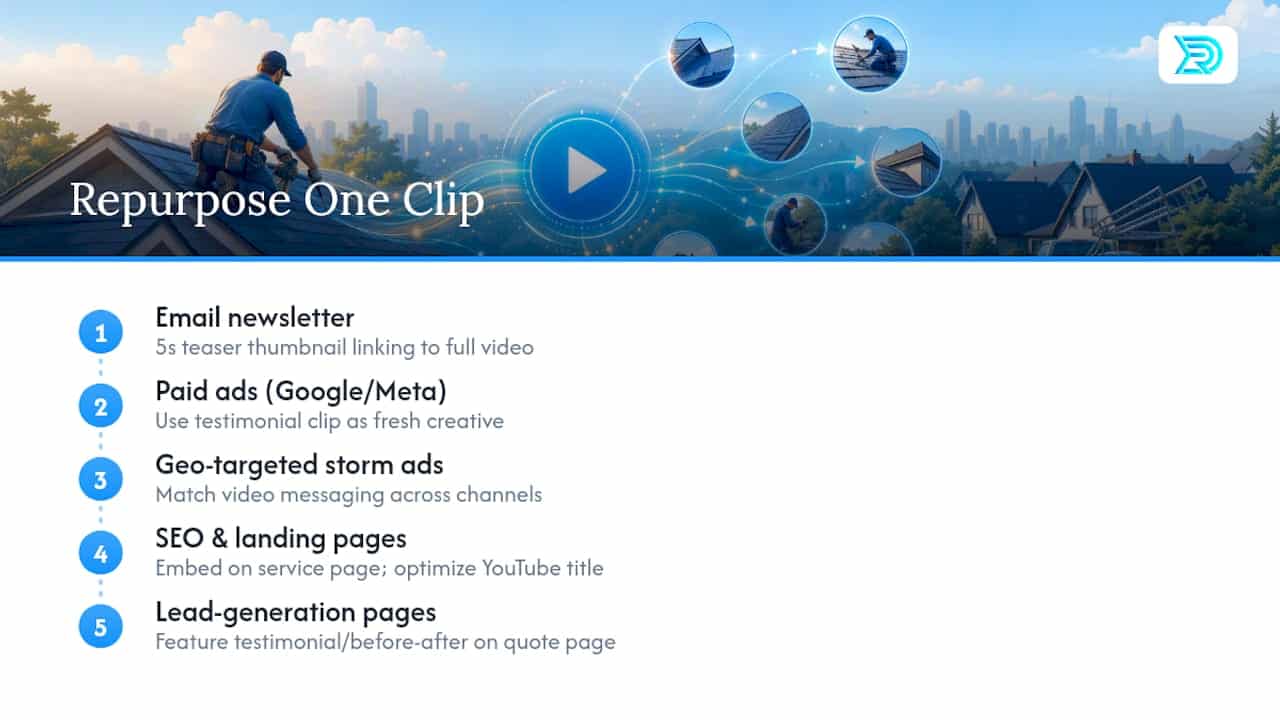
Video performs best when it isn’t standing alone; integrating your video content into a broader contractor brand awareness strategy amplifies its impact and reach. Treat every clip you batch as raw material for at least three other channels.
Drop a still frame or a 5 second teaser clip into your monthly email newsletter with a link back to the full video on your website; email subscribers who click video thumbnails tend to engage far more than those clicking plain text links. Feed the same testimonial clip into your Google and Meta ad accounts as a low-cost creative refresh, since ad platforms tend to reward newer creative with better delivery. Pair a storm-response video with a matching geo-targeted paid campaign the same week, so a homeowner searching for storm repair sees consistent messaging across search ads, Facebook, and YouTube.
Your video and your SEO strategy should also reinforce each other directly. Embedding video on a service-area landing page increases average time on page, a signal that helps that page rank, and a well-optimized YouTube title targeting a specific repair question can rank in Google’s video results independently of your website. That’s two shots at page one search visibility from a single piece of content.
Finally, loop testimonial and before/after footage back into your lead generation funnel by featuring it directly on your quote-request or scheduling page, where a hesitant homeowner is deciding whether to submit their information.
The Author’s Quick-Start Priority List
Week 1: record one before/after clip and one testimonial. Upload both to Google Business Profile and YouTube with your phone number in the description.
Month 1: build the 60-minute batching routine, add direct-dial calls to action to every clip, and test a small local ad running one of your best videos.
The mistake that sinks more roofing videos than bad lighting ever will: leaving out the license number, insurance details, or manufacturer certification on screen. Homeowners are quietly checking, even when they don’t ask out loud.
— Results
Get Your Roofing Video Strategy Built and Running
Batching your own footage gets you started, but turning those clips into a consistent lead pipeline takes ad management, landing page optimization, and tracking most contractors don’t have time to run alongside actual roofing work. Resultsdigitalus builds video-driven landing pages, manages YouTube and Meta ad accounts, and sets up the conversion tracking that tells you which clip is actually generating calls, not just views.
Because Resultsdigitalus partners with only one contractor per trade per market, the campaigns built around your video content aren’t competing against a rival roofer’s budget in the same city. There’s no long-term contract locking you in either; the relationship gets renewed monthly based on results. If you’re ready to turn your batched footage into a real lead pipeline, start with a free digital marketing strategy call and get a plan built around your market specifically.
Sources
- Statista — Global social networks ranked by number of users
- Neil Patel — Roofing marketing guide
- Versely — Roofing company video marketing with AI
