
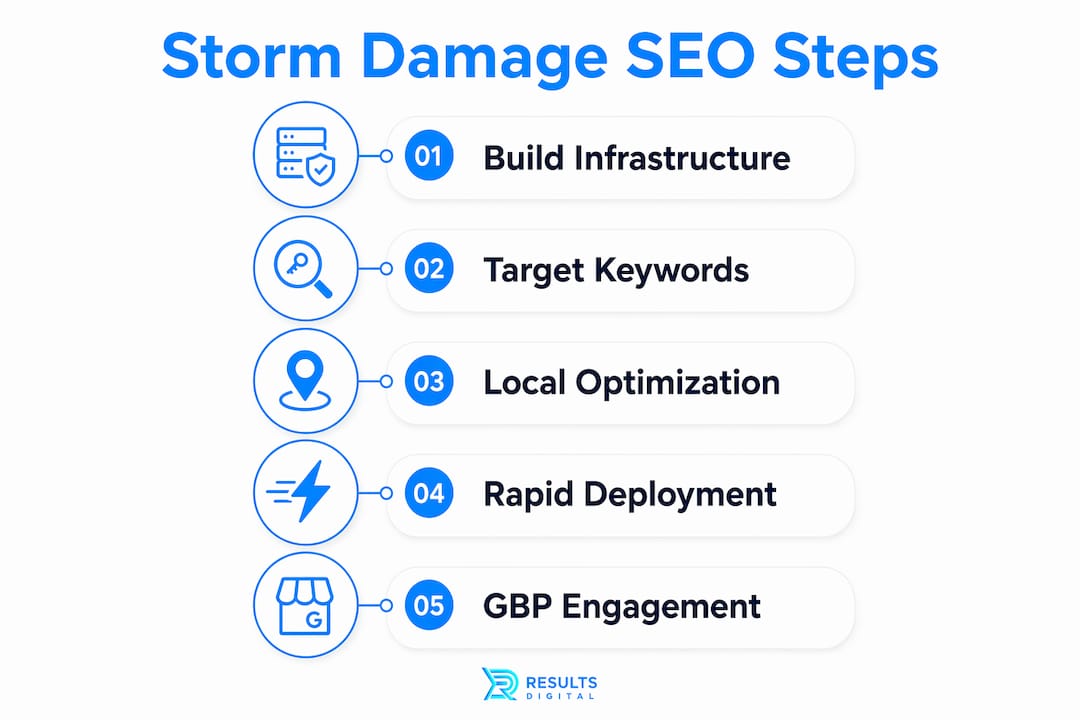
Ranking for storm damage searches comes down to three things you either have built before the storm hits or you don’t: hyperlocal service area pages targeting emergency and insurance keywords, a fully active Google Business Profile that posts weekly, and storm-responsive content you can publish within 24 hours of a weather event. Contractors who own the Local Map Pack when a hailstorm rolls through a zip code capture the majority of leads. The ones scrambling to build landing pages after the fact are chasing a window that’s already closing.
Here’s what the winning playbook looks like in practice:
- Hyperlocal service area pages for every city and neighborhood you serve, written specifically for that market, not templated copy with the city name swapped in
- An optimized Google Business Profile with weekly posts, geotagged photos, and an active Q&A section that answers storm damage questions before competitors do
- Storm-responsive content published within 24 hours of a confirmed weather event in your market, targeting searches like “hail damage roof inspection [city]”
- Insurance claim keyword clusters targeting high-intent searches like “roof insurance claim denied” and “hail damage roof claim [state]” that convert far better than generic roofing terms
- Steady-state local SEO running year-round so your Google Ads account tenure, GBP authority, and review velocity are already built when storm season hits
- Paid ads and SMS campaigns triggered by real-time storm data from tools like NOAA Storm Events and commercial hail trackers, activated within hours of a confirmed event
The contractors who dominate storm damage searches didn’t build that infrastructure the week of the storm. They built it in January.
How do homeowners search for roofers after a storm?
The search behavior shift after a major storm is dramatic and fast. Search volume spikes significantly within 48 hours of a hail or wind event, and that window is where the majority of leads are won or lost. A homeowner who woke up to dented gutters and missing shingles isn’t browsing. They’re searching with urgency, and they’re calling the first contractor they trust.
The queries homeowners run fall into three distinct categories. The first wave is damage assessment: “hail damage roof inspection [city],” “signs of hail damage on roof,” and “wind damage roof [city].” The second wave, which arrives 24–72 hours later, is insurance-driven: “how to file a roof insurance claim,” “roof insurance claim process,” and “what does homeowners insurance cover for roof damage.” The third wave, often the highest-converting, is claim complication: “roof insurance claim denied,” “insurance adjuster lowballed roof estimate,” and “roof claim supplement [city].”
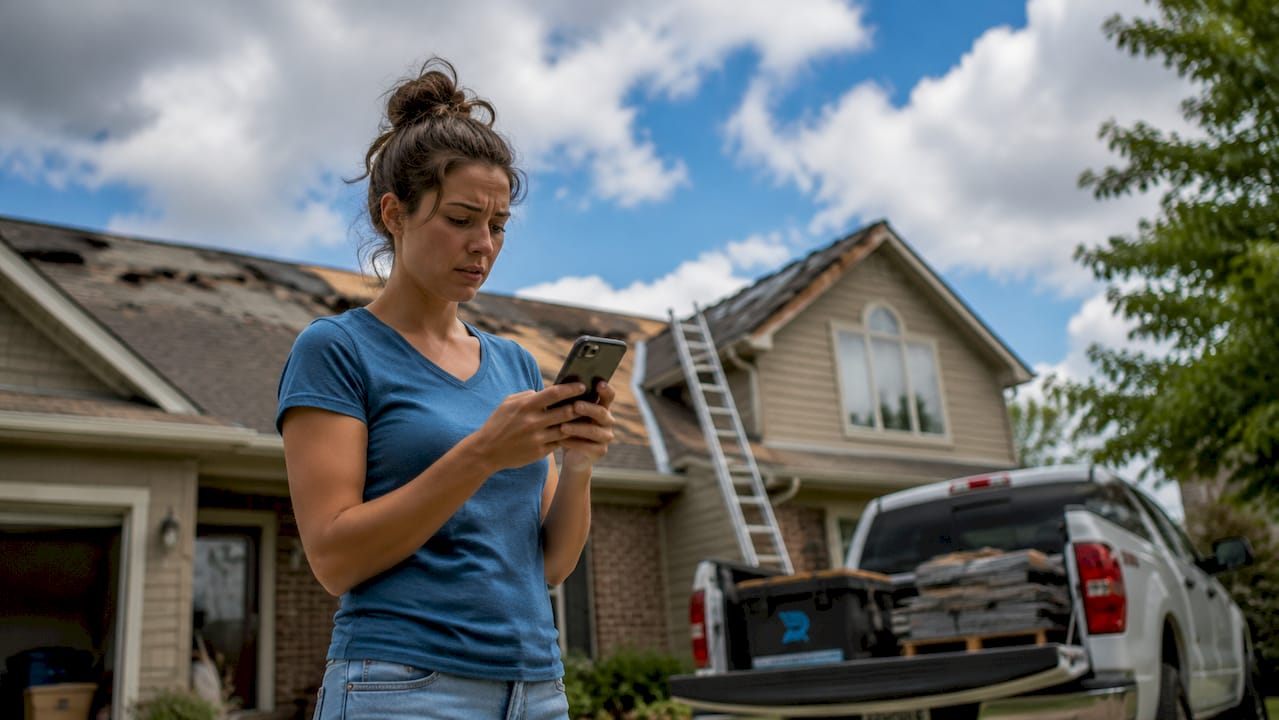
The revenue at stake makes this worth understanding precisely. A mid-sized roofing shop can book $400,000–$1.2M in 30 days after a hailstorm, with insurance replacements closing at 45–65%, roughly three times the rate of non-storm leads. That close rate difference justifies building your entire SEO infrastructure around capturing these searches.
| Search Category | Example Queries | Search Intent |
|---|---|---|
| Damage assessment | “hail damage roof inspection Dallas,” “signs of hail damage on roof” | Informational, high urgency |
| Emergency repair | “emergency roof repair near me,” “storm damage roof repair [city]” | Commercial, immediate |
| Insurance filing | “how to file roof insurance claim,” “roof claim process [state]” | Informational, high intent |
| Claim complications | “roof insurance claim denied,” “adjuster lowballed roof estimate” | Transactional, highest converting |
| Contractor selection | “best roofer for storm damage [city],” “hail damage roofer near me” | Transactional |
Timing is everything. A “Plano hail damage roof inspection” page published Wednesday morning after a Tuesday storm captures searches from homeowners who are still in the assessment phase. Wait a week and the storm chasers have already run $50,000 in Google Ads and knocked every door in the affected zip code.
What SEO strategies actually work for roofing companies targeting storm damage leads?
The core of roofing SEO strategies for storm damage isn’t complicated, but most contractors skip the parts that require real work. Here’s what actually moves the needle:
-
One service area page per city, not a list. The biggest mistake roofers make is a single “service areas” page that lists 40 cities in bullets. Google ranks that page for nothing. Each city needs its own 800–1,500 word page written for that specific market, referencing local neighborhoods, permit requirements, and roof types common to that area.
-
Storm damage content published fast. Storm-response content needs to go live within 24 hours of a weather event. That means having page templates ready, not starting from scratch when the storm clears. A well-optimized “hail damage roof repair [city]” page published the morning after a storm captures searches for months and years of future storm seasons.
-
Insurance claim content as a dedicated cluster. Search “roof insurance claim denied” and look at who ranks: public adjusters, law firms, and content farms. Almost no actual roofers. That’s a gap you can own. Each insurance-related query deserves its own 1,200–2,000 word page written from a contractor’s perspective, covering how to document damage, how to read a Xactimate estimate, and what to do when an adjuster pushes back.
-
Google Business Profile fed weekly. Profiles with 100+ photos generate 520% more calls than profiles with fewer than 10. Weekly posts, geotagged job site photos, and active Q&A management are what separate the contractors ranking in the Map Pack from those buried on page two. These are key components emphasized in Roofer SEO Services that boost local storm damage SEO through strategic use of location-tagged roofing photos.
-
Technical SEO that doesn’t slow you down. Your site needs to load fast on mobile, period. A homeowner searching from their driveway after a storm isn’t waiting for a slow page. Structured data markup using Schema.org LocalBusiness and Service schemas helps Google understand your service areas and offerings without ambiguity.
-
Before/after project galleries with location data. Every job site photo you upload with EXIF location data is a piece of original content no competitor can copy. These galleries feed your GBP photo count, supply your service area pages with unique imagery, and build the visual proof that converts a searcher into a caller.
The honest math on timeline: service area pages take 4–8 weeks to index and start ranking on long-tail terms. Map Pack improvements show up faster, often within 4–12 weeks, if you fix GBP fundamentals immediately. Anyone promising storm damage leads in 30 days is selling Google Ads dressed up as SEO.
How does local SEO drive storm damage lead volume for roofers?
Local SEO for roofers is won or lost in the Google Local Map Pack. That three-business box at the top of search results for queries like “roofer near me” or “roofing contractor [city]” is where the phone calls come from. Getting there and staying there requires consistent attention to four specific signals.

NAP consistency is the foundation. Your business name, address, and phone number must match exactly across every directory listing: Google Business Profile, Yelp, Angi, HomeAdvisor, the BBB, and every local citation source. A single inconsistency, like a suite number formatted differently, creates a trust gap that suppresses your local rankings. Audit your citations quarterly and fix discrepancies immediately.
Review velocity and recency matter more than total review count. Two reviews per week beats 200 reviews from five years ago. The contractors hitting the Map Pack consistently are the ones who have a system for asking every customer for a review within 24 hours of job completion, not the ones who ask occasionally and hope for the best.
GBP photo uploads and posts are the most underused ranking lever in local roofing SEO. Most roofers have never written a single Google Post. The ones who post weekly about recent jobs, seasonal tips, and neighborhood-specific work outrank them within 90 days. Upload geotagged photos from every job site, every before/after, every crew shot.
The Q&A section is where you can preemptively own the conversation. Add your own questions and answers covering storm response time, insurance claim assistance, and service area coverage. If you don’t fill it, competitors or random users will, often with wrong information.
- Claim and verify your GBP with a physical address or service area designation
- Add all relevant secondary categories, including “Storm damage restoration service” and “Roof inspection service”
- Set business hours to reflect 24/7 availability during storm season
- Respond to every review, positive and negative, within 48 hours
- Post a GBP update naming the specific storm within hours of a major weather event
Pro Tip: Disciplined weekly GBP updates, including at least one new post and three to five geotagged photos per week, consistently produce Local Map Pack ranking improvements within 90–180 days. Set a recurring calendar block every Monday morning and treat it like a job site visit.
Local citations from directories like the BBB, Angi, and local Chamber of Commerce sites don’t directly move rankings the way they once did, but they reinforce NAP consistency and build the trust signals Google uses to verify your business is legitimate and active in the area you claim to serve.
What advanced keyword strategies help roofers capture storm damage searches?
Generic roofing keywords like “roof repair” and “roofing contractor” are competitive and expensive. The contractors capturing the highest-converting storm damage leads are targeting a different layer of search intent entirely.
Insurance claim terms like “roof insurance claim denied” and “hail damage roof insurance claim [state]” convert at far higher rates than generic roofing searches. The homeowner running that query has a specific, urgent problem and money on the line. They’re not browsing. Few roofers create expert content on insurance claims, which means the ranking opportunity is wide open for those who do.
| Keyword Type | Example Terms | Intent Level | Conversion Potential |
|---|---|---|---|
| Generic roofing | “roofing contractor,” “roof repair near me” | Moderate | Moderate |
| Storm damage focused | “hail damage roof repair [city],” “storm damage roof inspection” | High | High |
| Insurance claim related | “roof insurance claim denied,” “how to file roof claim with State Farm” | Very high | Very high |
| Emergency repair | “emergency roof repair [city],” “roof tarping near me” | Immediate | Highest |
| Supplement claims | “roof claim supplement [city],” “adjuster lowballed roof estimate” | Very high | Very high |
The keyword clusters that convert best after a storm:
- “hail damage roof inspection [city]”
- “roof insurance claim denied what to do”
- “how to file roof claim with [State Farm / Allstate / USAA]”
- “insurance adjuster lowballed roof estimate”
- “storm damage roof inspection [city]”
- “roof claim supplement [city]”
- “[state] hail damage roof insurance claim”
- “emergency roof repair [city]”
- “wind damage roof [city]”
Each of these deserves its own dedicated landing page, not a paragraph buried in a generic storm damage post. A 1,200–2,000 word page written from the contractor’s perspective, with a click-to-call button above the fold, a homeowner-rights primer, and a clear next step, is what actually ranks and converts.
Long-tail local modifiers are where you win without fighting storm chasers dollar for dollar. “Hail damage roof inspection Frisco TX” is far less competitive than “hail damage roof repair Dallas” and converts at a higher rate because the searcher is already in your exact service area. Build pages for every suburb and neighborhood you actually work in, not just the metro.
Pro Tip: Build your storm damage landing pages before storm season, not after. URLs like /storm-damage-roof-inspection-[city]/ need to be live and indexed before the next hailstorm. A page published the day of a storm takes weeks to rank. A page that’s been live for six months ranks the morning after.
Rapid content deployment is the multiplier. Geo-targeted Google Ads within 24–72 hours of storm events produce 3–5 times higher click-through and conversion rates than standard roofing ads. Pair those ads with landing pages that are already indexed and you’re capturing both paid and organic traffic from the same storm event.
How should you optimize your Google Business Profile for storm damage searches?
Your Google Business Profile is the primary battlefield for storm damage SEO. When a homeowner searches “roofer near me” from their driveway after a hailstorm, the Map Pack result they see and call is determined almost entirely by GBP signals. Businesses with complete Google Business Profiles receive 70% more visits and 35% higher click-through rates than incomplete profiles.
The methodology that produces Map Pack dominance within 90–180 days follows a disciplined weekly rhythm:
- Weekly posts aligned with storm season. During active weather months, post storm-specific content: recent hail damage jobs, insurance claim tips, and neighborhood-specific work. During quiet quarters, post project galleries, seasonal maintenance advice, and local community content. Consistency beats volume.
- Geotagged photos from every job site. Upload at least three to five photos per week. Before/after shots, crew photos, drone footage of damage, and completed repair photos all count. The EXIF location data embedded in job site photos tells Google exactly where you’re working.
- Active Q&A management. Add your own questions and answers before competitors or random users do. Cover storm response time, insurance claim assistance, what to expect during an inspection, and your service area. Update these answers seasonally.
- Storm-specific GBP posts within hours of a major event. Name the specific storm, list the neighborhoods you’re actively servicing, confirm your 24-hour availability, and include a click-to-call link. A profile that names the exact storm signals relevance to Google and reassures homeowners that you’re already on the ground.
- Review requests tied to job completion. Ask for a review within 24 hours of finishing every job. Respond to every review within 48 hours. Review recency is a direct ranking signal.
- Service categories that reflect storm work. Add “Storm damage restoration service,” “Roof inspection service,” and “Emergency service” as secondary categories if they apply to your business.
Pro Tip: Treat your GBP like a job site, not a set-it-and-forget-it listing. The Google Business Profile is the single fastest path to Local Map Pack visibility for storm damage searches. Contractors who post weekly and upload photos consistently outrank competitors with better websites but dormant profiles.
GBP activity and local citations work together. Every consistent NAP mention across Angi, HomeAdvisor, and local directories reinforces the trust signals Google uses to validate your GBP. Think of citations as the foundation and GBP activity as the structure built on top of it. You need both, but the GBP is where the ranking gains show up fastest.
Comparing roofing SEO service approaches for storm damage lead generation
Not all roofing SEO services are built the same, and the difference shows up most clearly when a storm hits your market. A specialized service built around storm damage lead generation operates on a fundamentally different model than a generic local SEO agency that happens to take roofing clients.
| Feature | Standard Roofing SEO Service | Generic Local SEO Agencies |
|---|---|---|
| Best for | Roofers focused on storm damage and insurance lead generation | Businesses needing general local SEO without emergency focus |
| Storm damage keyword focus | Dedicated insurance claim clusters, emergency repair pages, storm-responsive content | Limited; generic roofing terms only |
| Google Business Profile optimization | Weekly posting, geotagged photos, Q&A management, storm-event updates | Basic profile setup; sporadic updates |
| Local SEO and citation management | Hyperlocal service area pages per city, NAP audits, citation building | Standard citation building; templated service pages |
| Content and topical authority | Original project galleries, insurance claim guides, storm-specific landing pages | Generic blog posts; no storm-responsive publishing |
| Lead generation effectiveness | High; captures high-intent insurance and emergency searches | Moderate; misses storm-window traffic spikes |
The Standard Roofing SEO Service model is built around the reality that storm damage leads close at 45–65%, roughly three times the rate of non-storm leads. That close rate justifies a content and GBP strategy built specifically around capturing those searches. Insurance claim pages, storm-responsive content published within 24 hours of an event, and weekly GBP management are standard deliverables, not add-ons.
Generic local SEO agencies bring real value for businesses that need broad local visibility across multiple service categories. For a roofer whose peak revenue comes from storm seasons, though, the lack of storm-specific keyword expertise and the absence of rapid content deployment capabilities are genuine gaps. A generic agency won’t have insurance claim content templates ready to publish the morning after a hailstorm. A specialized service will.
The integrated GBP management piece is where the gap is widest. Weekly posting, geotagged photo uploads, and storm-event GBP updates require someone who understands roofing seasonality and can move fast when weather events hit. That’s a different skill set than managing a Google Business Profile for a restaurant or retail store.
How do you choose the right SEO partner for storm damage lead growth?
Choosing an SEO partner for storm damage lead generation is a different decision than hiring a general marketing agency. The wrong choice costs you the storm window, which can mean missing $400,000–$1.2M in bookings from a single hail event. Ask the right questions before you commit.
- Do they have storm-responsive content capabilities? Can they publish a city-specific storm damage page within 24 hours of a weather event? Ask to see examples of content published post-storm for current clients.
- What does their GBP management actually include? Weekly posting and geotagged photo uploads are the minimum. If their answer is “we set it up and monitor it,” that’s not management.
- Can they show you keyword research specific to insurance claims? Terms like “roof insurance claim denied” and “roof claim supplement [city]” should be in their keyword strategy. If they’re only targeting “roof repair [city],” they’re leaving the highest-converting searches on the table.
- Do they have proven ROI in roofing or home services? Ask for case studies with specific metrics: lead volume, cost per lead, and revenue growth tied to SEO. Vague references to “improved rankings” aren’t enough.
- How do they handle the steady-state vs. storm-response balance? The right answer is both. A partner who focuses only on storm content will leave you dark for the 30 months between major events. One who ignores storm-specific strategy misses your highest-revenue window.
- Do they work exclusively with one roofer per market? An agency managing two competing roofers in the same city has a conflict of interest that will eventually cost you leads.
Tips on alignment and readiness:
- Confirm they understand your specific service area geography, not just your primary city
- Ask whether they have storm data monitoring in place or can integrate with tools like NOAA Storm Events
- Verify they can produce original content with your project photos, not stock imagery
- Check that their roofing marketing approach includes Google Business Profile as a primary deliverable, not an afterthought
- Ask specifically about their timeline for Map Pack ranking improvements and what milestones they track
The contractors who scale fastest pair a specialized SEO partner with their own commitment to feeding the system: photos from every job, review requests after every project, and quick approvals on storm-response content. The agency can build the infrastructure, but the raw material comes from your crews in the field.
Key Takeaways
Roofing contractors who rank for storm damage searches build their SEO infrastructure before storm season, maintain it through quiet quarters, and activate it within hours of a confirmed weather event.
| Point | Details |
|---|---|
| Storm window revenue is massive | A mid-sized roofing shop can book $400,000–$1.2M in 30 days after a hailstorm, with insurance leads closing at 45–65%. |
| GBP is the primary ranking lever | Profiles with many photos generate significantly more calls; weekly posting produces Map Pack gains within a few months. |
| Insurance keyword clusters convert best | Terms like “roof insurance claim denied” and “roof claim supplement [city]” outperform generic roofing searches in conversion rate. |
| Steady-state SEO funds the storm response | Year-round local SEO builds the GBP authority and LSA account tenure that captures storm traffic when it spikes. |
| Resultsdigitalus | A veteran-owned agency built exclusively for roofing contractors, offering specialized storm damage SEO, GBP management, and no long-term contracts. |
Why specialized roofing SEO outperforms generic marketing for storm damage
The conventional wisdom in contractor marketing is that any good SEO agency can handle roofing. That’s wrong, and the gap shows up most clearly in the 48-hour window after a storm.
Generic marketing lacks the storm-season search behavior knowledge that makes the difference between capturing a lead and missing it. A generalist agency doesn’t know that “roof insurance claim denied” converts better than “storm damage roof repair.” They don’t know that a GBP post naming the specific storm event signals relevance to Google in a way that a generic “we handle storm damage” post doesn’t. They don’t have insurance claim content templates ready to publish the morning after a hailstorm. These aren’t minor gaps. They’re the difference between owning the storm window and watching a storm chaser take your leads.
Specialized roofing SEO integrates Google Business Profile expertise, insurance claim content, and storm-responsive publishing into a single system. Each piece reinforces the others. The GBP authority built through weekly posting makes your storm-event updates rank faster. The insurance claim pages you publish during quiet months rank for the high-intent searches that spike after every storm. The service area pages you built for every suburb capture the long-tail searches that storm chasers can’t replicate in two weeks.
The risks of generic marketing are real and specific:
- No storm-responsive content capability means you miss the 300–800% search spike in the first 48 hours
- Sporadic GBP management means competitors with disciplined weekly updates outrank you in the Map Pack
- No insurance claim keyword strategy means you’re invisible for the highest-converting searches in roofing
- Templated service area pages rank for nothing and waste your crawl budget
The contractors who build sustainable lead volume combine steady-state local SEO with a storm-response system that’s ready to activate on two hours’ notice. That’s not something a generic agency builds. It requires deep familiarity with roofing seasonality, insurance claim processes, and the specific search behaviors of homeowners in crisis. Specialized expertise isn’t a premium; it’s the baseline for competing in storm damage markets.
Resultsdigitalus builds roofing SEO that performs when storms hit
Most roofing contractors are flying blind when storm season arrives. Their GBP is stale, their service area pages are generic, and their insurance claim content doesn’t exist. Resultsdigitalus was built to fix exactly that.
Founded in 2015 in Montgomery, Texas, Resultsdigitalus is a veteran-owned agency that works exclusively with roofing contractors, gutter companies, siding contractors, and general contractors across the United States. Every strategy, keyword, and campaign is built for contractor lead generation, not adapted from a generic playbook. The exclusivity model means we partner with only one roofing company per market, so your SEO, Google Ads, and GBP management work solely for you. No long-term contracts. We earn your business every month.
The results are concrete: we helped a Florida roofing company grow from 3 crews to 18 before selling for $60 million. If you’re ready to own your market’s storm damage searches, talk to our roofing SEO team and find out what’s possible in your specific market.
