
Roofing website conversion rate optimization is the practice of improving your site so more visitors become leads and paying customers, without spending more on ads. The average contractor website converts at roughly 2.8%, meaning 97 out of every 100 visitors leave without contacting you. That number is not fixed. With the right fixes to speed, contact clarity, landing page messaging, and form design, roofing contractors routinely double or triple their lead volume from the same traffic. Tools like Google PageSpeed Insights, Core Web Vitals, and interactive quoting widgets from platforms like GeoQuote.ai are now central to any serious conversion strategy.
How does roofing website conversion rate optimization work?
Roofing website conversion rate optimization, known in digital marketing as CRO, is the structured process of identifying where visitors drop off and fixing those friction points. Your roofing conversion rate is the percentage of site visitors who complete a desired action, such as calling, submitting a form, or requesting an estimate. Most roofing sites bleed leads at three predictable points: slow load times, buried contact options, and landing pages that do not match what the visitor was searching for.
The good news is that CRO does not require more ad spend. You fix the site, and the same traffic produces more calls. Resultsdigitalus has seen this pattern repeatedly with roofing clients across the country. The contractors who treat their website as a sales tool, not a digital brochure, consistently outperform competitors spending twice as much on Google Ads.

What website speed factors kill roofing conversions?
Speed is the single most controllable conversion variable on your site. 53% of visitors abandon roofing pages that take longer than 3 seconds to load on mobile. That abandonment directly inflates your Google Ads cost per lead, because you are paying for clicks that never convert.
Google measures site performance through Core Web Vitals, a set of three metrics every roofing contractor should know:
- LCP (Largest Contentful Paint): How fast your main content loads. Target 2.5 seconds or less.
- INP (Interaction to Next Paint): How fast the page responds to a tap or click. Target under 200ms.
- CLS (Cumulative Layout Shift): How much the page jumps around while loading. Target below 0.1.
Fix these in a specific order. Start with TTFB (Time to First Byte), which is your server response time. A slow server makes every other fix less effective. After TTFB, address LCP. Roofing sites are image heavy, and the hero image is almost always the LCP element. Use preload tags for that image and reduce render-blocking JavaScript. Then address INP and CLS.
Google PageSpeed Insights data shows that sites loading under 2 seconds have a 9% bounce rate, while 5-second load times push bounce rates to 38%. That gap represents real leads walking out the door. Expect 4–6 weeks for Core Web Vitals improvements to show up in Google’s CrUX data after you make changes.
Pro Tip: Run your roofing site through Google PageSpeed Insights on mobile, not desktop. Mobile is where most homeowners search after a storm, and mobile scores are almost always worse.
How does contact visibility affect roofing lead volume?
Contact placement is not a design preference. It is a conversion decision. 64% of roofing site visitors expect to find contact information above the fold without scrolling. If your phone number is buried in the footer, you are losing more than half your potential callers before they even try.
Click-to-call buttons in the header convert 30–45% better than form-only approaches. On mobile, a tappable phone number in the header is the single highest-ROI element you can add to a roofing site. Here is what your mobile header should include:
- A click-to-call phone number in large, readable text
- A short CTA button like “Get a Free Estimate” that links directly to your form or quote page
- Your company name and logo for immediate brand recognition
Project photo galleries also belong above the fold or in the first scroll. Real photos of completed roofs in your service area build trust faster than any headline. Homeowners want proof that you work in their neighborhood and do quality work. A gallery of 10 to 15 local project photos on the homepage directly supports conversion by reducing skepticism before the visitor ever reaches your form.
Statistic to know: Roofing sites with click-to-call in the header consistently outperform those without it by 30–45% in conversion rate. That is not a marginal gain. That is the difference between 10 leads a month and 14.
Why does landing page message match matter for roofing leads?
Message match is the alignment between what your ad or search result promises and what the visitor sees when they land on your page. Poor message match reduces credibility and conversion immediately. A homeowner who clicks a Google Ad for “emergency storm damage repair” and lands on a generic homepage about all roofing services will bounce within seconds.
Effective roofing landing pages are built around the visitor’s immediate problem. A storm damage page should open with a headline like “Storm Damage in [City]? Get a Free Inspection Today.” The hero copy, CTA, and trust signals all reinforce that single message. Nothing on the page should distract from the next step.
Here is what a high-converting roofing landing page includes:
- Headline: Matches the ad or search term exactly, naming the service and location
- Hero copy: One to two sentences explaining what happens next after they contact you
- CTA: One clear action, not three options competing for attention
- Trust signals: License number, insurance badge, Google review count, and years in business
Vague promises kill conversions. “Quality roofing at great prices” tells a homeowner nothing. “Licensed, insured, and serving City] since 2009 with 200+ five-star reviews” tells them everything they need to decide. Operational follow-up is also part of CRO. [Slow callback breaks the conversion chain even after a visitor submits a form. If your team does not respond within 5 minutes during business hours, you lose the lead to a competitor who does.
Pro Tip: Build separate landing pages for each major service and each city you serve. A page targeting “roof replacement in Houston” will always outperform a generic homepage for that search.
How should roofing site forms be designed to get more submissions?
Form length is one of the most studied variables in CRO, and the data is clear. One-field forms convert at 18.2%, three-field forms drop to around 11.5%, five fields fall to 8.1%, and nine or more fields collapse to 4.2%. Every field you add costs you submissions.
For roofing sites, the optimal short form asks for name, phone number, and ZIP code. That is enough to route the lead and qualify the service area. Push all other qualification questions to the follow-up call. The goal of the form is to get contact information, not to pre-screen every lead before a human talks to them.
| Form Type | Avg. Conversion Rate |
|---|---|
| One field | 18.2% |
| Three fields (name, phone, ZIP) | ~11.5% |
| Five fields | ~8.1% |
| Nine or more fields | 4.2% |
| Interactive AI/satellite widget | 8–15% |
Interactive quoting tools change the dynamic entirely. Satellite estimate widgets reduce bounce rates by 40–62% by engaging homeowners before asking for contact details. Platforms like GeoQuote.ai let visitors see a roof measurement and rough estimate first, which builds enough trust that they willingly submit their information. These tools push average conversion rates to 8–15%, compared to the industry baseline of 2.8%.
Pro Tip: Never require an email address on your primary roofing form. Phone converts faster, and most homeowners prefer a call over email when dealing with roof damage or replacement.
Which trust signals actually increase roofing website conversions?
Trust is the conversion factor that most roofing websites underinvest in. Design polish does not build trust. Proof does. Photo-driven project galleries with 25 or more real photos increase lead close rates 2–3x compared to sites using stock imagery. Homeowners want to see your actual work, not a generic photo of a roof from a stock library.
Good website design produces 3x more roofing leads than a poorly structured site, but design alone does not close the gap. The content inside the design matters more. Here is what actually builds trust on a roofing site:
- Real project photos with location tags or neighborhood names
- Google review count and average rating displayed prominently near the top of the page
- License and insurance information listed clearly, not buried in a footer
- Service area map or city list so visitors confirm you work in their area
- Named team members or the owner’s photo to put a face to the company
Simplicity outperforms complexity in roofing site design. A clean page with clear proof points converts better than a visually elaborate site with no social proof. If a visitor cannot find your reviews, your license number, and your phone number within 10 seconds, your design is working against you.
Key takeaways
The most effective roofing website CRO strategy combines fast load times, visible contact options, intent-matched landing pages, short forms, and real social proof to convert more visitors into leads.
| Point | Details |
|---|---|
| Speed is non-negotiable | Sites loading under 2 seconds have a 9% bounce rate; over 5 seconds jumps to 38%. |
| Contact must be above the fold | 64% of visitors expect contact info without scrolling; click-to-call converts 30–45% better. |
| Match the message to the visitor | Landing page headlines must reflect the exact service and location the visitor searched for. |
| Shorter forms get more submissions | Three-field forms outperform nine-field forms by more than double the conversion rate. |
| Real photos outperform stock imagery | Galleries with 25+ project photos increase lead close rates 2–3x over stock image sites. |
What i’ve learned running CRO for roofing contractors
Most roofing contractors come to us focused on getting more traffic. That is the wrong starting point. If your site converts at 2%, doubling your traffic just doubles your waste. The first question we ask every new client at Resultsdigitalus is: “What happens when someone lands on your site at 9 PM on a Sunday after a hailstorm?” The answer is almost always the same. The phone number is small, the form is long, and the page is slow.
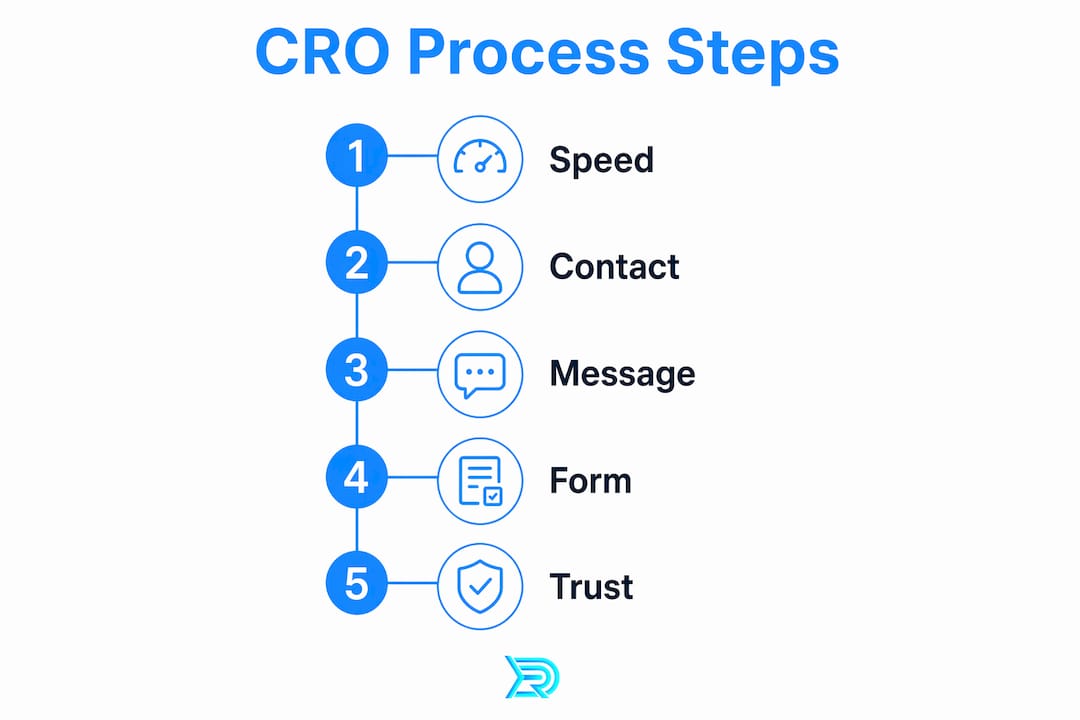
The fix order matters. Speed first, contact clarity second, message match third. Contractors who try to fix messaging before fixing speed are building on a broken foundation. We have seen sites where a single speed fix, specifically reducing TTFB by switching hosting providers, dropped cost per lead by 20% within 60 days. That is money back in your pocket without changing a single ad.
The other thing most articles will not tell you: CRO does not stop at the website. If your office takes 4 hours to call back a form submission, your conversion rate is broken at the operational level, not the digital one. The website gets the lead to raise their hand. Your team has to close the loop fast. We built a roofing lead generation guide specifically around this idea, because the contractors who win are the ones who treat speed of follow-up as seriously as speed of page load.
Interactive tools are the next frontier. Satellite estimate widgets are not a gimmick. They work because they give the homeowner something before asking for anything. That shift in dynamic is powerful, and it is where roofing CRO is heading in 2026 and beyond.
— Results
Ready to turn your roofing site into a lead machine?
Your website should be your best salesperson, working around the clock and converting visitors before your competitors even pick up the phone. Resultsdigitalus builds and optimizes roofing websites specifically for lead generation, not aesthetics. Every site we design is engineered around speed, contact clarity, and message match from day one.
We specialize exclusively in roofing contractors, gutter companies, siding contractors, and general contractors across the United States. That means every strategy we apply comes from real contractor data, not guesswork. From roofing SEO services to Google Ads and custom website design for roofers, we build the full system that turns clicks into calls. No long-term contracts. Just results you can measure every month.
FAQ
What is a good conversion rate for a roofing website?
The average contractor website converts at roughly 2.8%. Interactive estimate tools can push that to 8–15%, which is the benchmark to target with a fully optimized site.
How many form fields should a roofing contact form have?
Three fields (name, phone, and ZIP code) is the proven sweet spot. One-field forms convert at 18.2%, but three fields still deliver strong results while capturing enough data to route the lead.
Does page speed really affect roofing lead generation?
Yes, directly. Sites loading under 2 seconds have a 9% bounce rate, while 5-second load times produce a 38% bounce rate. Slow pages also inflate Google Ads cost per lead by wasting paid clicks.
What is intent matching on a roofing landing page?
Intent matching means your landing page headline and content reflect exactly what the visitor searched for, such as “storm damage repair” or “roof replacement in [city].” Mismatched pages lose credibility and conversions immediately.
How do interactive quoting tools improve roofing conversions?
Satellite estimate widgets engage homeowners before requesting contact details, reducing bounce rates by 40–62%. By showing value first, these tools build enough trust that visitors willingly submit their information.