
Contractor ad targeting needs refining because broad, generic campaigns routinely pay for low-intent clicks that drain budgets without producing booked jobs. The industry term for this problem is audience segmentation failure, and it shows up in every platform from Google Ads to Meta Ads. When your campaigns mix research queries, DIY searches, and service-ready buyers into the same ad group, you pay the same cost per click for all three. Only one of those groups is ready to hire you. This article breaks down exactly why that structure fails, and what a refined targeting strategy looks like in practice.
Why contractor ad targeting needs refining now
The core problem is simple: most contractor campaigns are built for volume, not quality. Broad account structures with mixed intent keywords cause conversion rates to drop by up to 50% or more. That number means half your potential revenue disappears before a single lead picks up the phone.
When a roofing contractor runs a campaign targeting “roof repair,” that keyword captures homeowners with an emergency leak, DIY researchers looking up YouTube tutorials, and renters who cannot hire anyone. Google Ads and Meta Ads charge you for all of them. The fix is not a bigger budget. The fix is separating those audiences at the campaign level.

Audience segmentation, the practice of grouping ads by buyer intent and service type, is the foundation of every high-performing contractor campaign. Without it, you are flying blind. You cannot tell which clicks convert, which keywords waste money, or which audiences actually book jobs.
Generic offers make this worse. Overly broad targeting and generic offers like “free estimates” fail to filter price shoppers, resulting in wasted ad spend and lower ROI. Price shoppers call, take your time, and never sign a contract. Refined targeting filters them out before they click.
What causes poor performance in contractor ad campaigns?
Poor campaign performance almost always traces back to three structural mistakes: mixed intent keywords, missing negative keywords, and no buyer urgency segmentation.
Mixed intent keywords are the biggest budget drain. A campaign targeting “roof replacement” alongside “how long does a roof last” is paying for curiosity, not customers. These queries have completely different conversion potential, and grouping them together pollutes your data and your budget.
Neglecting negative keywords compounds the damage. Skipping negative keywords can waste 15–20% of contractor ad budgets on irrelevant clicks. For a contractor spending $5,000 per month on Google Ads, that is $750 to $1,000 gone every single month with nothing to show for it.
Here is what a refined negative keyword list looks like for a roofing contractor:
- “DIY roof repair”
- “how to fix a roof yourself”
- “roofing jobs near me” (job seekers, not buyers)
- “roof repair cost Reddit”
- “free roofing materials”
No buyer urgency segmentation means you treat a homeowner with a storm-damaged roof the same as someone planning a renovation six months out. Those two buyers need different ad copy, different landing pages, and different bidding strategies.
Pro Tip: Build separate campaigns for emergency service intent (“roof leak repair today”) and planned project intent (“roof replacement quote”). Bid more aggressively on emergency terms because those buyers convert faster and tolerate less friction.
The result of fixing these three issues is not marginal. It is the difference between a campaign that generates 10 leads per month and one that generates 30 at the same spend.
How do retargeting and lookalike audiences improve ad efficiency?
Retargeting and lookalike audiences are the two most underused tools in contractor advertising. Most contractors run cold traffic campaigns and wonder why their cost per lead is high. The answer is that cold audiences require far more touchpoints before they convert.
Retargeting website visitors converts at 3–5 times the rate of cold audiences on Meta platforms. A homeowner who visited your roofing website last week already knows your brand. Showing them a retargeting ad with a specific offer costs a fraction of what it costs to acquire a cold click. You can learn the full setup process for retargeting campaigns to implement this for your own contractor business.
Lookalike audiences take this further. Building 1%–2% lookalike audiences from your actual customer lists drives better efficiency than manual interest targeting. Meta’s algorithm finds homeowners who behave like your best customers, not just people who clicked “interested in home improvement” on a Facebook survey.
Here is what a refined Meta Ads targeting stack looks like for a contractor:
- Layer 1: Retargeting website visitors from the past 30 days
- Layer 2: Retargeting video viewers and lead form openers
- Layer 3: 1% lookalike audience from closed customer list
- Layer 4: Geographic and homeowner demographic targeting for cold traffic
Combining local homeowner targeting and retargeting on Meta Ads delivers significantly better leads than generic interest-based targeting. This is not a theory. It is the consistent result Resultsdigitalus sees across roofing, siding, and gutter contractor accounts.
Speed matters once the lead arrives. Contacting leads within 5 minutes makes them 100 times more likely to convert than waiting 30 minutes. Your retargeting investment is wasted if your follow-up system is slow. Pair refined targeting with a fast response process, and your cost per booked job drops significantly.
What role does campaign structure play in refining targeting?
Campaign structure is where targeting strategy becomes real. A well-structured campaign tells Google Ads and Meta exactly who to show your ads to, and when. A poorly structured one lets the algorithm guess, and algorithms optimize for clicks, not booked jobs.
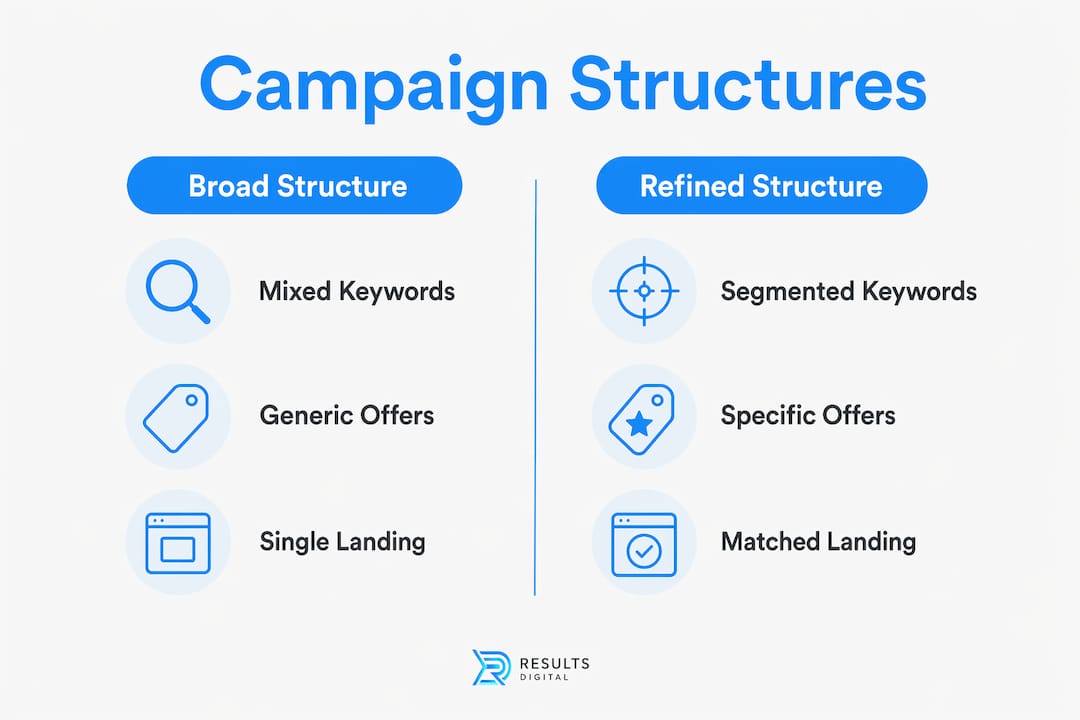
The comparison below shows how broad structure and refined structure perform differently:
| Campaign Element | Broad Structure | Refined Structure |
|---|---|---|
| Keyword grouping | All services in one ad group | Separate ad groups by service type |
| Match types | Broad match only | Phrase and exact match with negatives |
| Landing pages | Single homepage | Service-specific pages with one clear call to action |
| Bidding | Maximize clicks | Target CPA based on booked job data |
| Geographic targeting | Entire metro area | Zip codes with highest close rates |
Landing pages must match keyword intent closely to prevent bounces and boost conversion. Sending a “storm damage roof repair” click to your homepage homepage is a conversion killer. That visitor sees a general company overview when they need an immediate solution. A dedicated landing page with one obvious next step, a phone number and a form, keeps them moving toward a booked estimate.
Long-tail, local intent keywords outperform broad generic terms in both cost and conversion rate. “Emergency roof repair Houston TX” costs more per click than “roof repair,” but it converts at a much higher rate because the buyer intent is explicit. You pay more per click and far less per booked job.
Pro Tip: Feed actual booked job data back into your Google Ads conversion tracking, not just form submissions. The algorithm optimizes toward whatever signal you give it. If you track form fills, it finds form fillers. If you track booked jobs, it finds buyers.
How can contractors balance multi-channel advertising?
No single channel captures every contractor lead. Google Search captures buyers who are ready right now. Meta Ads builds awareness and nurtures homeowners who are not ready yet. SEO captures long-term organic demand. Each channel serves a different stage of the buying process.
31% of consumers hire home service businesses after seeing a social media ad. That statistic shows that Meta is not just a brand awareness play. It is a direct lead generation channel when the targeting is precise. The key is understanding that Meta buyers typically need more nurturing than Google Search buyers.
Successful contractors manage 3–4 concurrent channels for optimal lead flow. Running Google Ads alone creates a feast-or-famine cycle tied to search volume. Adding Meta retargeting, a strong multi-channel marketing approach, and SEO creates a more stable pipeline.
Seasonal adjustments are non-negotiable. Targeting strategies must evolve with business seasonality and current capacity to avoid inefficient spend and missed conversions. A roofing contractor fully booked through August should reduce Google Ads spend and shift budget to brand awareness on Meta. When capacity opens up in September, the retargeting audience is already warm. You can also explore off-season targeting strategies to keep lead flow steady year-round.
The goal is not maximum lead volume at all times. The goal is the right number of leads at the right cost, matched to your actual capacity to close and deliver.
Key takeaways
Refined contractor ad targeting is the single most direct path from wasted ad spend to predictable, high-quality lead generation across Google Ads and Meta Ads.
| Point | Details |
|---|---|
| Segment by buyer intent | Separate emergency, planned project, and research queries into distinct campaigns. |
| Use negative keywords | Removing irrelevant traffic saves 15–20% of ad budget every month. |
| Retarget warm audiences | Website visitors convert at 3–5x the rate of cold traffic on Meta platforms. |
| Match landing pages to intent | Service-specific pages with one clear call to action reduce bounce rates and increase booked estimates. |
| Adjust for seasonality | Scale spend up or down based on booking capacity, not just search volume. |
What we’ve learned running contractor ads at scale
At Resultsdigitalus, we have managed contractor ad accounts across roofing, siding, gutters, and general contracting since 2015. The pattern we see most often is not a targeting problem. It is a measurement problem that looks like a targeting problem.
Many contractors equate volume with success without measuring click-to-booked-job conversion, which makes ROI metrics meaningless. We have taken over accounts with 200 leads per month and a cost per booked job of $800. After restructuring the campaigns and fixing conversion tracking, the same budget produced 90 leads per month at $180 per booked job. Fewer leads, far more revenue.
Low lead volume often reflects lead-handling failures rather than targeting failures. Before you blame your Google Ads campaign, check your response time, your CRM follow-up sequence, and your close rate by lead source. We have seen contractors with great targeting lose 40% of their leads simply because no one called back within the hour.
The metrics that matter are not clicks or impressions. They are cost per booked job, close rate by channel, and revenue per campaign dollar. Everything else is noise. When you build your reporting around those three numbers, refining your targeting becomes obvious because the data tells you exactly where to cut and where to invest more.
— Results
Ready to stop paying for clicks that don’t convert?
If your contractor ad campaigns are generating clicks but not booked jobs, the targeting structure is almost certainly the problem. Resultsdigitalus builds and manages Google Ads campaigns and Meta Ads accounts exclusively for contractors, with campaign structures built around buyer intent, negative keyword lists, and retargeting audiences from day one. We do not run generic campaigns. Every keyword, every ad group, and every landing page is built for your trade and your market.
Explore our full suite of contractor digital marketing services to see how refined targeting translates into a predictable pipeline of high-quality leads. No long-term contracts. Just results.
FAQ
Why does broad targeting hurt contractor ad performance?
Broad targeting mixes low-intent and high-intent queries into the same campaign, which causes conversion rates to drop by up to 50%. You pay the same cost per click for a DIY researcher and a homeowner ready to book.
How does retargeting work for contractor meta ads?
Retargeting shows ads to people who already visited your website, converting at 3–5 times the rate of cold audiences. Pairing retargeting with 1%–2% lookalike audiences from your customer list produces the most efficient Meta Ads results.
What is the most important metric for contractor google ads?
Cost per booked job is the metric that matters most. Tracking only form submissions or clicks gives the algorithm the wrong optimization signal and produces leads that never convert to revenue.
How often should contractors update their ad targeting?
Targeting should be reviewed monthly and adjusted for seasonality, current booking capacity, and new negative keyword opportunities. Campaigns that go untouched for 60 or more days typically drift toward inefficiency as audience behavior and competition shift.
Does speed-to-lead really affect contractor ad ROI?
Contacting a lead within 5 minutes makes them 100 times more likely to convert than following up after 30 minutes. Even the best-targeted campaign loses revenue if the follow-up system is slow.
