
Most contractors think content marketing means posting a few blog articles and waiting for the phone to ring. It doesn’t work that way. A contractor content marketing strategy is a deliberate, sequenced plan for creating and distributing educational content that earns trust before a homeowner ever picks up the phone. Done right, it shortens sales cycles by building credibility during the research phase, before your competitors even know a prospect exists. This guide breaks down exactly what that strategy looks like, how long it takes, and how to build one that actually generates leads.
Table of Contents
- Key takeaways
- What contractor content marketing strategy really means
- How homeowners actually research contractors
- Content cadence, sequencing, and realistic timelines
- Multichannel content distribution
- Measuring what actually matters
- My honest take on what most contractors get wrong
- Ready to build your contractor content strategy?
- FAQ
Key takeaways
| Point | Details |
|---|---|
| Content marketing is a long-term plan | It is a structured strategy to attract and educate prospects, not just a blog or social feed. |
| Homeowners research before calling | Most spend 7 to 14 days researching contractors online before making contact. |
| Timelines require patience | Expect near-zero traffic for months 1 to 3 and meaningful ROI only after month 13. |
| Multichannel beats website-only | Repurposing content across platforms multiplies visibility far beyond your site alone. |
| Measurement drives improvement | Tracking seven core KPIs monthly is what separates strategies that grow from ones that stall. |
What contractor content marketing strategy really means
A contractor content marketing strategy is a documented plan for creating, publishing, and distributing content that educates potential clients during the critical pre-bid research window. It is not about going viral on social media or padding your website with keyword-stuffed filler. Content formats like project photos, case studies, and FAQs are the engine, and the goal is answering the exact questions your prospects are asking before they ask you directly.
Here is what that content actually looks like in practice:
- Project photos and before/after videos showing real work from real jobs in your market
- Case studies that document the problem, your solution, the timeline, and the result
- Safety and process guides that demonstrate professional standards and reduce perceived risk
- FAQ pages that tackle the questions every homeowner asks but contractors rarely answer publicly
- How-to articles explaining what a good job looks like so prospects can evaluate proposals accurately
- Video walkthroughs of completed projects or the installation process itself
- Checklists homeowners can use when comparing bids or preparing for a project
Each of these content types does something specific. A case study proves you can perform. A safety guide signals professionalism. An FAQ reduces the friction between a nervous homeowner and a phone call. Together, they form a trust architecture that positions you as the obvious choice before the bid ever gets submitted.
Pro Tip: The fastest way to build a content library is to start with the last ten questions your customers asked you on-site or over the phone. Those questions are your first ten content pieces, and they are already validated by real buyer intent.
For creative content ideas that go beyond basic blog posts, look at what your best customers wanted to know before they hired you. That is your content roadmap.
How homeowners actually research contractors
Here is the reality most contractors overlook. Homeowners research contractors for 7 to 14 days before making contact. They are reading reviews, comparing websites, watching videos, and forming opinions about who they trust, all before a single phone call happens. By the time someone calls you, they have often already made a shortlist and you are either on it or you are not.
What wins that pre-call research phase? Transparency. Specifically, content that addresses the three things buyers think about most:
- Pricing context. Not an exact quote, but a clear explanation of what factors drive cost, what a reasonable range looks like, and why prices vary. Contractors who hide everything behind “call for a quote” lose prospects to whoever was willing to explain it.
- Honest comparisons. Content that compares materials, methods, or approaches signals confidence. It says you understand your trade deeply enough to educate a client rather than just pitch them.
- Objection responses. What do prospects worry about? Fly-by-night contractors, poor cleanup, unclear contracts, hidden fees. Content that addresses these concerns directly converts better than any marketing claim you can make.
Effective contractor marketing focuses on what customers are trying to decide, not just what you want to say. That distinction matters more than any writing skill or production value.
Pro Tip: Write one piece of content specifically addressing your most common objection. If the objection is “you’re more expensive,” explain what your pricing includes and why the lower bid carries hidden risk. That one article can shift your conversion rate measurably.

Publishing transparent pricing content is uncomfortable for many contractors. But the ones who do it consistently outperform those who don’t.
Content cadence, sequencing, and realistic timelines
This is where most contractors either set themselves up for success or abandon the entire effort. You need to understand the growth curve before you commit, because the curve is not intuitive.
Here is what a realistic content marketing timeline looks like:
- Months 1 to 3. Near-zero organic traffic. Google is indexing your content and assessing topical authority. No leads from content during this window. Run paid ads alongside content to cover this gap.
- Months 4 to 6. Traffic begins to emerge on long-tail keyword queries. You may see occasional form fills or calls from content, but not consistently.
- Months 7 to 9. First content-driven leads arrive. Traffic is growing. Rankings on secondary keywords are appearing.
- Months 10 to 12. A clear content asset base exists. Multiple articles rank on page one. Lead volume from content becomes predictable.
- Months 13 to 18. Meaningful ROI from content marketing becomes visible. Compounding returns accelerate because older content keeps ranking while new content adds to it.
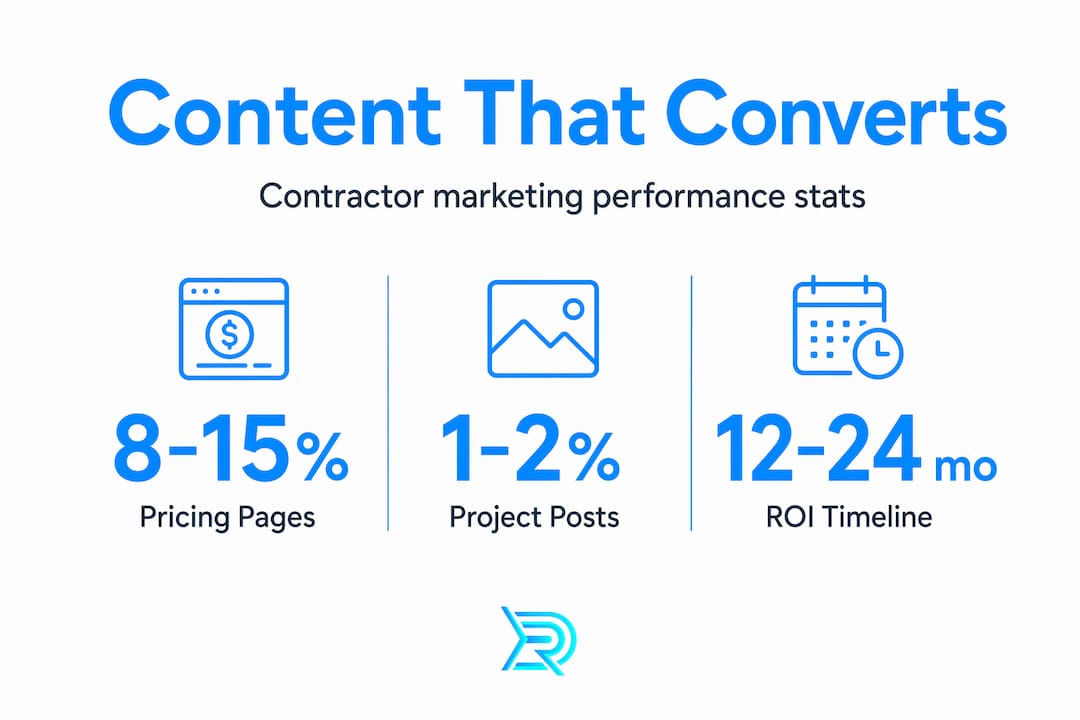
The recommended publishing cadence to hit these milestones is 2 to 3 quality articles per week over 12 to 24 months. That volume matters because Google rewards topical concentration and consistency. A contractor who publishes 150 articles in a focused topic cluster over 18 months builds significantly more authority than one who publishes 30 scattered posts over 3 years.
You also need to balance your content mix. Pricing and comparison content converts at 8 to 15% compared to 1 to 2% for purely educational content. That does not mean skip educational content. It means your calendar should include both: high-volume educational articles that build topical authority and targeted commercial content that captures buyers close to a decision.
Pro Tip: Treat your content calendar like a construction schedule. Block the publishing dates, assign the topics, and hold the cadence the way you hold a project deadline. Inconsistency is the single biggest reason content strategies fail.
Multichannel content distribution
Publishing on your website is the foundation. Stopping there is the mistake. A contractor digital marketing plan that only uses one channel is like bidding one job at a time when you could be running multiple crews.
Repurposing one core message into multiple formats and distributing it across platforms gives you exposure on high-authority channels within 48 to 72 hours of publication. That accelerates both visibility and trust signals back to Google.
| Channel | Content Format | Primary Benefit |
|---|---|---|
| Your website | Long-form articles, FAQs | SEO rankings, organic leads |
| YouTube | Project walkthroughs, how-to videos | Video search traffic, trust-building |
| Facebook and Instagram | Before/after photos, short clips | Local brand awareness, retargeting |
| Google Business Profile | Photo updates, Q&A posts | Local pack rankings, direct calls |
| Industry directories | Press releases, guest articles | Authority backlinks, wider reach |
Here is the practical approach: write one thorough article on, say, “how to choose a roofing contractor in [your city].” Pull three key points from that article and turn them into short social posts. Record a two-minute video covering the same topic. Post the video to YouTube and embed it in the article. Submit a condensed version as a digital communication piece for an industry platform. One idea, five placements, far more reach.
The contractors who combine this multichannel distribution with a local digital marketing agency that understands their trade do not just rank. They dominate their local market across every channel a homeowner checks.
Measuring what actually matters
You can publish great content and still miss the point if you are not tracking the right numbers. Flying blind is not a strategy. These are the seven KPIs every contractor content marketing effort should monitor monthly:
| KPI | What it tells you |
|---|---|
| Organic traffic | How many visitors arrive from search engines |
| Ranking keywords | Which queries your content appears for in search |
| Content-driven leads | Calls and form fills traced back to specific articles |
| Conversion rate | Percentage of visitors who become leads |
| Time on page | Whether readers are actually consuming your content |
| Bounce rate | Whether visitors engage or leave immediately |
| Top-performing content | Which articles generate the most traffic and leads |
Monitoring these KPIs monthly enables timely optimization decisions. If a piece of content generates traffic but zero leads, the problem is likely a weak call to action or a mismatch between the content topic and buyer intent. If time on page is low, the content may not be answering the question fast enough.
Trust signals are also a measurable asset. The E-E-A-T framework Google uses to evaluate content rewards structured data, consistent author identity, and verifiable expertise. For contractors, this means crediting real project experience in your content, citing sources when making claims, and ensuring your Google Business Profile and website tell a consistent story. Expertise-driven publishing with transparent, verifiable content creates long-term competitive advantages that generic marketing copy simply cannot match.
Pro Tip: Set a monthly 30-minute review to check these seven KPIs. Pull your top five articles by traffic and top five by leads. If the lists don’t overlap, you have a conversion problem worth fixing.
My honest take on what most contractors get wrong
I’ve worked with contractors across every trade and every market size. The pattern I keep seeing is the same: a contractor invests in content for three or four months, sees no leads, and concludes it doesn’t work. They quit right before the strategy was about to pay off.
Content marketing costs 62% less and generates 3 times more leads than traditional marketing over time. But that “over time” is the part nobody wants to hear. The contractors who get rich from content are the ones who kept publishing when it felt pointless.
What I’ve found actually works is running paid ads alongside content for the first 12 months. Paid ads generate leads now while content builds the authority that eventually reduces your cost per lead. Treating them as competitors is a mistake. They are teammates.
I’ve also learned that the contractors who win with content are the ones willing to be honest and specific in public. Not vague “we’re the best” claims. Real answers to real questions, with real project photos and transparent pricing context. That kind of content builds trust at a scale no sales rep can match. And in a trade where trust determines who gets called, that advantage compounds every month you stay committed to it.
— Results
Ready to build your contractor content strategy?
If you’ve gotten this far, you understand that content marketing for contractors is not a quick win. It’s a compounding asset that builds lead flow, reduces cost per lead, and establishes your brand as the obvious choice in your market. But strategy without execution is just a document.
At Resultsdigitalus, we build contractor digital marketing plans engineered for lead generation, not vanity metrics. From SEO and content strategy to Google Ads and local lead generation, every service we offer is built exclusively for contractors. We work with one company per trade per market, so your strategy works solely for you. No long-term contracts. No guesswork. Just results you can measure every month. Contact Resultsdigitalus today to get a plan built for your market.
FAQ
What is a contractor content marketing strategy?
A contractor content marketing strategy is a documented plan to create and publish educational content that attracts potential clients during their pre-bid research phase. It includes content types like project photos, case studies, FAQs, and how-to articles designed to build trust and generate leads.
How long before content marketing generates leads for contractors?
Most contractors see their first content-driven leads between months 7 and 9, with meaningful ROI typically appearing between months 13 and 18. The key is maintaining a consistent publishing cadence of 2 to 3 quality articles per week throughout that period.
What content types work best for contractor marketing?
Pricing and comparison content converts at 8 to 15%, making it the highest-performing category for contractors close to a buying decision. Educational content like how-to articles and FAQs builds organic traffic and trust at scale over time.
Why do contractors fail at content marketing?
The most common reason is quitting during the first three to six months when traffic is still near zero. This early period is normal indexing behavior, not failure. Contractors who stop publishing before month seven rarely see the compounding returns that make content marketing profitable.
How does multichannel distribution help contractor content marketing?
Repurposing content across YouTube, Google Business Profile, social media, and industry directories allows your core message to appear on high-authority platforms within 48 to 72 hours of publication. This accelerates visibility and generates trust signals that a website-only strategy cannot produce.
