
Most roofing contractors assume competitor advertising is a black box. You see their ads, maybe notice they rank above you, and chalk it up to bigger budgets. That assumption is costing you money. Understanding how competitor roofing ads work is not guesswork anymore. Between Google Ads Auction Insights, Meta Ads Library, and a few smart operational moves, you can see exactly who you’re competing against, how often they’re beating you, and what creative angles they’re testing. This article breaks it all down so you can stop reacting and start outmaneuvering.
Table of Contents
- Key takeaways
- How competitor roofing ads work in Google Auction Insights
- Reverse-engineering competitor creatives with Meta Ads Library
- Bidding tactics, LSA dynamics, and timing patterns
- Applying competitor insights to your own campaigns
- Platform comparison: where competitors focus their roofing ad budgets
- My take on what most contractors get wrong
- How Resultsdigitalus can help you outperform competitors
- FAQ
Key takeaways
| Point | Details |
|---|---|
| Auction Insights reveals true rivals | Your real paid-search competitors may not be the local roofers you think — they’re whoever bids on the same keywords. |
| Meta Ads Library exposes winning creatives | Ads running 30+ days without changes signal profitable offers worth studying and testing against. |
| LSA responsiveness outranks ad spend | Answering leads within 5 minutes can improve conversion rates 8x, which directly lifts your LSA ranking. |
| Timing patterns expose bidding windows | Competitor impression share data by hour reveals when budgets run out and when you can win cheaper clicks. |
| Multi-platform integration wins markets | Competitors dominating locally use Google Ads, LSAs, and Meta together for full-funnel coverage. |
How competitor roofing ads work in Google Auction Insights
Google Ads Auction Insights gives you a structured view of who you’re actually competing against in paid search. Not who you think your competitors are. Who is literally bidding on the same keywords at the same time you are. That distinction matters more than most roofing contractors realize.
The report surfaces four core metrics you need to understand:
- Impression share: The percentage of eligible auctions where your ad appeared. If your impression share is 40% and a competitor’s is 70%, they’re showing up nearly twice as often as you.
- Overlap rate: How frequently your ad and a competitor’s ad appeared in the same auction. A high overlap rate means you’re fighting for the same clicks constantly.
- Position above rate: How often a competitor’s ad appeared in a higher position than yours when you both showed up. This tells you who is consistently outranking you, not just occasionally.
- Outranking share: How often your ad ranked above a competitor’s, or showed when theirs didn’t. This is your clearest measure of head-to-head competitive performance.
Here’s what trips up most contractors: the businesses showing up in your Auction Insights report are often not your perceived local rivals. A national lead aggregator, a franchise, or a contractor from a neighboring city targeting your zip codes can dominate your auctions without you ever knowing it. True paid-search competitors are defined by auction behavior, not geography or reputation.
| Metric | What it tells you | How to use it |
|---|---|---|
| Impression share | Overall auction presence | Identify budget or Quality Score gaps |
| Overlap rate | Direct head-to-head frequency | Prioritize which competitors to study |
| Position above rate | Who consistently outranks you | Evaluate bid and Quality Score strategy |
| Outranking share | Your competitive wins | Measure progress after bid adjustments |
One critical limitation: Auction Insights doesn’t show competitor ad copy, budgets, or whether their campaigns are actually profitable. A competitor with 80% impression share might be burning cash. Cross-reference with tools like SpyFu or SEMrush to get a fuller picture.
Pro Tip: Segment Auction Insights data at the ad group or keyword level, not just the campaign level. Low-volume campaign data can mislead you into thinking you have more or fewer competitors than you actually do.
Reverse-engineering competitor creatives with Meta Ads Library
Meta’s Ads Library is one of the most underused tools in roofing marketing. It’s free, publicly accessible, and shows you every active Facebook and Instagram ad any competitor is running right now, including the creative, copy, call-to-action, and how long the ad has been live.
Here’s how to use it effectively:
- Go to the Meta Ads Library at facebook.com/ads/library
- Select “All Ads” and set the country to the United States
- Search by your competitor’s business name or page name
- Filter by platform (Facebook, Instagram, Messenger) to see where they’re focusing spend
What you’re looking for is duration. Ads running 30 or more days without changes are almost certainly profitable. Roofing companies don’t keep losing ads alive. If a competitor has been running the same “Free Roof Inspection After Storm Damage” video for six weeks, that offer is converting. That’s a signal, not a coincidence.
Common creative patterns you’ll spot in roofing ads on Meta include before-and-after photo carousels, short testimonial videos from homeowners, storm damage urgency ads, and financing offer callouts. Each of these tells you something about what that market responds to.

Pro Tip: Don’t copy competitor ads directly. Instead, identify the underlying offer or emotional hook that’s working and test your own variation with a different angle, stronger guarantee, or more specific proof point. Differentiation beats imitation every time.
The Meta Ads Library also reveals platform focus. If a competitor is running exclusively on Instagram Stories with video, they’ve likely tested formats and found that one works best in your market. That’s months of testing handed to you for free.
Bidding tactics, LSA dynamics, and timing patterns
Competitor roofing ads don’t just compete on creative and keywords. They compete on timing, operational speed, and bidding structure. Most contractors miss this entirely.
Start with Local Services Ads. LSA rankings are not purely pay-to-win. LSA costs range from $40 to $120+ per lead in 2026, but the contractors who dominate the top spots are often winning on responsiveness, not just budget. Companies that answer 95% or more of their LSA leads consistently outrank those responding to 70 to 80% of leads. Responding within five minutes can improve conversion rates 8x. Your competitor who always appears above you in LSAs might not be outspending you. They might just be answering their phone faster.
Here’s a practical framework for reading competitor bidding behavior from Auction Insights time-segmentation:
- Pull Auction Insights data segmented by hour of day and day of week.
- Look for competitors whose impression share drops sharply in the afternoon or on weekends. That’s a budget exhaustion pattern, and it’s a window for you to capture cheaper clicks.
- Identify competitors with stable impression share across all hours. That signals Smart Bidding or automated strategies, which means they’re letting Google’s algorithm optimize spend around conversion data.
- Look for competitors who spike in impression share on Monday mornings. Storm-chasing contractors often front-load budgets early in the week after weekend weather events.
- Use these patterns to schedule bid adjustments and budget increases during competitor low-budget windows.
| Strategy type | Impression share pattern | Your counter-move |
|---|---|---|
| Manual bidding | Stable, drops at budget limits | Increase bids during their off-hours |
| Smart Bidding | Spikes around high-conversion times | Compete on Quality Score, not just bid |
| Storm-chasing | Surges after weather events | Pre-schedule budget increases post-storm |
| Budget-limited | Drops predictably mid-day | Shift budget to afternoon for cheaper CPCs |
Pro Tip: Don’t get drawn into bidding wars on your highest-volume keywords. Niche keyword segments where fewer competitors overlap often deliver better cost per lead with less wasted spend.
Applying competitor insights to your own campaigns
Knowing how roofing ads perform in the competitive landscape is only half the job. The other half is translating that data into specific changes in your campaigns.
Here’s where to focus first:
- Outranking share below 40% on a high-value keyword: This is your clearest signal to either raise bids, improve your Quality Score, or both. Check your ad relevance and landing page experience scores before throwing more money at the problem.
- High overlap rate with a specific competitor: If you’re appearing in the same auctions as one competitor 80% of the time, study their ad copy and landing page. Are they offering something you’re not? A financing option, a faster timeline, a stronger warranty?
- Competitor stable ads on Meta: Use long-running ad creatives as your testing baseline. If their storm damage offer has been live for two months, test your version of that same offer with your own differentiation baked in.
- Competitor budget exhaustion windows: Once you identify when competitors go dark, allocate budget strategically to those hours. You’ll pay less per click and face less competition for the same leads.
The quality score piece deserves extra attention. Many roofing contractors focus entirely on bids and ignore the fact that a better Quality Score reduces your cost per click while improving your position. Competitor analysis often reveals gaps in ad relevance or landing page experience that, once fixed, let you outrank better-funded competitors at a lower cost.
Platform comparison: where competitors focus their roofing ad budgets
Understanding roofing ad strategies means knowing which platforms your competitors prioritize and why. Not every channel works the same way.
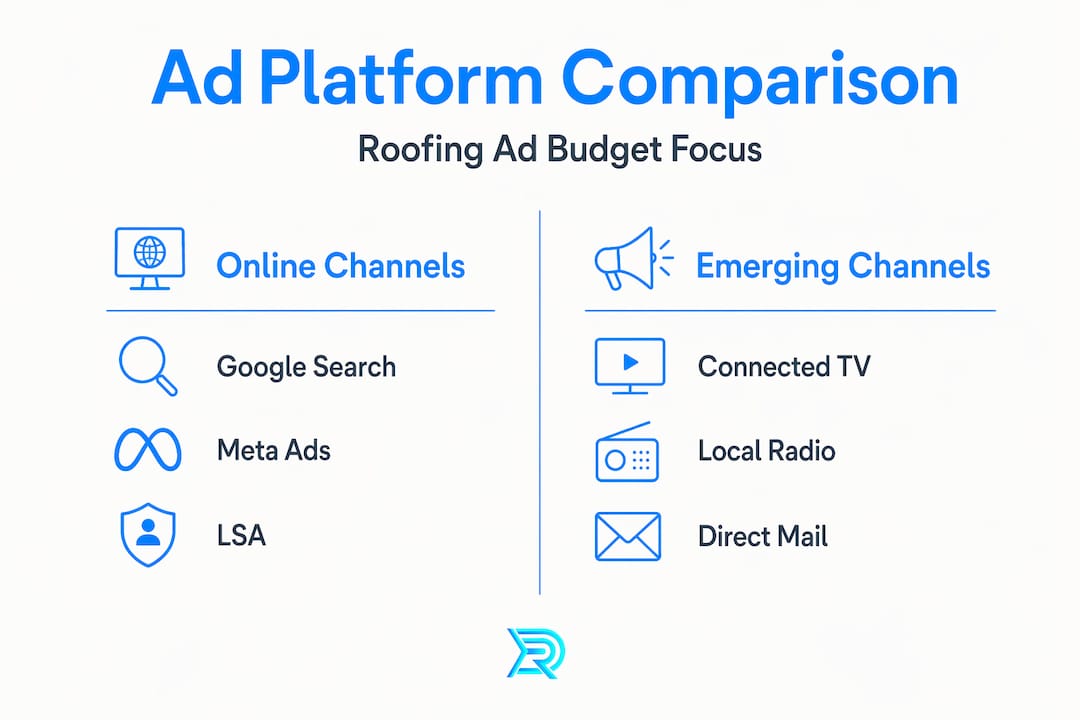
| Platform | Cost model | Intent level | Competitive intelligence available |
|---|---|---|---|
| Google Search Ads | Pay per click | High (active search) | Auction Insights, SpyFu, SEMrush |
| Local Services Ads | Pay per lead | Very high (local intent) | Limited; ranking signals are operational |
| Meta (Facebook/Instagram) | Pay per impression/click | Low to medium (interruption) | Full creative visibility via Ads Library |
| Connected TV | Pay per impression | Low (brand awareness) | Limited; requires direct research |
Google Search Ads and LSAs capture demand that already exists. Someone searching “roof replacement near me” is ready to buy. That’s why competition is fierce and cost per lead is higher. Meta platforms work differently. They interrupt people who aren’t actively searching, which means the creative and offer have to work harder to generate a response. Competitors using Meta effectively are usually building brand awareness, retargeting website visitors, or running storm-damage campaigns timed to local weather events.
Connected TV is an emerging channel in roofing. Some competitors use local audience targeting on CTV to dominate viewership within specific zip codes over a 90-day flight. It’s not a direct lead-generation play, but it builds the kind of name recognition that makes your Google Ads perform better because people recognize your brand when they search.
The contractors winning in competitive markets aren’t picking one channel. They’re running Google Ads for immediate leads, LSAs for high-intent local capture, Meta for retargeting and awareness, and top roofing advertising channels for full-funnel coverage. That integrated approach is what makes them hard to displace.
My take on what most contractors get wrong
I’ve worked with roofing contractors across the country, and the pattern I see most often is this: contractors look at a competitor’s impression share, panic, and immediately raise bids. That’s the wrong move almost every time.
What I’ve learned from integrating Auction Insights data with real operational changes is that the contractors who win long-term are the ones who fix their lead response speed, improve their Quality Scores, and then adjust bids. Not the other way around. Spending more money on a broken funnel just loses money faster.
The other mistake I see constantly is treating competitor analysis as a one-time audit. You pull the data once, make a few changes, and move on. But your competitors are adjusting their budgets, testing new creatives, and shifting platforms every single month. The contractors I’ve watched grow fastest treat competitor intelligence as a weekly habit, not a quarterly project.
One more thing: chasing the top position is a trap. I’ve seen roofing companies spend themselves into negative margins just to hold the number one spot on a broad keyword. Profitable bidding means knowing when to compete and when to let a competitor waste their budget on a keyword that doesn’t convert for your specific market.
— Results
How Resultsdigitalus can help you outperform competitors
If reading this made you realize you’ve been flying blind on competitor ad analysis, you’re not alone. Most roofing contractors don’t have the time or the tools to pull Auction Insights data weekly, monitor Meta Ads Library, and adjust bids around competitor timing patterns simultaneously.
Resultsdigitalus was built specifically for roofing contractors who want to win their local market without guessing. From roofing PPC advertising to LSA optimization and Meta Ads management, every strategy is built around your market, your competitors, and your growth targets. We helped one Florida roofing company scale from 3 crews to 18 before selling for $60 million. That kind of growth doesn’t happen by accident. It happens when every ad dollar is working with competitor intelligence behind it. Explore our PPC ads for roofers page to see what a competitor-informed campaign looks like in practice.
FAQ
What is Google Ads Auction Insights for roofing?
Google Ads Auction Insights is a report showing which competitors appear in the same keyword auctions as you, along with metrics like impression share, overlap rate, and outranking share. It helps roofing contractors identify their true paid-search rivals and adjust bids accordingly.
How do I find competitor roofing ads on Facebook?
Use the Meta Ads Library at facebook.com/ads/library, search by your competitor’s business page name, and filter by country and platform. You’ll see every active ad they’re running, including creative, copy, and how long each ad has been live.
Does LSA ranking depend on budget alone?
No. Lead responsiveness is a major LSA ranking factor, with contractors answering 95% or more of leads consistently outranking lower-response competitors. Responding within five minutes can improve conversion rates dramatically regardless of budget.
How can I tell if a competitor’s roofing ad is working?
On Meta, ads running 30 or more days without creative changes are strong indicators of a profitable offer. On Google, a competitor with high outranking share and stable impression share over time is likely running a well-optimized campaign.
What’s the best way to use competitor ad data without copying?
Identify the underlying offer, emotional trigger, or format that’s performing well, then build your own version with a distinct angle, stronger proof point, or more specific guarantee. Studying effective roofing advertisements from competitors should inform your strategy, not replace your own creative thinking.
