
TL;DR:
- Modern website design can triple contractor lead generation and increase conversion rates.
- Key features include fast load times, mobile responsiveness, clear CTAs, and trust badges.
- Integrating design with SEO and marketing maximizes local leads and client trust.
Your referral network is valuable, but it cannot scale your roofing business alone. 75% of users judge a company’s credibility based on its website before they ever pick up the phone. That means a homeowner who finds you through a neighbor’s recommendation will still check your site before calling. If what they see looks outdated, slow, or confusing, you lose the job before the conversation even starts. This article breaks down exactly how strategic website design drives more leads, what real ROI looks like for contractors, and which specific features separate high-performing sites from the ones that cost you business.
Table of Contents
- Why website design is the key to contractor lead generation
- ROI of website redesign: What contractors can expect
- Design essentials: Features that turn visitors into leads
- Integrating website design with local digital marketing
- Why most contractor website redesigns miss the mark
- Ready to transform your website into a lead engine?
- Frequently asked questions
Key Takeaways
| Point | Details |
|---|---|
| Website design boosts trust | A modern contractor website instantly raises perceived credibility and attracts more qualified leads. |
| Better sites get more leads | Roofers and siding contractors see up to triple the inquiries and jobs when they redesign outdated sites. |
| Small tweaks, big results | Updating calls-to-action and adding trust signals can dramatically increase bookings with minimal investment. |
| Integrate marketing channels | Combining strong web design with local SEO and digital ads delivers the best results for sustained growth. |
Why website design is the key to contractor lead generation
First impressions online happen fast. Research shows users form an opinion about your website in about 50 milliseconds. That split-second judgment shapes whether a homeowner requests a quote or clicks back to find your competitor. For roofing and exterior contractors, this is not a small problem. Most of your market is searching online before making any contact, and your website is the first thing they see.
Contractors who boost leads and trust through modern site design consistently outperform those relying on outdated pages. The numbers back this up. Contractors with updated websites earn up to 3x more roofing leads than those with older designs. That gap is not about having a prettier logo. It is about removing friction, building trust fast, and making it easy for homeowners to take action.
Here are the design elements that directly drive lead volume:
- Easy navigation: Visitors should find your services, service area, and contact info within two clicks.
- Visible contact information: Phone number and quote request button should appear above the fold on every page.
- Trust badges: Licenses, insurance info, manufacturer certifications, and BBB ratings reduce hesitation.
- Photo galleries: Before-and-after project photos prove your work quality without a single word.
- Fast load speed: Pages that take more than three seconds to load lose a significant portion of visitors.
The contrast between dated and modern contractor sites is stark:
| Feature | Dated Site | Modern Site |
|---|---|---|
| Mobile experience | Poor or broken | Fully responsive |
| Average load time | 6 to 10 seconds | Under 2 seconds |
| Monthly lead volume | 2 to 5 inquiries | 10 to 20+ inquiries |
| Trust signals | Missing | Prominently displayed |
| CTA visibility | Buried | Above the fold |
The data is clear. A site built for conversion is not a luxury. It is the foundation of your lead generation system. Without it, every dollar you spend on ads or SEO is working against an uphill battle.
ROI of website redesign: What contractors can expect
Given that design directly drives lead flow, you might wonder about the actual financial returns from an updated website. The math is straightforward, and the numbers are hard to ignore.
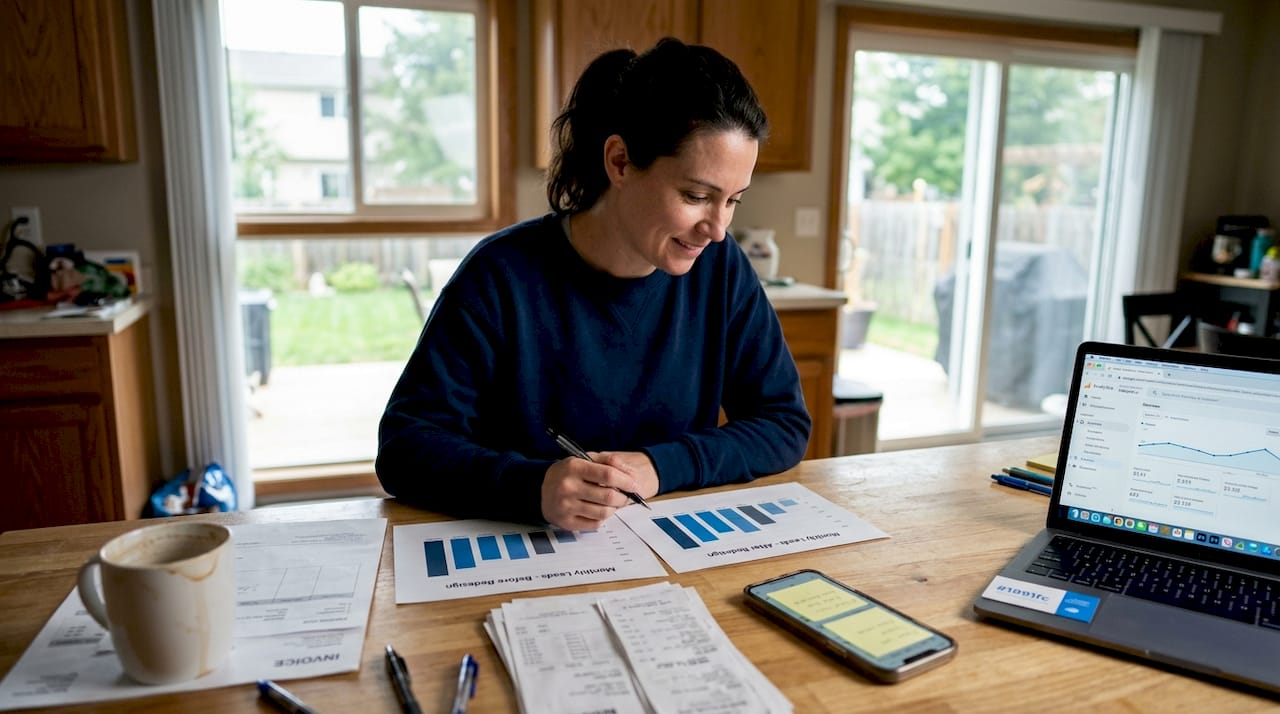
Let’s say your current site generates four leads per month and you close 25% of them. That is one new job per month from your website. A well-designed site that converts more visitors can push that to 12 to 15 leads per month. At the same close rate, you are now booking three to four jobs monthly from the same traffic. One roofing job averages $9,000 to $15,000 in revenue. That is $18,000 to $45,000 in additional monthly revenue from a single design upgrade.
Here is a simple before-and-after comparison:
| Metric | Before Redesign | After Redesign |
|---|---|---|
| Monthly site visitors | 300 | 300 |
| Conversion rate | 1.3% | 4.5% |
| Monthly leads | 4 | 13 |
| Booked jobs (25% close) | 1 | 3 |
| Estimated monthly revenue | $12,000 | $36,000 |
A professional contractor website redesign typically costs between $3,000 and $8,000. Using the numbers above, many contractors recover that investment within the first month of improved performance. The roofing leads case study data shows that updated design increases customer inquiries and conversion rates within months, not years.
Here is a simple process for thinking about your redesign investment:
- Calculate your current monthly leads from your website.
- Estimate your average job value.
- Project lead volume at a 4% to 5% conversion rate.
- Multiply the increase in booked jobs by your average job value.
- Compare that figure to your redesign cost.
Pro Tip: Before committing to a redesign, use Google Analytics or your CRM to document your current baseline numbers. You cannot measure improvement without a starting point, and having clean data makes it easy to prove ROI to yourself and your team.
Design essentials: Features that turn visitors into leads
The ROI is clear, but what exactly should your website include to maximize every visitor’s potential? Not all design features are equal. Some look impressive but do nothing for conversions. Others are simple and directly tied to more calls and quote requests.
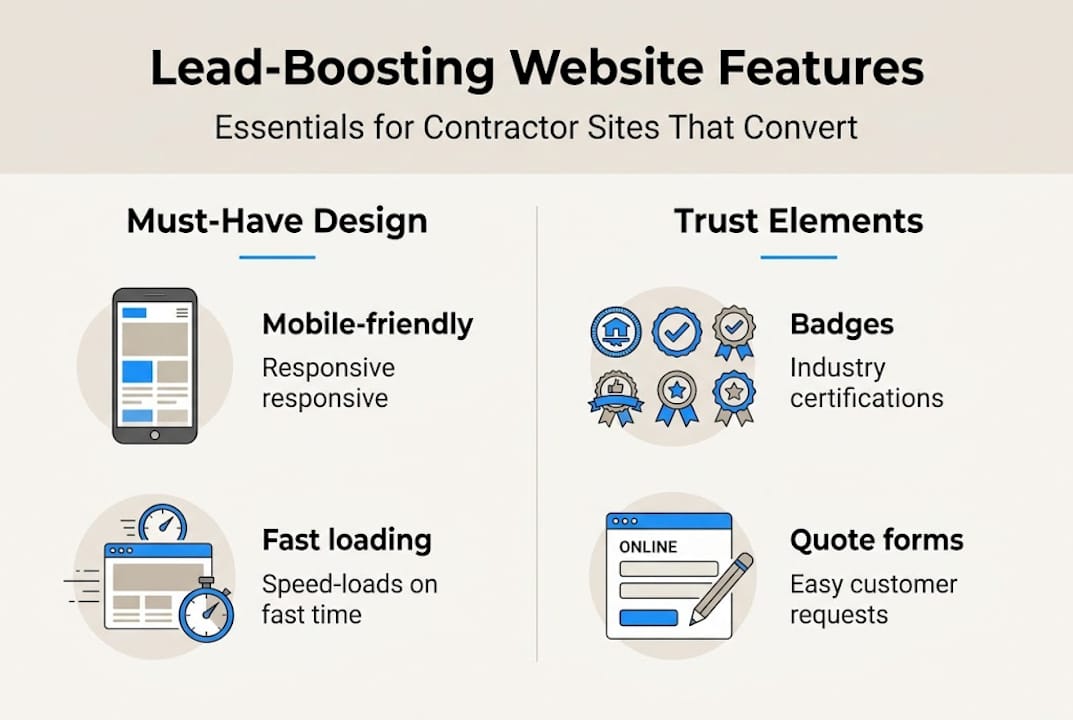
Modern website features that generate leads share a few non-negotiable traits. Mobile responsiveness is at the top. More than 60% of homeowners search for contractors on their phones. If your site is hard to navigate on a small screen, you are losing more than half your potential leads before they even read a word about your services.
Here is what every high-converting contractor website needs:
- Prominent call-to-action buttons: “Get a Free Quote” or “Call Now” should appear on every page, in a contrasting color that stands out.
- Google reviews integration: Displaying your star rating and review count directly on your homepage builds instant credibility.
- License and insurance display: Homeowners worry about liability. Showing your credentials removes that concern before they ask.
- Fast load time: Use compressed images and clean code. Every second of delay reduces conversions by roughly 7%.
- Simple contact forms: Ask for name, phone, and project type only. Long forms kill inquiry rates.
- Service area pages: Dedicated pages for each city or neighborhood you serve help you rank locally and signal relevance to visitors.
“A website that looks great but loads slowly or buries the contact form is just an expensive online brochure. The goal is action, not admiration.”
Pro Tip: Run your site through Google PageSpeed Insights for free. It gives you a performance score and specific fixes. Even small improvements in load time can noticeably lift your lead volume. Pair that with site optimization steps designed for contractors and you will see results faster.
User experience matters just as much as visual design. A clean layout that guides visitors toward a quote request is more valuable than a flashy homepage with no clear next step. Modern websites improve the user experience, boosting booked jobs for local contractors who prioritize function alongside form.
Integrating website design with local digital marketing
Next, it is crucial to tie your redesigned website into the rest of your online marketing efforts. A great website sitting in isolation will not reach its potential. The real power comes when design, SEO, reviews, and paid ads work together as one system.
Search engine optimization starts with your website’s technical foundation. Clean code, fast load speed, and properly structured content all signal quality to Google. But local SEO goes further. Contractors who align web design with lead generation workflows see higher ROI because their site is built to capture traffic from every channel, not just organic search.
Here is how to connect your website to your full marketing strategy:
- Google Business Profile: Your site and your GBP listing should match in name, address, phone number, and service descriptions. Inconsistencies hurt local rankings.
- Online reviews: Encourage satisfied customers to leave Google reviews. A steady flow of new reviews signals activity and trust to both Google and potential leads.
- Local landing pages: Create dedicated pages for each service area. These pages rank for city-specific searches and give paid ad campaigns a relevant destination.
- Facebook and Google Ads: Paid campaigns drive immediate traffic, but they only convert when they land on a page designed to capture leads. A weak landing page wastes ad spend.
- Directory listings: Angi, HomeAdvisor, and Houzz listings should link back to your site, reinforcing authority.
Pro Tip: Do not send paid ad traffic to your homepage. Build dedicated landing pages for each campaign with a single focus, one service, one call-to-action, and a short form. This alone can double your ad conversion rate. Explore the full lead generation guide to see how each piece connects.
The contractors who dominate local markets are not just running ads or just doing SEO. They have built a system where every piece reinforces the others, and the website sits at the center of all of it.
Why most contractor website redesigns miss the mark
Here is something most agencies will not tell you: the majority of contractor website redesigns fail to move the needle on leads. Not because the sites look bad, but because they were built to impress rather than convert. There is a real difference between those two goals, and confusing them is expensive.
Most redesigns focus on color palettes, stock photos, and modern fonts. Those things matter, but they are not what turns a visitor into a call. What actually drives conversions is the user flow: how quickly someone can understand what you do, confirm you serve their area, and take action. Many contractors skip testing this entirely. They launch a new site and wait for results that never come.
Custom solutions tailored to contractor needs consistently outperform generic templates because they are built around real homeowner behavior, not a one-size-fits-all layout. A custom design accounts for how your specific market searches, what objections your customers have, and what trust signals matter most in your area.
The contractors who see the biggest gains from a redesign are the ones who treat it as a conversion project, not a visual refresh. They test their mobile layout on real devices, simplify their forms, and make sure every page has one clear next step. That mindset shift is what separates a site that generates 15 leads a month from one that generates four.
Ready to transform your website into a lead engine?
If you have made it this far, you already know that a well-designed website is not optional for contractors who want to grow. It is the single highest-leverage investment you can make in your digital presence.
At Results Digital, we specialize exclusively in roofing and exterior contractors. Our digital marketing services are built to generate real leads, not just traffic. From custom website design to SEO for roofing companies, every solution is tailored to your market and your goals. We work with only one contractor per market, so your growth is our full focus. Request a free strategy session today and find out exactly what it would take to double your monthly leads.
Frequently asked questions
How long does a contractor website redesign typically take?
Most full redesigns for contractors take 4 to 8 weeks, depending on project scope and content needs. Once live, updated designs typically show increased inquiries within the first few months.
What’s the difference between a template site and a custom design for roofers?
Custom designs are tailored to your brand and local market, often converting more leads than generic templates. Custom solutions account for your specific service area, customer objections, and competitive landscape.
Can a new website really increase my leads?
Yes. A modern, optimized contractor site can generate two to three times more leads than an outdated one. Updated websites earn significantly more roofing leads by removing friction and building trust faster.
What features matter most for contractor websites?
Mobile responsiveness, clear calls-to-action, trust badges, and simple quote forms are the highest-impact features. Modern websites that prioritize these elements consistently book more jobs from the same traffic volume.
How does web design impact SEO and local rankings?
Effective design improves technical SEO signals like load speed and mobile usability, which directly affect local search rankings. Contractors who align design with workflows see stronger performance across both organic and paid channels.