
TL;DR:
- Conversion-focused website design increases leads by over 30% within 90 days.
- Trust signals, clear CTAs, and fast load times are essential for contractor websites.
- Integrating SEO from the start improves local rankings and consistent lead flow.
Most roofing and exterior contractors assume a good-looking website is a winning website. That assumption is costing you jobs. The contractors pulling in the most leads online aren’t winning because of flashy animations or expensive photography. They’re winning because their sites are built to convert visitors into calls, quote requests, and booked appointments. Redesigns done right yield 30%+ more leads within 90 days, and top contractor sites convert at over 11%. That gap between average and elite performance comes down to design decisions you can make right now. This guide breaks down exactly what those decisions are.
Table of Contents
- Why website design matters for contractors
- Essential website design elements that drive leads
- SEO and website design: A critical partnership
- Common contractor website mistakes (and how to fix them)
- Our perspective: What most contractors miss about website design
- Supercharge your contractor website and lead generation
- Frequently asked questions
Key Takeaways
| Point | Details |
|---|---|
| Function beats form | Contractor websites that prioritize trust-building and user-focused features win more leads than those focused on looks alone. |
| SEO is essential | Websites perform best when search optimization and design are integrated from the start. |
| Speed and trust convert | Fast-loading, proof-rich sites boost conversions and client confidence for roofing and exterior contractors. |
| Small changes, big impact | Updates like mobile click-to-call and reviews can increase conversions by up to 30% within 90 days. |
Why website design matters for contractors
There’s a common belief in the trades that your website just needs to look professional. Clean logo, nice photos, contact page. Done. But that thinking leaves serious money on the table. Why design matters for roofing leads goes far beyond aesthetics. It’s about whether a visitor stays, trusts you, and picks up the phone.
The numbers tell the story clearly. Average contractor site conversions sit at just 2.35%, while top-performing sites hit 11% or higher. That means for every 100 visitors, the average contractor gets about 2 leads. The best-designed sites get 11 or more. Same traffic, dramatically different results.
Here’s a quick comparison of what separates template sites from custom, functional designs:
| Feature | Template site | Custom functional design |
|---|---|---|
| Mobile optimization | Basic | Purpose-built for conversions |
| Trust signals | Generic | Reviews, certs, project galleries |
| Local SEO structure | Minimal | Fully integrated |
| Call-to-action placement | Random | Strategically placed |
| Load speed | Variable | Optimized for performance |
Trust is the real currency on a contractor website. Homeowners hiring a roofer or siding contractor are making a significant financial decision. They need proof before they call. That proof comes in the form of real customer reviews, before-and-after project galleries, manufacturer certifications, and association memberships. Website design and trust are directly connected. Visitors decide within seconds whether your site feels credible.
“Functional, trust-focused design consistently outperforms pretty sites. Contractors who prioritize proof and clarity over visual flair see faster lead growth and stronger ROI.”
The bottom line is simple. A fast-converting contractor website isn’t judged by how it looks in a design portfolio. It’s judged by how many people fill out your form or call your number after landing on it. That’s the only metric that matters.
Essential website design elements that drive leads
Knowing design matters is one thing. Knowing exactly what to put on your site is another. Let’s get specific about the features that move the needle for roofing and exterior contractors.
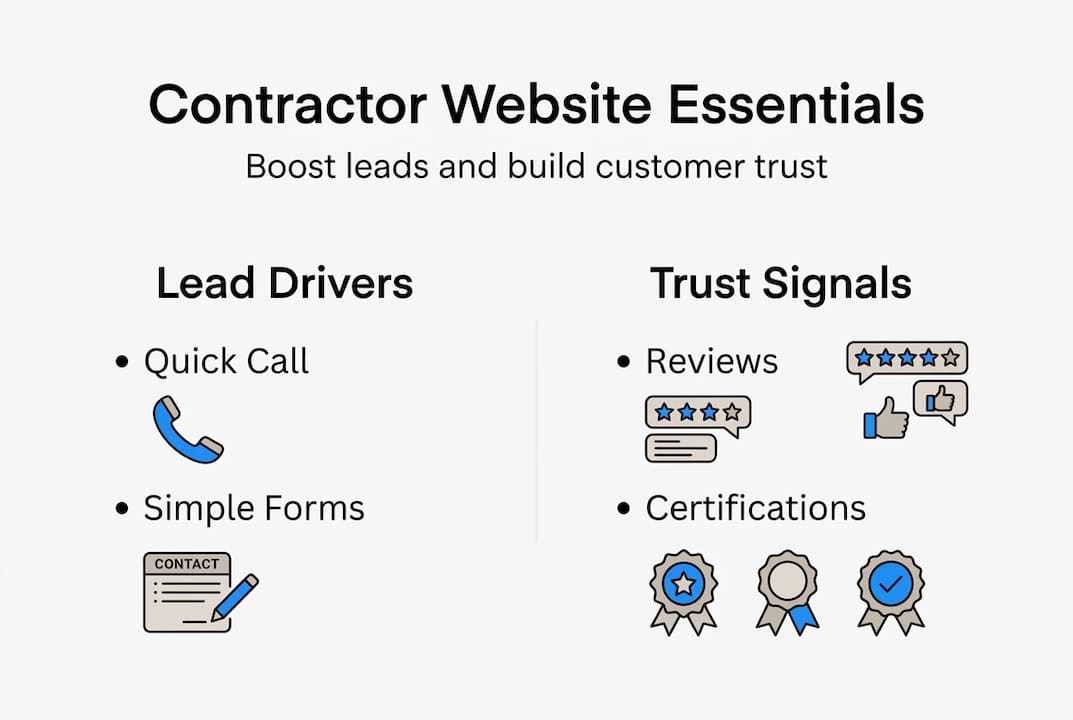
The highest-converting contractor sites share a set of common elements. Here’s what your site must include:
- Clear navigation that gets visitors to key pages in one or two clicks
- Strong calls-to-action above the fold on every page, not buried at the bottom
- Verified customer reviews with names, photos, and specific project details
- Before-and-after project galleries organized by service type and location
- Short, simple lead forms asking only for name, phone, and project type
- Click-to-call buttons visible on every mobile page
- Certifications and badges from manufacturers or industry associations
For roofing and exterior work, high-risk projects require trust. A homeowner spending $15,000 on a new roof isn’t going to call a contractor whose website has no reviews and no proof of past work. Every trust element you add reduces friction and increases the chance they reach out.
“Visitors scan websites in an F-pattern, reading across the top, then down the left side. Place your most important trust signals and CTAs where eyes naturally land first.”
Pro Tip: Mobile users are often in urgent situations, like dealing with storm damage or an active leak. Make sure your click-to-call button is visible without scrolling on every single page. One tap should connect them to your team.
Custom design for roofers takes all of these elements and builds them into a structure that reflects your specific services, service areas, and brand. Generic templates can’t do that effectively. Boosting contractor trust requires specificity. Visitors respond to sites that feel built for their exact situation, not copy-pasted from a theme library. Functional designs built for results consistently outperform visually impressive but conversion-weak alternatives.

SEO and website design: A critical partnership
You can build the most conversion-optimized site in your market. If nobody finds it, it generates zero leads. That’s why SEO (search engine optimization, the process of making your site rank higher in Google search results) must be woven into your design from day one, not bolted on afterward.
Sites lacking SEO lose credibility and performance fast. Here’s how SEO-driven sites compare to those built without it:
| Metric | Non-SEO site | SEO-integrated site |
|---|---|---|
| Bounce rate | 70%+ | Under 50% |
| Local search ranking | Page 2 or lower | Page 1 visibility |
| Monthly lead volume | Low, inconsistent | Steady, growing |
| Google Business Profile sync | None | Fully connected |
Building SEO for contractor leads into your site from the start means your pages are structured to rank for the searches your customers are actually doing. Here’s a step-by-step approach:
- Define your service pages first. Each service (roof replacement, gutter installation, siding repair) needs its own dedicated page with targeted keywords.
- Build location pages for every area you serve. Google rewards geographic relevance for local searches.
- Optimize page titles, headers, and meta descriptions before you launch.
- Set up and connect your Google Business Profile so your site and local listing reinforce each other.
- Ensure your NAP (name, address, phone number) is consistent across your site and all online directories.
- Add schema markup (a type of code that helps Google understand your business type and services) to key pages.
Unlocking local leads with SEO is one of the highest-ROI moves a contractor can make. Organic traffic compounds over time. Paid ads stop the moment you stop paying. SEO keeps working. Service area SEO strategies are especially powerful for contractors covering multiple zip codes or cities. Contractor lead generation strategies consistently point to local SEO as a top driver of inbound calls.
Pro Tip: Never launch a redesigned website without first confirming your Google Business Profile is updated and your citations (online directory listings) match your new site details. A mismatch can tank your local rankings overnight.
Common contractor website mistakes (and how to fix them)
Even contractors who invest in a new site often repeat the same costly errors. Here’s how to spot and fix the most damaging ones before they drain your results.
Slow load times are the single biggest silent killer. Every extra second of load time costs you 4.42% in conversions. A site that takes 5 seconds to load on mobile can lose nearly a quarter of its potential leads before a single word is read.
Here’s a step-by-step audit to fix the most common mistakes:
- Test your load speed using Google PageSpeed Insights. Aim for under 3 seconds on mobile.
- Compress all images before uploading. Large image files are the most common cause of slow sites.
- Remove outdated content. Old promotions, expired certifications, and stale blog posts erode credibility.
- Audit your mobile experience. Navigate your own site on a phone. Is the form easy to fill out? Is the call button visible immediately?
- Simplify cluttered pages. If a visitor can’t tell what you do and how to contact you within 5 seconds, your layout is too complex.
- Add missing trust signals. If you have no reviews, no gallery, and no certifications visible, add them now.
Designing for fast conversions means treating every page as a landing page with one clear goal: get the visitor to take action. Local SEO strategies for contractors also suffer when site errors go unfixed. Google factors in page experience when ranking local results. Data on functional vs. pretty sites confirms that performance beats polish every time.
Pro Tip: Run A/B tests on your primary call-to-action button. Test different colors, copy (“Get a free estimate” vs. “Call us now”), and placement. Small changes here can lift conversions by 10 to 20 percent without touching the rest of your design.
Our perspective: What most contractors miss about website design
After reviewing hundreds of contractor websites, one pattern stands out. Contractors consistently over-invest in visual design and under-invest in the elements that actually close leads. A site with stunning drone footage but no reviews, no clear service pages, and a slow mobile experience will lose to a simpler site that loads fast and shows proof.
Functional, trust-focused design outperforms award-winning aesthetics in real-world lead generation. Real ROI comes from clarity, proof, and speed.
“Contractors who integrate sales process tracking from the start, connecting their website forms to a CRM and monitoring which pages generate calls, multiply their ROI far faster than those who treat the site as a one-time project.”
Your website should never be finished. It should be a living tool you update based on what the data tells you. Which pages get traffic but no conversions? Which service generates the most calls? Building high-conversion contractor sites is an ongoing process, not a launch-and-forget exercise.
Pro Tip: Track every lead source from day one. Know whether calls come from organic search, Google Ads, or direct traffic. That data tells you where to invest next and which design changes are actually working.
Supercharge your contractor website and lead generation
You now have a clear road map for turning your website into a lead-generating machine. Putting these strategies into practice takes the right tools, the right structure, and a partner who understands what roofing and exterior contractors actually need.

Results Digital builds web design for roofers that are engineered for conversions, local SEO, and trust from the ground up. We follow a proven lead generation workflow for contractors that connects your site to Google Ads, local SEO, and real performance tracking. Our digital marketing services for contractors are built exclusively for this industry. No generic packages. No long-term contracts. Just results. Reach out today for a free web performance review and see exactly where your site is leaving leads behind.
Frequently asked questions
What design features boost contractor website conversions most?
Features like mobile-friendly click-to-call buttons, visible trust signals such as reviews and certifications, and short prominent lead forms are proven to drive the highest contractor website conversions.
How fast should a contractor website load?
Aim for under 3 seconds on mobile. Every extra second of load delay costs 4.42% in conversions, making speed one of the highest-impact improvements you can make.
Should contractors use website templates or custom designs?
Custom designs consistently outperform templates for lead generation and trust. Top-performing contractor sites invest in function and trust elements that templates rarely support well.
What’s the impact of integrating SEO during design?
Sites built with SEO from the ground up capture more local leads and rank higher in search results. SEO-led designs capture more consistent inbound traffic than sites where SEO is added after launch.