
Lead generation for general contractors is the process of attracting, qualifying, and converting prospective clients into booked jobs through a repeatable, measurable system. Knowing how to get leads for a general contracting business separates contractors who scramble for work from those who turn away projects. The industry term for this is contractor lead generation, and the most effective version integrates owned channels like Google Business Profile and referrals with targeted paid search and direct outreach. Owned channels generate 60–80% of a contractor’s total leads, and referred leads close at 40–50%. That single fact should shape every dollar you spend on marketing.
How to get leads for a general contracting business with Google Business Profile
Your Google Business Profile is the single highest-leverage free tool available to you right now. Fully optimized profiles appear 80% more often and generate 400% more website traffic than incomplete ones. That is not a minor difference. It means a neglected profile is actively costing you jobs every week.
Start with your category selection. Choosing a specific category like “Kitchen Remodeler” or “Bathroom Remodeler” instead of the generic “General Contractor” tells Google exactly which searches to show you for. Add every relevant secondary category your business qualifies for. Fill out your service descriptions with the specific project types and locations you serve.

Photos and posts matter more than most contractors realize. Profiles with recent project photos and weekly Google Posts rank higher and convert better because homeowners trust what they can see. Post before-and-after photos, completed project highlights, and seasonal promotions at least once per week.
Reviews are the conversion engine. A profile with 50 reviews at 4.8 stars beats a competitor with 10 reviews at 5.0 stars in both rankings and click-through rates. The best timing to request a review is 24–48 hours after job completion, when client satisfaction peaks. Give clients a short, forwardable text message they can share with neighbors. Reduce the friction and you will get more reviews.
- Select specific service categories, not just “General Contractor”
- Upload at least 10 project photos per service type
- Post weekly updates, promotions, or completed project highlights
- Request reviews within 24–48 hours of project completion
- Respond to every review, positive or negative, within 48 hours
Pro Tip: Link your Google Business Profile directly to a dedicated service landing page rather than your homepage. Visitors who land on a page matching their search intent convert at a significantly higher rate.
What makes a referral program actually generate contractor leads?
Referrals are the highest-quality leads you will ever receive. They close at 40–50% compared to 10–20% for cold platform leads. The problem is most contractors treat referrals as something that happens by accident. A structured referral program turns that accident into a system.
Here is how to build one that works:
- Ask at the final walkthrough. Client satisfaction peaks at project completion. That is the moment to say, “We loved working on your project. If you know anyone planning a remodel or addition, we would genuinely appreciate the introduction.” Do not wait a month. The emotional high fades fast.
- Offer a clear incentive. A $250 referral credit toward future work for any project above $5,000 gives clients a concrete reason to refer. Make the incentive easy to explain in one sentence.
- Provide a forwardable message. Write a short two-sentence text your clients can copy and send to neighbors. Something like: “I just finished a major kitchen remodel with [Your Company]. Here’s their number if you’re thinking about a project.” Remove the effort and referrals multiply.
- Follow up 30 days post-job. Send a short email or text checking in on the project. Include a one-line referral ask at the bottom. Most contractors never do this, which means you stand out immediately.
- Track referrals separately in your CRM. If you do not track referral leads as their own source, you cannot measure the program’s performance or reward the right clients.
Pro Tip: A simple Google Form linked in your follow-up email lets clients submit a referral contact directly. You get the lead, they feel helpful, and nothing falls through the cracks.
How does building permit data help you find high-value leads early?
Building permit data is one of the most underused contractor lead generation channels available. Permit data identifies projects days or weeks before construction starts, giving you full project details including scope, address, and often the property owner’s contact information. You are reaching out before your competitors even know the job exists.
The practical advantage is enormous. When you contact a homeowner during the planning phase, you influence the project scope, the timeline, and sometimes the budget. Contractors who engage clients early in the design and planning phase close at three times the rate of those who wait for the competitive bid phase. Early involvement builds trust before price becomes the only differentiator.
| Permit lead approach | Benefit | Challenge |
|---|---|---|
| Manual city permit searches | Free, direct access | Time-consuming, inconsistent data |
| Permit aggregation platforms (e.g., PermitGrab) | Automated, enriched contact data | Subscription cost |
| Filtering by project value ($25K+) | Targets high-margin jobs | Requires data normalization |
| Daily tracking feeds | Catches leads before competitors | Needs consistent follow-up workflow |
Focus your permit searches on residential projects valued at $25,000 or more. Smaller permits rarely justify the outreach effort. Platforms like PermitGrab aggregate permit data across multiple cities and enrich it with phone numbers and licensing information, solving the biggest friction point in manual permit sourcing.
- Filter permits by project type: additions, ADUs, full remodels
- Target permits filed within the last 7 days for the freshest leads
- Personalize outreach with the specific project address and permit type
- Track all permit leads in your CRM with their own source tag
What website and digital advertising strategies convert visitors into leads?
Your website is either your best salesperson or a dead end. Most contractor websites fall into the second category because they send all traffic to a generic homepage. Dedicated landing pages for each service improve lead quality and campaign ROI by addressing exactly what the visitor searched for. A homeowner searching “kitchen remodel contractor in Austin” should land on a page about kitchen remodeling in Austin, not your company’s about page.
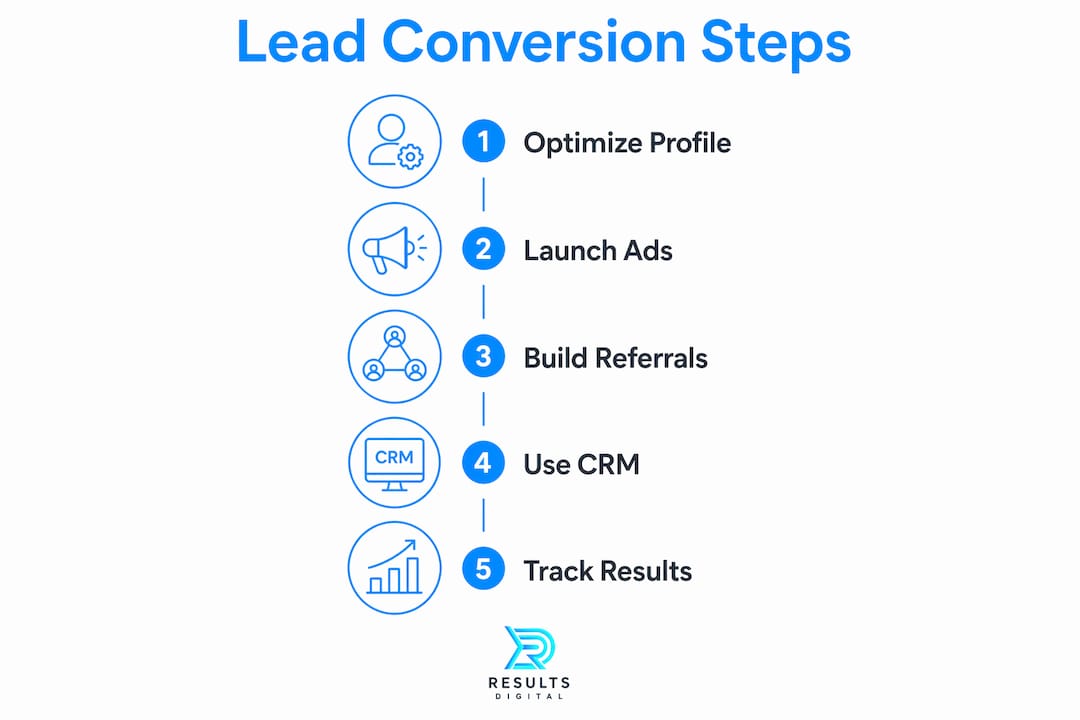
Google Ads and Google Local Service Ads serve different buyer stages. Google Local Service Ads work best when buyers want to talk immediately, typically for smaller or urgent projects. Google Search Ads perform better for larger, more complex scopes where the homeowner is researching and comparing options. Google Ads targeting high-intent keywords can produce leads within 24 hours, but the cost per lead is high. Use paid ads to fill schedule gaps, not as your primary long-term channel.
| Channel | Best for | Cost profile | Lead quality |
|---|---|---|---|
| Google Local Service Ads | Immediate, smaller projects | Pay per lead | High intent |
| Google Search Ads | Larger scope, research phase | Pay per click | High intent |
| Organic SEO | Long-term visibility | Time investment | Very high |
| Referral program | Warm introductions | Low cost | Highest close rate |
Your contact forms matter more than most contractors think. A form with more than five fields kills conversions. Ask for name, phone, project type, and zip code. That is enough to qualify a lead and start a conversation. Every extra field you add reduces the number of people who complete it.
Effective SEO for contractors compounds over time in a way paid ads never can. A well-ranked page generates leads every month without an ongoing ad spend. Pair your SEO with contractor-specific Google Ads to cover both the immediate and long-term pipeline simultaneously.
How does CRM integration improve your closing rate and marketing ROI?
Flying blind on lead sources is one of the most expensive mistakes a contractor can make. If you do not know which channel produced a booked job, you cannot make smart decisions about where to invest next. Connecting lead sources into a CRM workflow ensures every inquiry is tracked, followed up on, and analyzed from first contact to won or lost job.
The mechanics are straightforward. Every lead source, whether Google Ads, referral, permit outreach, or organic search, gets a source tag when it enters your CRM. Tools like JobNimbus, HubSpot, or ServiceTitan let you assign follow-up tasks, set reminder timelines, and track conversion rates by source. When you review your numbers monthly, you will quickly see which channels produce booked jobs and which produce tire-kickers.
Assign every lead to a specific person with a specific follow-up deadline. Unassigned leads die. A lead that does not receive a response within two hours is 10 times less likely to convert than one contacted immediately. Speed to response is a competitive advantage most contractors ignore.
- Tag every lead with its source at intake
- Set a two-hour response target for all new inquiries
- Track lead status: new, contacted, quoted, won, lost
- Review source-to-close data monthly to reallocate budget
- Use lost job data to identify pricing or messaging gaps
Pro Tip: Use a CRM workflow built for contractors to automate follow-up reminders. Missing a callback on a $40,000 remodel because it slipped through a spreadsheet is a problem you can solve today.
Key takeaways
A sustainable contractor lead generation system requires owned channels, paid search, direct outreach, and CRM tracking working together, not in isolation.
| Point | Details |
|---|---|
| Owned channels dominate lead volume | Google Business Profile and referrals generate 60–80% of total contractor leads. |
| Referral timing is everything | Ask for referrals at the final walkthrough to capture peak client satisfaction. |
| Permit data gives early access | Reaching prospects during planning triples close rates versus the competitive bid phase. |
| Landing pages beat homepages | Service-specific pages convert paid and organic traffic at a significantly higher rate. |
| CRM tracking prevents revenue leaks | Tagging and following up every lead by source reveals which channels produce booked jobs. |
What I have learned about contractor lead generation after years in the field
Most contractors I work with come to us chasing volume. They want more leads, full stop. What they actually need is fewer, better leads from channels they control. The contractors who grow fastest are not the ones spending the most on lead platforms. They are the ones who have locked down their Google Business Profile, built a referral system that runs on autopilot, and know their cost per booked job down to the dollar.
The permit lead strategy is one I rarely see contractors using well, and it is a genuine competitive edge. Getting in front of a homeowner while they are still planning a project changes the entire dynamic of the conversation. You are a trusted advisor, not just another bid.
The uncomfortable truth about paid ads is that they work best as a supplement, not a foundation. I have seen contractors spend $8,000 a month on Google Ads with no landing pages and no CRM follow-up, then wonder why their close rate is 5%. The ads were not the problem. The system around them was broken.
Build the foundation first: optimize your profile, systematize your referrals, and get a CRM in place. Then add paid traffic on top of a system that can actually convert it. That sequence is what separates contractors who grow from those who stay stuck.
— Results
How Resultsdigitalus helps general contractors build a full lead pipeline
General contractors who want a predictable lead pipeline need more than a single tactic. They need a connected system built specifically for their trade and their market.
Resultsdigitalus is a veteran-owned digital marketing agency built exclusively for contractors. We deliver SEO and Google Ads for general contractors engineered to produce booked jobs, not just clicks. Every campaign we build includes service-specific landing pages, call tracking, and CRM integration so you know exactly what is working. Our exclusivity model means we work with only one general contractor per market, so your strategy never benefits a competitor. No long-term contracts. We earn your business every month. If you are ready to build a lead system that scales, explore our contractor marketing services and see what a focused strategy looks like in practice.
FAQ
What are the best ways to attract leads as a general contractor?
The best ways to attract leads combine an optimized Google Business Profile, a structured referral program, and targeted Google Ads. Owned channels like referrals and organic search generate 60–80% of total contractor leads and close at the highest rates.
How do referrals compare to paid lead platforms for contractors?
Referred leads close at 40–50%, while leads from shared platforms close at 10–20%. Referrals cost less to acquire and convert at more than twice the rate of cold platform leads.
How quickly can Google Ads generate construction leads?
Google Ads targeting high-intent keywords can produce leads within 24 hours of campaign launch. The cost per lead is higher than organic sources, so pair paid ads with strong landing pages and CRM follow-up to protect your ROI.
What is building permit lead sourcing for contractors?
Building permit lead sourcing means using public permit data to identify upcoming construction projects before they go out to competitive bid. Platforms like PermitGrab aggregate and enrich this data, giving contractors direct access to project owners during the planning phase.
How many leads should a general contractor track in a CRM?
Every lead, regardless of source or project size, should be tracked in a CRM with a source tag, follow-up owner, and status update. Tracking from inquiry to won or lost reveals which channels produce the highest-value booked jobs.
