
Google SGE now pulls answers straight from your Google Business Profile, structured data, and reviews before it ever reaches your website copy. If those signals are incomplete, a competitor gets cited and you don’t. Your priority this week: make your Google Business Profile and top service pages citation-ready, then shift your tracking from clicks to calls and mentions.
TL;DR:
- Optimize your Google Business Profile by filling out every field, posting weekly updates, and actively managing reviews to improve AI citation chances.
- Deploy structured data schema on service pages and ensure each page provides a clear, localized answer to boost AI extraction and ranking.
- Focus on building authoritative, unique service pages with concise answers and local context, avoiding generic, templated location pages.
- Track mentions and citations in AI Overviews through manual audits and monitor GBP impressions to gauge how often your business is featured instead of relying solely on click metrics.
- Prioritize quick fixes like updating GBP details and review acquisition before overhauling your website, as these influence AI citations faster.
Table of Contents
- What Is Google SGE and Why Does It Matter for Contractors?
- How Does SGE Find Information About Your Business?
- What Should Contractors Fix First for SGE Visibility?
- Structuring Content So AI Overviews Cite Your Pages
- How Do You Optimize Your Google Business Profile for AI Overviews?
- What Metrics Actually Show SGE Is Working?
- How One Contractor-Focused Agency Approaches SGE
- The Playbook That Actually Moves the Needle
- How Resultsdigitalus Helps Contractors Win AI Overview Citations
- Where to Verify SGE Signals and Tools
- Sources
What Is Google SGE and Why Does It Matter for Contractors?
Google’s Search Generative Experience, also called AI Overviews, generates a summarized answer at the top of the results page instead of sending searchers straight to a list of ten blue links. For a query like “roof repair near me” or “emergency plumber cost,” the AI Overview synthesizes an answer from multiple sources and often names one or two businesses directly in that summary.
This changes the math for local trades. SGE summarizes information across multiple sources rather than ranking pages in order, which means the old goal, getting a blue link into position one, matters less than getting your business named inside the summary itself.
Zero-click behavior is the real shift. When SGE answers the question directly on the results page, fewer people click through to any website at all. A homeowner asking “how much does gutter replacement cost” might get a full answer, a price range, and a business name without visiting a single site. If that business name isn’t yours, you never even show up as an option.
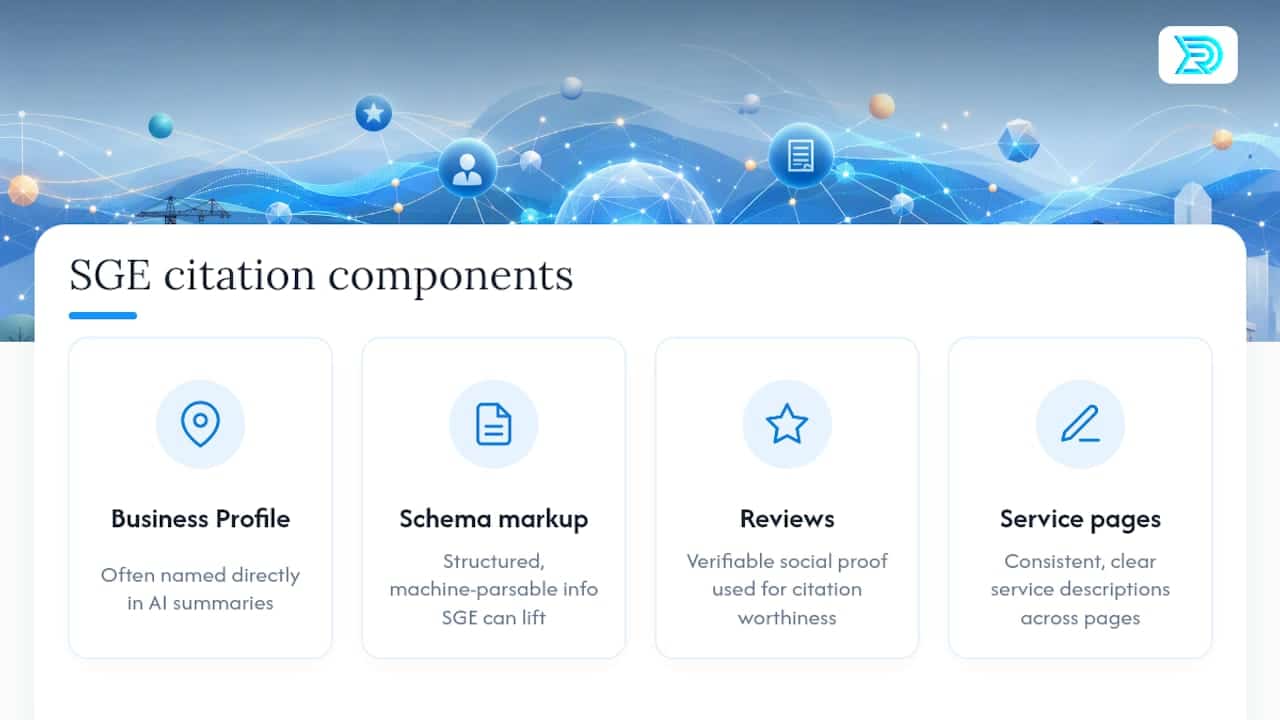
The practical consequence: ranking well used to be the finish line. Now it’s just the entry fee. Being citation-worthy, having the kind of structured, verifiable information that an AI system can lift and trust, is the new competitive edge. That means your Google Business Profile, your schema markup, your reviews, and your service pages all need to say the same clear thing in a format a machine can parse instantly. Contractors who treat this as a formatting exercise rather than a content exercise tend to move faster than competitors still chasing backlinks.
How Does SGE Find Information About Your Business?
SGE doesn’t crawl your website the way traditional search does. It draws from a narrower, more structured set of signals, and understanding the hierarchy tells you exactly where to spend your time.
Google Business Profile is the primary source. GBP activity, posts, Q&A, reviews, is a major input for AI Overviews, which means a profile you update weekly carries more weight than one you set up once and ignored. Former Google insiders note that businesses with strong, active GBP profiles sometimes get cited over competitors with technically superior websites, simply because the profile gives the AI cleaner, more current data to work with.
Beyond GBP, four other signal types feed the system:
- Structured data (schema markup): LocalBusiness and Service JSON-LD tell Google explicitly what you do, where you do it, and what it costs, removing the guesswork that plain text requires.
- Review content: Not just star ratings, but the actual text of reviews, since AI models scan review language for service details, response times, and satisfaction signals.
- Photos and posts: Recent, geotagged project photos and weekly GBP posts act as freshness signals that tell the algorithm your business is active right now, not dormant.
- On-site service content: Pages with clear, concise answers near the top still get cited when the topic requires more nuance than a GBP snippet can hold, like financing options or multi-step processes.
On-site content still wins citations for complex questions, anything involving comparisons, financing, or step-by-step processes usually needs a real page, not a profile field. But for the simple, high-volume queries, “who does X near me,” GBP completeness now outweighs almost everything else.
What Should Contractors Fix First for SGE Visibility?
Not every fix matters equally, and trying to do everything at once usually means nothing gets done well. Here’s the order that produces results fastest, based on how these signals actually get weighted.
- Complete and verify your Google Business Profile. Fill every field, service categories, service areas, attributes, booking links, and business description. An 80% complete profile is invisible next to a competitor’s 100%.
- Deploy LocalBusiness and Service schema sitewide. Every service page needs JSON-LD that spells out the service name, area served, and price range in machine-readable format, not just prose.
- Build focused service pages with concise answer blocks. One deep page per service (roof replacement, gutter installation, siding repair) with a two or three sentence direct answer near the top, followed by detail.
- Run an accelerated review acquisition program. Volume and recency both matter; a business earning five reviews a week reads as more active than one sitting on 200 reviews from three years ago. Respond to every review, good or bad.
- Fix site speed and mobile performance. If a page loads slowly or renders poorly on mobile, AI crawlers may fail to extract a clean snippet, even from good content.
- Add Q&A and FAQ blocks to service pages, marked with schema. These mirror the exact question-and-answer format AI Overviews already use, making your content easier to lift verbatim.
Pro Tip: Don’t wait for a full website overhaul before touching your Google Business Profile. GBP changes can influence AI Overview citations within days, while schema and page rebuilds take weeks to show up. Fix the fast lever first.
Combining these efforts with a strong service area business strategy keeps satellite pages from competing against each other while still covering every ZIP code you actually work.
Structuring Content So AI Overviews Cite Your Pages
The pillar-and-satellite model works better for SGE than a pile of near-duplicate location pages. Build one deep, authoritative page per core service, roofing replacement, gutter guards, siding repair, and let that page anchor a handful of specific local or intent-based satellite pages that each answer a narrower question a real customer types into Google.
Local SEO surveys, including Whitespark-style factor analysis cited in contractor marketing research, consistently rank Google Business Profile signals among the heaviest-weighted local ranking factors, and SGE appears to amplify that weight further by pulling GBP data directly into generated summaries.
Three structural habits separate citation-worthy pages from ignored ones:
- Place a two-to-three sentence direct answer immediately below the H1, before any marketing copy, since AI extraction tends to favor the first concise block of text on a page.
- Build project or case pages with structured metadata, location, scope of work, and outcome, rather than generic before-and-after galleries with no context.
- Avoid mass-producing templated service-area pages that swap only the city name; each page needs a genuinely local detail, a nearby landmark, a specific permit requirement, a climate factor, that a generic template can’t fake.
A page that says “we serve Austin, Round Rock, and Georgetown” with identical paragraphs under each city name reads as thin to both users and AI systems. One with a specific answer block, real project photos, and unique local context gets pulled into a summary far more often.
How Do You Optimize Your Google Business Profile for AI Overviews?
Your GBP listing is doing more work than your website right now, and the fields you fill in determine whether SGE trusts your business enough to cite it. Start with the categories: choose the most specific primary category available (not just “Contractor” but “Roofing Contractor” or “Gutter Installer”) and stack secondary categories underneath it. Then list every service area explicitly rather than relying on a single pinned address, and add booking or quote-request links wherever the interface allows it.
Photos and posts function as freshness signals. A profile with recent, geotagged job-site photos, crews on ladders, finished siding jobs, before-and-afters with dates, reads as active. Posting weekly, even a short update about a completed job or a seasonal reminder, keeps the profile in the rotation that AI systems treat as current.
Q&A sections deserve active management rather than passive hope. Post the five or six questions homeowners actually ask (“Do you offer financing?” “How long does a roof replacement take?”) and answer them yourself before a stranger posts a wrong answer that sits there for months.
- Ask for reviews within 24 hours of job completion, when satisfaction is highest and memory is freshest.
- Send a direct link, not a general request, since fewer clicks between the ask and the review form dramatically raises completion rates.
- Respond to every review within 48 hours, since response activity itself is a signal of an actively managed profile.
Pro Tip: Ask happy customers to mention the specific service by name in their review. “Fast, clean roof replacement” gives AI Overviews more usable language than “Great job, thanks!”
What Metrics Actually Show SGE Is Working?
Traffic dashboards built around clicks will lie to you in the SGE era. A drop in organic clicks doesn’t necessarily mean a drop in demand; it might mean SGE answered the question before the searcher ever clicked anything, and your business was the one it named.
Shift your primary KPIs toward:
- Call volume from tracked numbers, since a phone call is a much stronger buying signal than a click ever was.
- Booked estimates and quote requests, which tie directly to revenue rather than to a vanity traffic metric.
- GBP impressions and search appearances, visible in your Business Profile insights, showing how often you’re surfacing even when no click occurs.
- Mention rate, manually checking whether your business name appears in AI Overview summaries for your priority queries.
Call tracking with unique tracked numbers on your GBP listing versus your website tells you which channel is actually generating the phone to ring. Layer in UTM parameters on any links inside GBP posts or booking buttons to separate that traffic from organic search.
If clicks fall but calls hold steady or climb, that’s not a red flag, it’s the expected pattern when SGE is doing its job well and sending qualified callers your way instead of curious clickers.
How One Contractor-Focused Agency Approaches SGE
Resultsdigitalus has worked exclusively with roofing, siding, gutter, and general contracting companies since its founding in Montgomery, Texas in 2015 under founder Preston Toor. That singular focus shapes how the agency sequences SGE work: audit and complete the Google Business Profile first, deploy LocalBusiness and Service schema across the site next, then build three to six priority service pages with concise answer blocks before launching a sustained review program.

One Florida roofing client grew from 3 crews to 18 crews before selling the business for $60 million, a trajectory built on the same fundamentals covered here: profile completeness, structured data, and consistent review velocity, not one clever trick.
A realistic starter checklist: verify every GBP field, add Service schema to your top three pages, request five reviews this week, and audit whether your homepage answers “what do you do and where” in the first two sentences.
The Playbook That Actually Moves the Needle
Most advice on this topic treats SGE like a technical SEO problem, fix the code, add the markup, wait. That undersells what’s actually happening. SGE rewards businesses that look active and verifiable in the same way a homeowner judges a contractor: recent work, real feedback, clear answers to obvious questions. The mechanics (schema, JSON-LD, structured fields) matter because they translate that human trust signal into a format a machine can read, not because the markup itself is magic.
Where conventional advice falls short is pacing. Guides tell contractors to “optimize everything,” but a profile updated once and left alone loses ground within weeks, while a page rebuilt with concise answers but no review momentum behind it rarely gets cited either. Sequence matters more than completeness.
Prioritize the Google Business Profile first, always. It updates fastest, it costs nothing, and SGE draws from it more heavily than any other single source. Everything else, schema, service pages, review programs, builds on that foundation rather than replacing it.
— Results
How Resultsdigitalus Helps Contractors Win AI Overview Citations
Resultsdigitalus is the alternative to a generic marketing retainer for contractors trying to get cited in AI Overviews, built exclusively around one company per trade per market, so the schema, the service pages, and the review program running for you aren’t shared with a competing roofer three towns over.
Our team handles the full sequence: Google Business Profile optimization, LocalBusiness and Service schema deployment, service-page builds with citation-ready answer blocks, structured review acquisition programs, and call tracking that shows you exactly which calls came from which source. There’s no long-term contract locking you in while you wait to see results. If you want a clear picture of where your profile and pages stand today, start with a contractor lead generation strategy built around your market and see what a focused, trade-exclusive approach looks like for your business.
Where to Verify SGE Signals and Tools
For hands-on implementation, Google’s own Business Profile help center documents every field worth completing, and Schema.org’s LocalBusiness and Service documentation covers the exact markup structure AI Overviews parse. For ongoing monitoring, rank tracking platforms with AI Overview detection features and manual query audits, checking your priority search terms weekly, remain the most reliable way to confirm whether your business is actually being cited. Pairing that internal tracking with construction-focused AI tools built for project and risk management can also round out how a contracting business uses AI beyond marketing alone.
Sources
- How Google SGE Affects Local Service Businesses | BizAI SEO Intelligence
- (https://www.roofingcontractor.com/articles/99751-video-how-google-search-changes-impact-your-business)
