
Post 4 to 8 times a month, or roughly 1 to 2 times per week. That’s the baseline for most roofing companies, and it’s the number to start with if you’re not posting at all right now.
Adjust from there based on your market. Small, low-competition shops can get by on 2 posts a month just to keep the lights on. Roofers in metro areas or storm-prone regions should push toward 12 to 16 posts a month, closer to 3 to 4 times a week, because industry benchmarks show that competitive home-service markets reward higher frequency.
Here’s why the number matters at all:
- Standard Google Business Profile posts remain visible for about a week before archiving, so posting at least once weekly helps keep your profile looking active.
- Consistent posting is a freshness signal Google’s algorithm and homeowners both notice.
- More visible activity tends to translate into more calls, more direction requests, and more website clicks from your profile.
4 to 8 posts a month is the number to build your calendar around. Everything else in this guide is about executing that number without burning your Friday afternoons.
Key Takeaways
Roofers should publish 4 to 8 Google Business Profile posts monthly as a baseline, scaling to 12 to 16 in storm or metro markets, because consistent posting exploits the platform’s seven-day visibility cycle.
| Point | Details |
|---|---|
| Baseline cadence | Post 4 to 8 times monthly (1 to 2 per week) for most roofing companies. |
| Storm market cadence | Scale to 12 to 16 posts monthly (3 to 4 per week) during active storm season. |
| Content priority order | Post job completions first, then seasonal offers, then review highlights, then tips. |
| Measure before scaling | Track calls, direction requests, and click-through rate over a 90-day test. |
| Agency option | Results Digital manages posting cadence and ties it to SEO and measurable lead outcomes. |
Table of Contents
- How Many Google Business Profile Posts Should a Roofer Publish Monthly by Market Type?
- What Should Roofers Actually Post on Google Business Profile?
- How Do You Schedule and Batch Google Business Profile Posts?
- What Are the Technical Best Practices for Google Business Profile Posts?
- How Do You Measure Whether Google Business Profile Posts Are Working?
- Should You Post This Month, or Fix Your Profile First?
- What Does Agency-Managed Google Business Profile Posting Look Like in Practice?
- Why Posting Consistency Beats Chasing a Magic Number
- Let Results Digital Manage Your Google Business Profile Posting
- Sources
How Many Google Business Profile Posts Should a Roofer Publish Monthly by Market Type?
The right cadence depends on two things: how much competition you’re facing in local search, and how much real material your crews generate in a given month. A four-crew roofer working through hail season has a different posting reality than a two-person outfit doing mostly repairs. Below are four cadences you can copy directly into your content calendar.
1. Minimum cadence: 2 posts per month
This is the floor, not a goal. It fits very small shops, owner-operators juggling sales and installs, or roofers in rural markets with little local search competition. Two posts a month keeps your profile from going dark, but it won’t do much for visibility on its own. Think of this as damage control, not a strategy.
2. Baseline cadence: 4 to 8 posts per month (1 to 2 per week)
This is where most roofing contractors should live. It matches the 1 to 2 posts per week benchmark that shows up across local SEO research, and it’s achievable for a solo marketer or an office manager handling posting on the side. At this cadence you can cover one job-completion post and one seasonal or offer post most weeks without scrambling for content.
3. Growth cadence: 9 to 12 posts per month (2 to 3 per week)
Multi-crew operators in markets with steady competition should aim here. Local SEO practitioners frequently recommend 2 to 3 posts weekly as the sweet spot for local service businesses trying to outpace competitors who post sporadically. This cadence also gives you room to test different post types (a promo one week, a review highlight the next) and see what actually drives clicks.
4. High-frequency cadence: 12 to 16 posts per month (3 to 4 per week)
Reserve this tier for storm markets and larger operators with constant job activity. When hail or wind events hit a region, homeowner search volume spikes fast, and profiles posting daily updates on availability, insurance claim help, and completed repairs capture disproportionate attention. Outside of storm season, dial this back to the growth cadence. Sustaining 3 to 4 posts a week year round usually isn’t worth the labor unless you have a dedicated content person.
When time is tight and you can’t hit your target cadence, prioritize in this order:
- Job completion photos (they prove you’re actively working and build trust fast).
- Seasonal offers and storm-related updates (they’re timely and often drive the most calls).
- Review highlights and social proof (they reinforce credibility without needing new photos).
- Educational tips (useful, but the lowest priority when time runs short).
What Should Roofers Actually Post on Google Business Profile?
Running out of things to post is the number one reason roofers abandon their Google Business Profile after a month or two. The fix is a rotation of seven content categories, not a search for something new every week.
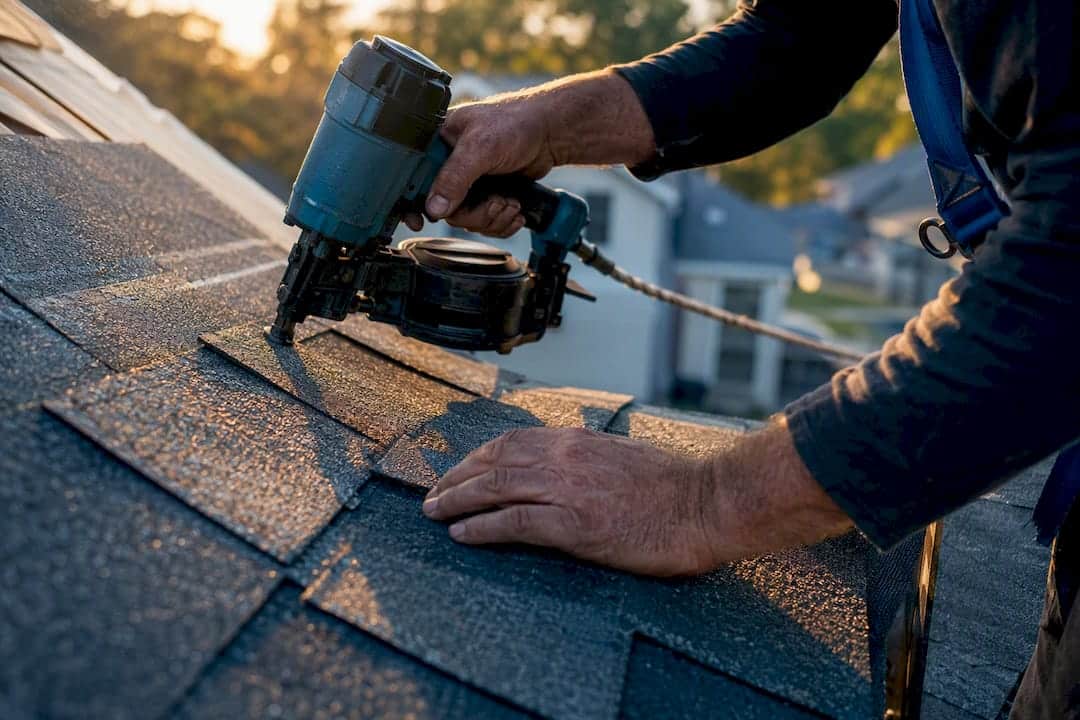
- Job completion and project photos. Before-and-after shots of a finished roof are the highest-performing content type for contractor-specific GBP guides, and they double as portfolio proof for anyone browsing your profile.
- Weather and seasonal triggers. Storm warnings, freeze-thaw damage reminders, and spring inspection pushes tie your services to what homeowners are already worried about that week.
- Offers and promos. A discount on inspections, a financing option, or a referral bonus gives browsers a reason to act now instead of bookmarking your profile for later.
- Review highlights and social proof. Screenshot a strong review, pair it with a photo from that job, and let the customer’s words do the selling.
- Educational tips. Short posts on warning signs of roof damage or maintenance basics position you as the local expert, even if they don’t convert as fast as a job photo.
- Team and crew spotlights. Homeowners hire people, not logos. A quick post introducing your lead installer builds trust before the first phone call.
- Neighborhood and zip code updates. Mentioning specific streets or subdivisions where you’ve completed work helps you show up in hyperlocal searches and signals you’re active nearby.
Map these categories to your cadence. In a slow month, stick to job completions and one educational post. During storm season, lean hard into weather triggers and offers, since urgency is doing most of the conversion work for you.
Every post needs a clear next step. Match your call-to-action to the content type: “Book a free inspection” for seasonal posts, “Call now” for storm response, “Learn more” for educational tips, and “Claim this offer” for promos.
Pro Tip: Write your CTA before you write the caption. If you can’t name one clear action you want the reader to take, the post isn’t ready to publish.
How Do You Schedule and Batch Google Business Profile Posts?
The roofers who post consistently almost never do it one post at a time. They batch an entire month’s content in a single sitting, usually 60 to 90 minutes, and schedule it out. Here’s the workflow that makes that possible.
- Capture photos on every job. Make it standard practice for crews to snap before, during, and after shots. You need volume to choose from, not just one good picture per project.
- Pick your best 12 images at month’s end. Sort by job type, lighting quality, and whether the shot clearly shows finished work. Twelve images covers a baseline-to-growth cadence for the month.
- Write captions using a simple template. Something like: “[Job type] completed in [neighborhood/zip]. [One proof detail, like material or warranty]. [CTA].” Keep it to two or three sentences.
- Schedule through Google Business Profile’s built-in post manager or a supported third-party scheduler. Batch-scheduling means you’re not logging in weekly to post manually.
A few reusable habits make this repeatable every month. Name your photo files descriptively (e.g., “shingle-repair-oakwood-ave.jpg”) instead of leaving default camera filenames, since it’s a minor discoverability signal and keeps your library organized. Keep a short list of proof prompts on hand, like warranty length, material brand, or completion time, so captions don’t take longer to write than the job itself.
Timing matters more than most contractors assume. Weekday late mornings tend to align with when homeowners are actively searching for contractors, based on patterns local SEO practitioners have documented in scheduling research. Avoid posting late at night or on weekends when search volume for “roofer near me” drops off. For storm events, throw the calendar out. Post same-day updates on availability and emergency response, since urgency beats polish in that window.

What Are the Technical Best Practices for Google Business Profile Posts?
A well-timed post that displays badly or says nothing useful won’t move the needle. Google’s own community guidance emphasizes quality and truthfulness over volume, and the technical details below are what separate a post that converts from one that gets scrolled past.
Image specs:
- Minimum resolution of 720×720 pixels; 1200×900 displays noticeably sharper on both mobile and desktop.
- Use JPG or PNG file formats.
- Never use your logo as the main image. Real job photos consistently outperform branded graphics on engagement.
- Use descriptive file names before uploading, not “IMG_4821.jpg.”
Text and CTA guidance:
- Keep captions under 1,500 characters, though 2 to 3 short sentences perform better than a wall of text.
- Include exactly one CTA per post. Multiple competing actions confuse the reader and dilute clicks.
- Add one proof element per post: a before-and-after pair, a warranty length, or a quick stat about the job.
Offer and event rules:
- Every offer post needs a clear start and end date. An expired offer left live looks careless and erodes trust.
- Update or remove event posts once the date passes.
- Before publishing anything, confirm your hours, service areas, and phone number are current. A great post pointing to a wrong phone number wastes the click entirely.
Because standard posts archive after roughly seven days, a technically clean post that runs its full week does more for you than three rushed posts published and forgotten.
How Do You Measure Whether Google Business Profile Posts Are Working?
Posting without measurement is flying blind. You need to know if the activity is generating calls, not just filling a calendar. Google Business Profile Insights gives you five numbers worth tracking every month:
- Calls generated directly from the profile.
- Direction requests (a strong signal of local purchase intent).
- Website clicks from the profile to your site.
- Post impressions (how many people saw each post).
- Click-through rate on individual posts, which tells you which content categories are actually working.
Run a simple 90-day test before you commit to any cadence long-term. Spend the first 30 days establishing a baseline: don’t change your posting habits, just record your current numbers. Over the next 60 days, implement your target cadence consistently. At the end, compare the lift in calls and clicks against the time you invested. Agency benchmarks suggest consistent GBP activity can correlate with meaningful year-over-year lead growth, though results vary widely by market and must be measured against your own baseline, not someone else’s case study.
| KPI | What it tells you | Action if flat after 60 days |
|---|---|---|
| Calls | Direct lead volume from the profile | Test a stronger CTA or add more proof elements |
| Direction requests | Local intent to visit or meet in person | Check your service area accuracy and hours |
| Website clicks | Interest strong enough to seek more info | Add a link to a specific landing page, not just your homepage |
| Post impressions | How often your posts get seen | Increase cadence toward the growth tier |
| Click-through rate | Which content categories convert | Shift rotation toward the top-performing category |
If impressions climb but clicks stay flat, the problem is usually the CTA or image quality, not the frequency. If impressions themselves are low, that’s when scaling up posting volume actually makes sense.
Should You Post This Month, or Fix Your Profile First?
Posting into a broken or incomplete profile wastes the effort. Run through this checklist before you schedule anything:
- Is your profile verified? An unverified listing can’t display posts reliably and undermines everything else you do.
- Are your hours and services accurate? Wrong hours generate wasted calls and bad reviews you didn’t earn.
- Do you have recent photos on the profile itself, not just in your post history?
- Do you have a process for responding to reviews, good and bad, within a few days?
- Do you have a truthful update worth posting, or are you about to publish filler just to hit a number?
If any of the first four items fail, fix that before you post. An unverified profile needs a call to Google support. Missing hours or services take five minutes to update in your profile dashboard. No recent photos means your next job is your content opportunity. No review response process means picking one person on your team to own it weekly, even if it’s just three sentences per reply.
Google’s own guidance backs this order of operations: posting quality and truthfulness matter more than post volume, and a profile with the fundamentals in place converts far better than one racking up posts on a broken foundation.
What Does Agency-Managed Google Business Profile Posting Look Like in Practice?
Results Digital is a veteran-owned digital marketing agency founded in 2015, built exclusively for roofing, siding, gutter, and general contracting companies. GBP posting is one piece of a larger local visibility stack that also includes SEO and paid ads, and the agency works with only one company per trade per market, so the strategy isn’t split across competitors.
A typical monthly workflow looks like this: batch photo collection from active jobs, a rotation of 8 to 12 posts scheduled across job completions, seasonal triggers, and review highlights, then a monthly review of calls, direction requests, and click-through rate tied back to that specific content.
The clearest illustration of what a full-stack approach can do: Results Digital helped one Florida roofing company grow from 3 crews to 18 crews before it sold for $60 million. GBP activity was one input among several, not a standalone tactic, and that scale of outcome isn’t typical or guaranteed for every roofer.
Why Posting Consistency Beats Chasing a Magic Number
The obsession with finding the “perfect” number of monthly posts misses the actual lever. Frequency matters because it forces consistency, not because Google rewards volume for its own sake. A roofer who posts 6 times a month, every month, for a year will outperform one who posts 16 times in March and goes dark until August.
Where conventional advice falls short is treating all posts as equal. A thin promotional post with no photo does less for your visibility than a single strong job-completion post with real proof, even though both count as “one post” in a monthly tally. Quality-per-post determines whether your cadence produces calls or just activity.
Prioritize this: build the batching habit first, then worry about hitting the growth or high-frequency tier. A contractor who reliably manages the baseline cadence of 4 to 8 posts every single month, tied to real job photos and a working review process, will beat a competitor who posts erratically at higher volume.
— Results
Let Results Digital Manage Your Google Business Profile Posting
Batching photos, writing captions, and tracking click-through rates is one more task competing against estimates, job site visits, and payroll. Results Digital gives roofing contractors a done-for-you alternative: a dedicated team manages your Google Business Profile posting cadence, pairs it with SEO built specifically for roofing companies, and reports back on the same KPIs covered above, calls, direction requests, and website clicks, so you’re never guessing whether the activity is paying off.
Hiring this out saves the hours most owners lose trying to stay consistent on their own, and it keeps posting tied to a broader lead-generation strategy instead of running as an isolated task. Results Digital also builds construction-focused digital strategies around consistent, useful communication, a principle that applies directly to how contractors show up on their Google profile. Because the agency partners with only one roofing company per market, the strategy built for you isn’t shared with a competitor down the street.
If you’re ready to stop managing this yourself, request a review of your current profile and see what a dedicated contractor marketing team can do with your posting, SEO, and ad strategy combined.
Sources
The posting frequencies and technical rules in this guide draw from a mix of Google’s own documentation and local SEO benchmarking research, not guesswork.
- How often to post on Google Business Profile (HigherVisibility)
- Google Business Profile posts best practices – Google Business Profile Community
- Google Business Profile Posting: Best Practices for 2026 (Richwood Marketing)
