
TL;DR:
- Template websites erode trust and limit scalability, costing contractors more in missed leads long-term.
- Custom websites boost lead conversion rates by 2-5 times through tailored design and targeted calls to action.
- Investing in a custom site offers higher ROI, faster growth, and better trust signals for established contractors.
Most roofing and exterior contractors are losing high-value leads every single day, and they don’t even know it. The culprit isn’t bad pricing or poor service. It’s a generic, template-based website that fails to earn trust from local homeowners the moment they land on it. A cookie-cutter site signals that your business is just like every other contractor in town, and that’s a costly message to send. Custom website design changes that equation entirely. This guide breaks down exactly why tailored sites outperform templates, what the numbers look like, and how to decide which path is right for your roofing or exterior contracting business.
Table of Contents
- The limitations of template websites in roofing and exteriors
- How custom website design amplifies lead generation
- ROI comparison: Cost versus value for contractors
- When to choose custom vs. template: A decision guide
- Our take: Why custom design is non-negotiable for local roofing success
- Ready to grow? Next steps for custom website success
- Frequently asked questions
Key Takeaways
| Point | Details |
|---|---|
| Templates limit growth | Template websites look generic and can’t scale with a growing contractor business. |
| Custom boosts conversions | Tailored design and layout deliver up to 2-5 times more high-quality leads for roofers and exterior contractors. |
| ROI favors custom design | Though custom sites cost more upfront, they quickly deliver better leads and pay for themselves. |
| Local trust depends on design | Unique branding and user-focused features build homeowner trust, key to winning local jobs. |
| Decide by stage and goals | Growing contractors should invest in custom design—templates best fit for new, low-budget companies. |
The limitations of template websites in roofing and exteriors
Template websites feel like a smart shortcut when you’re trying to get online fast. They’re affordable, quick to launch, and look decent at first glance. But for roofing and exterior contractors competing in local markets, “decent” doesn’t win jobs.
The core problem is trust. Homeowners searching for a roofer are making a significant financial decision, often spending $10,000 or more. When they land on a site that looks identical to three competitors they just visited, they don’t feel confident. There’s nothing unique, nothing that signals your crew, your community, or your track record. As a brutally honest cost-benefit analysis of web design options confirms, the cookie-cutter look erodes trust and creates real barriers to lead conversion.
Beyond appearance, templates carry serious technical baggage:
- Slow load speeds from bloated code and unnecessary plugins that templates bundle in by default
- Security vulnerabilities because widely used templates are popular targets for attacks
- Rigid layouts that can’t adapt to your specific services, service areas, or sales process
- Duplicate content risks when thousands of sites share identical page structures
- Poor mobile performance that kills conversions since most homeowners search on their phones
Scalability is another hidden trap. If you’re adding service lines, expanding to new cities, or building out a multi-location operation, templates hit a ceiling fast. You end up patching workarounds instead of building a real digital foundation.
“Template sites suit startups with basic needs, but they fail growing contractors. The bloat causes slow speeds and security issues, and they simply can’t scale for complex local lead generation.”
The short-term savings of a $1,000 to $3,000 template site can quietly cost you tens of thousands in missed leads over a 12 to 24 month period. Understanding the custom design benefits for contractors makes it clear why established roofing companies treat their website as a revenue tool, not just a digital business card. If you want a deeper look at what a purpose-built site looks like, website design for roofing shows the difference in practice.
How custom website design amplifies lead generation
Now let’s see how custom-built websites actually change the numbers and the quality of your inbound leads.
Every element of a custom site is built around one goal: turning visitors into booked jobs. That means the layout, the calls to action, the contact forms, and even the navigation are all designed to match how homeowners actually make buying decisions. They don’t browse like they’re shopping for shoes. They’re anxious, looking for reassurance, and ready to call if they feel confident.
A conversion-focused website design places phone numbers at the top of every page, positions trust signals like reviews and project photos above the fold, and uses forms that ask only what’s necessary to qualify a lead. Templates can’t do this because they weren’t built for your sales process. They were built for everyone, which means they’re optimized for no one.
The performance gap is significant. Custom sites yield 2-5x higher conversion rates than template alternatives when UX and layout are tailored to the contractor’s sales flow. That’s not a marginal improvement. That’s the difference between 10 leads a month and 30 to 50.
| Feature | Template site | Custom site |
|---|---|---|
| CTA placement | Fixed/generic | Strategically placed for conversions |
| Lead forms | Standard fields | Tailored to qualify roofing leads |
| Mobile optimization | Basic responsive | Built for phone-first homeowners |
| Local trust signals | None built in | Neighborhood reviews, local photos |
| Page speed | Often slow | Optimized from the ground up |
For example, a custom lead form for a roofing company might ask about roof age, damage type, and preferred contact time. That single change filters out tire-kickers and delivers higher-quality inquiries to your sales team. Explore custom design for more leads to see real-world examples of how these elements come together, and review custom web design features for a full breakdown of what to prioritize.
Pro Tip: Run a heatmap tool like Hotjar on your current site for 30 days. You’ll quickly see where visitors drop off and which CTAs they actually click. Use that data to inform your custom design priorities before you build.
ROI comparison: Cost versus value for contractors
With the lead generation benefits established, it’s time to compare the numbers and understand the return on investment for contractors.
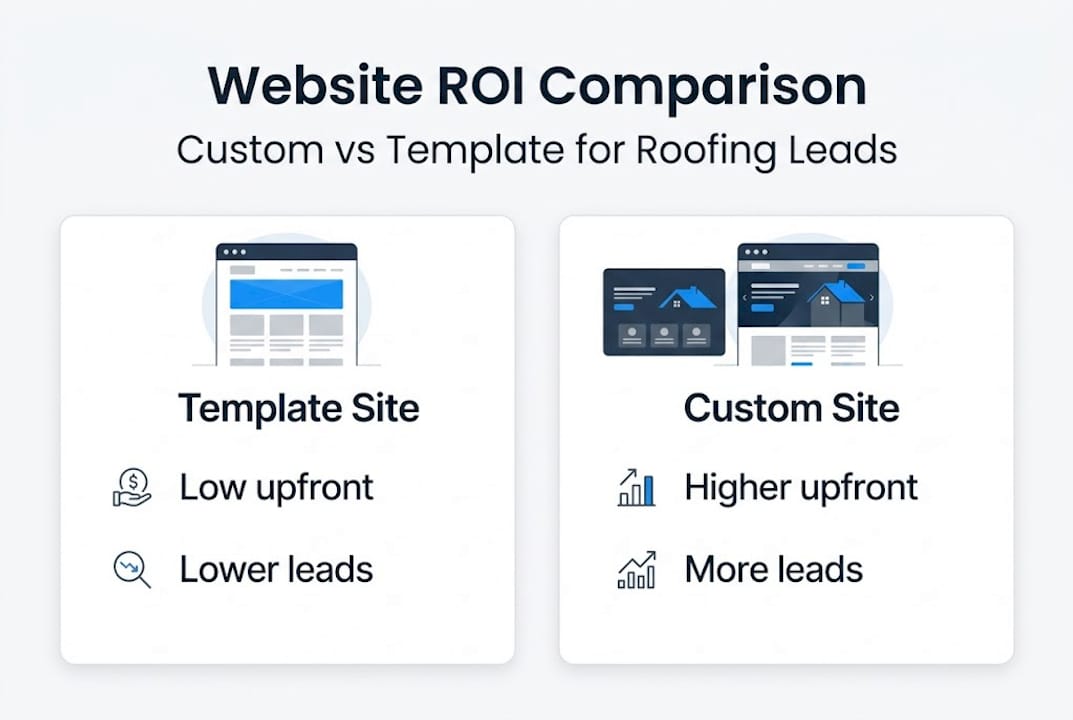
The upfront cost difference between template and custom is real. A template site typically runs $1,000 to $5,000 to set up. A professionally built custom site for a roofing contractor starts around $10,000 and can go higher depending on features, integrations, and service area complexity. That gap makes contractors hesitate. It shouldn’t.
Here’s why. A single roofing job averages $8,000 to $15,000 in revenue. If your custom site generates even two additional qualified leads per month compared to your old template, the investment pays for itself within the first 60 to 90 days. The long-term ROI is substantially higher for custom sites, with contractors seeing 3-5 times more organic traffic and a significantly lower cost-per-lead over time.
| Metric | Template site (year 1) | Custom site (year 1) |
|---|---|---|
| Upfront cost | $1,000 to $5,000 | $10,000+ |
| Monthly organic leads | 5 to 15 | 20 to 60 |
| Avg. cost per lead | $80 to $150 | $20 to $50 |
| Estimated revenue generated | $40,000 to $120,000 | $160,000 to $480,000 |
The math becomes even clearer when you factor in the cost of paid advertising. Contractors running Google Ads on a poorly converting template site pay for clicks that never become calls. A custom site with strong landing pages and clear CTAs makes every ad dollar work harder.
Here’s a simple way to think about the ROI timeline:
- Month 1 to 3: Site launches, SEO foundation builds, paid traffic starts converting at higher rates
- Month 4 to 6: Organic rankings improve, cost-per-lead drops, lead volume increases
- Month 7 to 12: Investment fully offset by additional revenue from higher conversion rates
Stat to remember: Contractors who invest in custom design for more leads routinely see their cost-per-lead cut in half within the first six months compared to template-based sites running the same ad spend.
When to choose custom vs. template: A decision guide
Armed with cost and performance facts, let’s get practical. Here’s how contractors should make the smart website choice.
Not every contractor is at the same stage, and the right decision depends on where you are and where you’re headed. A brand-new solo operator with three jobs booked and no marketing budget has different needs than a 10-person crew targeting $2 million in annual revenue.
That said, most contractors outgrow templates faster than they expect. Here are the signs you’ve hit that ceiling:
- You’re running ads but your cost-per-lead keeps climbing
- Homeowners tell you they “almost didn’t call” because your site looked outdated
- You can’t easily add new service pages or location-specific landing pages
- Your site loads slowly on mobile and you’re losing rankings
- Competitors with newer sites are winning jobs you should be getting
As the research on template limitations confirms, templates fail growing contractors by eroding trust and blocking scalability. If any of the signs above sound familiar, you’re already past the template stage.
Here’s a quick decision checklist:
- Choose a template if: You’re brand new, testing a market, or have under $500/month in marketing budget
- Choose custom if: You’re established, running ads, targeting growth, or competing in a crowded local market
For general contractors expanding service lines, design for general contractors covers the specific considerations for multi-service businesses. And if you want to understand how design directly affects homeowner trust, website design and client trust is worth your time.
Pro Tip: If your business relies on local reputation, specialty services like storm damage or commercial roofing, or referral networks, custom is not optional. Those trust signals cannot be faked with a $2,000 template.
Our take: Why custom design is non-negotiable for local roofing success
Here’s the uncomfortable truth most marketing agencies won’t say out loud: the majority of roofing contractors treat their website like a utility bill. They pay for it, they forget about it, and they wonder why their phone isn’t ringing.
In 2026, your website is your most important salesperson. It works 24 hours a day, speaks to homeowners at their most motivated moment, and either earns their trust or loses it in under five seconds. A template cannot do that job at a high level.
What most competitors miss is that boosting leads and trust isn’t about having a “nice” website. It’s about having a site engineered to convert the specific type of homeowner in your specific market. That requires custom thinking, custom structure, and custom execution. Cutting corners here doesn’t save money. It costs you market share, one lost lead at a time.
Ready to grow? Next steps for custom website success
If you’ve made it this far, you already know that a generic template is holding your business back. The question now is what to do about it.
Results Digital builds custom websites exclusively for roofing and exterior contractors, designed from the ground up to generate local leads, calls, and booked jobs. Whether you’re starting fresh or replacing a site that isn’t performing, our team can help you build a digital asset that works as hard as you do. Explore web design for roofers to see what’s possible, check out our guide on how to boost bookings in 2026, and review our lead generation workflow to understand how a high-performing site fits into a complete marketing system.
Frequently asked questions
Is a custom website really worth the higher upfront cost?
Yes. Custom sites typically generate 3-5 times more traffic than templates and offset the investment quickly through higher quality leads and lower cost-per-lead over time.
What features make custom websites better for contractors?
Custom sites include tailored CTAs, qualifying lead forms, and layouts built around your sales process, which is why they consistently deliver 2-5x higher conversion rates compared to template alternatives.
Who should still consider a template website?
Templates work for brand-new contractors testing a market with a limited budget, but as the research on template limitations shows, established or growing companies need custom design for scalability and trust.
How long does it take to launch a custom website for contractors?
A custom contractor website typically takes 6 to 12 weeks to complete, depending on the number of service pages, integrations, and how quickly content is provided.
Are security and speed really that different with custom sites?
Yes. Custom sites eliminate template bloat, making them faster and far less vulnerable to attacks. The template bloat and security issues that plague generic sites directly hurt your local SEO rankings and user experience.
