
Social media ads work for gutter businesses because they combine precise local targeting, visual proof of work, low-cost creative testing, and a retargeting funnel that converts homeowners into booked jobs faster than any yard sign or door hanger ever will. The mechanics are straightforward: you put a clogged-vs-clean before-and-after in front of homeowners within a 10-mile radius, retarget everyone who watched past the 3-second mark, and follow up within the hour. That sequence, done consistently, is what fills a schedule.
A few numbers frame the opportunity. Gutter cleaning is a large service category in the U.S., with a market size of $1.2 billion and about 60% of annual revenue concentrated between September and December. That seasonality is not a problem for paid social. It is the targeting signal. You know exactly when homeowners need you, which means you can build creative, audiences, and budget bursts around those windows before competitors even think to run an ad.
Your immediate next step: Run a single fall “before-and-after” ad to one high-demand ZIP code with a direct booking link. Set a modest daily budget, let it run for about a week, and monitor your cost per lead.
Table of Contents
- Why gutter social media ads work: the mechanics behind real leads
- Which platforms actually work for gutter businesses?
- What ad creative actually stops the scroll and converts homeowners
- How to target the right homeowners in your service area
- Campaign types and the follow-up system that turns leads into booked jobs
- How to budget for gutter social ads and which metrics to track
- Ad templates and hooks that work for cleaning, guard installs, and repairs
- How Resultsdigitalus runs gutter ad campaigns: a real-world example
- Key Takeaways
- The part most gutter contractors get wrong about social ads
Why gutter social media ads work: the mechanics behind real leads
The funnel for gutter services on paid social has four stages, and each one does a specific job.
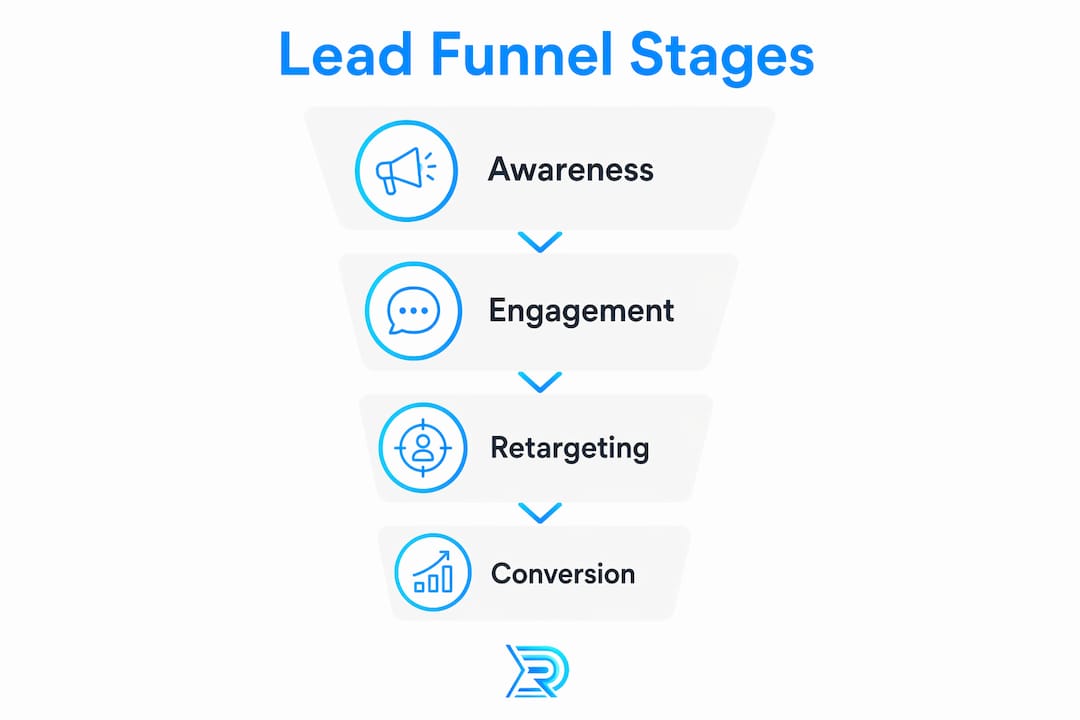
Awareness puts your brand in front of homeowners who have never searched for gutter cleaning but live in older homes in your service area. Paid social reaches homeowners before they ever type a query into Google, which means you are creating demand rather than competing for it. That distinction matters for your cost per lead.
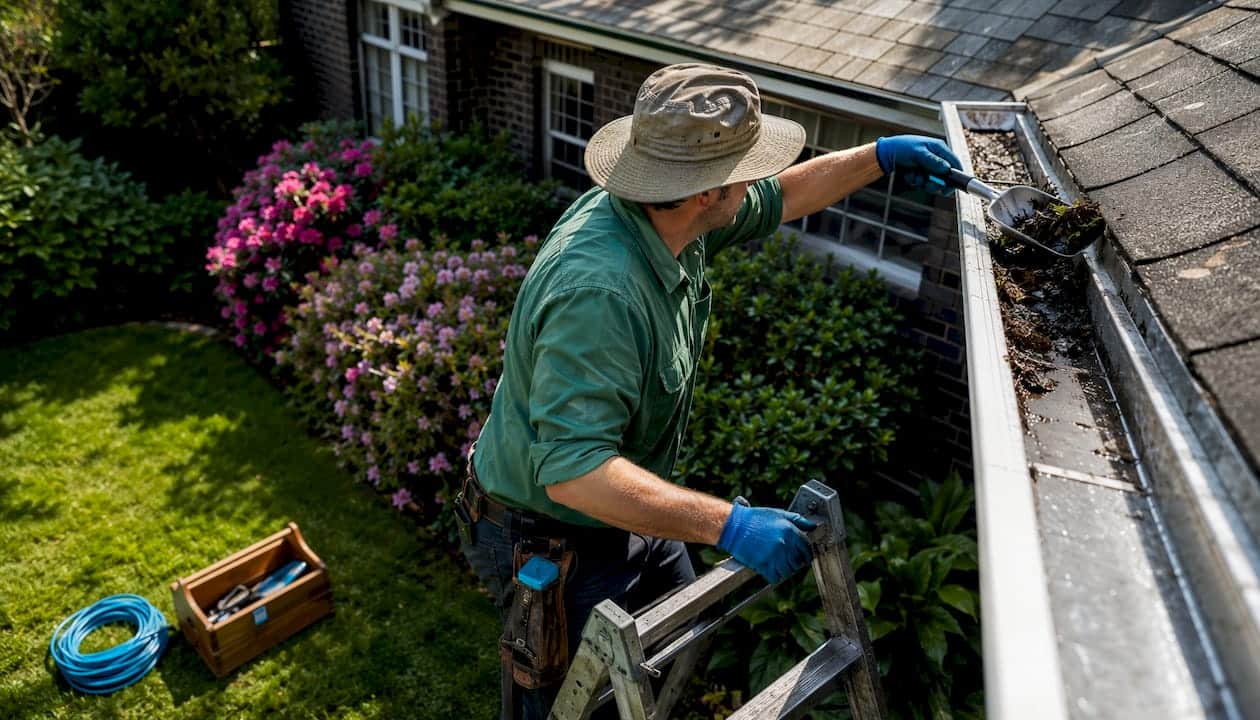
Engagement is where visual proof does the heavy lifting. A ladder-on-house hero shot or a 15-second video showing debris pouring out of a clogged gutter stops the scroll in a way that a logo ad never will. Homeowners see the problem, recognize their own gutters, and click. The trust curve shortens dramatically when the creative shows the work rather than describing it.
Retargeting is where the real efficiency lives. Once someone watches 50% of your video or clicks your ad without booking, you serve them a follow-up offer, a testimonial carousel, or a limited-slot urgency message. These audiences are warm. They already know who you are.
Conversion happens when a lead form or landing page captures the homeowner’s contact info and your team responds fast. The ad gets the click. Your follow-up system gets the job.
Stat to know: A structured Facebook Ads approach using lookalike audiences and creative rotation reduced cost per lead substantially after retargeting optimizations during a fall pilot, generating dozens of leads per week at peak.
Which platforms actually work for gutter businesses?
Not every platform deserves your budget. Here is how to think about channel selection:
- Meta (Facebook + Instagram): Your primary channel, full stop. The combination of detailed homeowner targeting, lookalike audiences, lead forms, and retargeting makes Meta the most reliable platform for gutter company lead generation. Facebook skews toward the middle-aged homeowner demographic that owns the home and writes the check. Instagram Reels and Stories work well for before-and-after short videos targeting younger suburban homeowners.
- Nextdoor: A situational channel with high local intent. Neighborhood posts and pre-storm targeting on Nextdoor can deliver several times the normal lead volume when timed about a week to 10 days ahead of a forecasted storm. Use it for fall check reminders and storm-prep messaging in specific neighborhoods.
- TikTok: Worth testing in younger suburban markets where homeowners aged 28–40 are buying their first homes. Short “satisfying clean” videos showing debris removal perform well organically and can be boosted as paid ads. TikTok builds brand reach; it rarely drives immediate bookings the way Meta does.
- LinkedIn: Skip it for cleaning and repair. It makes sense only if you are targeting property managers or HOA decision-makers for commercial gutter contracts.
Format matters as much as platform. On Meta, feed ads work for static before-and-after images; Stories and Reels demand video. On Nextdoor, neighborhood posts with a local mention (“We just cleaned 14 homes on Oak Street”) outperform generic ads. Match your creative format to the placement before you spend a dollar.
What ad creative actually stops the scroll and converts homeowners
The visual checklist that works for gutter ads is short and repeatable:
- Ladder-on-house hero shot: Shows scale, professionalism, and capability in one frame.
- Clogged-vs-clean close-up: The single highest-performing image type for cleaning campaigns. Homeowners see their own gutters in that shot.
- Crew-on-roof capability shot: Builds trust for guard installs and larger jobs.
- Warranty or product stamp close-up: Justifies price for higher-ticket guard installs.
For short video, the first 1–2 seconds must show the result, not the setup. Open on the clean gutter or the debris pouring out. Keep videos under 30 seconds for Reels and Stories. Caption hooks that mention a season or a damage risk (“Your gutters are holding 40 lbs of wet leaves right now”) outperform generic “call us today” copy.
Three ad copy templates you can adapt immediately:
- Cleaning: “Clogged gutters cause $3,000+ in water damage. We clean, flush, and inspect in one visit. Book your fall slot before they’re gone. [Get a Free Quote]”
- Guard install upsell: “Stop cleaning gutters twice a year. Our guards come with a lifetime warranty and install in a day. [See How It Works]”
- Emergency repair: “Sagging gutter pulling away from your fascia? We fix it same week. [Call Now]”
Pro Tip: Rotate your creative every 3–4 weeks during peak season. Ad fatigue hits fast in small geographic audiences. Keep 3–4 image variants and 2 video variants in rotation so the algorithm has options and your audience does not go blind to your ads.
Social proof embedded in the ad itself, such as a star rating overlay or a short testimonial snippet, raises CTR and conversion. Pairing strong visuals with reviews is one of the fastest ways to improve ad performance without changing your budget.
How to target the right homeowners in your service area
Targeting is where most gutter contractors leave money on the table. Here is a step-by-step recipe:
- Set your radius or ZIP list first. Start with a 10–15 mile radius around your base or target 3–5 specific ZIP codes where you have existing customers. Tight geography keeps CPL low and response times fast.
- Layer homeowner signals. In Meta Ads Manager, layer interests like “home improvement,” “homeownership,” and income proxies (household income top 25–50%) to filter out renters who cannot book your service.
- Add property-age targeting. Homes built before 1990 are more likely to have aging gutters. Use ZIP-level demographic data or Meta’s detailed targeting to skew toward older neighborhoods.
- Build a lookalike audience from your customer list. Upload your past customer emails or phone numbers to Meta and create a 1–2% lookalike. This audience consistently outperforms cold interest targeting once you have 200+ seed records.
- Exclude recent buyers. Create a custom audience of people who submitted a lead form in the last 90 days and exclude them from cold campaigns. You do not want to pay to reach someone who already booked.
- Set up weather-triggered rules. In Meta Ads Manager, you can create automated rules that increase your daily budget by a set percentage when a campaign hits a performance threshold. Pair this with manual monitoring during storm windows. Ship pre-storm creative 7–10 days ahead of a forecasted event.
- Retarget video viewers. Build a custom audience of people who watched 50% or more of your video ad and serve them a lead form or a testimonial carousel within 3–7 days.
Pro Tip: Tie budget bursts to your local weather forecast. When a storm system is 7–10 days out, double your daily budget on Nextdoor neighborhood posts and Meta ZIP-targeted campaigns. Pre-storm leads convert at a higher rate because urgency is real.
Campaign types and the follow-up system that turns leads into booked jobs
The campaign mix that works for gutter services follows a simple funnel:
| Campaign Stage | Ad Type | Goal | Audience |
|---|---|---|---|
| Awareness | Short video (15–30s) | Views + reach | Cold homeowner audience |
| Engagement | Carousel or image | Link clicks | Video viewers (50%+) |
| Lead capture | Instant lead form | CPL | Warm + lookalike |
| Booking | Landing page | Scheduled job | High-ticket upsell |
| Retargeting | Urgency offer | Conversion | Form openers, non-converters |
For cleaning jobs, Meta’s instant lead forms reduce friction and lower CPL. For guard installs, a dedicated landing page with a booking link converts better because the homeowner needs more information before committing to a $1,500–$3,000 job.
The follow-up system is where most contractors lose the job. Here is the operational checklist:
- Respond within 5 minutes of a lead form submission. Response time is the single biggest predictor of whether a lead converts to a booked job.
- Call first, text second. A live call closes faster than an SMS thread. If no answer, send an SMS within 2 minutes with a direct booking link.
- Push leads into your CRM immediately. Use a tool like Jobber, ServiceTitan, or HubSpot to log every lead, assign a follow-up task, and score by job type (cleaning vs. guard install vs. repair).
- Set a 24–48 hour booking SLA. If a lead is not booked within 48 hours, trigger an automated re-engagement sequence with a new offer or a scheduling link.
- Pair social ads with a recurring SMS cadence in March and September. Branded SMS reminders double re-book rates versus text-only outreach for past customers.
How to budget for gutter social ads and which metrics to track
Start lean, then scale based on what the data tells you.

| Monthly Budget | Expected CPL | Est. Leads/Month | Best For |
|---|---|---|---|
| $500 | $18–$25 | 15–25 | Single-market test |
| $500 | $15 | 40 | Active lead-gen campaign |
| $1,500–$3,000 | $9–$14 | — | Peak season scaling |
These ranges align with the CPL trajectory documented in a structured fall Facebook Ads pilot, where CPL dropped from $21.29 to $14.51 after creative rotation and later dropped further to $9.51 after retargeting optimizations were added.
Simple ROI formula: (Average ticket × lead-to-job conversion rate) ÷ ad spend = your effective CAC. If your average cleaning job is $250 and you close 30% of leads, a $15 CPL means you are spending $50 in ad cost to acquire a $250 job. That is a 5:1 return before upsells. For a deeper look at how this math scales across channels, the contractor lead generation model breaks it down by trade.
Metrics to watch:
- Daily: CPL, CTR, and ad frequency (if frequency exceeds 4, rotate creative)
- Weekly: Cost per booked job, lead-to-appointment rate, and top-performing ad creative
- Monthly: Customer acquisition cost (CAC), return on ad spend (ROAS), and LTV by job type
Flying blind on metrics is the fastest way to burn budget. If your CTR is above 1.5% but your CPL is high, the problem is your landing page or lead form. If your CPL is low but your booking rate is poor, the problem is your follow-up speed.
Ad templates and hooks that work for cleaning, guard installs, and repairs
Copy these and adapt the details to your market:
1. Fall cleaning urgency
- Headline: “Your Gutters Are Full. We Can Fix That This Week.”
- Body: “Clogged gutters cause fascia rot and foundation damage. Book your fall clean before our slots fill up.”
- CTA: Get a Free Quote | Format: Before-and-after image
2. Gutter guard upsell
- Headline: “Never Clean Your Gutters Again.”
- Body: “Our lifetime-warranty guards install in one day and pay for themselves in 2–3 years of avoided cleanings.”
- CTA: See How It Works | Format: Side-by-side comparison image or short video
3. Storm prep
- Headline: “Storm Coming? Your Gutters Need to Be Ready.”
- Body: “Blocked gutters overflow in heavy rain and send water straight into your foundation. We have openings this week.”
- CTA: Book Now | Format: Short video with weather hook
4. Emergency repair
- Headline: “Sagging Gutter? We Fix It Same Week.”
- Body: “Don’t let a pulling gutter damage your siding or soffit. Fast repair, fair price, local crew.”
- CTA: Call Now | Format: Close-up photo of damaged gutter
5. Neighborhood social proof
- Headline: “We Just Cleaned 22 Homes on [Local Street Name].”
- Body: “Your neighbors trust us. Now it’s your turn. Book before the season ends.”
- CTA: Get My Quote | Format: Crew photo with local landmark visible
Stat to know: Showing side-by-side guard comparison imagery to existing cleaning customers converts 18–28% of them into higher-LTV guard install clients. Running a dedicated upsell campaign to your past customer list is one of the highest-ROAS moves in gutter advertising.
How Resultsdigitalus runs gutter ad campaigns: a real-world example
Resultsdigitalus is a veteran-owned agency founded in 2015 in Montgomery, Texas, built exclusively for roofing, gutter, siding, and general contractors. Founder Preston Toor’s team runs Facebook Ads campaigns for gutter companies using a repeatable process that any contractor can model:
- Week 1: Quick creative shoot or AI-rendered before-and-after imagery. Build 3–4 image variants and one short video. No production studio needed.
- Week 2: Launch a one-ZIP pilot at $15–$20/day with a Meta instant lead form. Track CPL and CTR daily.
- Week 3: Build a lookalike audience from engaged users and past customer records. Expand to 3–5 adjacent ZIPs.
- Week 4: Activate retargeting for video viewers and form openers. Add an urgency offer (limited slots, seasonal discount).
- Ongoing: Rotate creative every 3–4 weeks. Push all leads into CRM with a 5-minute response SLA. Score leads by job type and follow up high-ticket guard install leads with a call-first workflow.
In one anonymized fall campaign, this process reduced CPL by more than 50% over 8 weeks while scaling lead volume to 40+ per week during peak season. The exclusivity model means every campaign runs only for one gutter company per market, so your budget is never competing against another client’s ads.
Key Takeaways
Social media ads generate consistent local leads for gutter businesses when you combine precise ZIP-level targeting, visual proof creative, and a sub-5-minute follow-up system.
| Point | Details |
|---|---|
| Start with one ZIP and one creative | Run a single before-and-after ad to one ZIP code at $10–$15/day before scaling. |
| CPL drops with retargeting | Adding lookalikes and retargeting can reduce CPL from $21.29 to $9.51 in a single fall season. |
| Upsell campaigns have the highest ROAS | Guard install upsell ads convert 18–28% of cleaning customers into higher-LTV jobs. |
| Follow-up speed determines booking rate | Responding within 5 minutes of a lead form submission is the single biggest conversion lever. |
| Seasonal timing multiplies results | Pre-storm campaigns launched 7–10 days ahead of a forecast can deliver 3–5x normal lead volume. |
The part most gutter contractors get wrong about social ads
The contractors who struggle with paid social almost always have the same problem: they treat the ad as the whole system. They spend $500 on a campaign, get 20 leads, and then take 48 hours to call them back. By then, the homeowner has already booked someone else. The ad did its job. The operation failed.
The second most common mistake is overcomplicating the lead form. A six-field form asking for address, home size, last cleaning date, and preferred appointment window will kill your conversion rate. Homeowners do not want to fill out a survey. They want to book a service. Keep the form to four fields maximum and qualify the rest on the phone.
What actually works is treating paid social as a measured experiment, not a one-time campaign. You run a small test, read the CPL and CTR data after 7 days, rotate the creative that is underperforming, and scale what works. The contractors who do this consistently are the ones who end up with a predictable lead pipeline instead of a feast-or-famine schedule.
One more thing: do not ignore the integration between your ads and your organic presence. Pairing social ads with weekly Google Business Profile photo refreshes during September through November correlates with map-pack ranking improvements. Your ads drive traffic; your GBP converts it. Both need attention during peak season. If you want to see how gutter company digital marketing works as a full system rather than a collection of tactics, that is the right place to start.
