
Contractor market positioning online is the practice of defining and communicating a specific, differentiated value proposition across digital channels so the right clients find you, trust you, and choose you over every competitor in your market. The industry term for this is digital positioning, and it goes far beyond running Google Ads or posting on social media. Most contractors lose deals not because their work is inferior, but because their messaging is generic and interchangeable, forcing buyers to default to whoever quotes the lowest price. Strong positioning fixes that at the source. This guide covers what contractor market positioning online actually means, which digital assets drive it, how Answer Engine Optimization is reshaping discovery in 2026, and how to build a phased plan that generates better leads at better margins.
What is contractor market positioning online?
Contractor market positioning online is the strategic process of shaping how potential clients perceive your business before they ever call you. It answers one question in the buyer’s mind: “Why you instead of the other guy?” According to industry positioning experts, your homepage, FAQs, and service pages are the critical battlegrounds where that perception forms, often before any direct contact happens.
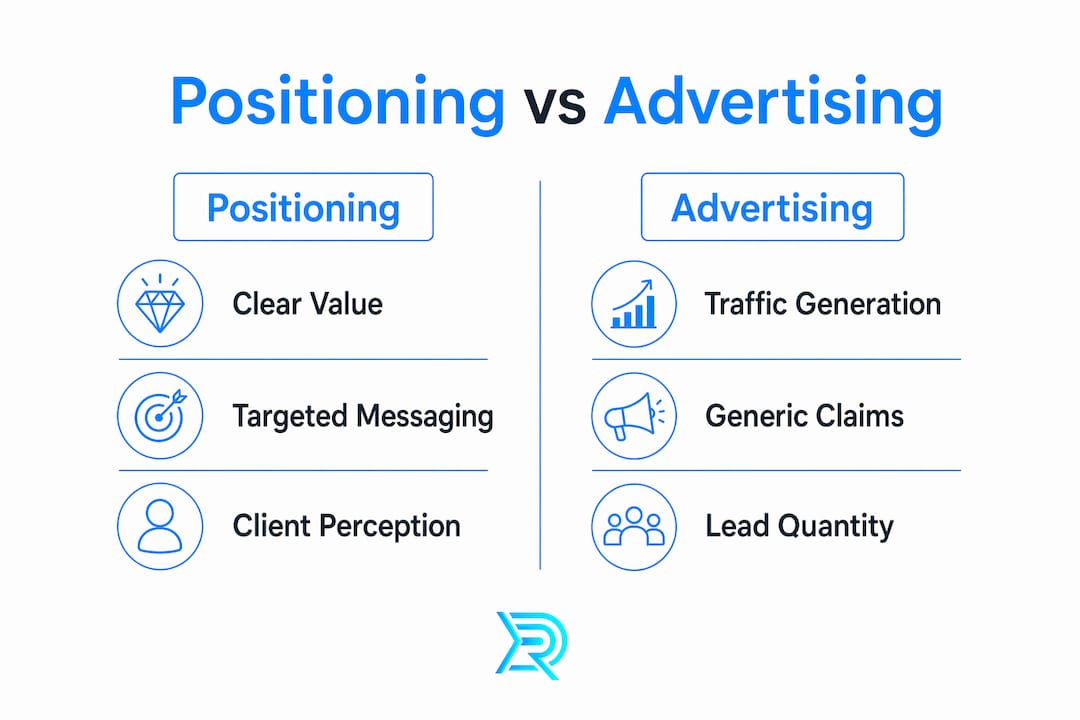
This is fundamentally different from advertising. Advertising drives traffic. Positioning determines what that traffic thinks when it arrives. A roofing contractor who runs Google Ads to a generic homepage that says “quality work, great service, free estimates” is paying to send buyers to a page that gives them no reason to choose him over the next result. The ad budget is wasted because the positioning is broken.

Effective online market positioning for contractors involves three interconnected layers: your messaging (what you say and how you say it), your digital assets (where you say it), and your proof (why anyone should believe it). When all three align, buyers perceive alternatives as riskier and less reliable. Price becomes a secondary factor rather than the deciding one.
Why generic messaging destroys your positioning
Generic claims like “quality work” cause buyers to treat contractors as interchangeable commodities, which pushes every decision toward price. This is a positioning problem, not an advertising problem. No amount of ad spend fixes messaging that fails to differentiate.
Buyers do not hire contractors. They hire solutions to specific problems. A homeowner dealing with storm damage does not want a “reliable roofing contractor.” She wants someone who handles insurance claims, gets permits pulled fast, and has photos of completed jobs in her neighborhood. The contractor who communicates that outcome wins the call, even at a higher price.
Here is the difference between generic and outcome-focused positioning in practice:
- Generic: “We provide quality roofing services with 20 years of experience.”
- Positioned: “We specialize in insurance claim roofing in [City]. Most jobs are complete in one day, and we handle the adjuster process for you.”
- Generic: “Licensed, insured, and family-owned general contractor.”
- Positioned: “We build custom additions for growing families in [County]. Every project includes a fixed-price contract and weekly photo updates.”
The positioned versions answer the buyer’s real question: what specific problem do you solve, for whom, and with what outcome? That specificity builds trust before the first conversation even starts. Better positioning also gives contractors the leverage to raise prices without losing clients, because buyers are no longer comparing you on price alone. They are comparing you on perceived risk and reliability.
Pro Tip: Write your positioning statement from the buyer’s perspective, not yours. Replace “we offer” with “you get.” Replace “20 years of experience” with “your project is managed by a crew that has completed 400+ jobs in this county.”
Building the digital assets that reinforce your position
Digital positioning does not live in one place. It lives across a network of assets that must tell a consistent story. Here are the four most critical assets for contractor market positioning online:
-
Google Business Profile (GBP). Your GBP is your online storefront and often the first lead trigger a buyer encounters. A weak or incomplete GBP means you lose high-intent leads before your website ever sees traffic. Optimize your business categories, add service descriptions that use buyer-intent language, upload project photos consistently, and respond to every review. Learn the full setup process in this roofing GBP guide from Resultsdigitalus.
-
Specialized service pages. One generic “Services” page does not position you for anything. Build individual pages for each service and each major market area. A page titled “Flat Roof Replacement in Austin, TX” with photos, a case study, and a clear call to action outperforms a generic services page in both search rankings and conversion rate.
-
Project photos and case studies. Photos are proof. Before-and-after images, project timelines, and short written case studies answer the buyer’s unspoken question: “Can they actually do this?” Include the scope, the challenge, and the outcome in every case study. Three sentences is enough.
-
Reviews with specificity. A review that says “Great job!” adds almost no positioning value. A review that says “They replaced our roof in one day, handled the insurance adjuster, and left the yard cleaner than they found it” is a positioning asset. Train your team to ask satisfied clients for specific feedback.
Pro Tip: Keep your business name, phone number, and primary service categories identical across your GBP, website, and every directory listing. Inconsistency creates buyer uncertainty and weakens your local SEO signal simultaneously.
Local SEO reinforces all of this. Improving your local search visibility through consistent citations, geo-targeted content, and GBP activity compounds your positioning over time by making you the most visible and most credible option in your market.
How AI answer engines and matching platforms are reshaping contractor discovery
The biggest shift in online market positioning for contractors in 2026 is not a new ad platform. It is the rise of AI-driven answer engines like ChatGPT, Perplexity, and Google’s AI Overviews. Answer Engine Optimization (AEO) is defined as structuring your content so AI systems cite your brand in generated answers, rather than simply ranking your page in traditional blue-link results. This is a fundamentally different game.
Classic SEO gets you ranked. AEO gets you cited. When a homeowner asks an AI assistant “Who are the best roofing contractors in Dallas for insurance claims?”, the AI pulls from structured, credible, answer-ready content. Contractors whose websites answer specific questions directly, with verifiable proof and consistent entity mentions across the web, get cited. Everyone else gets ignored.
| Traditional SEO | Answer Engine Optimization (AEO) |
|---|---|
| Targets keyword rankings in blue-link results | Targets citations inside AI-generated answers |
| Optimizes for crawl and index signals | Optimizes for structured, extractable answers |
| Measured by page rank and organic traffic | Measured by brand citations and branded search volume |
| Content can be broad and informational | Content must be direct, specific, and question-answering |
| Authority built through backlinks | Authority built through consistent entity mentions and trust signals |
Being cited in AI answers creates a positive feedback loop: more citations drive more branded searches, which drive more brand recognition, which drives more purchasing consideration. Contractors who build this citation moat early will be very difficult to displace later.
Alongside AEO, digital matching platforms are shifting from broad lead generation to specialty-filtered procurement. Platforms now match buyers to contractors based on specialty, certifications, and project type rather than just availability and zip code. This rewards contractors who have sharp, specific positioning and penalizes those with vague, catch-all profiles.
Pro Tip: Structure at least five pages on your website as direct question-and-answer content. Use headings like “How long does a roof replacement take in [City]?” and answer in the first sentence. This is the format AI systems extract and cite.
Implementing a phased positioning plan that builds real authority
Improving contractor online presence does not happen overnight. A phased approach builds authority without wasting resources on tactics that require a foundation you have not yet built.
-
Month 1: GBP optimization and category alignment. Claim and fully complete your Google Business Profile. Select the most specific primary category available. Add services, photos, and a keyword-informed business description. This is your fastest path to appearing in the Google Map Pack for high-intent local searches.
-
Months 1 to 2: Service pages and portfolio proof. Build or rewrite individual service pages for your top three to five services. Add real project photos, a short case study, and a clear call to action on each page. This is where website optimization directly supports your positioning.
-
Months 2 to 4: Review generation system. Set up a repeatable process to request reviews after every completed job. Use a short text message with a direct link to your GBP review page. Aim for at least two to four new reviews per month with specific, outcome-focused language.
-
Months 3 to 6: Content and AEO structure. Publish question-based content pages targeting the specific problems your buyers search for. Focus on topical hubs with verifiable local proof rather than thin keyword pages. This builds the AI-citation foundation described in the previous section.
-
Month 6 and beyond: CRM tracking and lead quality measurement. Track leads by source inside a CRM. Measure cost per qualified lead, not just cost per click. As your positioning strengthens, you will see average job size increase and sales cycle length decrease. That is the signal that your positioning is working.
| Phase | Primary Action | Key Metric |
|---|---|---|
| Month 1 | GBP optimization | Map Pack appearances |
| Months 1 to 2 | Service pages and portfolio | Page traffic and form submissions |
| Months 2 to 4 | Review generation | Review count and rating |
| Months 3 to 6 | AEO content structure | AI citations and branded search |
| Month 6 plus | CRM and lead quality tracking | Cost per qualified lead |
Pro Tip: Avoid creating multiple thin location pages that say the same thing with a different city name swapped in. Search engines and AI systems both penalize this. Build one strong topical hub per service with real local proof, photos, and case studies specific to that area.
Key takeaways
Strong contractor market positioning online requires consistent messaging, optimized digital assets, and structured content that earns citations from both buyers and AI answer engines.
| Point | Details |
|---|---|
| Positioning beats advertising | Clear differentiation fixes lead quality at the source; ads alone cannot compensate for generic messaging. |
| GBP is your first lead trigger | An optimized Google Business Profile captures high-intent buyers before they reach your website. |
| AEO is the new frontier | Structuring content for AI citation builds a brand authority moat that compounds over time. |
| Specialty focus improves lead fit | Digital matching platforms reward specific positioning and penalize vague, catch-all contractor profiles. |
| Phased implementation wins | A month-by-month plan from GBP to CRM tracking builds durable authority without wasted effort. |
What I have seen contractors get wrong about positioning
After working with roofing and general contractors across the country at Resultsdigitalus, the pattern is consistent. Contractors invest in ads before they fix their positioning, and then wonder why their cost per lead keeps climbing. The ads are not the problem. The message the ad sends people to is the problem.
The contractors who grow fastest are the ones willing to get specific. Not “we do roofing.” We do insurance claim roofing for homeowners in [specific metro], and here are 47 completed jobs in your zip code to prove it. That specificity is uncomfortable for contractors who worry about narrowing their appeal. In practice, it does the opposite. It makes you the obvious choice for the buyers who matter most.
I have also watched contractors dismiss AEO as a future concern. It is not. The contractors building question-based content and earning AI citations right now are building a moat that will take competitors years to cross. The phased local SEO approach that starts with GBP and builds toward AI-visible authority is not optional for contractors who want to compete in 2027 and beyond. It is the baseline.
The contractors who raise prices without losing clients are not the ones with the flashiest websites. They are the ones whose positioning makes buyers feel that choosing anyone else is a risk they cannot afford to take.
— Results
How Resultsdigitalus helps contractors build positioning that generates leads
Resultsdigitalus builds digital marketing systems exclusively for roofing contractors, gutter contractors, siding companies, and general contractors across the United States. Every strategy is built around your specific trade, your specific market, and your specific positioning goals. That means no recycled templates and no shared campaigns with your competitors.
The agency’s work covers Google Business Profile optimization, service page development, local SEO, Google Ads, and Meta Ads, all engineered to convert positioning into qualified leads. Resultsdigitalus partners with only one contractor per trade per market, so your strategy works entirely for you. Explore the full contractor digital marketing services and see how a sharper position translates directly into more calls, better jobs, and higher margins.
FAQ
What is contractor market positioning online?
Contractor market positioning online is the practice of defining and communicating a specific value proposition across digital channels so buyers choose you over competitors. It covers your messaging, digital assets like Google Business Profile and service pages, and the proof that backs your claims.
How is positioning different from SEO or Google Ads?
SEO and Google Ads drive traffic to your business. Positioning determines what buyers think when they arrive. Without clear positioning, paid and organic traffic converts poorly because visitors see no compelling reason to choose you over a cheaper alternative.
What is Answer Engine Optimization and why does it matter for contractors?
Answer Engine Optimization is the practice of structuring content so AI systems like ChatGPT and Perplexity cite your brand in generated answers. Contractors who earn AI citations build branded authority that drives long-term lead flow beyond traditional search rankings.
How long does it take to see results from improved positioning?
A phased positioning plan typically produces GBP and Map Pack improvements within the first month, measurable lead quality gains within three to four months, and compounding authority from content and AEO within six months.
Why do digital matching platforms favor specialized contractors?
Specialty-filtered matching platforms match buyers to contractors based on project type and certifications rather than availability alone. Contractors with specific, well-documented positioning in a defined specialty receive better-fit leads and face less price-driven competition.
