
You launched Google Ads, set a budget, and waited for the phone to ring. Instead, you watched money leave your account while your lead count barely moved. This is one of the most common frustrations in contractor digital marketing, and the reason is rarely the platform itself. Understanding why contractor PPC campaigns waste budget comes down to a handful of specific, fixable mistakes that most contractors never see until thousands of dollars are gone. This article breaks down exactly where your money is disappearing and what to do about it.
Table of Contents
- Key Takeaways
- Why contractor PPC campaigns waste budget on bad keywords
- Landing pages and conversion tracking failures
- How competitor activity quietly drains your budget
- Invalid clicks and click fraud silently burn your budget
- Practical steps to stop wasting PPC spend
- My take on why most contractor campaigns fail
- Let Resultsdigitalus manage your PPC spend the right way
- FAQ
Key Takeaways
| Point | Details |
|---|---|
| Keyword targeting is the first leak | Broad match keywords without negative keyword lists drain budgets on irrelevant, non-converting searches. |
| Landing pages determine conversion | Sending ad traffic to your homepage instead of a dedicated service page kills your conversion rate and inflates cost per lead. |
| Competitor moves cost you money | Rising CPCs and falling conversions often trace back to competitor bid changes you never noticed. |
| Invalid clicks are a hidden drain | Up to 22% of PPC clicks may come from invalid sources that will never convert, distorting your data. |
| Patience and tracking are non-negotiable | Pulling the plug before the 60 to 90 day learning period resets your campaign and wastes your initial spend. |
Why contractor PPC campaigns waste budget on bad keywords
The single biggest source of wasted PPC spend for contractors is poor keyword targeting, specifically the habit of running broad match keywords without a maintained negative keyword list. When you run a broad match term like “roofing services,” Google can show your ad for searches like “roofing services jobs,” “DIY roofing tips,” or “free roofing estimate forms.” None of those searchers are your customers. You pay for the click anyway.
Contractors spend most PPC budgets without adequate negative keyword lists, paying for irrelevant searches from job seekers and DIY researchers. Here is what that looks like in practice:
- A gutter contractor bidding on “gutter installation” gets clicks from people searching “gutter installation videos” or “gutter installation cost per foot Reddit.”
- A siding company running “siding contractor” as a broad match term attracts searches for siding manufacturer reviews and wholesale siding suppliers.
- A general contractor bidding on “home renovation” captures searches from people comparing paint colors or looking for interior design inspiration.
These are not edge cases. They happen every day, and they are pulling real money out of your daily budget. Beyond the wasted spend, poor keyword targeting also hurts your Quality Score. When your ads generate clicks that bounce quickly because the intent was wrong, Google interprets that as a relevance problem and raises your cost per click (CPC). You end up paying more for every future click because of the bad ones you already paid for.
Pro Tip: Review your Search Terms Report weekly, not monthly. Every irrelevant query you find is a negative keyword you should add that same day. This single habit can cut wasted spend by a meaningful margin within the first 30 days.
Landing pages and conversion tracking failures
Getting clicks is only half the equation. Where those clicks land determines whether you get a lead or a bounce. Many contractors make the mistake of sending all ad traffic to their homepage. The homepage is designed to introduce your company. It is not designed to convert someone who just searched “roof replacement estimate Montgomery Texas” and wants a phone number or a form right now.

Dedicated landing pages tailored to specific services increase Quality Scores and reduce CPC while dramatically improving your conversion rate. A well-built landing page for your roofing service should match the ad’s message, feature a single clear call to action, display your phone number prominently, and load in under three seconds on mobile.
The second failure is not tracking what happens after the click. If you are measuring success by click volume or even cost per click, you are flying blind. True ROI measures cost per booked job, not just cost per lead or clicks. That means tracking from the click, to the call, to the booked appointment, to the completed invoice.
Without call tracking, you cannot tell which keywords generate real customers versus which ones generate tire-kickers who never book. You keep spending on both. That missing data also prevents Google’s algorithm from learning which users are most likely to convert, so it cannot optimize your bids toward the right audience.
Pro Tip: Use unique phone numbers for each campaign or ad group through a call tracking platform. This tells you exactly which ads are driving real calls versus which ones are eating budget without results.
How competitor activity quietly drains your budget
You are not bidding in a vacuum. Every contractor in your market is competing for the same searches, and their decisions directly affect what you pay. When a competitor raises their bids, your CPC goes up. When a new competitor enters the market, your impression share drops. When a competitor starts targeting your brand name as a keyword, your cost per lead climbs.
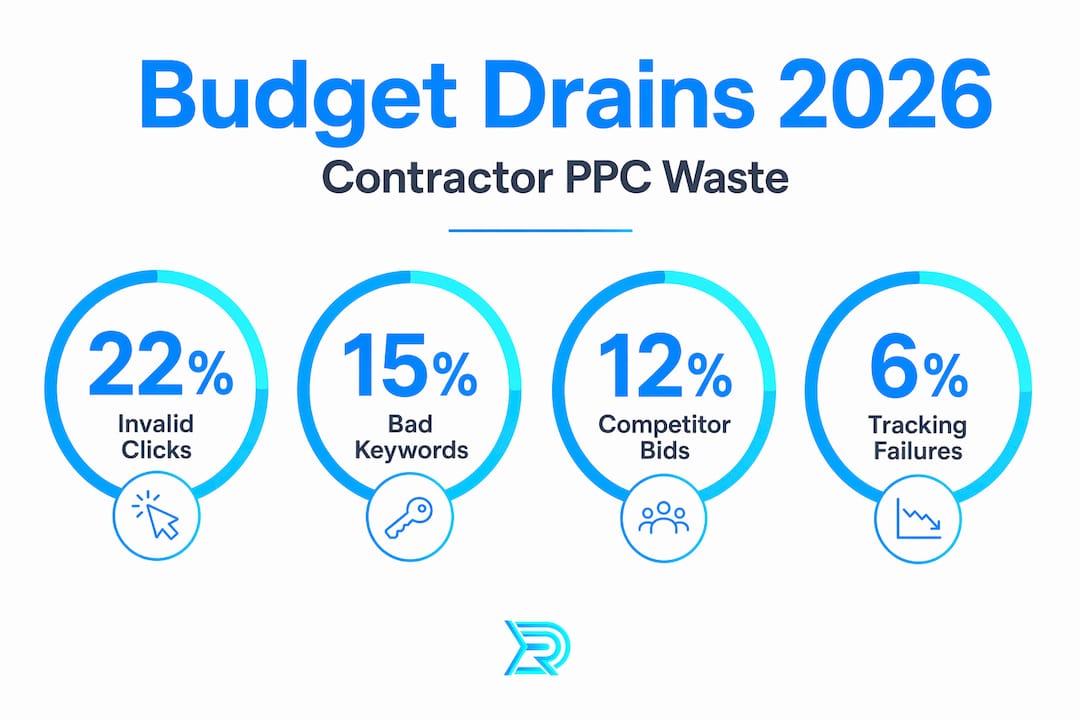
Most contractors respond to these shifts only after they show up in monthly reports. By then, the damage is done. Proactive competitor keyword tracking spots auction pressure shifts before they impact results, giving you time to adjust before you are overpaying.
Here are the competitor signals that matter most and what each one tells you:
- Rising CPC with stable search volume. A competitor has increased bids on keywords you share. You need to either raise your bid, improve your Quality Score, or shift budget toward less contested terms.
- Falling click-through rate (CTR). A competitor has launched a stronger ad copy that is pulling attention away from yours. It is time to test new headlines and offers.
- Declining impression share. A new competitor entered your market or an existing one significantly increased their budget. Monitor auction insights weekly to catch this early.
- Drop in conversions with steady traffic. A competitor may be targeting your converting keywords with a more compelling landing page or offer. Review their ads and adjust your positioning.
| Signal | Likely Cause | Response |
|---|---|---|
| CPC increases without traffic drop | Competitor raised bids | Improve Quality Score or adjust bids |
| CTR decline | Stronger competitor ad copy | Test new headlines and calls to action |
| Impression share loss | New competitor or increased budget | Increase bid or tighten geographic targeting |
| Conversions drop with stable clicks | Competitor has a better landing page | Audit your landing page against competitors |
Effective PPC teams track competitor signals proactively rather than waiting for performance drops to appear in reports. Understanding how competitor roofing ads work is a core skill for protecting your budget.
Invalid clicks and click fraud silently burn your budget
This is the part most contractors never hear about from their marketing agencies, and it is one of the most significant reasons PPC campaign failures go unexplained. Not every click on your ad comes from a potential customer. Some clicks come from bots, click farms, or even competitors trying to exhaust your daily budget.
Between 11 and 22% of PPC clicks are from invalid sources with no possibility of converting. On a $3,000 monthly ad budget, that could mean $330 to $660 per month going to traffic that will never call you. Over a year, that is up to $7,920 in pure waste.
The types of invalid clicks hitting contractor campaigns include:
- Bots and automated crawlers that trigger ad clicks as a byproduct of scraping activity.
- Click farms where low-wage workers click ads manually to generate revenue for fraudulent publishers.
- Competitor sabotage where a competing contractor repeatedly clicks your ads to drain your daily budget and remove you from the auction.
- Accidental clicks from users who immediately leave, which still count and still cost money.
Google does filter some invalid click traffic and provides refunds, but platform refund processes often take weeks, meaning your budget is spent and your bidding algorithm is learning from bad data before those refunds arrive. That algorithmic contamination is the real long-term damage. Your campaigns start optimizing toward the wrong users because their behavior signals are baked into the data.
Real-time fraud detection software integrated directly with your ad platform prevents this by blocking invalid clicks before they are counted, keeping your data clean and your budget protected.
Practical steps to stop wasting PPC spend
Fixing wasted ad spend is not about spending more. It is about spending smarter on the traffic that actually converts. Here is the structured approach Resultsdigitalus uses with every contractor account:
- Build your negative keyword list on day one. Pull your Search Terms Report and eliminate irrelevant queries immediately. Add job-seeking terms, DIY terms, and competitor brand names you do not want to pay for. Revisit this list every single week.
- Create dedicated landing pages for every campaign. Each service and each geographic area deserves its own page. A roofing landing page for Houston is not the same as one for Dallas. Match the page content to the ad copy so the experience is seamless from click to contact.
- Set up call tracking with unique numbers. You need to know which campaigns, which keywords, and which ads are generating real customer calls. Without this, you are tracking from click to booked job in the dark.
- Monitor competitor activity weekly. Check your Auction Insights report. Watch for rising CPCs. Test new ad copy regularly to maintain a strong CTR against competitor pressure.
- Commit to the learning period. Contractors who pause campaigns prematurely during the 60 to 90 day window reset the optimization process and throw away their initial investment. Give Google’s algorithm the data it needs to work.
- Integrate fraud protection. Use a click fraud detection tool to block invalid traffic in real time before it corrupts your data and your budget.
- Analyze and adjust campaign structure regularly. Outdated PPC tactics fail in AI-driven search systems. One hour of account analysis monthly often reveals where budget is leaking and where opportunities are being missed.
Pro Tip: Do not measure your PPC success by click volume or even cost per lead alone. Measure it by cost per booked job. That number tells you whether your campaigns are actually profitable, not just active.
Understanding PPC advertising fundamentals for contractors is the foundation for everything listed above. Get that right first.
My take on why most contractor campaigns fail
What I have seen working with contractors across the country is that most PPC failures come down to two things: impatience and ignorance of what to track. Not ignorance as an insult. Ignorance as in nobody told them what mattered.
Contractors are action-oriented people. When they see money going out and not enough calls coming in, they pull the plug. I understand that instinct. But pulling campaigns before the 60 to 90 day learning window closes is one of the most expensive mistakes I see. You just paid for Google’s algorithm to start learning your market, and then you reset it. That money does not come back.
The second pattern I see constantly is treating clicks as success. A campaign reporting 500 clicks at $4 each looks fine on a dashboard. But if zero of those clicks turned into a booked job, you spent $2,000 on nothing. I push every contractor I work with to track all the way to the invoice. Anything short of that is vanity metrics dressed up as results.
Competitor monitoring is another place where contractors fall behind. Most do not realize their CPC jumped 30% because a well-funded competitor entered their market three weeks ago. By the time it shows in the monthly report, the budget damage is already done. Proactive, weekly monitoring is not optional if you want to protect your spend.
The contractors who win with PPC are the ones who commit to the process, measure what actually matters, and adjust based on data rather than gut feelings.
— Results
Let Resultsdigitalus manage your PPC spend the right way
Wasted ad spend is not inevitable. It is the result of specific, correctable problems, and fixing them requires expertise built specifically for the contractor industry. Resultsdigitalus does not manage generic campaigns. Every account we run is built around contractor lead generation with dedicated landing pages, call tracking, competitor monitoring, and ongoing bid management.
If you are a roofing, gutter, siding, or general contractor ready to stop burning budget on clicks that never convert, we can help. Our Google Ads management for contractors is built to cut waste, protect your data from invalid traffic, and generate leads that actually turn into booked jobs. No long-term contracts. No shared campaigns with your competitors. Just results. Reach out to Resultsdigitalus and see what a properly built contractor PPC campaign actually looks like.
FAQ
Why do contractor PPC campaigns waste so much budget?
The most common causes are broad match keywords without negative keyword lists, sending traffic to homepages instead of dedicated landing pages, and lack of conversion tracking. These mistakes together can waste the majority of a contractor’s ad spend before a single adjustment is made.
How much of my PPC budget is lost to invalid clicks?
Up to 22% of PPC clicks may come from bots, click farms, or competitor sabotage. On a $3,000 monthly budget, that can mean hundreds of dollars per month spent on traffic that will never convert.
How long should I run a Google Ads campaign before judging results?
Commit to at least 60 to 90 days without pausing. Google’s algorithm needs that window to learn which users convert in your specific market. Pausing campaigns prematurely resets the learning process and wastes your initial investment.
What is the right way to measure PPC ROI for contractors?
Measure cost per booked job, not cost per click or cost per lead. Tracking from the click through the call to the completed invoice is the only way to know whether your campaign is actually profitable.
How do competitor bids affect my PPC costs?
When competitors raise their bids or new players enter your market, your CPC increases and your impression share drops. Proactive competitor tracking lets you catch these shifts early and respond before your budget takes a significant hit.
