
Most roofing companies have a lead problem. Not a shortage of leads. A conversion problem. You’re spending money on ads, your phone rings, and somehow your close rate stays flat. Understanding how roofing sales funnel works is the difference between a business that chases leads and one that converts them systematically. This article breaks down every stage of the roofing sales funnel, the digital tools that power it, the sales tactics that close deals, and the metrics that tell you where your funnel is leaking.
Table of Contents
- Key takeaways
- How roofing sales funnels work: the core stages
- Digital tools that power the roofing funnel
- The sales process steps that actually close deals
- Measuring and fixing your funnel leaks
- Commercial roofing funnels: what changes
- My take on what actually moves the needle
- Ready to build a funnel that actually converts?
- FAQ
Key takeaways
| Point | Details |
|---|---|
| Funnels convert, ads just attract | Generating leads without a structured funnel means most prospects fall through before they ever become customers. |
| Speed determines conversion | Responding to a new lead within 5 minutes dramatically increases your chance of booking an estimate. |
| Financing closes more deals | Not offering financing causes roofing companies to lose roughly 40% of potential deals before they even start. |
| Metrics reveal the leaks | Tracking cost per booked estimate, response time, and stage-by-stage conversion rates shows exactly where leads drop out. |
| Commercial funnels need patience | Commercial roofing sales cycles run 3 to 12 months and require a structured, relationship-based approach to close. |
How roofing sales funnels work: the core stages
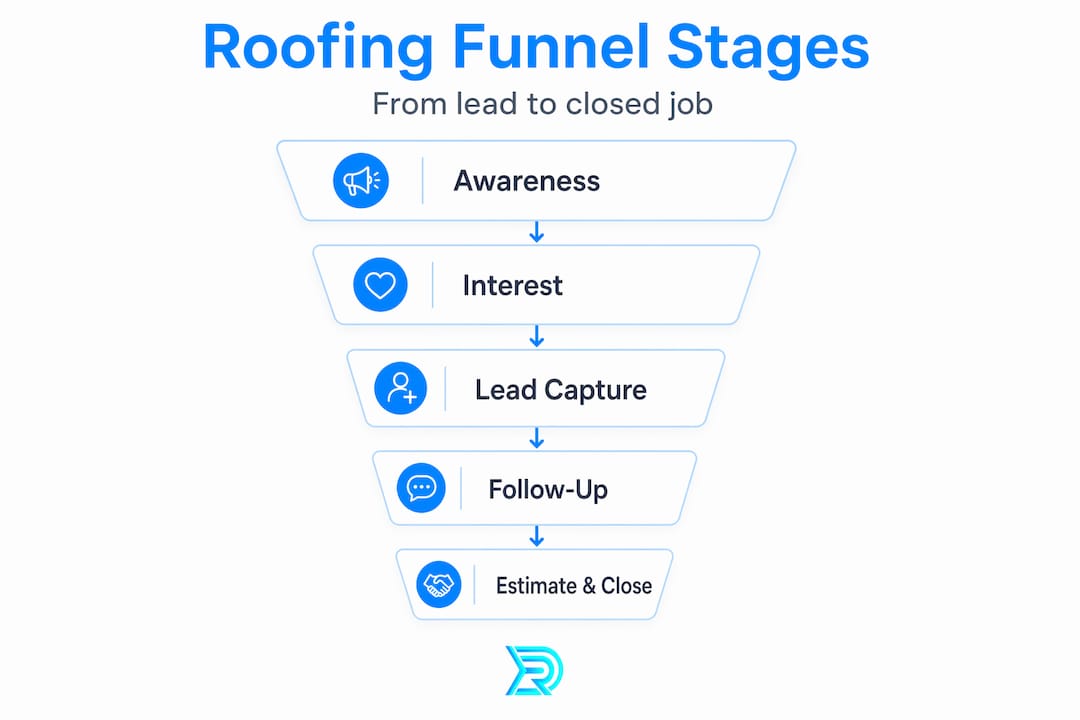
A roofing sales funnel is the structured path a prospect takes from first hearing about your company to signing a contract and paying for work. Most roofing businesses treat this as a loose process. The ones that grow fast treat it as a system.
Here are the core stages every residential roofing funnel should include:
-
Awareness. The prospect discovers your business through a Google search, a Facebook ad, a neighbor’s referral, or a door knock after a storm. This is top-of-funnel. Your job here is visibility, not selling.
-
Interest. The prospect visits your website or landing page and decides whether to contact you. This is where your offer, reviews, and photos do the heavy lifting. Landing pages with social proof and minimal form fields convert best at this stage.
-
Lead capture. The prospect submits a form, calls your number, or books directly through your site. Keep forms short. Conversion rates drop sharply with every field you add beyond name, phone, address, and issue description.
-
Follow-up and nurturing. This is where most roofing companies lose deals. Responding within 5 minutes closes exponentially more deals than waiting an hour. Use automated texts and calls to make contact immediately, then schedule the inspection.
-
Inspection and estimate. Your rep visits the property, builds rapport, documents the damage or need, and presents options. This stage is where trust is built or broken.
-
Decision and close. The homeowner reviews your proposal, handles objections, and either signs or stalls. Your pricing presentation and financing offer determine the outcome here.
-
Action and project completion. The contract is signed, the job is scheduled, the work is done, and you collect payment. A strong post-job follow-up for reviews and referrals feeds the top of your funnel again.
Pro Tip: Set up automated SMS confirmation immediately after a lead submits a form. Text message open rates sit at 98% compared to email’s 20%, making SMS your fastest path to keeping a lead engaged before your rep calls.
Digital tools that power the roofing funnel
The roofing sales process does not run on hustle alone. The companies converting at the highest rates are running a coordinated digital system that feeds leads into the funnel and moves them through it automatically.
Here is how the pieces fit together:
-
Local SEO and Google Ads. High-intent traffic comes from people searching “roof replacement near me” or “storm damage roofer.” Optimizing your local search presence puts you in front of buyers who are already ready to act. Google Ads captures demand that exists right now.
-
Facebook, Instagram, and YouTube ads. These platforms work at the awareness and retargeting stages. A homeowner who visited your site but did not call can be served a retargeting ad with a testimonial video or a limited-time offer. This keeps your brand visible while they make a decision.
-
Landing page design. Your landing page is not your homepage. It is a focused page with one offer, a clear headline, before-and-after photos, star ratings, and a short form. A well-designed roofing landing page removes every reason a prospect has to leave without contacting you.
-
CRM and AI-powered automation. A CRM tracks every lead by stage. AI automation handles the first response, sends follow-up texts, schedules callbacks, and flags stalled leads for your sales team. Combining local SEO, Google Ads, Meta ads, and AI automation creates a hybrid system that delivers leads consistently, not just after a storm.
-
Email nurturing. Not every lead is ready to buy today. Email campaigns keep your company top of mind for prospects who are still deciding. Roofing email campaigns generate $36 to $42 in return per dollar spent by nurturing leads who are not yet ready to commit.
Pro Tip: Do not send leads from your ads directly to your homepage. Build a dedicated landing page for each campaign with a single call to action. You can find detailed guidance on improving website conversion specifically for roofing contractors.
The sales process steps that actually close deals
Getting a lead to the inspection is only half the battle. The steps in roofing sales that happen during and after the inspection determine your close rate. Top performers follow a repeatable process, not a gut feel.
-
Discovery call. Before the inspection, a brief call qualifies the lead. Ask about the issue, the timeline, and whether they own the property. This filters out tire-kickers and sets expectations for the visit.
-
Inspection with documentation. Walk the roof with your phone or tablet. Take photos of every issue. Narrate what you are seeing. When the homeowner watches you document damage in real time, trust builds fast. This is not just about the roof. It is about showing you are thorough and honest.
-
Good/Better/Best pricing presentation. Present three options: a basic repair or entry-level replacement, a mid-tier option with better materials, and a premium package with the best warranty and materials. Structured tiered pricing combined with financing consistently improves closing rates because it gives the homeowner control over the decision rather than a take-it-or-leave-it price.
-
Introduce financing early. Do not wait for the homeowner to say the price is too high. Bring financing into the conversation during the pricing presentation. Saying “this comes out to about $189 a month with our financing option” shifts the conversation from sticker shock to affordability. Not offering financing costs roofing companies roughly 40% of deals because most homeowners cannot pay $15,000 or more out of pocket.
-
Handle objections with confidence. The most common objections are price, timing, and “I need to think about it.” For price, go back to the financing monthly payment. For timing, create urgency around weather, material costs, or permit timelines. For the “need to think” stall, ask what specific concern is holding them back and address it directly.
-
Close and confirm. Once the homeowner agrees, get the contract signed on the spot. Use a digital signing tool so there is no delay. A deal that leaves the table unsigned rarely comes back.
Measuring and fixing your funnel leaks
You cannot fix what you do not track. Effective roofing marketing strategies require you to measure each stage of the funnel so you know exactly where leads are dropping out.
| Metric | What it tells you | Target benchmark |
|---|---|---|
| Lead response time | How fast your team contacts new leads | Under 5 minutes |
| Lead to estimate rate | How many leads become booked inspections | 40% or higher |
| Estimate to close rate | How many inspections turn into signed contracts | 30% to 50% |
| Cost per booked estimate | What you pay to get a prospect to the inspection stage | Varies by market |
| Cost per acquired customer | Total marketing spend divided by jobs closed | Track monthly |
A weak ideal customer profile and poor lead routing is one of the most common causes of funnel leaks. If your ads are pulling in commercial inquiries but your team only handles residential, or your leads are going to a sales rep who is already overloaded, deals stall before they ever get a real shot.
To optimize roofing funnels, audit each stage monthly. Check where leads are entering, where they are stalling, and what the handoff looks like between marketing and sales. Most of the time, the fix is not more leads. It is a faster follow-up, a better landing page, or a clearer sales script.
Pro Tip: Use call tracking numbers for each ad source so you know which campaigns are producing booked estimates, not just calls. Flying blind on attribution means you could be cutting your best lead source and doubling down on your worst.
Commercial roofing funnels: what changes
Commercial roofing customer acquisition follows a fundamentally different rhythm than residential. The funnel stages are similar, but the timeline, the decision-making process, and the relationship requirements are not.
Key differences to understand:
- Longer sales cycles. Commercial roofing sales cycles run 3 to 12 months, involving property managers, facility directors, boards, and procurement teams. Patience and consistent follow-up are not optional. They are the job.
- Five-stage commercial process. Discovery, site assessment, proposal development, stakeholder alignment, and project kickoff. Each stage requires documentation, follow-up, and often multiple meetings before you advance.
- Relationship-first lead generation. Commercial prospects respond better to LinkedIn outreach, direct mail to property management companies, and referrals from general contractors than to Facebook ads. Build the relationship before you pitch the project.
- Proposal depth matters. A commercial proposal is not a one-page estimate. It includes scope of work, material specs, warranty details, timeline, and references from comparable projects. Cutting corners on the proposal signals that you will cut corners on the job.
- Stakeholder alignment is the real close. Even after the decision-maker says yes, you often need sign-off from a board or a procurement department. Map out who needs to approve the project and address each stakeholder’s concerns proactively.
Systems discipline and patience in commercial sales create sustainable roofing businesses. The companies that win commercial work consistently are the ones that show up, follow up, and never let a warm relationship go cold.
My take on what actually moves the needle
I’ve worked with roofing contractors across the country, and the pattern is almost always the same. The owner is convinced they need more leads. What they actually need is a better system for the leads they already have.
I’ve seen companies spending $10,000 a month on Google Ads with a 15% close rate because no one was calling leads back within the same day. The ads were not the problem. The follow-up process was. When we fixed the response time and added SMS automation, the same ad spend produced 60% more booked estimates.
The financing conversation is the other thing I see roofing pros avoid. It feels awkward to bring up money before the homeowner does. But offering financing during the pricing presentation shifts the entire dynamic. You are no longer selling a $18,000 roof. You are selling a $220 monthly payment. That is a completely different conversation, and it closes at a much higher rate.
My honest take: most roofing companies do not need a more complex funnel. They need to execute the basics with discipline. Fast follow-up, a clean landing page, a structured estimate presentation, and a financing offer on the table. Get those four things right before you worry about anything else.
— Results
Ready to build a funnel that actually converts?
Understanding how a roofing sales funnel works is one thing. Building one that runs consistently and generates qualified leads every month is another. At Resultsdigitalus, we work exclusively with roofing and exterior contractors. Every campaign, every keyword, and every landing page we build is designed for one goal: getting you more booked estimates at a lower cost per lead.
We helped one Florida roofing company scale from 3 crews to 18 before they sold for $60 million. That kind of growth starts with the right digital foundation. Start with our SEO guide for roofers to understand how search visibility feeds your funnel, or explore our Google Ads program for roofers to start capturing high-intent leads today. No long-term contracts. No shared accounts. Just results.
FAQ
What are the main stages of a roofing sales funnel?
The main stages are Awareness, Interest, Lead Capture, Follow-Up, Inspection and Estimate, Decision and Close, and Project Completion. Each stage requires a specific action or tool to move the prospect forward.
How fast should roofing companies respond to new leads?
You should respond within 5 minutes of receiving a new lead. Responding within that window closes exponentially more deals than waiting an hour or longer, making speed your single biggest conversion lever.
Why is financing important in the roofing sales process?
Not offering financing causes roofing companies to lose roughly 40% of potential deals because most homeowners cannot pay $15,000 or more upfront. Presenting a monthly payment option during the estimate shifts the conversation from total cost to affordability.
How do you find leaks in a roofing sales funnel?
Track lead response time, lead-to-estimate rate, and estimate-to-close rate at each stage. A weak ideal customer profile and poor lead routing are the most common root causes of leads stalling before they convert.
How is a commercial roofing sales funnel different from residential?
Commercial funnels involve longer sales cycles of 3 to 12 months, multiple stakeholders, and detailed proposals. Relationship building and consistent follow-up matter far more than ad spend in the commercial roofing sales process.
